Kingdom Bacteria, Archaea, and Protists (copy) (copy)
 Call Kai
 Learn
Learn Practice Test
 Spaced Repetition
 Match
Match Flashcards
 Knowt Play
 Podcast
1/117

There's no tags or description
Looks like no tags are added yet.
Name | Mastery | Learn | Test | Matching | Spaced | Call with Kai | Chat |
|---|
No analytics yet
Send a link to your students to track their progress
118 Terms
What is a Prokaryote?
Single-celled organism that lacks a nucleus, is unicellular (bacteria and archaea).
What is the capsule?
Surrounds bacteria, protect the cell from the immune system. Many bacteria that make us sick, like salmonella, have capsule.
What is the cell membrane?
This membrane encloses the cytoplasm of the cell. The cell membrane regulates what comes in and out of the cell.
What is the cell wall?
Underneath the capsule is the cell wall. The cell wall provides additional support and protection.
What is the plasma membrane?
Is the internal boundary, controls what enters and leaves the cell; site of energy production.
What is the cytoplasm?
Is internal, jelly-like fluid where metabolic reaction occurs.
What are ribosomes?
They are responsible for making proteins that are used to build and maintain cell part.
What is the nucleoid?
Is internal, region containing the bacterial chromosome (DNA). Not membrane bound.
What are plasmids?
The plasmid is a circular DNA molecule that is involved in sexual reproduction. Plasmids also contain genes that are involved in antibiotic resistance.
What are Pili?
Are external, helps the bacteria attach to surfaces, some specialized pili transfer DNA during conjugation (the direct transfer of genetic material between two cells that are temporarily joined together).
What is the flagellum?
Is external, provides movement for the bacteria or helps bacteria stick to surfaces.
What does aerobic mean?
Organisms that require oxygen to produce energy.
What does anaerobic mean?
Organisms that live in the absence of oxygen.
What does obligate anaerobe mean?
Can only survive in environments without oxygen.
What does facultative anaerobe mean?
Will use oxygen if it is available but can still produce energy and survive in the absence of oxygen.
What is the difference between the cell wall of eubacteria and archaebacteria?
Eubacteria, contains peptidoglycan (a complex of protein and sugars). Archaebacteria, composed of polysaccharides (sugars).
How does asexual reproduction (binary fission) work?
1.) DNA replicates
2.) The cell membrane pinches off to create 2 genetically identical daughter cells.
What are the advantages and disadvantages of of asexual reproduction (binary fission)?
ADVANTAGES:
Quick: don't need to find a mate
DISADVANTAGES:
All offspring are genetically identical therefore the entire population they are more susceptible to threat
How does conjugation work?
1.) Donor cell attaches to recipient cell by a CONJUGATION PILUS
2.) Cells draw in closer and contact one another.
3.) One strand of a PLASMID DNA transfers to the recipient bacterial cell.
4.) The recipient and donor bacteria synthesize a complementary plasmid strand (should always have a double copy of each plasmid).
5.) Bacteria detaches.

Why is the ability to pass genetic material through conjugation advantageous for bacterial cells?
Passes on advantageous traits, creates diversity.

What is antibiotic resistance and how does it occur?
● Natural selection for mutations resistant to antibiotics
● Resistant genes are passed on by surviving bacteria or shared through conjugation etc
What is the difference in environments in which archaebacteria and eubacteria live in?
Archaebacteria live in extreme environments, while eubacteria are not commonly found in extreme environments.
What is the classification within archaea?
1.) Halophiles-(Live in saturated brine and salt crust)
2.) Thermophiles-(Live in hot springs and black smokers)
3.) Methanogens-(methane producers- responsible for swamp gas)
What is the classification within eubacteria?
1.) Gram-negative-(2 membranes and 1 thin layer of peptidoglycan, stains pink)
2.) Gram-positive-(1 membrane and 1 thick layer of peptidoglycan)
Which is less susceptible to antibiotics, gram-negative, or gram-positive?
Gram negative is less susceptible, because the additional membrane makes it harder for antibiotics to infect.
What are the names for the shapes of bacteria?
Coccus- round
Bacillus- rod shaped
Spirillum- spiral
What is the names for the arrangement of bacteria?
Diplo- in pairs
Staphylo- clumped
Strepto- chain
What is the functions of bacteria inside our gut?
Break down food the body can't digest such as fiber and some starches and sugars.
2. Produce important nutrients like vitamin B12 and vitamin K.
3. Regulate the immune system.
4. Protect against harmful bacteria.
What are protists?
The organisms that don't nicely fit into one of the other kingdoms. There are plant-like, animal-like, and fungi-like
What are the characteristics of protists?
Unicellular, eukaryotic, and reproduce through binary fission, sexual reproduction, and many other different methods.
What mode of nutrition do plant-like protists use?
Autotrophic
What mode of nutrition do animal-like protists use?
● Heterotrophic
● Phagocytosis

What mode of nutrition do fungi-like protists use?
● Heterotrophic
● Decomposers/saprophytes
(Eat dead/decaying matter)
What locomotion do protists use?
Pseudopodia: Short lived extension of the cytoplasm that are used for locomotion and phagocytosis.
What are ciliates?
Short hair-like organelle that help protozoan move through water or draw in food.
What type of protist is euglena?
Plant-like
What are the organelles of euglena?
Flagellum
Eye spot
Contractile vacuole
Mitochondrion
Nucleus
Chloroplast
Pellicle
What makes plant-like protists similar to plants?
They have chloroplasts which mean they do photosynthesis, and are autotrophic.
Why are plant-like protists not classified as plants?
Unicellular, move around and eat, lack a cell wall.
What do plant-like protists do that is positive?
Green algae are a phytoplankton and produce 80% global O2
How are plant-like protists harmful?
● Harmful Algal Blooms
● Known as red tides, blue-green algae or cyanobacteria
● Harmful algal blooms have severe impacts on human health, aquatic
ecosystems and the economy
● Algal blooms can be toxic.
What are the organelles of the paramecium?
Contractile vacuole
2. Micronucleus
3. Macronucleus
4. Trichocysts (harpoons)
5. Contractile vacuole
6. Oral groove
7. Gullet
8. Food vacuole
9. Anal pore
10. Cilia
What type of protist is the paramecium?
Animal-like
How do animal-like protists eat?
Heterotrophic (digest organic compounds)
Move to obtain food
Why can't we classify animal-like protists as animals?
Lack true tissue
Some are unicellular
What do animal-like protists do that is positive?
Protozoa such as zooplankton play a key role in the food chain of many aquatic ecosystems
How are animal-like protists harmful?
Sporozoans
◦ lack a means of locomotion
◦ Are exclusively parasitic
◦Some have trichocysts (harpoons) for defense
◦Malaria is caused by Plasmodium sporozoan
◦African sleeping sickness caused by Trypanosoma
◦protozoan transmitted by the tsetse fly
What are the characteristics of fungi-like protists?
● resemble protozoans during part of life cycle
●prefer cool, shady, moist environments
●also called slime moulds
What makes fungi-like protists similar to fungi?
Have cell wall
Reproduce via spores
Feed on decaying matter
Why can't we classify fungi-like protists as fungi?
Cell walls made of cellulose NOT chitin
What do fungi-like protists do that is positive>
Decompose and continue nutrient cycle
How are fungi-like protists harmful?
● Many water molds cause diseases
● Many destroy crops (great potato famine)
Why are protists considered symbiotic organisms?
Because many of them live in a close, helpful partnership with other living things where partners benefit (ex. coral and algae. Algae lived in colorful coral, algae uses sunlight to make food to coral, and coral gives algae a safe home.)
What is the photosynthesis equation?
6CO2 + 6H2O ------> C6H12O6 + 6O2
What is the cellular respiration equation?
C6H12O6 + 6O2 --> 6CO2 + 6H2O + ATP

What is this?
Cell wall
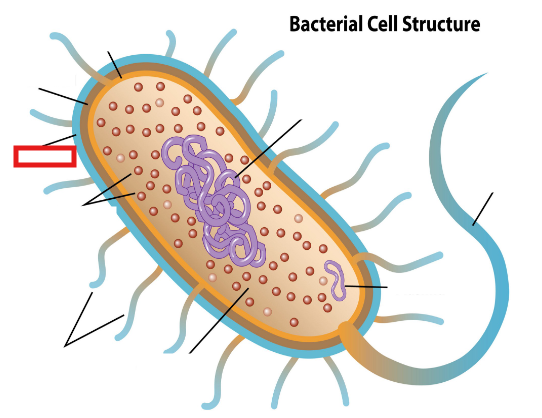
What is this?
Capsule

What is this?
Ribosomes

What is this?
Pilus

What is this?
Cytoplasm

What is this?
Flagellum

What is this?
Nucleoid (DNA)

What is this?
Plasma membrane

What is #1?
Flagellum

What is #2?
Eye spot
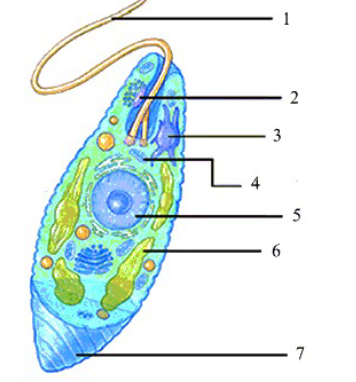
What is #3?
Contractile vacuole

What is #4?
Mitochondrion
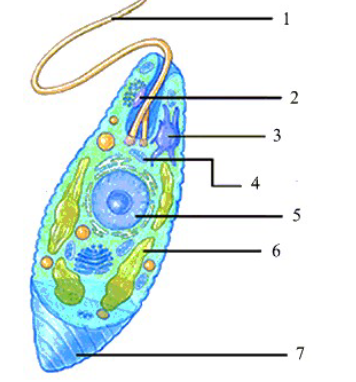
What is #5?
Nucleus

What is #6?
Chloroplast
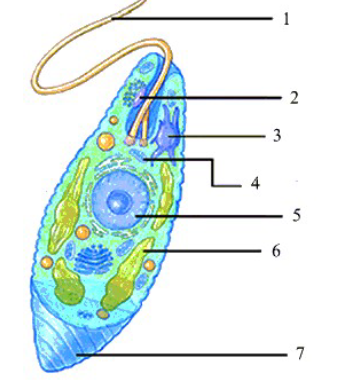
What is #7?
Pellicle

What is this?
Euglena, plant-like protist

What is this?
Paramecium, animal-like protist

What is #1?
Contractile vacuole

What is #2?
Micronucleus

What is #3?
Macronucleus

What is #4?
Trichocysts (harpoons)

What is #5?
Contractile vacuole

What is #6?
Oral groove

What is #7?
Gullet

What is #8?
Food vacuole

What is #9?
Anal pore

What is #10?
Cilia
Why are protists considered eukaryotic organisms?
Because they have a true nucleus and other membrane bound organelles.
What feature distinguishes protists from bacteria?
Protists possess a defined nucleus and organelles, while bacteria are typically unicellular prokaryotes without these structures.
In what type of environment do most protists live in?
Most protists thrive in moist or aquatic environments, such as ponds, oceans, and damp soil.
What are the three main groups of protists based on how they obtain nutrients?
Autotrophs, heterotrophs, and mixotrophs
Name one example of an autotrophic protist?
Green algae.
Name one example of a heterotrophic protist.
An example of a heterotrophic protist is the amoeba.
What is an example of a protist that is both autotrophic and heterotrophic
(mixotrophic)?
Euglena.
What are protozoans?
Are tiny, microscopic creatures made up of just one single cell.
What structures do amoebas use for movement?
Temporary extensions of their cell membrane and cytoplasm called pseudopodia.
How do amoebas capture and digest food?
Phagocytosis,
Spot the target: The cell finds a germ or piece of trash floating nearby.
Reach out: The cell stretches out parts of itself—like tiny sticky arms called pseudopods—to wrap around the target.
Trap it: The arms close around the germ, pulling it safely inside the cell into a little bubble pocket.
Digest it: Special cleaning tools inside the cell break the germ apart and destroy it completely
What is the function of a contractile vacuole in amoebas?
Water regulation, preventing lysis, and waste removal.
How do paramecia move?
By using thousands of tiny, hair-like structures called cilia that cover their entire outer body.
What is the oral groove in a paramecium used for?
Feeding and capturing food
How do ciliates reproduce?
Asexually through binary fission and sexually through a process called conjugation
What are plant-like protists commonly called?
Algae
What pigments are found in algae that allow them to photosynthesize?
Chlorophylls, carotenoids, and phycobilin
What are diatoms, and what is unique about their cell walls?
Single-celled, microscopic algae found in oceans, freshwater, and moist soils. Live inside a hard, transparent shell made of silica, which is the exact same material used to make real glass.
Why are euglenas considered mixotrophs?
They can switch between autotrophic (making their own food) and heterotrophic (consuming external organic matter) modes of nutrition depending on environmental conditions