MACRONUTRIENT BIOCHEMISTRY - FINAL EXAM - KENT STATE UNIVERSITY
 Call Kai
 Learn
 Practice Test
 Spaced Repetition
 Match
 Flashcards
 Knowt Play
1/120

There's no tags or description
Looks like no tags are added yet.
121 Terms
What are lipids?
biological molecules that are insoluble in aqueous solutions and soluble in organic solvents
What are some of the different functions of lipids?
Fatty acids - building blocks for triglycerides/phospholipids, precursor for eicosanoids
Triglycerides - E storage, flavor enhancer
Phospholipids - Major component of cell membranes
Cholesterol - component of cell membrane, precursor for bile acids & steroid hormones
What is the make up of a fatty acid?
Hydrocarbon chain that has a methyl group at one end and carboxylic acid group at the other
Carboxyl group - polar hydrophilic end, forms an ester bond with glycerol to form mono-, di-, tri-acylglycerols
Methyl group - nonpolar hydrophobic end

What are qualities that provide distinction between different fatty acids?
Various length & saturation: decide hardness of fat
Length of chains : 4 - 24 (can be extended longer than 24 C; the shorter the chain, the more soluble though they do NOT dissolve, but they linger)
Ex. Butyric Acid - 4C FA in milk that seems soluble but is not
Saturation:
Differ in terms of number of double bonds between carbon atoms
0=saturated, 1=monounsaturated, 2 or more=polyunsaturated
What are the different lengths of FAs and their identification?
Short chain= <6 C chain
Medium chain= 6-10 C chain
Long chain= >12 C chain
What are saturated fatty acids?
No double bond between carbons; linear, tight structure
Solid at room temperature
Meat, whole milk fat, coconut oil, palm oil
What are monounsaturated fatty acids?
One double bond: bending
Liquid at room temperature
Olive oil, canola oil
What is a hemolytic anemia?
Oxidation/free radicals damage cell membrane which damages vessel walls and ruptures RBC wall
What are polyunsaturated fatty acids?
More than 1 double bonds; bending
Liquid at room temperature
Corn, soy, sunflower oil, (most of plant oils except coconut oil and palm oil (SFAs), olive oil and canola oil (MUFAs)
What are trans fatty acids?
Hydrogens located on the opposite side of double bonded carbons. Linear
Trans Fats are often MAN generated - hydrogenation makes liquid oils hard (in high heat)
What are the two naming systems for fatty acids?
Delta system: carbon #s are counted from carboxyl end (C-1= Carbon that has COOH)
Omega system: carbon #s are counted from methyl end (C-1= Carbon that has CH3)
These systems let you know
Number of carbons in the fatty acid
Numbers of double bonds
Location of double bonds counting from each end
What is the delta system?
Count numbers of C from carboxylic acid end
Example
In delta system, linoleic acid is denoted as 18:2 Δ 9,12 in delta system
First 2 #: number of C and double bonds
The numbers after Δ sign: location of double bonds counted from the carboxyl end
This fatty acid has 18 carbons and 2 double bonds at 9th and 12th C from carboxyl end
What is the omega system?
Count numbers of C from methyl end
Example
In omega system, linoleic acid is denoted as 18:2 ω-6
First 2 #: number of C and double bonds
The first double bond occurs at the 6th carbon counted from methyl end
Following bonds are separated by 3 carbons. In this case, 2nd double bond is at 9th C from methyl end
This fatty acid has 18 carbons and 2 double bonds. The first double bond occurs in 6th carbon from methyl end
What are triglycerides?
Most stored body fat is in the form of TGs
~95% of dietary fat
Composed of the glycerol and three fatty acids bound by dehydration synthesis
Exist as fats or oils at room temp
Source of concentrated energy
80% lipid is stored in adipocytes (fat tissues)
When body needs energy, fatty acids are released from TGs in adipocytes (lipolysis), oxidized to many Acetyl CoA molecules (beta oxidation) and enter TCA cycle to produce energy.
Yield 9Kcal/g

What are essential fatty acids? Functions?
Fatty acids the body cannot make.
α-linolenic acids(ω-3) and linoleic acids(ω-6)
Ideal ratio: 1:4
Functions:
Producing "eicosanoids": hormone-like compounds
Supporting immune function
Helping with vision
Becoming a part of cell membrane
What are the omega-3 fatty acids?
May reduce heart disease risk if consumed regularly
Recommendation: 1.1-1.6 g (no more than 5g)
Dietary sources
Fatty fish or other seafood (6 oz/wk): salmon, mackerel, tuna, sardines
Nuts and seeds: flaxseed, chia seeds and walnuts
What are some sources of omega-3s and their content?
Salmon 2.0 g/serving
Mackerel 4.6 g/serving
Fish oil supplement 1.2 g/2 g capsule
Flaxseeds 2.2 g/TBS
Walnuts, English 0.7 g/TBS
What are some concerns when consuming omega-3 fatty acids?
Mercury warning
Due to industrial contamination, mercury from fish can accumulate in human body with high consumption of certain fish
Avoid big fish: shark, king mackerel, tile fish
No same fish consumption in a month
Supplement form NOT recommended (mercury may not be completely removed)
What are omega-6 fatty acids?
Found in vegetable oils and salad dressings
Only need ~ 1 tablespoon a day
Recommendation: 12-17 g
Most Americans may consume more than enough
What are eicosanoids?
Signaling molecules made from EFA
Three families of eicosanoids
Prostaglandins (1)
Thromboxanes (2)
Leukotrienes (3)
Subscript numbers next to family names indicate
Parent fatty acid (omega 3 or omega 6)
The number of double bonds
Impact on body varies depending on types:
Some are positive, others are negative
Whether good or bad depends on the series of the compound
NSAIDs block COX and decrease inflammation reaction
What are the eicosanoids that have positive effects?
Prostacyclin (PGI2), PGE1, PGE2
PG 3 series
Vasodilation (lower BP)
Platelet anti-aggregation
TX 3-series (weak compared to TX2 series)
[PG = prostaglandin; TX = thromboxane]
What are the eicosanoids that have negative effects?
PGF2
LT 4 series
Bronchial constriction (anaphylaxis)
Inflammatory
TX 2-series (Strong compared to TX3 series )
Platelet aggregation
Vasoconstriction
[PG = prostaglandin; TX = thromboxane; LT = leukotriene]
What are sterols and steroids?
Class of lipid characterized by a four-ring core structure (steroid)
Cholesterol is most common
What is cholesterol?
Component of cell membranes
Only in animal tissues
Meat, egg yolk and dairy products
Body makes 1000mg/day in the liver
If you have normal metabolism of cholesterol while having high cholesterol, it is more important to monitor Sat FA and Trans FA intake than it is to monitor cholesterol intake
What is cholesterol the precursor for?
Bile acids
Sex hormones (estrogens, androgens and progesterone)
Adrenocortical hormones
Vitamin D
What are phospholipids?
Consists of a glycerol molecule, two fatty acids, and a phosphate group
Amphipathic
Phosphate group has polar head, which is hydrophilic
Tails (fatty acids) are hydrophobic
Because of this characteristic, PL act as an emulsifier like a detergent that bind both water and fat
What are the functions of phospholipids?
Functions - important components of:
Cell membrane - helps passage of fat-soluble materials across the membrane
Micelle in small intestine - helps absorption of lipid soluble material
Chylomicron in enterocytes - helps travel of lipid soluble material through blood
What is lingual lipase?
Secreted in the mouth but it does not work until it get to the stomach because it is active at low pH (pH 2.0-7.5)
Ideal substrate of lingual lipase - short chain fatty acids
Significance of this enzyme:
Play important role in digestion in neonates. In adult stomach, it is destroyed by strong acid but it is important for infants whose stomach is less acidic which is the best environment for the enzyme to work
In addition, milk is the main source of energy and rich in short chain fatty acid that is the substrate of the enzyme
What is the role of emulsification in digestion?
Process of breaking down large fat globules into tiny droplets
Decreases the surface tension and increases the surface area of fat globules and thereby enzymes can digest lipids
It is accomplished by bile salts and shearing by peristalsis
Shearing: squeezing and pumping chyme through pyloric sphincter
Bile acids: released from gallbladder (CCK)
How does the digestion of a triglyceride take place?
Pancreatic lipase
Hydrolyzes fatty acids from C1 and C3
Does not work on C2
Yields MG + 2 FA (80%)
Isomerase
Moves remaining FA from C2 which was not
hydrolyzed by lipase to C1
Then, pancreatic lipase can release FA from C1
Yields glycerol + FA (20%)
What is the digestion of a cholesterol ester?
Cholesterol esterase hydrolyzes fatty acid from cholesterol
Products: Free FA + free cholesterol
What is the digestion of a lecithin (PL)?
Phospholipase A2 remove FA off of C2 position
Products: lysolecithin (1FA & lecithin on glycerol) + FFA
What is a micelle?
A molecule that has a hydrophobic core (free FA, MAG, cholesterol, lysolecithin, and fat soluble vitamins) and hydrophilic exterior (bile salt)
Micelles are small enough to penetrate intestinal cell membrane
Lipid part diffuses into mucosal cell
Bile salts: reabsorbed (ileum) enterohepatic circulation
After absorption, Free FA, MAG are reformed into TG and lysolecithin into PL in the intestinal cells (enterocytes)
What occurs following fatty acid absorption?
Medium & short chain FA directly enter portal circulation going to liver
MAGs, free FA,PL, cholesterol along with fat soluble vitamins are absorbed to enterocytes of small intestine
They will be esterified back to TG, and cholesterol ester and PL and packed in chylomicrons to travel through the lymphatic system
What allows for lipid transport to occur?
Poor solubility in water would compromise ability of lipids to be transported through the blood (an aqueous medium)
The body has developed transport systems to deal with this problem (water-soluble transporters)
- Albumin (can bind FFA)
- Lipoproteins
What are lipoproteins?
Classification: by density
Core: Hydrophobic lipids
Shell: proteins and PLs
Types
Chylomicron (CM): transport exogenous (dietary) lipids
VLDL: transport endogenous lipids from tissue to tissue
LDL: transport endogenous lipids from tissue to tissue
HDL: transport endogenous lipids from tissue to tissue
Metabolism requires:
Apolipoproteins
LPL (lipoprotein lipase)
What are apolipoproteins?
Protein on surface of LPs
Specificity of LPs
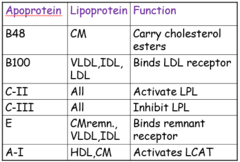
What are the functions of apolipoproteins?
Serving a structural role
Acting as ligands for LP receptors
Helping LP formation
Serving as activators or inhibitors of enzymes

What is lipoprotein lipase?
An enzyme expressed on the surface of cells (influenced by insulin)
Responsible for hydrolysis and uptake of TG into cell
Synthesized in muscle, heart, and adipose tissue (+ by insulin)
Secreted and attached to the endothelium of the adjacent blood capillaries.
Function:
Hydrolyzes the TG carried in CM/ VLDL into glycerol and FFAs
Glycerol --> liver
FFAs --> diffuse into cells
What is a chylomicron and its function?
Made in enterocytes
Composition: high lipid, low protein
Function
Transports dietary TG to body cells
Becomes CM remnant (less TG higher cholesterol) traveling to liver
Cleared after 10-12 hours fasting
What is the metabolism of chylomicron?
Receives protein coat in the enterocytes
Enters into lymphatic circulation --> blood stream
LPL on cell surface hydrolyzes TG --> FAs+ glycerol
In liver fat, it is repackaged into other lipoproteins
What is VLDL (function and metabolism)?
very low density lipoprotein
Composition: high lipid, low protein
Function & metabolism:
TG made in liver through fat synthesis in the body (endogenous lipid) and other fat-soluble materials such as cholesterol, PL and fat-soluble vitamins are packed into VLDL
VLDL delivers TG to cells throughout the body then converts to LDL
What is LDL (function)?
A lipoprotein that's left after VLDL delivers TG (endogenous fat) to cells
Composition: high cholesterol, less protein
Function: deposits cholesterol into peripheral cells that have LDL receptor
Hi LDL: associated w/ CVD risk. Blood level of LDL determined by LDL production & clearance
What is the clearance mechanism of LDL?
*Receptor mediated endocytosis*
LDL interacts with LDL receptors on cells
Upon binding, the receptor and LDL are internalized together, and inside the cell lysosomal enzymes degrade lipid components
Receptors are recycled through cell membrane
What is HDL?
High-density Lipoprotein
Synthesized in the liver going into circulation
Collecting excess cholesterol from LDL and peripheral tissues
Acts as a cleansing agent (janitor) picking up unnecessary cholesterol
Disposes of it into bile
What is the synthesis of fatty acids?
We can make fatty acids from carbohydrates, via acetyl CoA, under circumstances of energy excess
Takes place in liver, adipose tissue, brain, lung, mammary gland
Occurs in the cytosol (How do we get acetyl CoA out of mitochondria?)
Precursor is AcCoA (2C) and the end product is Palmitic acid (16 C)
Requires NADPH (from HMP), ATP, biotin, and bicarbonate as a source of CO2
What are the enzymes involved in fatty acid synthesis (function)?
AcCoA Carboxylase
- Rate-limiting enzyme
- Carboxylates AcCoA (2C) to Malonyl CoA (3C)
- Requires biotin as a coenzyme
Fatty acid synthase complex
- Contains 7 enzymes that incorporates ACP (Acyl Carrier Protein)
- ACP takes over the role of CoA in fatty acid synthesis
*First step in fatty acid synthesis reactions is always the removal of CoA*
What are the stages of fatty acid synthesis?
1 - Shuttling AcCoA from mitochondria to cytosol
2 - Initiation step (Loading of precursors)
- New acetyl coa is coming from glycolysis and is carboxylated to malonyl coa; then it goes through condensation with premade 4C Acyl ACP to elongate the chain until it reaches 16C
3 - Chain elongation
a. Condensation of the precursors
b. Reduction
c. Dehydration
d. Reduction
What are some modifications that occur after fat synthesis?
Further elongation:
- Body can make longer FA after fat synthesis of palmitate (16C) by other systems
- Addition of 2 Cs at a time
- Palmitic acid (16C) --> stearic acid (18C) or longer SFAs
Desaturation
- Double bonds can be created into the structure by desaturase
- BUT only up to C9
- Mammalian cells: do not have D12, D15 desaturases
- Dietary essential FA: i.e., linoleic acid, 18:2 D9,12
What is lipolysis?
Occurs in liver and adipose tissue
Glucagon/epinephrine activate hormone-sensitive lipase (HSL)
HSL hydrolyzes 3 fatty acids from glycerol backbone of TG
- FFA now go to the liver to go through beta oxidation to produce energy
- Glycerol converts to DHAP either to enter glycolysis or gluconeogenesis depending on cells' need
What is the beta-oxidation of fatty acids?
Occurs in mitochondria
Fatty acids are broken down to form Acetyl CoA which then enters TCA cycle to produce energy
For each cycle:
Fatty acid chain is shortened by two carbons
1 FADH2, 1NADH and 1 AcCoA are generated
Because oxidation is on the beta carbon and the chain is broken between the alpha and beta carbon, it is called beta oxidation
What are the different stages of beta-oxidation of fatty acids?
Stage 1: Oxidation
Stage 2: Hydration
Stage 3: Oxidation
Stage 4: Thiolysis
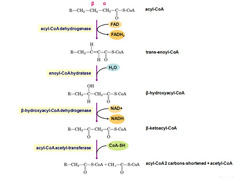
What is the 1st stage of beta-oxidation of fatty acids?
oxidation - FA-CoA is oxidized to Enoyl-CoA by Acyl-CoA DHase; this reaction reduces FAD to FADH2
What is the 2nd stage of beta-oxidation of fatty acids?
hydration - enoyl-CoA is hydrated to Hydroxy Acyl-CoA by Enoyl-CoA hydratase
What is the 3rd stage of beta-oxidation of fatty acids?
oxidation - Hydroxy Acyl-CoA is oxidized to Ketoacyl-CoA by hydroxy CoA DHase
This reaction produces NADH from NAD
What is the 4th stage of beta-oxidation of fatty acids?
thiolysis - cleave of αβ bond
This reaction produces AcCoA (2C) that enters TCA cycle to produce energy
What is the E calculation for beta-oxidation of fatty acids?
Overall, beta oxidation of one palmitic acid produces:
7 FADH2 (1 FADH2= 2 ATPs): 7X2= 14
7 NADH (1 NADH= 3 ATPs): 7X3=21
8 Acetyl CoA (1 AcCoA=12 ATP): 8X12=96
2 ATP lost in palmitate to palmityl CoA -2
Total net ATP produced from oxidation of 1 Palmitic acid= 129 ATP
Simplified equation = (8.5 x C#) - 7
What two steps lead up to Beta-oxidation?
1. FA activation to FA-CoA
- Cytosol
- FA is activated to Fatty Acyl CoA (FA-CoA)
- CoA added to FA by Fatty Acyl CoA synthetase using 2 ATP (-2ATP)
- CoA derivatives cannot go across mitochondria memb. & you need a shuttle system
2. Carnitine shuttle
- Transfers FA to mitochondria for oxidation
- First, carnitine replaces CoA of FA-CoA --> form FA-carnitine (CAT1 - carnitine acyl transferase-1)
- FA-carnitine passes through inner mitochondria memb.
- In the matrix, CoA replaces carnitine recovering FA-CoA (CAT2)
What are ketone bodies?
Byproducts of incomplete fat oxidation
Synthesized in liver mitochondria from AcCoA
Transported across the blood-brain barrier and cell membrane
Important alternative fuel during starvation: muscle, brain (75%) & heart
What is ketone body production active in?
Fasting
Low CHO diet
Vigorous exercise
Diabetics
What are some features of ketone bodies as an energy source?
Blood Brain barrier does not allow FA transport through the brain --> KBs can be used as fuel for brain KBs cause pH to go down when used as main energy source and begins to denature protein with high acidity --> dysfunctioning body
What are some examples of ketone bodies our bodies use?
Acetoacetate (blood)
Beta - Hydroxybutyrate (blood)
Acetone (lung)
Acetoacetate further breaks down to Acetone and Beta-hydroxybutyrate
What is the mechanism of ketogenesis?
Glucagon secretion increases during starvation
Fat oxidation occurs very quickly producing large amt of AcCoA
To enter TCA, AcCoA needs to condense with OAA.
However, due to low BG level, gluconeogenesis is stimulated using up OAA to convert it to glucose to ship it out to blood stream to maintain BG for CNS *please remember gluconeogensis uses OAA for pyruvate conversion to PEP
Without OAA, AcCoA's consumption into TCA slows down.
As a results, AcCoA accumulates fast and converts into ketones
Ketone bodies enter bloodstream targeting tissues that can use ketone
When ketone concentration is very high, excess spills into urine- ketouria
In extrahepatic tissues, KBs convert back to AcCoA
Enter TCA cycle for energy production
What is ketosis?
Ketone bodies are produced from fatty acids caused by a fasting or a very low intake of CHO. It does not progress to life threatening acidosis
What is ketoacidosis and its consequences?
Metabolic acidosis caused by uncontrolled DM or extreme starvation
Consequences:
Low pH
- Denatures body enzymes
- Impairs Hgb binding to O2
Ketonuria & vomiting cause:
- Ion depletion
- Dehydration /hypovolemia
Coma/death
Ketoacidosis occurs in T1DM - very low pH destroys body enzymes and impairs Hb binding to O2
What are some potential benefits of ketone bodies?
More efficient energy source for brain
May be protective against inflammatory disease
Decreases insulin production- helpful for DM
What do we use the keto diet for currently in weight reduction?
Low carb intake (
What are the basics of a keto diet?
Requires low intake of carbohydrates, < 20 to 50 grams of carbs per day (medium-sized banana = 27 grams of carbs).
Relies on ketone bodies, a type of fuel that the liver produces from stored fat.
What you can eat:
Nuts, seeds, tofu, olive oil
Palm/coconut oils. Lard, butter
Meats, poultry
What to limit:
All fruits except certain fruits (usually berries) in small portions.
Vegetables that are rich in carbs. Small portion of leafy greens, cauliflower, broccoli, Brussels sprouts, asparagus, bell peppers, onions, garlic, mushrooms, cucumber, celery, and summer squashes. A cup of chopped broccoli has about six carbs
What are proteins?
vary widely in chemical composition
nitrogen containing - ~16%
Single units - amino acids
- vary in size, charges, reactivity
- 20 AAs used in protein synthesis
- R groups are unique to each AA
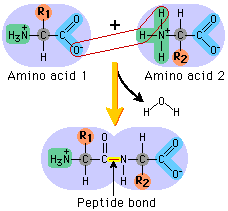
What is the primary structure of a protein?
a polypeptide chain created via peptide bonds
Covalent bonding between AAs with H2O being lost when bond is formed
What is the secondary structure of a protein?
H bonding between AAs within polypeptide chain
Coiling of amino acid chain (alpha-helix or random)
Beta-pleated sheet
What is the tertiary structure of a protein?
Folding back of secondary structure (3-D structure)
Example is disulfide bridges that can occur between amino acids in the chain
- Causes bending of the chain
Determine shape of protein and function
What is the quaternary structure of a protein?
Combination of > 2 polypeptide chains
Examples:
Hb - each subunit can bind 1 mol of O2
Regulatory enzymes - conformational changes when interacting with substrate
One subunit is sometimes not enough for a functional protein - can require multiple polypeptides to join together
What is the structure of Hemoglobin?

What are the general functions of proteins?
structural
immune system
transport
regulatory and metabolic i.e. hormones, neurotransmitters, enzymes, buffers, etc.
Ex. Collagen forms the network for the bone
Skin is first barrier of defense to our bodies - immune support
What are some major protein functions?
structure and movement
enzymes
hormones
buffering pH
fluid balance between blood and surrounding tissues
immunoproteins
transport and storage
E source when CHO is limited
How are proteins used for structure and movement?
muscle - actin and myosin
bone, teeth, connective tissue, hair, tendon
- collagen - skin, GIT, bone
- keratin - hair, nails
How are proteins used for enzymes?
digestive enzymes
energy metabolism
blood coagulation
How are proteins used for hormones?
insulin, glucagon, thyroid hormone
not all hormones are proteins
- testosterone is a steroid, not a peptide
How do proteins buffer pH?
Act as a buffer system helping body maintain proper pH in blood and bodily fluid
most are neutral and few are diacidic
two dibasic: histidine and arginine
How are proteins used for fluid balance between blood and surrounding tissues?
Albumin attracts water to stay in vessels
If protein level decreases in blood, osmosis causes fluid to leak out of vessels and accumulate in tissues causing edema
Decreased protein --> decreased albumin --> lack of body's ability to attract water back into vessels --> edema and excess water in tissues
How are proteins used as immunoproteins?
immunoglobulins (Ig) or antibodies (Ab)
Protein E malnutrition - causes a breakdown in immune system due to lack of Ig and Ab makes us sick often
What proteins function in transport and storage?
albumin
hemoglobin - O2
ceruloplasmin - Cu
transferrin - Fe
retinol-binding protein - Vitamin A
How do proteins impact our energy system?
Proteins are an energy source when CHO is limited
What is used in digestion to breakdown proteins?
HCl
Pepsin
Zymogens
End products: free AAs, small peptides
How does HCl impact digestion of proteins?
denatures protein structure
- uncoils peptide chains
- opens the peptide structure so enzymes can access
Activates pepsinogen to pepsin
How does pepsin impact digestion of proteins?
Hydrolyzes peptide bonds in proteins (endopeptidase)
Activated from pepsinogen
What are the pancreatic enzymes? How are they all activated?
Trypsinogen --> trypsin (endopeptidase in SI)
chymotrypsinogen --> chymotrypsin (phe, tyr, trp, met, asp, his) (trypsin)
proelastase --> elastase (polypeptides to smaller peptides) (trypsin)
procarboxypeptidases A & B --> carboxypeptidase (carboxyl end) (trypsin)
What is endopeptidase?
responsible for chain effects and activates trypsinogen to trypsin which activates other proenzymes to their active form
What is the anabolic metabolism of proteins?
"Building up"
Building of tissue proteins via protein synthesis
Must have enough of all essential amino acids or protein synthesis cannot proceed
- Concept of limiting amino acid will be described later
What is the catabolic metabolism of proteins?
"Breaking down"
Get rid of amino group
Oxidize the carbon skeleton (alpha-ketoacid)
Glucogenic amino acids and ketogenic amino acids
What is transamination?
NH₂ is removed from an AA and transferred to α-keto acid
Aminotransferases (V-B6 dependent)
Alanine aminotransferase (ALT, SGPT)
Aspartate aminotransferase (AST, SGOT)
Part of the liver function tests (high blood levels indicate injury to liver)
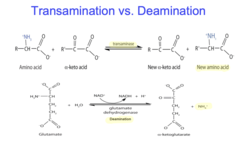
What is deamination?
NH₂ is removed from an AA, but not transferred to another compound
Instead, it is used to produce ammonia (NH₃) - urea cycle
Deaminases (V-B6 dependent)

What is the urea cycle?
Mechanism to dispose of ammonia
When proteins break down ammonia is produced
Converts ammonia to urea, a less toxic form in the liver
Urea is transported through the blood into the kidneys for removal

What is the alanine cycle (cahill cycle)?
During protein catabolism, muscle protein breakdown releasing amino group (deamination)
Alanine cycle shuttles this amino group from muscle to liver for ammonia formation
Purpose: to excrete excess urea (ammonia) out of the body - utilizing alpha-ketoacids to excrete ammonia (urea)

What are some factors influencing urea cycle activity?
Starvation, fasting
- increases cycle activity
- increased AAs breakdown --> increased urea synthesis
Low protein diets (has nothing to process)
- decreases cycle activity
What are urea cycle disorders?
caused by defects in urea cycle enzymes
- ornithine transcarbamylase (OTC) deficiency
- increases level of blood ammonia
- toxic to nervous system
S/S
- asterixis (flapping tremor)
- cerebral edema
= slurred speech
= ataxia
= altered mental status
= blurred vision
= vomiting
Tx: Low protein diet, medication, supplements
What are some urea cycle disorder treatments and what do they impact?
Low protein diet limits protein breakdown
Medication to decrease ammonia production limits ammonia
Supplemental AAs, citrulline or ornithine to increase urea formation and increase excretion through the kidneys
What is the fate of the carbon skeleton after trans- and deamination?
Use as energy: TCA cycle
FA (excess energy), Glc (glucogenic AAs), Ketones (ketogenic AAs)
What are the gluconeogenic AAs?
Ala, Gly, Cys, Ser, Asp, Asn, Glu, Gln, Arg, Met Val, His, Pro