Bone & Joint Pathology: Soft Tissue Tumors
 Call Kai
 Learn
 Practice Test
 Spaced Repetition
 Match
 Flashcards
 Knowt Play
1/120

There's no tags or description
Looks like no tags are added yet.
121 Terms
Which tumours are more common: benign soft tissue tumours or sarcomas, and by how much?
benign soft tissue tumours; 2 orders of magnitude (at least 100 times)
Benign soft tissue tumour show characteristic _________ patterns
age and site
Overall incidence of malignant soft tissue tumors in the general population?
5 cases per 100.000 persons per year 0,7% of all cancers
What percentage of all malignant tumors do soft tissue sarcomas account for?
1-2%
Soft tissue sarcomas represent what proportion of all malignant tumors in pediatric patients?
More than 10%
What % of soft tissue sarcoma cases recur locally following treatment?
20-30%
What proportion of soft tissue sarcomas metastasize to distant organs?
10%
Which organ is the most common site for distant hematogenous metastasis of soft tissue sarcomas?
Lungs
What is the typical 5-year overall survival rate for soft tissue sarcomas regardless of stage and histology?
55-65%
How many distinct tumor types of soft tissues are currently recognized by the WHO?
~150
How many distinct tumor types of the bone are recognized by the WHO?
50
What proportion of all sarcomas are categorized as ‘ultrarare’?
20%
What is the epidemiological threshold used to define and ‘ultrarare’ sarcoma?
Incidence < 1 case per 1 million person-years
Among all sarcomas, what percentages are represented by soft tissue/extra-osseous sarcomas versus primary malignant bone tumors?
Soft tissue and extra-osseous sarcomas represent 87.3%, while malignant bone tumors represent 12.7%
What is the median age at diagnosis for patients with soft tissue cancer?
Two peaks: teenage + 62 years
From which embryonic germ layer do soft tissues originate?
The mesoderm
Which embryonic structures give rise to limb musculature and the musculature of the body wall?
The somites (specifically the hypo mere)
What embryonic somitic division forms intrinsic back muscles?
The epimere
Which nerve ramus innervates muscles derived from the embryonic epimere?
The dorsal ramus of the spinal nerve
Which nerve ramus innervates body wall and limb musculature derived from the embryonic hypomere?
The ventral ramus of the spinal nerve
What four primary tissue types originate from the mesoderm?
Cartilage, bone, fat, and muscle
What is the Greek word origin and literal meaning of the term ‘sarcoma’?
Derived from the Greek word σαρκἡ (sarkos), meaning 'meat'
What anatomical region is the single most common primary location for soft tissue sarcomas?
The extremities (accounting for ~50% of cases, most commonly in the thigh)
What is the percentage distribution of soft tissue sarcomas across primary anatomical sites?
Extremities ~50%
Trunk wall ~15%
Retroperitoneum ~10%
GI tract ~8%
Head and neck ~6%
Uterus ~5%
How do superficial and deep soft tissue sarcomas of the extremity and trunk wall differ in median size at diagnosis?
Superficial tumors have a median size of ~5 cm (~30% of cases), whereas deep tumors have a median size of ~9 cm (~60% of cases)
Why are retroperitoneal soft tissue sarcomas typically diagnosed at much larger sizes than extremity tumors?
Because they expand silently within a large, non-restrictive abdominal cavity, producing symptoms only after reaching significant size
Which specific soft tissue sarcoma subtype occurs almost exclusively in children?
Embryonal rhabdomyosarcoma
Which soft tissue sarcoma subtype is predominantly seen in young adults?
Synovial sarcoma
Which four soft tissue sarcoma subtypes predominate in elderly patients?
Undifferentiated pleomorphic sarcoma (UPS), liposarcoma, leiomyosarcoma, and myxofibrosarcoma
Are soft tissue sarcomas benign or malignant lesions?
Malignant; they can recur and destroy adjacent tissues
What four clinical features strongly indicate that a soft tissue lump may be malignant?
Size greater than 5 cm (larger than a golf ball)
Increasing size
Location deep to the fascia
Presence of pain
What is the clinical rule of thumb regarding deep growing soft tissue lumps?
Consider any deep growing soft tissue lump larger than a golf ball (4.2 cm) to be a sarcoma until proven otherwise
What proportion of benign soft tissue tumors are superficial and under 5 cm in diameter?
99% of benign soft tissue tumors are superficial, and 95% are less than 5 cm in diameter
WHO risk stratification: Benign lesions
Do not recur
Cured by surgery
Almost never metastasize (rare exception rate 1 : 50.000)
WHO risk stratification: Intermediate (locally aggressive) lesions
Infiltrative and locally aggressive growth pattern
Recur after surgery
Require wide resections for disease control
WHO risk stratification: Intermediate (rarely metastasizing) lesions
Locally aggressive
<2% chance of distant metastasis (cannot be reliably predicted based on morphology)
WHO risk stratification: Malignant lesions
Aggressive
Significant potential for distant metastasis (20-100%)
Give two examples of Intermediate (locally aggressive) soft tissue tumors
Desmoid-type fibromatosis
Atypical lipomatous tumor/Well-differentiated liposarcoma
Give two examples of Intermediate (rarely metastasizing) soft tissue tumors
Solitary fibrous tumor
Kaposi sarcoma
Which six histologic subtypes account for ~65% of all soft tissue sarcomas?
Undifferentiated pleomorphic sarcoma (UPS)
Liposarcoma
Leiomyosarcoma
Myxofibrosarcoma
Synovial sarcoma
Malignant peripheral nerve sheath tumor (MPNST)
What is the primary treatment modality that offers the best hope for cure in soft tissue sarcoma?
Complete surgical resection
What is the standard of care therapy for most locally advanced and metastatic soft tissue sarcomas?
Cytotoxic chemotherapy
What is the primary overarching goal of soft tissue sarcoma clinical management?
To balance local disease control and survival with preservation of limb/organ function and quality of life
Where should the final diagnosis and therapy plan for suspected soft tissue sarcomas be performed?
In specialized scond- or third-level reference centers
When can formal tissue biopsy be bypassed in diagnosing soft tissue tumors?
When non-invasive imaging findings are highly characteristic or pathognomonic for a specific benign lesion
What four main features on standard H&E stained slides guide the diagnostic classification of mesenchymal tumors?
Predominant shape of neoplastic cells
Pattern of growth
Quality of the background stroma
Architecture of the vascular network
What are the four main cell morphologies seen in soft tissue tumors?
Spindle cells
Epithelioid cells
Round cells
Pleomorphic cells
Morphology of spindle cells
Cells with elongated cytoplasm with blunt, tapering, or pointed ends

Morphology of epithelioid cells
Polygonal cells with abundant cytoplasm and distinct cell borders

Morphology of round cells
Circular cells with scanty cytoplasm surrounding a central, round nucleus

Why are round-cell sarcomas commonly called ‘blue’ tumors on histological examination?
Because the high nuclear-to-cytoplasmic ratio of densely packed round cells causes intense hematoxylin (blue) nuclear staining
Morphology of pleomorphic cells
Monster bizzarre cells, multinucleated giant cells, severe nuclear atypia, and frequent atypical mitoses
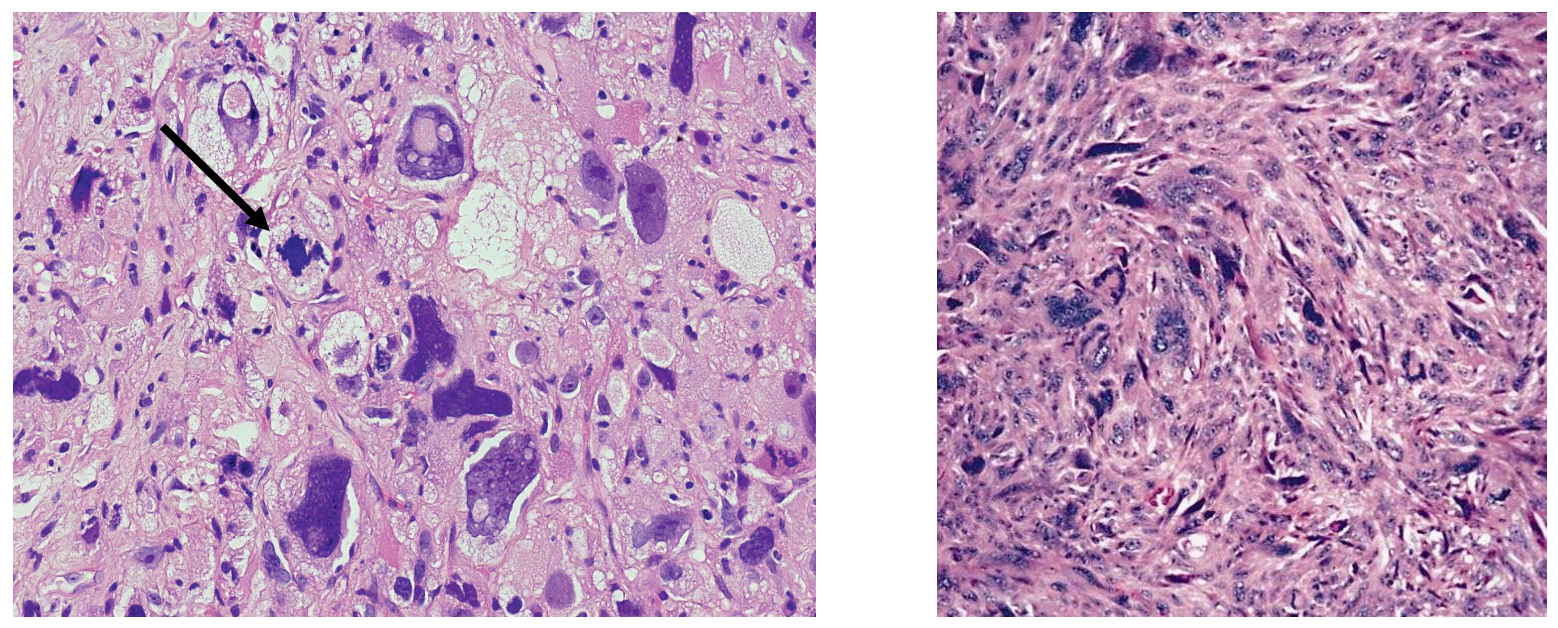
What are the six growth patterns seen in soft tissue tumors?
Fascicular
Herringbone
Storiform
Alveolar
Solid
Biphasic
Describe the fascicular growth pattern in soft tissue tumors + example
Tumor cells arranged in parallel fascicles of variable length (leiomyosarcoma)

Describe the herringbone growth pattern in soft tissue pathology + example
Spindle cells, arranged in long, regular, intersecting fascicles angled like fish bones (fibrosarcoma)

Describe the storiform growth pattern
Tumor cells forming short, pinwheel-like or cartwheel intersecting fascicles radiating from a central axis
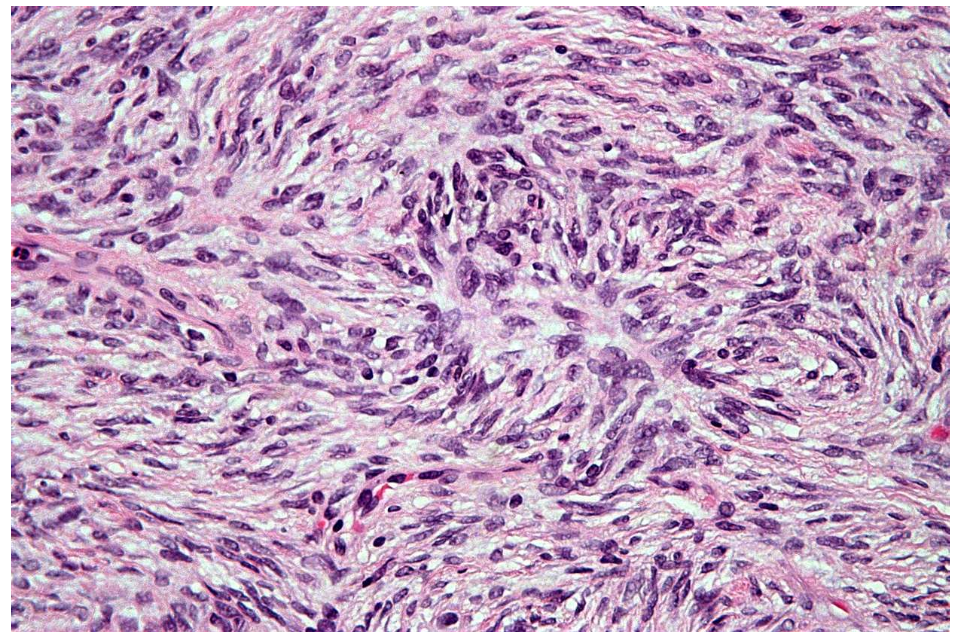
Describe the alveolar growth pattern
Tumor cells arranged in rounded aggregates with central loss of cohesion, reminiscent of pulmonary alveoli

Describe the solid growth pattern
Tumor cells are arranged in undifferentiated sheets

Describe the biphasic growth pattern + example
Tumor cells have divergent features (synovial sarcoma)

Name two soft tissue sarcoma entities that characteristically exhibit an alveolar growth pattern
Alveolar soft part sarcoma and alveolar rhabdomyosarcoma
What are the five main background stroma seen in soft tissue tumors?
Fibrous
Sclerotic
Myxoid
Chondro-myxoid
Osteogenic

Classify this background
Fibrous background with collagenized stroma
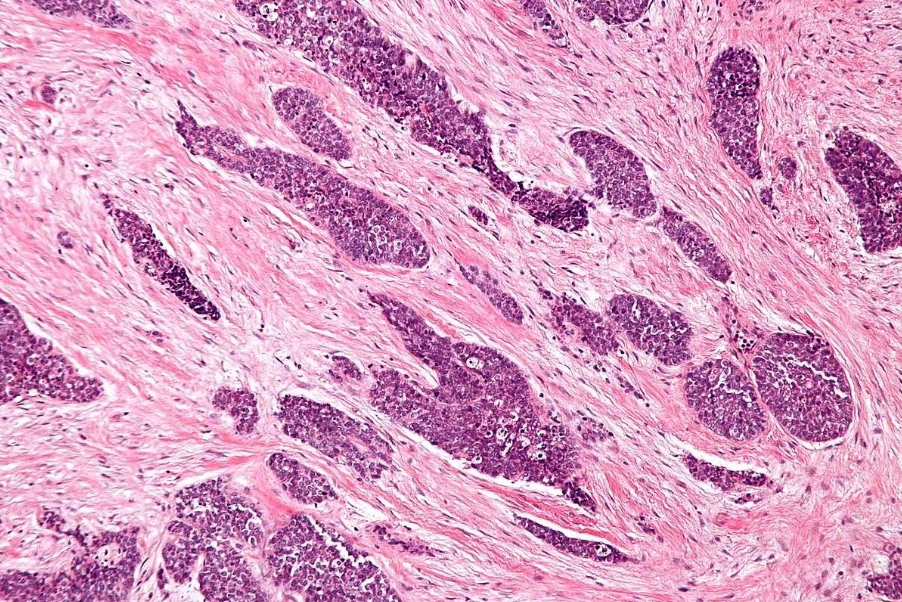
Classify this background
Sclerotic background with heavily collagenized stroma (desmoplastic round cell sarcoma)

Classify this background
Myxoid pattern with loose stroma rich in water and mucin (myxoid liposarcoma)

Classify this background
Chondroid (chondrosarcoma)
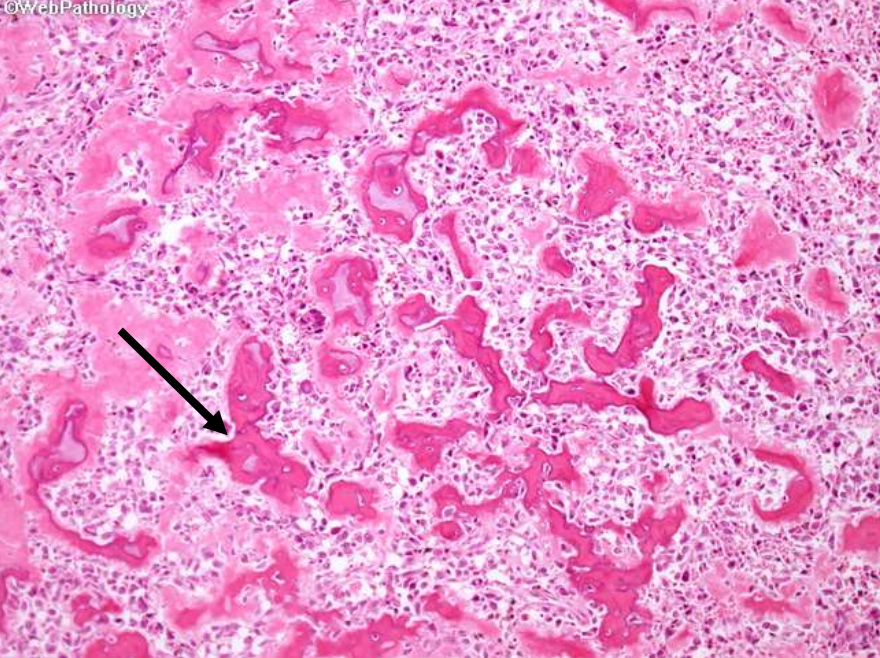
Classify this background
Osteogenic backgound with synthesis of osteoid matrix
from tumor cells (osteosarcoma)
What are the three types of vascular networks seen in soft tissue tumors?
• Plexiform
• Archiform
• Hemangiopericitoma-like
Plexiform vasculature + example
small capillary-size vessels and chicken-wire appearance (myxoid liposarcoma)

Archiform vasculature example
Myxofibrosarcoma

Hemangiopericitoma-like architecture + example
dilated thin walled vessels with staghorn appearance (malignant solitary fibrous tumor)

Name two soft tissue sarcoma histotypes that show a distinct predilection for lymph node metastasis
Epithelioid sarcoma and clear cell sarcoma
How common is lymphatic spread in soft tissue sarcomas compared overall to hematogenous spread?
Lymph node metastasis is rare in soft tissue sarcomas overall; hematogenous spread (to lungs) is far more common
Under the WHO classification, which adipocytic lesion is categorized as intermediate (locally aggressive)?
Atypical lipoma/well-differentiated liposarcoma
Under the WHO classification, which fibroblastic lesions are categorized as intermediate (locally aggressive)?
Superficial fibromatosis, desmoid-type fibromatosis, and lipofibromatosis
In the smooth muscle category, name a benign and malignant tumor
Angiolyeiomyoma/leiomyoma of deep soft tissue (benign)
Leiomyosarcoma (malignant)
In skeletal muscle lineage, what are the benign and malignant WHO equivalents?
Rhabdomyoma (benign)
Rhabdomyosarcoma (malignant)
Name a malignant tumor arising from vascular lineage in soft tissue
Angiosarcoma of soft tissue (or epithelioid hemangioendothelioma)
Name a chondro-osseous malignancy that arises in soft tissues outside the skeleton
Extraskeletal osteosarcoma (or mesenchymal chondrosarcoma)
List malignant soft tissue tumor types classified under ‘uncertain differentiation’
Synovial sarcoma
Epithelioid sarcoma
Clear cells sarcoma of soft tissue
Extraskeletal myxoid chondrosarcoma
Extraskeletal Ewing tumor
Intimal sarcoma
Sarcomatogenesis etiology
Largely unknown
Rare cases: viral infections (HHV8 in Kaposi sarcoma) or chemical exposure (vinyl chloride in angiosarcoma)
Phenoxyherbicides, chlorophenols, dioxins in agricultural or forestry work
Radiation (5%), usually ≥50 Gy
Genetic susceptibility (NF1, p53)
Which familial syndromes predispose patients to the development of soft tissue tumours?
Desmoid fibromatosis
NF1
NF2-related schwannomatosis
Li-Fraumeni syndrome
Lynch syndrome
Retinoblastoma syndrome
Which genetic tumor syndrome caused by TP53 variants carries a >30% risk of developing sarcomas by age 30?
Li-Fraumeni syndrome
What percentage of patients with Neurofibromatosis type 1 (NF1) develop Malignant Peripheral Nerve Sheath Tumors (MPNSTs)?
5-10% of NF1 patients
What percentage of patients with Neurofibromatosis type 1 (NF1) develop Gastrointestinal Stromal Tumors (GISTs)?
5-7% of NF1 patients
What gene, chromosome, location, and inheritance pattern are associated with Neurofibromatosis type 1?
NF1 gene on chromosome 17q11 autosomal dominant
What type of nerve sheath tumor is associated with NF2-related schwannomatosis?
Benign nerve sheath tumors (shwanommas)
Which specific histotypes exhibiting microsatellite instability (MSI) are linked to Lynch syndrome?
UPS (undifferentiated pleomorphic sarcoma) and pleomorphic rhabdomyosarcoma
Retinoblastoma syndrome (RB1 variants) markedly increases the risk of developing secondary sarcomas following what medical exposure?
Radation therapy
Large genomic studies suggest up to what proportion of sarcoma patients carry pathogenic germline variants?
As many as half (50%) of all sarcoma patients
What histological triad of features defines leimyosarcoma (LMS) on high-power microscope evaluation?
Moderate to severe cellular pleomorphism/nuclear atypia
High mitotic rate (>10 mitoses per 10 HPF)
Tumor cell necrosis
What pattern of invasive growth is typically demonstrated at the outer borders of leiomyosarcomas?
An infiltrative border pushing into surrounding soft tissues
What are the most critical prognostic factors determine outcome in leiomyosarcoma?
Histological grade
Tumor location
Tumor size (with worse outcomes for retroperitoneal and vascular lesions)
Why does conventional H&E microscopy remain crucial in soft tissue tumor diagnosis despite advances in molecular genetics?
H&E stain provides the necessary baseline architecture, cell shape identification, mitotic index calculation, and necrosis assessment required to direct targeted molecular testing and determine tumor grade