Modelling Pathology in Laboratory
 Call Kai
 Learn
Learn Practice Test
 Spaced Repetition
 Match
Match Flashcards
 Knowt Play
1/74

Earn XP
Description and Tags
For exams - what would be the most appropriate assay to use if we're researching this...
Name | Mastery | Learn | Test | Matching | Spaced | Call with Kai | Chat |
|---|
No analytics yet
Send a link to your students to track their progress
75 Terms
What 2 laws must be abided when using patient data in research
General Data Protection Regulations (EU law)
Health Research Regulations (Irish law)
What happened Henrietta Lacks


When was each paper retracted

Why is the level of stromal tumour infiltrating lymphocytes (sTILs) used in treatment
It may be a predictor of response to chemotherapy
Does high/low sTILs → good/bad response to chemotherapy
Patients with low levels of sTILs do significantly worse.
Explain how patients with low levels of sTILs do significantly worse.
Hypothesis is that when patients received chemotherapy, their tumour cells undergo apoptosis which releases tumour neoantigens
The tumour neoantigens are seen as “foreign” and so immune cells help to clear the tumour
If there is a lack of sTILs in the tumour microenvironment – process can’t occur
Of relevance to the action of immune check point inhibitors (e.g. anti-PD-L1)
How does neoantigen load have an effect on possible therapies

How can AI improve Our Ability to Reliably assess tumours
May Improve Our Ability to Reliably Quantify sTILs

Give 2 examples of Target Manipulation tests
shRNA
CRISPR
Give 2 examples of Functional Assays tests
Cell Invasion
Toxicity Assays
Give 2 examples of OMIC tests
RNA sequencing
Proteomics
What is Triple Negative Breast Cancer & what does it mean for treatment
Characterised by absence of ER, PR, HER2 → no response to targeted chemotherapeutic treatment


High HERV-K & iNOS are predictive of good/bad prognosis
Bad
What kind of treatment could HERV-K & iNOS be used for
Potential targets for the treatment of high grade hormone independent breast cancer
HERV-K is an important predictor for what in breast cancer
Metastasis in TNBC (Triple-negative breast cancer)
At what stage of progression are HERV-K & iNOS seen
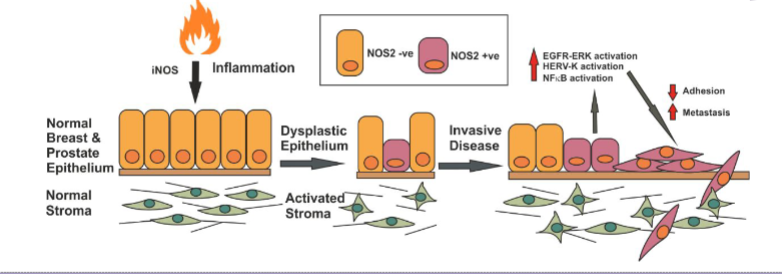
In what ways does NO influence cancer formation & progression
NO influences all processes relevant to cancer formation and progression

What are Mobile DNA elements (name 2 types)
Pieces of DNA that can move around within the genome
DNA transposons
Retrotransposons
Differentiate between DNA transposons & Retrotransposons

2 types of Retrotransposons
Non-LTR retrotransposons -These don't have LTRs (Long Terminal Repeats).
LTR retrotransposons
3 types of Non-LTR retrotransposons
LINEs
SINEs (Alus)
SVAs

What are ERVs & why do we care about them
Endogenous Retroviruses - A type of LTR (Long Terminal Repeat) retrotransposons
Some ERV sequences become more active/expressed in certain diseases
(HERV-K is a type of ERV)
What % of the human genome is made up of ERVs (endogenous retroviruses)
8%
What class & subclass of retrovirus does HERV-K belong to
Class II retroviruses
beta-retrovirus-like
How many HERV-K HML-2 loci are there
How many of these are:
solo-LTR insertions
provirus insertions
unfixed polymorphic loci
1063 total
973 solo-LTR insertions
90 provirus insertions
69 of these loci are unfixed polymorphic loci
HERV-K HML-2 can produce several proteins through alternative splicing - name 3
1× spliced → Env
2× spliced → Rec
2× spliced → Np9
How might HERV-K contribute to cancer?
HERV-K products can alter immune responses, promote inflammation, evade immune surveillance and activate pathways involved in cell proliferation and migration, potentially contributing to tumour progression.
How would you assess iNOS and HERV-K Protein Expression in TNBC Patient Samples
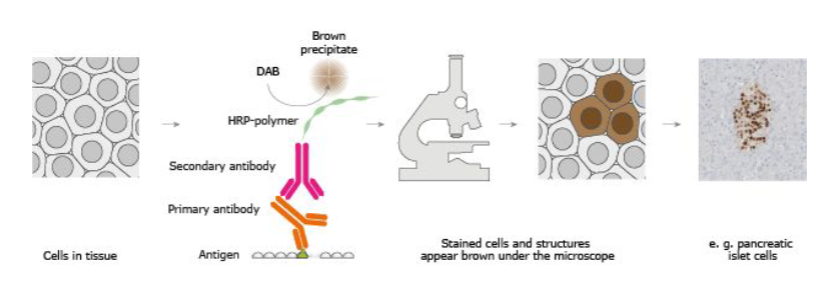
Immunohistochemistry
Explain how IHC can be used to assess for iNOS and HERV-K
In IHC, you use an antibody against the protein you want to detect:
Anti-iNOS antibody → binds iNOS
Anti-HERV-K antibody → binds HERV-K protein
The antibody is then detected using an enzyme system, commonly horseradish peroxidase (HRP). When the DAB chromogen is added, HRP converts DAB into an insoluble brown precipitate at the location where the target protein is present
What is HERV-K Env Expression used to predict
Survival
High HERV-K Env expression is associated with metastasis to what 2 tissues
Liver
Soft tissue
Dual HERV-K Env and iNOS Expression leads to what fold increase in
most distant metastases
liver metastases
Doubles most distant metastases
5x Liver metastases
What is shRNA & how can it be used to investigate the role of HERV-K in breast cancer?
Short hairpin RNA (shRNA) is an artificial RNA molecule with a tight hairpin turn used to silence target gene expression through RNA interference
shRNA can be used to destroy HERV-K mRNA, reducing production of HERV-K protein
How does shRNA reduce HERV-K expression (MOA)
A complementary shRNA sequence binds to the HERV-K mRNA, causing the mRNA to be degraded and therefore reducing the corresponding protein.
How was successful reduction of HERV-K expression confirmed?
Using Western blotting in MDA-MB-231 TNBC cells following stable lentiviral shRNA treatment.
What does a stronger band on a Western blot indicate
A greater amount of protein.
What are the main stages of a Western blot
SDS-PAGE – separates proteins according to size.
Protein transfer to a membrane.
Immunodetection/staining using antibodies against the protein of interest.
Visualisation of the bands to determine protein expression

What does Western blotting allow researchers to determine
Whether the amount of a specific protein has changed, such as whether HERV-K protein expression has been reduced after shRNA treatment.
Name 3 methods for Analysing Cell Proliferation
You could physically count the cells
XTT assay
Luminescent Assay
How can cell proliferation be measured by physically counting cells?
Trypan blue is added to the sample (which will be taken up by dead cells, but not live ones - allows live to be counted) & cells can be counted directly
What is a disadvantage of physically counting cells with trypan blue?
It is not efficient.
What does an XTT assay measure?
It measures metabolically active cells through MTS reduction.
What is the sensitivity and time frame of the XTT assay ?
Approximately 800 cells, measured over 1–4 hours, using a colourimetric readout
What does a luminescent assay measure
ATP, which reflects metabolically active cells
What is the sensitivity and time frame of the luminescent assay
Approximately 50 cells in 10 minutes, using luminescence.
What effect did HERV-K knockdown have on TNBC cell proliferation?
TNBC proliferation was reduced
Cell migration of HERV-K Knockdown MDA-MB-231 cells were also measured. How?
Using a Boyden chamber, where cells migrate through 8 μm (micron) pores
The Boyden Chamber's has been coated with a thin layer of matrigel. The cells must degrade it and then access the 8 micron pores to migrate through.
They are visualised with Crystal Violet stain

What effect did HERV-K knockdown have on cell migration in MDA-MB-231 cells?
HERV-K knockdown reduced cell migration potential
Name a more realistic way of assessing tumour cell invasion
Tumour invasion is multidimensional in reality, so 3D tumour spheroids may provide a more realistic model of tumour cell invasion
Using 3D tumour spheroids we can assess the ability of tumour cells to invade out of the spheroid

How can researchers investigate signalling pathways regulated by iNOS and HERV-K?
RNA sequencing (RNA-seq)
Why is interpreting RNA-seq data difficult
RNA-seq provides expression information for approximately 60,000 genes, including mRNA, lncRNA, snoRNA and miRNA.
How can researchers make sense of thousands of RNA-seq results?
They can group genes into biological pathways/hallmarks and examine which pathways are upregulated or downregulated
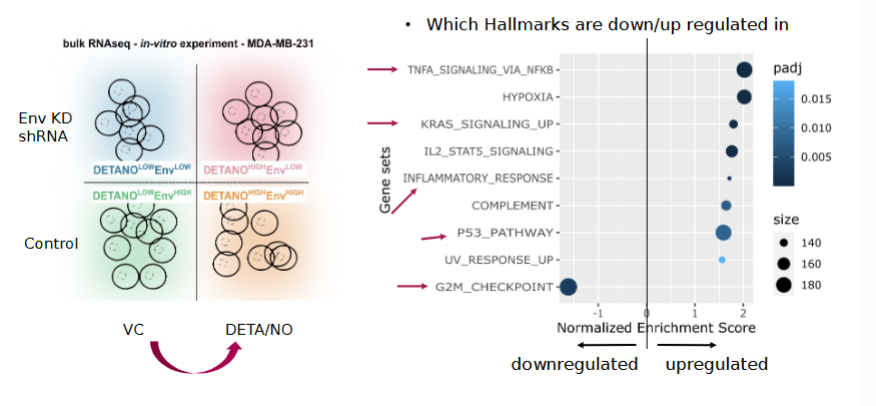
How were these hallmarks affected by high DETA/NO (high iNOS)
Inflammatory response
TNFA signalling via NFκB
KRAS signalling
p53
G2M checkpoint
Upregulated:
Inflammatory response
TNFA signalling via NFκB
KRAS signalling
p53
Downregulated
G2M checkpoint
How were these hallmarks affected by high HERV-K (EnvHIGH)?
Inflammatory response
TNFA signalling via NFκB
KRAS signalling
All downregulated
What does “more than additive” mean in the analysis of iNOS and HERV-K
The combined effect of high iNOS and high HERV-K is greater than would be expected from simply adding their individual effects.
If a patient is diagnosed with breast cancer, they are assessed for estrogen receptor, progesterone receptor and HER2 receptor status using what test
IHC
1 Limitation of Immunohistochemistry
We are limited to identifying one protein at a time
Name an alternative approach to allow for staining with multiple antibodies on the one tissue
Immunofluorescence
Once tumour punches are obtained from therapeutic excision specimens, what is constructed for their analysis
A tissue microarray (TMA).
What is the MACSima Spatial Multi-Omics Platform used for?
It allows detailed spatial analysis of tissue, including cell phenotyping, cellular neighbourhoods, cell-cell interactions and functional states of cells.
How does tissue imaging & marking work
Tissue is stained, imaged, the markers are erased, and the tissue can then be stained and imaged again with additional markers
This allows many different markers to be assessed sequentially on the same tissue section, enabling extensive multiplex spatial profiling


What test is used for each of these research questions:
Research question: Does a target affect tumour cell proliferation?
XTT/MTS assay or ATP luminescence assay
Research question: Does a target affect tumour cell migration?
Use: Boyden chamber migration assay
Research question: Does a target affect tumour cell invasion?
Use: Matrigel-coated Boyden chamber
Research question: Want a more realistic 3D model of tumour invasion?
Use: 3D tumour spheroid model
Research question: Does knocking down a target reduce its protein expression?
Use: Western blot
Research question: What genes/pathways are affected by manipulating a target?
Use: RNA sequencing
Research question: Where is a protein expressed in patient tissue?
Use: Immunohistochemistry (IHC)
Research question: Want to detect multiple proteins in the same tissue section?
Use: Immunofluorescence / multiplexing
Research question: Want to study spatial interactions between many cell types/proteins?
Use: Spatial multi-omics / multiplex imaging
Research question: Is a biomarker associated with patient survival
Use: Patient cohort + biomarker measurement + survival/outcome analysis
Research question: Does a biomarker actually cause a disease phenotype
Use: Manipulate the biomarker in a laboratory model and assess the phenotype
Research question: Does a diagnostic marker give consistent results between observers
Assess: Reproducibility
Research question: Does an antibody detect only the intended target?
Assess: Antibody specificity