CH531 Nucleic Acids & Processes
 Call Kai
 Learn
Learn Practice Test
 Spaced Repetition
 Match
Match Flashcards
 Knowt Play
1/71

Earn XP
Description and Tags
Exam 1 Material
Name | Mastery | Learn | Test | Matching | Spaced | Call with Kai | Chat |
|---|
No analytics yet
Send a link to your students to track their progress
72 Terms
List the building blocks from Nitrogen bases to chromosomes.
Nitrogen bases → Nucleosides → Nucleotides → Nucleic Acids → Genes → Chromosomes
What are the five major bases of nucleic acids?
Adenine
Guanine
Cytosine
Thymine
Uracil
What makes up a Nucleoside?
base + sugar
What makes up a Nucleotide?
base + sugar + phosphate
What makes up nucleic acids?
chains of nucleotide building blocks
What is the difference between a gene and a chromosome?
A gene is a unit of DNA that holds instructions to make proteins
A chromosome is a long strand of DNA tightly coiled around proteins that package up to thousands of genes
Which of the five nucleic bases are Purines?
Adenine & Guanine
PuAG
Which of the five nucleic bases are Pyrimidines?
Thymine, Cytosine & Uracil
PyTUC

What is this nucleic base?
Adenine

What is this nucleic base?
Guanine

What is this nucleic base?
Thymine

What is this nucleic base?
Cytosine

What is this nucleic base?
Uracil

What is this image?
ATP - Adenosine triphosphate

What is this image?
ADP - Adenosine Diphosphate

What is this?
Ribose (RNA)
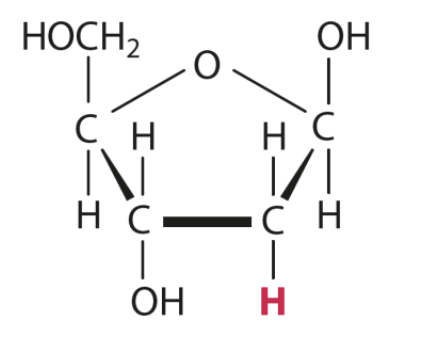
What is this image?
2’-deoxyribose (DNA)

What is this image?
GTP - Guanosine Triphosphate
What is a phosphodiester bond?
Strong covalent chemical linkage that joins the 5’ carbon atom of one sugar molecule to the 3’ carbon atom of another in the sugar-phosphate backbones of DNA and RNA
usually a condensation reaction (joins molecules together & releases molecule of water)
single phosphorus atom forms two ester bonds w/hydroxyl (-OH) groups of two neighboring sugars
How is DNA and RNA structured?
Double helix, right handed
10-base pairs complete a turn
Held together by H-bonds and base stacking
Watson & Crick
What are Chargaff’s Rules?
1) The Base composition of DNA generally varies from one species to another
2) DNA specimens isolated fro different tissues of the same species have the same base composistion
3) The base composition of DNA is a given species does not change with an organism’s age, nutrition state, or changing environment
4) In all cellular DNAs, regardless of species, the number of A residues is equal to the number of T residues, so that the number of C residues is equal to the number of G residues. From this relationship we find that the sum of purines equals the sum of pyrimidines : A+G = C+T ; (G+C NOT EQUAL A+T)
Draw the pairing of Adenine and Thymine.

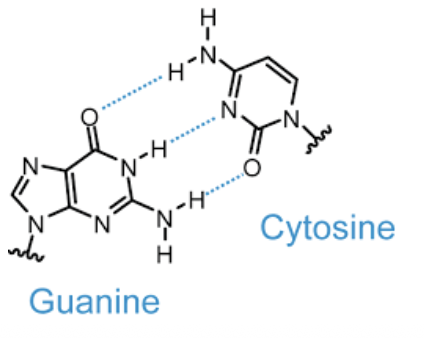
Draw the pairing of Guanine and Cytosine.
What is the ‘central dogma’ of biology?

What does the Anti and Syn conformation in nucleotides look like? Which conformation is normally preferred?
Anti: O-2 in pyrimidines or the 6-membered ring in purines is away from the sugar
Syn: O-2 in pyrimidines or the 6-membered ring in purines is over the sugar
Anti is preferred among natural nucleotides for steric reasons
Exception: G prefers syn. in mononucleotide (intramolecular hydrogen bond)
What are three conformations of DNA? What type of helix do they have and how many base pairs per turn?
A-DNA - Right-handed, 11 prs
B-DNA - Right-handed, 10 prs
Z-DNA - Left - handed, 12 prs
Which direction does DNA syntehsis occur?
5’ to 3’
What is bidirectional DNA replication?
the process where DNA copying starts at a specific spot and moves outward in two opposite directions at the same time
What does it mean for replication to be Semi-Discontinuous?
Lagging strand
Small replication products from discontinuous products from discontinuous replication on lagging strand
Replication requires RNA primers that have free 3’-OH (DNA polymerases cannot initiate a new strand by themselves)
In DNA replication, which strand is replicated continuously?
Leading Strand
In DNA replication, which strand is replicated discontinuously?
Lagging Strand
What does DNA Polymerase III do in the replication process?
does the bulk of copying DNA in Replication
What does the DNA clamp protein do in DNA Replication?
(also known as a sliding clamp) binds DNA polymerase and prevents this enzyme from dissociation from the template DNA strand
What would happen to linear chromosomes in Eukaryotic DNA Replication over time if the cell didn’t add DNA sequences to the ends of chromosomes?
Linear chromosomes become progressively shorter with each round of DNA replication
What is telomerase?
Contains protein and RNA
specialized enzyme that maintains length of telomeres (end cap of chromosomes) by adding repetitive DNA sequences
Allows to bind to 3"‘ overhange
What is DNA Transcription?
Produces RNA that is complementary to one DNA strand
What are the three phases of DNA Transcription in prokaryotes and eukaryotes?
Initiation, Elongation & Termination
What does Initiation in DNA Transcription do?
RNA polymerase binds to specific region on DNA called a promoter to begin copying a gene
sequences will differ slightly from gene to gene
Abundant proteins have “stronger” promoters that enable more frequent initiation
What occurs during Elongation in DNA transcription?
The middle phase where RNA Polymerase moves along the DNA template strand and builds a complementary RNA molecule
What occurs during Termination in DNA transcription?
RNA polymerase stops synthesizing RNA, and the newly formed RNA transcript and enzyme detach from the DNA template
1) two-fold symmetric DNA sequence; when transcribed, the RNA forms a hairpin
2) A string of A-T base pairs
Hairpin structure forces RNA away from the polymerase. This is enhanced by the weak A-U bonds at the DNA-RNA hybrid site
What occurs during RNA translation - Protein synthesis?
Converting info stored in nucleic acid sequences into proteins
Sequences of mRNA are translated into unique sequence of amino acids in a polypeptide chain (linear order is preserved throughout!)
What is a codon?
contains triplet nucleotides and specifies the sequence of amino acids
What is a(n) Start/Initiation codon?
AUG (encode Met)
What are Termination (stop) codons?
UAA: Ochrecodon
UGA: Opal codon
UAG: AMber codon
Is DNA or RNA more susceptible to hydrolysis? Why?
RNA - Can attack phosphodiether backbone
How many bonds are formed between A & T?
2
How many bonds are formed between C & G?
3
What is the name of the DNA and RNA backbone called?
Phosphodiether backbone
Which sugar is used in RNA?
Ribose
mRNA
messenger RNA
rRNA
ribosomal RNA
tRNA
transfer RNA
miRNA
microRNA
siRNA
small interfering RNA
What steps are involved in RNA Translation - Protein synthesis?
Initiation
Elongation
Termination
What happens during initiation, elongation and termination in RNA Translation - Protein synthesis?
Initiation: small ribosomal subunit binds to the mRNA near the start codon (AUG), the first tRNA attaches carrying methionine, and the large ribosomal subunit joins
Elongation: The ribosome reads subsequent codons, matching them with incoming tRNAs that drop off their amino acids to form a growing polypeptide chain
Termination: The ribosome hits a stop codon, releases the finished protein chain, and disassembles
What are the three sites in the ribosome in the initiation step of RNA translation?
A-site: aminoacyl-tRNA
P-site: peptidyl-tRNA
E-site: exit
For each ribosome, how many binding sites are there from mRNA and tRNA?
1 binding site for mRNA and 3 binding sites for tRNA
What does the large subunit do in RNA translation during the initiation step?
One large subunit - catalyzes the formation of the peptide bond
What does the small subunit do in RNA translation during the initiation step?
One small subunit - matches the tRNA to the mRNA
What does a Ribosome do in RNA Translation?
Moves along the mRNA adding amino acids to growing protein chain
Why is Thymine in DNA and Uracil in RNA?
1.) C → U conversions is a problem (happens lots in cells)
2.) T is more stable (methyl group) (has sterics)
3.) U is much more reactive susceptible
4.) T is more “expensive” to make
Provide an overview of what occurs in molecular cloning.
1.) Amplification of gene of interest - PCR of gene within a plasmid
2) Digestion of gene of interest using restriction enzymes (endonucleases)
3) Digestion of host organism vector using restriction enzymes of plasmid
4) Isolate, identify & purify digestion products (gene and vector using gel electrophoresis
5) Sequence of gene of interest
6) Ligation of gene and host vector to create recombinant DNA/recomb. plasmid
7) Identify ligation products using gel electrophoresis
8 ) Transformation of recom. plasmid into host cells
9) selection of host cells carrying recom. plasmid
10) Isolate and purify recom. plasmid from host
11) Run diagnostic digestion and gel electrophoresis
12) Sequence recom. plasmid
13) more science 😎
What is a plasmid?
small, extrachromosomal DNA molecule within a cell that cna replicate independently (typically bacteria)
What is a primer?
Short, single stranded nucleic acid that initiates DNA synthesis (used by organisms during replication)
What does DNA Sequencing use?
DNA primers
DNA polymerase
dNTP’s
ddNTP’s (with fluorophores attached)
In molecular cloning, what is transformation?
When recom. DNA is added via heat shock or electroporation to prokaryotes
In molecular cloning, what is transduction?
When Viruses are used (in place of heat shock or electricity) to introduce recom. DNA in prokaryotic or eukaryotic cells
In molecular cloning, what is transfection?
When recom. DNA is added to eukaryotic cells without viruses
What makes an organism classified to be a transgenic organism?
When transformation, transduction, or transfection is used to add recom. DNA from one organism to another organism
Is a genetically modified organism (GMO) the same as a transgenic organism?
NO
Genetic engineering
an extension of molecular cloning
after transformation and selection, the DNA is isolated again and then modified before being put back onto a host organism