Ex 1. Materiales Ing. Civil Ch.1
 Call Kai
 Learn
 Practice Test
 Spaced Repetition
 Match
 Flashcards
 Knowt Play
1/43

Earn XP
Description and Tags
44 Terms
Criteria for Material Selection
Economic Factors
Mechanical Properties
Nonmechanical Properties
Production/Construction Considerations
Aesthetic Properties
Sustainable Considerations
Material Variability
Economic Factors
Availability and Cost of Raw material
Manufacturing Cost
Transportation
Placing
Maintenance
Mechanical Properties
Response of the material to loads
Failure types
Catastrophic and Functional
Example of catastrophic failure
material failure
Examples of functional failure
Excessive roughness, excessive displacement, excessive vibrations
Static (Dead) loads
long term forces applied and removed slowly, therefore vibrations dont occur.
What are static loads a result of ?
gravity
Dynamic (Live) Loads
short term forces that cause shock or vibration
types of dynamic loads
periodic (repeating wave form), transient (quick impulse that decays back to resting) and random (never repeats)
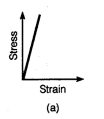
Which material has this stress-strain response
Glass and Chalk
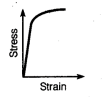
Which material has this stress-strain response
Steel
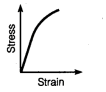
Which material has this stress-strain response
Aluminum

Which material has this stress-strain response
Concrete
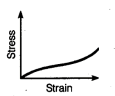
Which material has this stress-strain response
Rubber
Elastic Behavior
Instantaneous response to load
Returns to its original shape upon unloading
Characteristic of linear behavior
a linear material has a straight line stress-strain graph
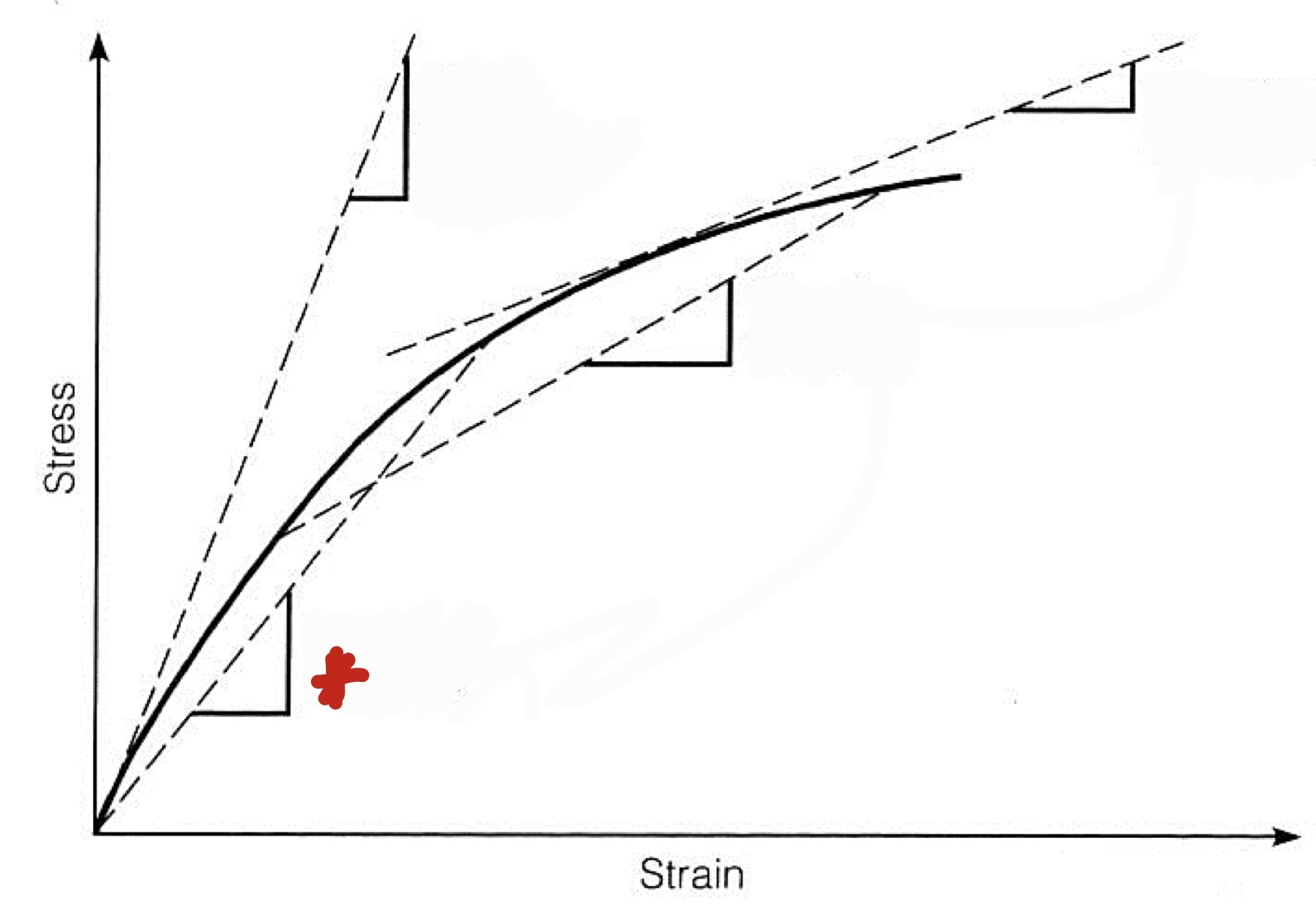
What approximating modulus is used in the graph?
Secant modulus
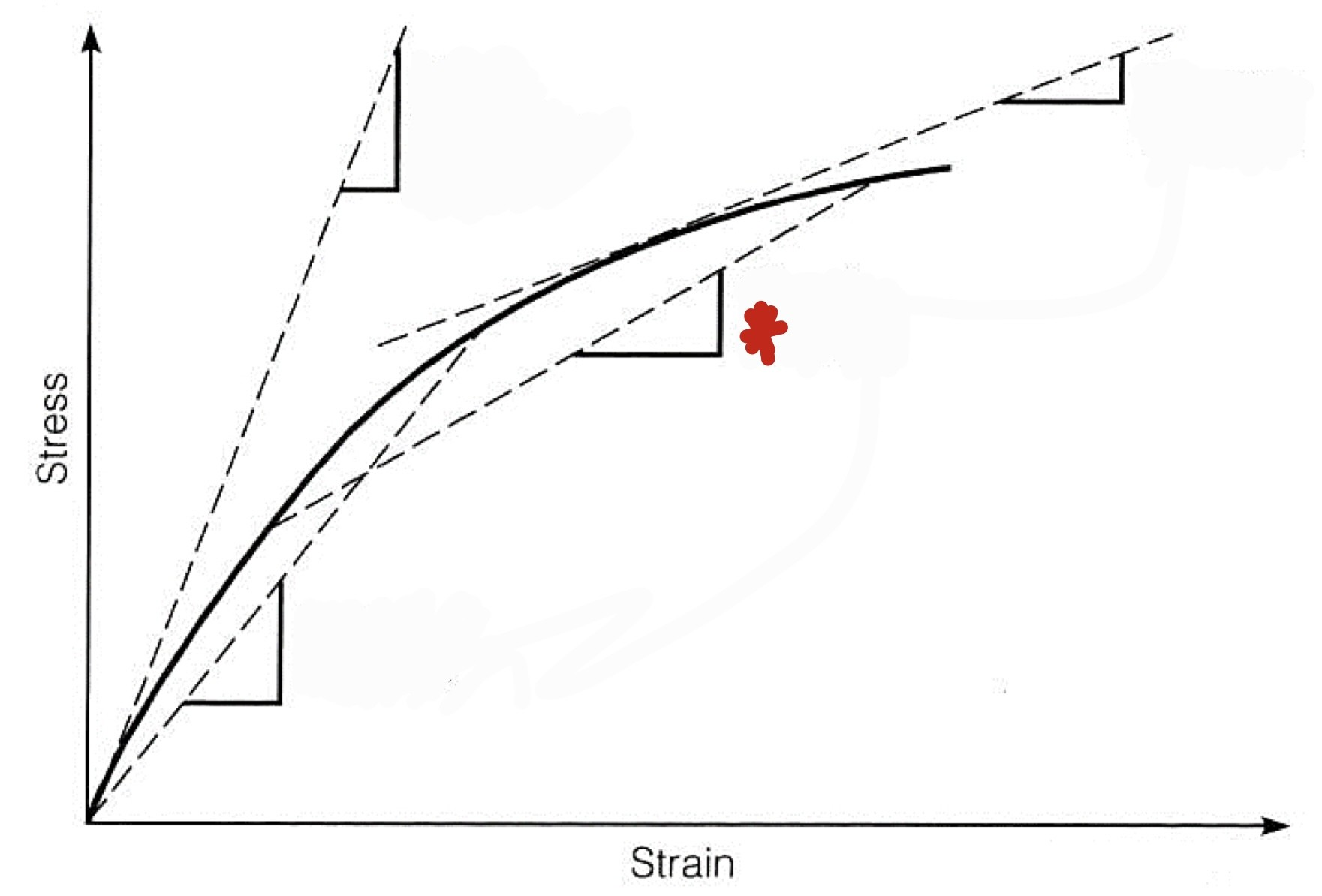
What approximating modulus is used in the graph?
Chord modulus
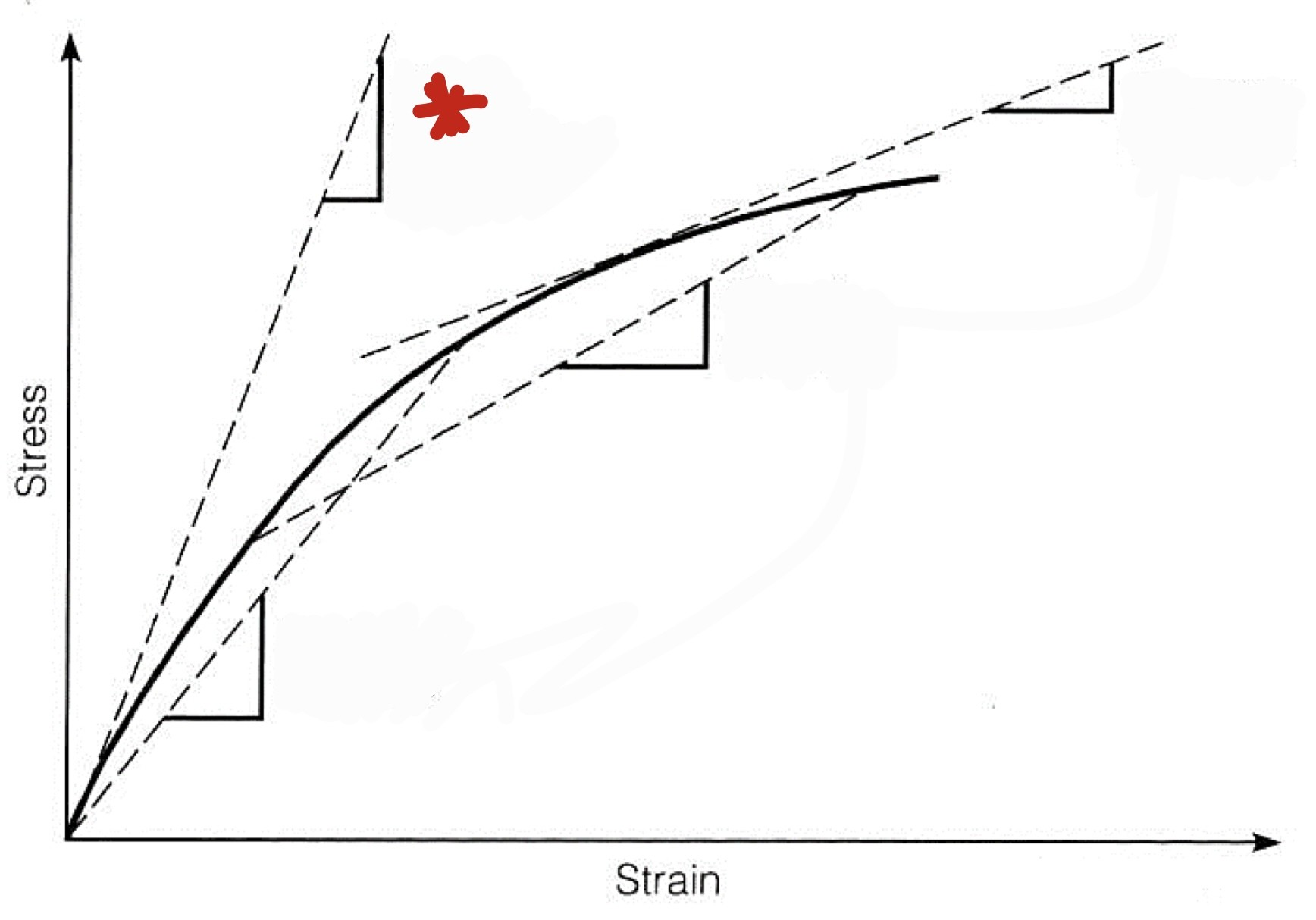
What approximating modulus is used in the graph?
Initial tangent modulus
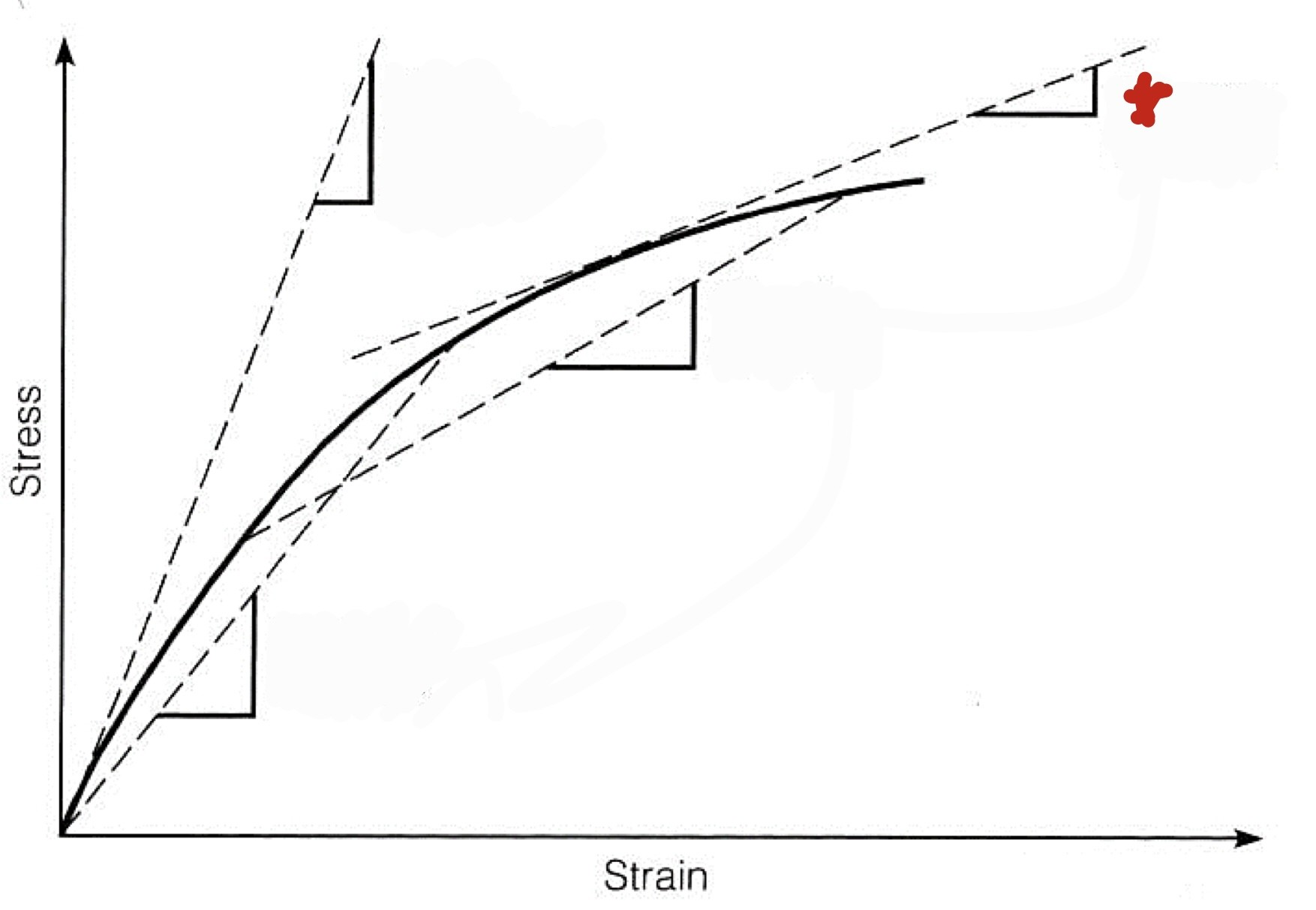
What approximating modulus is used in the graph?
Tangent modulus
Definition of yield point when not well defined
0.2% offset method and 0.5% extension method
Viscosity
resistance to flow/shear force
Viscoelastic Materials
Have both elastic and viscous response and have a delayed response
On what depends the deformation on viscoelastic materials
duration of load
rate of loading
temperature
Creep
long-term deformation under constant load
Rheological models
combination of elements used to model mechanically the time-dependent behavior of materials
Types of failure
fracture, fatigue, buckling, yielding, excessive deformation
Safety Factor
Base on how well certain values are known
Example of nonmechanical properties
unit weight, density, specific gravity, surface roughness, absorption, permeability, porosity
Surface Characteristics
Corrosion and Degradation
Abrasion and Wear resistance
Surface texture
Corrosion and degradation
Deterioration over time
Depends on the material characteristics
Abrasion and Wear Resistance
Important in moving parts
Mostly for pavements (aggregates)
Surface texture
Smooth or rough textures
Fatigue
Ocurre en siglos dependiendo la densidad de la carga
Buckling
Ocurre por debajo del esfuerzo de ruptura. Depende de la rigidez de la seccion
Yielding
Articulacion plastica
Excessive deformation
hay mucho desplazamiento
Three sources of variance:
material, sampling, testing
Error vs Blunder
error means something donde incorrectly and blunder is a careless mistake often unnecessarily
Precision
measure many times and get same result
Bias
Tendency to deviate in one direction from true value
Accuracy
close to true value; absence of bias