Human Movement Exam 2
 Call Kai
 Learn
 Practice Test
 Spaced Repetition
 Match
 Flashcards
 Knowt Play
1/647

There's no tags or description
Looks like no tags are added yet.
Name | Mastery | Learn | Test | Matching | Spaced | Call with Kai | Chat |
|---|
No analytics yet
Send a link to your students to track their progress
648 Terms
Talocrural Joint
pronation
supination
pronation
Dorsiflexion (maximum 15-25°)
Abduction (small)
Eversion (small)
supination
Plantarflexion (maximum 40-55°)
Adduction (small)
Inversion (small)

Extensor carpi radialis longus OIAN
O: lateral supracondylar ridge
I: base 2nd metacarpal
A: extension and radial deviation of wrist
N: radial n

Extensor carpi radialis brevis OIAN
O: Lateral epicondyle of humerus
I: posterior aspect base of 3rd MCP
A: extends fingers and abducts hand
N: Radial n

Supinator OIAN
Origin:
- Lateral epicondyle of humerus and ulna
Insertion:
- Lateral surface of proximal third of radius
Action:
- Supinates forearm
innervation
-radial nerve

extensor digitorum OIAN 1
O: lateral epicondyle of humerus,
I:distal phalanges of fingers 2-5
action: extends digits 2-5
innervation: radial nerve

extensor digiti minimi OIAN
Origin: Lateral Epicondyle of Humerus
Insertion: Proximal Phalanx of Digit Five
action: extends 5th digit
innervation: radial nerve
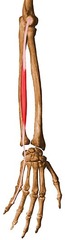
extensor carpi ulnaris OIAN
Origin: Lateral epicondyle of humerus
Insertion: Base of 5th metacarpal
action: wrist extension, ulnar deviation
innervation: radial nerve

Abductor pollicis longus OIAN
Origin: Posterior surface of ulna and radius; interosseous membrane
insertion: base of first metacarpal
action: abducts and extends thumb
innervation: radial nerve

Extensor pollicis brevis OIAN
O: posterior surface of radius and interosseous membrane
I: base of proximal phalanx of thumb
action: extends proximal phalanx of thumb
innervation: radial

Extensor pollicis longus OIAN
O: Posterior surface of ulna and interosseous membrane
I: Base of distal phalanx of thumb
action: extends distal phalanx of thumb
innervation: radial

Extensor indicis OIAN
Origin: posterior surface of ulna; interosseous membrane
Insertion: Extensor expansion of index finger
action: extends index finger
innervation: radial nerve

Flexor digitorum superficialis OIAN
O: Medial epicondyle, coroNoid process and radius
I: Middle phalanx of digits 2-5
A: MCP and PIP flexion, assists wrist flexors
N: MEdian (C7-T1)

Flexor carpi radialis OIAN
O: Medial epicondyle of humerus
I: Base of 2nd and 3rd metacarpals
A: Wrist flexion, radial deviation
N: Median nerve (C6-7)`
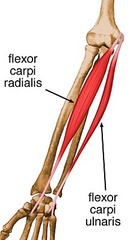
Flexor carpi ulnaris OIAN
O: Medial epicondyle of humerus
I: Pisiform and base of 5th metacarpal
A: Wrist flexion, ulnar deviation
N: Ulnar nerve (C8, T1)

palmaris longus OIAN
O: Medial epicondyle of humerus
I: Palmar fascia
A: Assists in wrist flexion
N: Median nerve (C6-7)

flexor digitorum profundus OIAN
O: proximal anterior ulna and interosseous membrane
I: DIPs 2-5
A: flexes DIPs and hand
N: MEDIAN AND ULNAR

flexor pollicis longus OIAN
O:anterior surface of radius and interosseous membrane
I: base of distal phalanx of thumb
A: flexion of thumb, flexion of wrist
N: median

pronator quadratus OIAN
O: Distal 1/4 of ulna
I: Distal 1/4 of radius
A: Forearm pronation
N: Median nerve (C8, T1)

4 articulations within the elbow and forearm complex
•Humero-ulnar joint
•Humeroradial joint
•Proximal radio-ulnar joint
•Distal radio-ulnar joint

capitulum (of humerus) articulates with
head of radius
put a cap on the radius
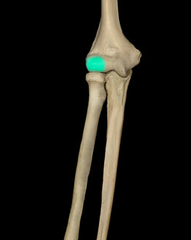
trochlea articulates with
trochlear notch of ulna

medial epicondyle, insertion site of
common flexor-pronator tendon

lateral epicondyle, insertion site of
common extensor- supinator tendon

radial fossa of humerus
small lateral depression; receives the head of the radius when the forearm is flexed
-above the capitulum

coronoid fossa of humerus
anterior depression that receives the coronoid process of the ulna when forearm is flexed.

olecranon fossa (humerus) articulates with
olecranon process of ulna
-posterior side of humerus

Trochlea, articulate with
trochlear notch (of ulna)
has a lateral lip, medial lip, trochlea groove in the middle
sulcus for ulna nerve

Elbow osteology
humerus (coronoid fossa, trochlea, radial fossa, capitulum)
radius (head of radius)
ulna (coronoid process)

Elbow Osteology: Radius and Ulna
Radial notch
Trochlear notch
Ulna tuberosity, insertion site of brachialis
Radial tuberosity, insertion site of biceps brachii
Fovea (of radius) , articulate with capitulum

Ulna tuberosity, insertion site of
brachialis

Radial tuberosity, insertion site of
biceps brachii

Fovea, articulate with
capitulum

Elbow Osteology: Ulna
Olecranon process
Coronoid process
Radial notch
Supinator crest

Olecranon, insertion site of
triceps brachii

Joints of the Elbow and Forearm
•Humero-ulnar joint
•Pretty stable due to the tight fit between the trochlea and trochlear notch
•Humeroradial joint
•Less congruous joint surface, requires many capsuloligamentous connective tissue for stability
•Proximal radio-ulnar joint
•Distal radio-ulnar joint

which joint is more stable? humeroulnar or humeroradial
humeroulnar
•Pretty stable due to the tight fit between the trochlea and trochlear notch
•Humeroradial joint is Less congruous joint surface, requires many capsuloligamentous connective tissue for stability
Humero-Ulnar Joint
•Hinge joint (Modified...)
•Flexion/extension ONLY ??
Almost a hinge joint but it can do radial and ulnar deviation too, pronation, supination

Humeroradial Joint - what type of joint?
•Pivot Joint
•Door knob
•Spinning of one member around a single axis of rotation
•Flexion/extension
•Concave radial head vs convex capitulum
Spinning movement for pronation and supination

Axis of Rotation of the Elbow
Axis of rotation is going through _____ and __________
•Axis of rotation is going through trochlea and capitulum
Medial lip of the trochlea extends more distally
this axis is Not exactly perpendicular to long axis (axis for flexion and extension)

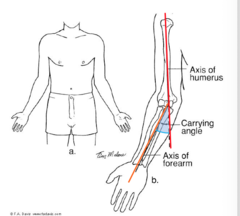
Carrying Angle
The angle between the humerus and ulna when the arm is in anatomical position.
•Normal cubitus valgus (Extended elbow)
Axis of humerus to long axis of forearm: carrying angle
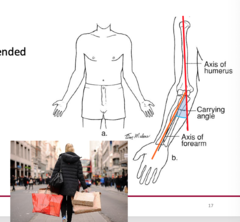
carrying angle: Axis of ________ to long axis of ___________
humerus
forearm
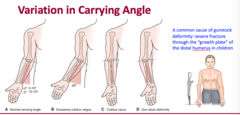
Variation in Carrying Angle
A. normal carrying angle (Female has a larger carrying angle 10-15 degrees and males 5-10 degrees)
B. excessive cubitus valgus 30 degrees
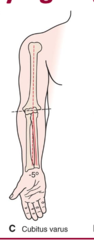
C. cubitus varus -5 degrees
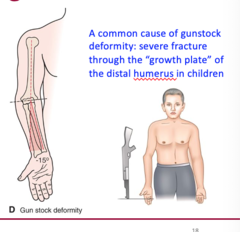
D. gun stock deformity -15 degrees
A common cause of gunstock deformity: severe fracture through the "growth plate" of the distal humerus in children
who has larger carrying angle? men or women?
women!
women typically have 10-15 degrees
men typically have 5-10 degrees
A. normal carrying angle
Variation in Carrying Angle
(Female has a larger carrying angle 10-15 degrees and males 5-10 degrees)

B. excessive cubitus valgus
Variation in Carrying Angle
30 degrees

C. cubitus varus
Variation in Carrying Angle
-5 degrees
D. gun stock deformity
Variation in Carrying Angle
-15 degrees
A common cause of gunstock deformity: severe fracture through the "growth plate" of the distal humerus in children
connective tissues of the elbow
•Thin articular capsule
what 3 joints does it surround?
what is it strengthened by?
•surrounds the humero-ulnar, humeroradial, and proximal radio-ulnar joints
•strengthened by collateral ligaments (lateral collateral ligament and medial collateral ligament)
Capsule surrounds 3 joints- with synovial fluid inside

Medial Collateral Ligament (MCL) of elbow
what other name does it go by?
•Aka. Ulnar collateral ligament (UCL)

Medial Collateral Ligament (MCL)
discuss the different fibers
•Anterior fibers
•Strongest and stiffest of the MCL
•Provide most significant resistance against a valgus producing force
•Resist valgus throughout the full range of flexion and extension
•Posterior fibers
•Resist valgus-producing force in the extremes of elbow flexion
•Transverse fibers
•Attachment sites on the same bone
•Limited function
•Olecranon to ulna (doesn't provide joint resistance)

•Anterior fibers of MCL (elbow)
•____________ and ___________ of the MCL
•Provide most significant resistance against a ________ producing force
Strongest and stiffest
valgus
•Resist valgus throughout the full range of flexion and extension
goes from humerus to ulna

•Posterior fibers of MCL
•Resist ____________-producing force in the extremes of elbow _____________-
valgus
flexion
goes from humerus to ulna

•Transverse fibers
•Attachment sites on the _________ bone from ______ to __________
•Limited function
(does or does not) provide joint resistance?
same
•Olecranon to ulna (doesn't provide joint resistance)

MCL injury
which 2 are most common?
•Falling onto an outstretched and supinated arm
•Medial collateral ligament (most likely the anterior fibers) injury
•Compression of humeroradial joint --> fracturing radial head
•Repetitive stretching of the ligament
•Elite level baseball pitcher
•MCL reconstruction --> Tommy John surgery
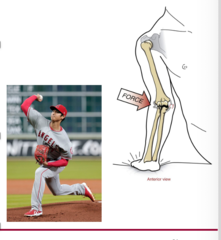
MCL injury
•Falling onto an outstretched and supinated arm
•Medial collateral ligament (most likely the ______________ fibers) injury
•Compression of ____________ joint --> fracturing __________ head
anterior
humeroradial
radial
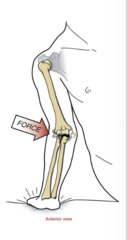
MCL injury
•Repetitive stretching of the ligament
•Elite level baseball pitcher
•MCL reconstruction --> _____________surgery
Tommy John

Lateral Collateral Ligament (LCL) Complex is made of which two ligaments?
•Radial Collateral Ligament
•Merge with annular ligament
•Resist varus-producing force
•Lateral Ulnar Collateral Ligament
•Thicker
•Attaching to supinator crest (on ulna)
•Resist varus-producing force
•Most taut at full flexion (due to relative posterior location)
•Together with anterior fibers of the MCL --> primary frontal plane stability

Lateral Collateral Ligament (LCL) Complex
•Radial Collateral Ligament
•Merge with _________ ligament
•Resist ___________ -producing force
annular
varus

Lateral Collateral Ligament (LCL) Complex
•Lateral Ulnar Collateral Ligament
•(Thicker or thinner )than radial collateral ligament?
•Attaching to __________ crest (on ulna)
•Resist ________-producing force
•Most taut at full ___________ (due to relative posterior location)
•Together with anterior fibers of the MCL --> primary _________ plane stability
thicker
supinator crest
varus
full flexion
frontal plane

which two ligaments provide primary frontal plane stability of the elbow joint
anterior fibers of the MCL
lateral ulnar collateral ligament of lateral collateral ligament complex
in the Lateral Collateral Ligament (LCL) Complex which is thicker? the radial collateral ligament or the lateral ulnar collateral ligament?
lateral ulnar collateral ligament

medial collateral ligament (anterior fibers)
motions that increase tension
valgus
extension (anterior components)
flexion (posterior components
medial collateral ligament (posterior fibers)
motions that increase tension
valgus
flexion
radial collateral ligament
motions that increase tension
varus
lateral (ulnar) collateral ligament
motions that increase tension
varus
external rotation of the elbow complex
flexion
annular ligament
motions that increase tension
distraction of the radius
Valgus
Outward angulation of the distal segment of a bone or joint, as in knock-knees

Varus
Inward angulation of the distal segment of a bone or joint, as in bowlegs

axis of rotation of the forearm
•The axis of rotation of the forearm passes through the head of the _________ and the head of the _________
•The radius and hand rotates and crosses over an essentially fixed ________ during pronation (reverse movement during supination)
head radius and head of ulna
ulna

Proximal Radio-ulnar Joint
which parts are concave or convex?
convex radial head articulates with concave radial notch on ulna

Connective Tissues of Proximal Radio-ulnar Joint
•____________ ligament
Limits distraction of proximal radioulnar joint
Annular
Annular ligament holds radius head- stabilize

annular ligament
•Holds the proximal _______ against the ulna
•Internal surface is lined with _________ to reduce friction during pronation and supination
•External surface receives attachments from ____________, ________________, and _______________
radius
cartilage
elbow capsule, radial collateral ligament, and supinator muscle
Annular ligament is like a belt- holding radius head against ulna
Ring: annular ligament and radial notch does the rest of the ring

distal radioulnar joint
which parts are convex or concave?
convex ulnar head articulates with concave ulnar notch on radius

Connective Tissues of Distal Radio-ulnar Joint
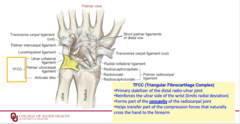
Triangular fibrocartilage complex (TFCC) (in ulnarcarpal space)
•Primary stabilizer of distal radio-ulnar joint
1.Triangular fibrocartilage disc (TFC)
2.Palmar capsular ligament
3.Dorsal capsular ligament

•Primary stabilizer of distal radio-ulnar joint
1, 2, 3
1.Triangular fibrocartilage disc (TFC)
2.Palmar capsular ligament
3.Dorsal capsular ligament
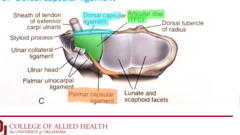
Triangular Fibrocartilage Complex (TFCC)
•Primary ____________ of the distal radio-ulnar joint
•Reinforces the _________ side of the wrist (limits radial deviation)
•Forms part of the __________ of the radiocarpal joint
•Helps transfer part of the compression forces that naturally cross the hand to the forearm
stabilizer
ulnar
concavity
•TFC, the articular disc, follows the moving radius during pronation & supination
disc is distal to ulnar head
Palmar- disc- dorsal
Interosseous Membrane Structure
•Structure
•Central band - twice the thickness of other fibers, large tensile strength
•Oblique cord
•Distal oblique fibers

central band of interosseous membrane
•Central band - ____________ the thickness of other fibers, large tensile strength
twice

Interosseous Membrane Functions
•Functions
•Binds the radius to the ulna
•Serves as a stable attachment site for several extrinsic muscles of the hand
•Provides a mechanism for transmitting force proximally through the upper limb

•Compression force at the wrist
•The compression force transmitted primarily through the ______________ joint to the __________
•Pull the central band ___________
•(interosseous membrane ) Transfers force to ulna
•Humero-ulnar joint
•Shoulder
radiocarpal joint to the radius
taut

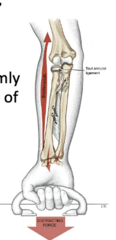
•Distracting force at the wrist (carrying a suitcase)
•____________the central band
•_________ the oblique cord, annular ligament
•Contraction of the brachioradialis assist holding the radius firmly against the ____________ of the humerus
Slack
Taut
capitulum
Arthrokinematics of Humero-Ulnar Joint
extension/flexion which tissues are pulled taut and which are slacked
extension
What tissues are pull taut? flexors, anterior capsule
What tissues are slack? extensors, posterior capsule
flexion
What tissues are pull taut? extensors, posterior capsule
What tissues are slack?flexors, anterior capsule

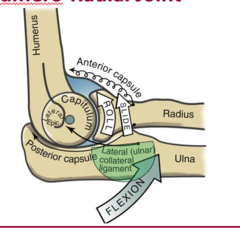
Arthrokinematics of Humero-Radial Joint
flexion which are taut and which are slacked
Flexion
What tissues are pull taut? posterior capsule, lateral (ulnar) collateral ligament
What tissues are slack? anterior capsule
Pronation and Supination
•The ____________ and hand rotates around an essentially fixed __________ during pronation and supination
•Require simultaneous movement at the
• _____________________ joint
• _____________________joint
• _____________________joint
radius
ulna
Proximal radio-ulnar joint
Distal radio-ulnar joint
Humeroradial joint

Arthrokinematics During Supination
Distal radio-ulnar joint
•___________ ulnar notch of the radius (relative mobile)
•______________ head of ulna (relative fix)
•Roll and glide in the __________ direction
•_________________ capsular ligament is pulled taut at end range --> enhance stability
Concave
Convex
same (concave on convex)
Palmar

Arthrokinematics During Supination
•Proximal radio-ulnar joint
•_______________ rotation of proximal radius due to the constraint of the fibro-osseous ring (annular ligament and radial notch on the ulna)
External
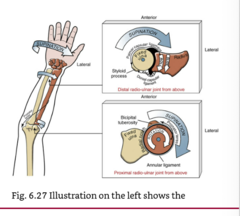
Arthrokinematics During Pronation
Distal radio-ulnar joint
•_______________ ulnar notch of the radius (relative mobile)
•_____________ head of ulna (relative fix)
•Roll and glide in_______ direction
•_____________capsular ligament is pulled taut at end range ---> enhance stability
Concave
Convex
same (concave on convex)
Dorsal

Arthrokinematics During Pronation
•Proximal radio-ulnar joint
•____________ rotation of proximal radius due to the constraint of the fibro-osseous ring (annular ligament and radial notch on the ulna)
Internal

Humero-Radial Joint During Pronation
•A spin of the fovea of the radial head against the __________ of the humerus
Contraction of _______________ generate compression force on the humero-radial joint (especially when elbow at extension)
capitulum
pronator teres

Functional Consideration of Pronation and Supination
•Can be compensated through movements of the ________________
shoulder

Dislocation of the Proximal Radio-Ulnar Joint
•The "pulled-elbow" syndrome
•More common in young children due to
•Ligamentous laxity
•A non-ossified radial head
•Relative reduced strength and slowed reflexes
•↑likelihood of others forcefully pulling on their arms

elbow flexors
•Biceps brachii
•Flexion
•Supination
•Brachialis
•Largest PCSA --> generate largest force
•Brachioradialis
•Longest moment arm for elbow flexion
•Pronator teres

elbow flexor with the
Largest PCSA --> generate largest force
•Brachialis
•Longest moment arm for elbow flexion
Brachioradialis

elbow extensors
•Triceps brachii
•Long head
•Lateral head
•Medial head
•Anconeus
•Mostly slow-twitch fiber (durable type I fibers), provide "background" joint stability

Muscle substitution
•For patient with C6 tetraplegia:
•Loss of motor and sensory function below C6 nerve root level (may lose ability to extend the elbow joint)
•Proximal shoulder muscle (i.e. pectoralis major and/or anterior deltoid) may be used to "extend" the elbow by "locking" the joint.

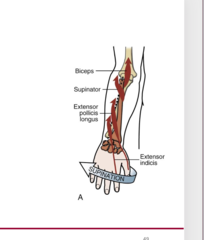
forearm supinators
primary?
secondary?
primary supinators
supinator
biceps brachii
secondary supinators
•Extensor pollicis longus
•Extensor indicis
•Brachioradialis (from a pronated position)
forearm pronators
primary?
secondary?
primary pronators
pronator teres
pronator quadratus
secondary pronators
flexor carpi radialis
palmaris longus
brachioradials (from a supinated position)

brachioradialis
forearm supinator or pronator? or both? or neither?
is a forearm supinator from a pronated positions
is a forearm pronator from a supinated position

Pronator Teres
forearm pronator
•Also an elbow flexor
e.g.unscrew an overtightened screw
