Physics - Heat transfer
 Call Kai
 Learn
 Practice Test
 Spaced Repetition
 Match
 Flashcards
 Knowt Play
1/23

There's no tags or description
Looks like no tags are added yet.
24 Terms
How can thermal energy transfer take place?
By conduction, convection or radiation
What is conduction?
The transfer of heat through a substance
What does conduction mainly happen in?
Metals because they contain free electrons which helps the heat travel faster
What is a conductor?
A substance or material that allows heat to flow e.g. a metal frying pan or a radiator
What is an insulator?
A substance or material which does not readily allow the passage of heat e.g. a wooden spoon or oven gloves
Conduction in non-metals
If heat energy is supplied to one part of a solid, the atoms vibrate faster. As they vibrate more, the bonds, between the atoms are shaken more. This passes vibrations through onto the next atom and so on until the energy eventually spreads throughout the solid. The overall temperature increases.
Conduction in metals
They are good conductors of heat so the atoms vibrate more when heated. The free electrons carry charge around as well. These transfer the energy much faster than just vibrations in bonds.
Why are liquids poorer conductors of heat than solids?
The particles in liquids are further apart than those in solids. Therefore heat cannot pass on easily in liquids
Why are gases the poorest conductors?
The particles are very far apart
What is a vacuum?
A space where there are no particles. If there are no particles to pass on the vibrations (and hence heat) by conduction, it is the perfect insulator of heat.
What is convection?
It is a process where heat is transferred through the movement of fluid (liquid or gas)
Convection diagram
Moves in a circular motion
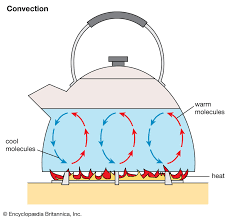
What is radiation?
The transfer of heat energy from a region of high temperature to a region of low temperature using infra-red radiation
What does radiation travel by?
Electromagnetic waves
What does radiation not need?
Particles so can work through a vacuum
What is a our planet’s most important source of thermal radiation?
The sun
Things convection is used for
Radiators heating rooms, cooking food, weather patterns, ocean currents and movement of tectonic plates
What do hotter objects do?
Emit more radiation and therefore emit more visible light
Shiny and / or white surfaces
Poor absorbers and emitters of radiation
Dark and / or matte surfaces
Better absorbers and emitters of radiation
Practicals for conduction
Heat a boiling tube with ice cover by a gauze and water in it.
Heat one end of a piece of metal and count how long it takes to feel the heat
Holding a match closer and closer to a Bunsen burner until it catches flame

Practicals for convection
Square glass tube with purple dye
Smoke box experiment
Online sea breeze animation experiment

Practicals for radiation
Leslie’s cube

Preventing heat transfers
Rubber stopper and glass walls = good insulators which reduces conduction
Vacuum has no particles so both conduction and convection can’t take place
Rubber stopper stops hot air rising, which reduces convection
Shiny silvered walls = poor absorbers and emitters of radiation so reflects rays back and emits less rays outwards so reduces radiation
