Cramming again b/c it worked :)
 Call Kai
 Learn
 Practice Test
 Spaced Repetition
 Match
 Flashcards
 Knowt Play
1/25

There's no tags or description
Looks like no tags are added yet.
26 Terms
When is insulin used/AEs
Type 1 diabetes: required b/c insulin deficiency
Type 2 diabetes: required when glucose control is inadequate with other medications or when insulin requirements are high
Acute severe hyperglycemia and diabetic emergencies
AEs: hypoglycemia, weight gain, lipohypertrophy/atrophy at injection sites, worsening of diabetic retinopathy with rapid changes in glucose
Rapid-acting insulin
Lispro
Aspart
Glulisine
Afrezza (fastest, inhaled)
Used for mealtime/postprandial glucose control (pt needs insulin immediately before a meal)
Short-actin insulin
Regular insulin (humulin R, novolin R)
Mealtime coverage, IV for certain emergencies
Intermediate insulin
NPH (Humulin N or Novolin N)
Intermediate basal coverage
Long-acting insulin
Glargine
Detemir
Basal insulin coverage
Ultra-long acting insulin
Degludec
Glargine U300
Extended basal coverafe
Sulfonylureas (drugs, MOA, when used, AEs, contraindications)
Glipizide, Glyburide, Glimepiride, Chlorpropamide (1st gen rarely used)
Bind to pancreatic beta cells, close potassium channels (depolarizing cell, opening calcium channels and stimulating insulin release)
T2DM to increase insulin secretion
AEs: hypoglycemia, weight gain, GI upset, hypersensitivity rxns
Use caution with renal/hepatic impairment, G6PD deficiency
Meglintinides (drugs, MOA, when used, AEs)
Repaglinide, nateglinide
Close potassium channels on pancreatic beta cells, stimulating insulin secretion
Used when pt needs help controlling post-meal glucose or flexible dosing around meals, rapidly absorbed, peak conc/half life 1 hour, taken before meals (pt has predominantly postprandial hyperglycemia)
AEs: hypoglycemia (less than sulfonylureas), weight gain, frequent dosing required
Biguanides (drugs, MOA, when used, AEs, contraindications)
Metformin
Primary effect= decreases hepatic gluconeogenesis, increases peripheral insulin sensitivity, increases glucose uptake and utilization, decreases intestinal glucose absorption
Used for T2DM when pt is overweight, does not directly stimulate insulin release (preserves beta cells)
AEs: GI problems, decreased vitamin B12 absorption (signs: fatigue/anemia), lactic acidosis, NO HYPOGLYCEMIA/WEIGHT GAIN
Contraindications: eGFR below 30, metabolic acidosis, significant hepatic impairment, excessive alcohol consumption, unstable or acute heart failure
Thiazolidinediones (TZDs) (drugs, MOA, when used, AEs, contraindications)
Pioglitazone, rosiglitazone
Activates PPAR gamma nuclear receptors, altering gene expression, improving insulin sensitivity in adipose tissue, liver, and muscle
Used for T2DM with insulin resistance when pt needs increased sensitivity rather than insulin secretion, preserves beta-cell function
AEs: weight gain/edema, heart failure, increased fracture risk, hepatic toxicity, macular edema, NO HYPOGLYCEMIA
Contraindications: heart failure, hepatic impairment, ALT>2.5 x upper limit
GLP-1 receptor (drugs, MOA, when used, AEs, contraindications)
Exenatide, liraglutide, dulaglutide, semaglutide, lixisenatide, tirzepatide (GIP/GLP-1)
Increases glucose dependent insulin secretion, decreases glucagon/slows gastric emptying, decreasing appetite
Used for T2DM with obesity, causes weight loss, low hypoglycemia risk, improves fasting and postprandial glucose
AEs: GI upset, pancreatitis, acute kidney injury associated with dehydration, medication absorption changes, thyroid C-cell tumors
Avoid with hx of medullary thyroid carcinoma
DPP-4 inhibitors (drugs, MOA, when used, AEs, contraindications)
Sitagliptin, saxagliptin, linagliptin, alogliptin
Inhibit DPP-4, which breaks down incretins such as GLP-1, increases glucose-dependent insulin secretion, decreases glucagon
Weight-neutral, low hypoglycemia risk, well tolerated, linagliptin does not require renal dose adjustment
AEs: modest A1c reduction, pancreatitis, heart failure, renal dose adjustments
Alpha-glucosidase inhibitors (drugs, when used, AEs, contraindications)
Acarbose, miglitol
Inhibit alpha glucosidase enzymes in intestinal brush border, delaying carbohydrate breakdown and absorption
Used for pts with elevated postprandial glucose, carbohydrate absorption needs to be slowed
AEs: GI upset, transaminase elevation
Contraindications: bowel disorders, renal/hepatic impairment, medication absorption impacts
Amylin/pramlintide (when used, AEs, contraindications)
Pramlintide= amylin analog, injection
Mimics amylin, normally co-secreted with insulin by pancreatic beta cells, decreases glucagon, slows gastric emptying, increases satiety
Used for additional postprandial control in T1 or T2 diabetics
AEs: nausea and vomiting, hypoglycemia
SGLT-2 inhibitors (drugs, when used, AEs)
-gliflozins
Block sodium-glucose cotransporter in the proximal renal tubule increasing urinary glucose excretion
Used in T2DM with heart failure/chronic kidney disease, cause weight loss, lower blood pressure, low hypoglycemia risk
AEs: yeast infections, UTIs, dehydration, hypotension, acute kidney injury, diabetic ketoacidosis
Pt presentation correlations just read

Pituitary adenomas
Lactotroph: produces excess prolactin (MOST COMMON) → amenorrhea and galactorrhea, often microadenoma in premenopausal women
Somatotroph: produces excess GH → acromegaly in adults, gigantism in children
Corticotroph: produces excess ACTH → cushing disease
Gonadotroph: produces excess FSH/LH → no distinct hormone-excess syndrome
Hypopituitarism
Causes: nonfunctioning pituitary adenoma, ischemic necrosis, sheehan syndrone, empty sella syndrone, and inflammatory lesions, trauma or metastatic tumors
Presentation: fatigue, weight loss, decreased libido, cold intolerance, anemia, infertility, menstrual irregularities/absent menstruation, loss of hair, failure to lactate
Diabetes insipidus (DI)
Posterior pituitary disorder
Central= insufficient ADH production/release, causes excessive urination/dilute urine
Nephrogenic= ADH is present but kidneys are not responding appropriately to it
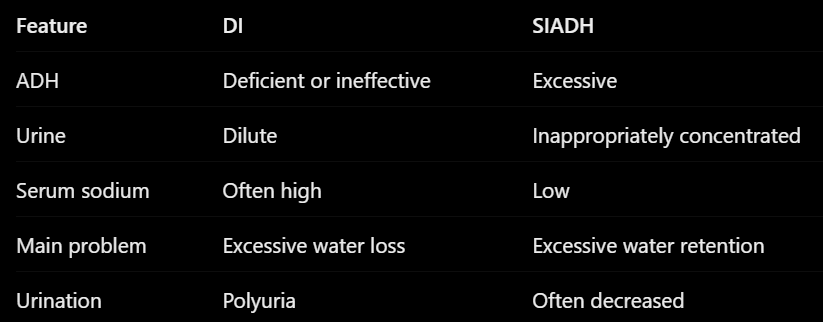
SIADH
Excess ASH release regardless of serum osmolality
Causes water retention and dilutional hyponatremia
Ectopic ADH production from small cell lung carcinomas can cause

Hyperthyroidism
Findings: weight loss, tachycardia, heat intolerance, muscle weakness
Primary= low TSH, high T4, secondary= high TSH, high T4
Grave’s disease= most common cause, includes goiter and eye findings, IgG autoantibodies stimulate TSh receptor
Hypothyroidism
Findings: weight gain, cold intolerance, lethargy, enlarged tongue
Primary= high TSH, low T4, secondary= low TSH and T4
Hashimoto= most common cause, autoantibodies interfere with thyroid function
Causes cretinism in children
Thyroid tumors
Follicular adenoma: benign encapsulated painless cold nodule
Follicular carcinoma: capsular or vascular invasion, spreads to lungs and bones through blood
Papillary carcinoma: most common thyroid cancer, nuclear grooves, pseudoinclusions, psammoma bodies, lymphatic spread, younger patients, radiation exposure
Medullary carcinoma: c-cell origin, produces calcitonin, associated with MEN 2A and 2B
Anaplastic carcinoma: aggressive, rapidly growing neck mass, typically found in older patients
Normal PTH actions
Increases serum calcium (increases reabsorption in kidney and bone turnover)
Decreases phosphate reabsorption in the kidney
Increases vitamin D activation n kidney
Hyperparathyroidism
Primary:
Inappropriately high PTH relative to serum calcium, most commonly caused by a parathyroid adenoma (can also be hyperplasia or carcinoma)
Causes renal stones, bone abnormalities, neuromuscular symptoms, and hypercalcemia
Shows high PTH and high calcium
Secondary:
Increased PTH due to chronic hypocalcemia, most commonly associated with chronic renal failure or calcium/vitamin D deficiencies
Kidney-related disturbance in calcium/phosphate/vitamin D drives increased PTH
Hypoparathyroidism/pseudoparathyroidism
Caused by thyroid/neck sx, congenital absence of parathyroid glands, DiGeorge syndrome, or autoimmune disease
Low calcium, high phosphate, low PTH
Tetany, paresthesias, convulsions, laryngospasm, positive chvostek and trousseau signs, cataracts and dental abnormalities may occur
pseudo: PTH is elevated but body is resistant to effects, high PTH, low calcium, high phosphate, short stature