Newborn care & Nutrition Ch 17 & 18
 Call Kai
 Learn
 Practice Test
 Spaced Repetition
 Match
 Flashcards
 Knowt Play
1/5

There's no tags or description
Looks like no tags are added yet.
6 Terms
What is the transition that is occuring in the first minutes of life?
Transitining to extrauterine life
Respiratory: Lung fluid clears; effective breathing expands alveoli and increases oxygenation.
Circulatory: Pulmonary resistance falls; fetal shunts begin physiologic closure.
Thermal/metabolic: Heat loss rises immediately; energy and glucose needs increase. → if baby is cold this can lead to glucoise drop as they have to use energy to keep them warm
What are the components of APGAR?
Record at 1 and 5 minutes; continue per protocol if low.
Appearance; Color: 0 blue/pale; 1 blue extremities(acrocyanosis); 2 pink overall.
Pulse; Heart rate: 0 absent; 1 below 100/min; 2 at least 100/min.
Grimace; Reflex response: 0 absent; 1 grimace; 2 active cry/withdrawal.
Activity; Tone: limp/flexed/active.
Respiration; Breathing: absent/slow or irregular/strong cry

What are the immediate nursing priorities of a newborn?
Standard care follows the infant’s clinical status and local protocol.
Assess respirations and heart rate; escalate apnea, gasping, or poor perfusion.
Dry promptly; use warm blankets, a hat when appropriate, and skin-to-skin if stable.
Support early parental contact and feeding; avoid unnecessary separation.
Verify identification and security measures with the family.
Administer indicated prophylaxis and complete ongoing transition assessments.
Vit K & erythomycin given at birth; for coagulation & treatment of bacteria that may have been contracted in birth canal
What are the appropiate vitals of a newborn?
Respirations: Approximately 30–60/min; assess rate for a full minute, effort, and breath sounds.
Heart rate: Often around 110–160/min; varies during sleep, crying, and transition.
Temperature: Target normal axillary temperature roughly 36.5–37.5°C (97.7–99.5°F).
Perfusion: Assess central color, capillary refill, pulses, activity, and feeding
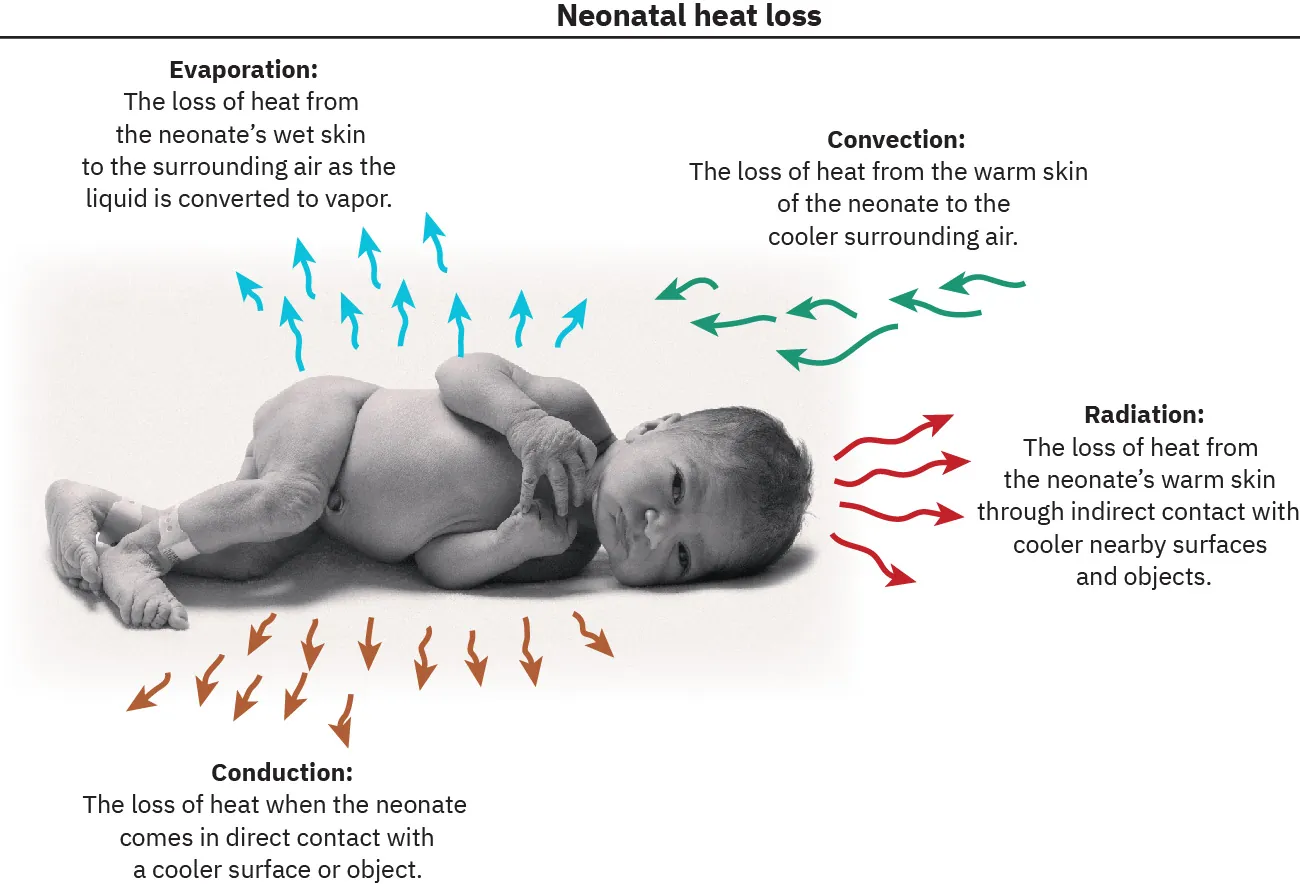
What are the four routes of newborn heat loss?
Evaporation; Wet skin after birth → dry immediately and remove damp linen.
Conduction: Contact with a cold scale or surface → warm contact surfaces.
Convection; Drafts or cool air → minimize exposure and keep room appropriately warm.
Radiation; Cold nearby wall/window → move away from cold surfaces.
What is expected/observed in head to toe assessment of newborn?
Overall appearance: tone, symmetry, color, cry, growth measurements.
Head/neck: molding, caput vs cephalohematoma, fontanelles, palate, clavicles.
Capt when head is cone shaped, cephelohemotoma is collection of blood on head d/t ruptured blood vessels during birth
Clavicles can break during birth can’t cast it would imoblize arm or just not use that side to promote healing
Cardiorespiratory: work of breathing, heart sounds, femoral pulses, perfusion.
Abdomen and GU: cord, bowel sounds, genitalia, patent anus, urine/stool.
Immediatly after birth would not expect bowl sounds bc have not eaten yet
Genetalia may be swollen, female can have vaginal discharge, pseudomenses (from Moms hormones) or even mild from nipple (rare)
Teste may not have descended in male can happen would wait and see and if noit do sugery to bring them down
Want minimum 1 pee or poop within 24hrs
Musculoskeletal/neurologic: hips, spine, extremities, Moro, rooting, suck, grasp
Refluxes indicate the neurological system is working as it should