The Electron Transport Chain & Oxidative Phosphorylation
 Call Kai
 Learn
 Practice Test
 Spaced Repetition
 Match
 Flashcards
 Knowt Play
1/5

There's no tags or description
Looks like no tags are added yet.
6 Terms
Oxidative phosphorylation
Oxidative phosphorylation is the cellular metabolic process that uses energy released by the oxidation of nutrients—via the electron transport chain and chemiosmosis—to produce adenosine triphosphate (ATP). In eukaryotes, it takes place in the inner mitochondrial membrane.
How It Works
• Electron transport chain (ETC): Electrons from molecules like NADH and FADH₂ pass through a series of protein complexes to a final electron acceptor (typically oxygen, forming water).
• Proton gradient: Energy released during electron transfer pumps protons (H⁺) across the membrane, creating an electrochemical proton-motive force.
• Chemiosmosis & ATP synthesis: Protons flow back through the enzyme ATP synthase, driving the phosphorylation of ADP into ATP.
The electron transport chain
Oxidative phosphorylation happens in the inner membrane of the mitochondrion and uses an electron transport chain, which is a series of mitochondrial membrane proteins that sit in the inner membrane of the mitochondrion. We refer to these as protein complexes I-IV. These proteins bear a variety of prosthetic groups, which are non-protein components that give the protein its functionality, including flavin mononucleotides and cytochromes. There’s also a molecule that is not a protein, and it’s called ubiquinone, a small hydrophobic molecule that is mobile within the membrane, and is also known as Coenzyme Q, or CoQ.
1
Once NADH feeds electrons into the first component of complex I, these proteins facilitate a series of redox reactions shuttling electrons downhill from one component to another, with each structure down the chain having a higher affinity for electrons than the last.
2
This process does not generate ATP directly but a byproduct of this series of electron transfers is the generation of a proton gradient across the membrane. Protons accumulate outside of the inner mitochondrial membrane, which then go to power another protein complex called ATP synthase.
3: ATP synthase
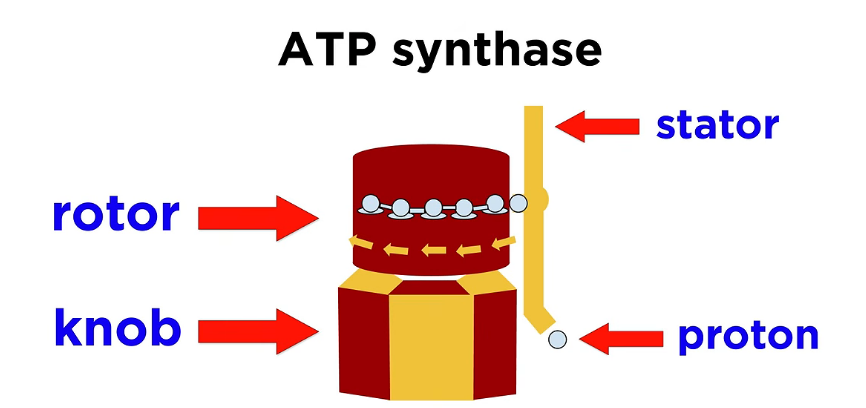
This is the component that synthesizes ATP. Because the proton concentration becomes greater in the intermembrane space, then in the mitochondrial matrix, the protons will spontaneously move with the gradient to re-enter the mitochondrial matrix, and the only route available is through ATP synthase. This process is called chemiosmosis, and because the gradient is able to do work through chemiosmosis, we also call this the proton-motive force, and it is these protons that power ATP synthase in phosphorylating ADP to generate ATP.
ATP synthase
Looks like a rotor, where individual protons can bind and cause it to spin in such a way that catalyzes phosphorylation of ADP, kind of like a stream of water turning a waterwheel, which can then power some other process. With the NADH and FADH2 that is generated from a single molecule of glucose, we can get around 26 or 28 ATP’s from this activity. So this is the pathway that generates the majority of cellular energy.