9.1 Membrane Lipids
 Call Kai
 Learn
 Practice Test
 Spaced Repetition
 Match
 Flashcards
 Knowt Play
1/14

There's no tags or description
Looks like no tags are added yet.
15 Terms
Fatty Acids
Fatty acids = amphipathic carboxylic acids
form a key component of storage & membrane lipids
shorthand notation indicates length & unsaturation
expected to be deprotonated, thus (-) charge

→ the most unsaturated (largest # of DB) fatty acids have the lowest mp
degree of unsaturation of fatty acids affects fluidity of membrane lipids

Membrane Lipids
Membrane Lipids = amphipathic molecules w segregated polar & non-polar regions
amphipathic nature allows them to form non-covalent interactions w e/o
hydroPHOBIC interactions form b/w non-polar groups (including protein-lipid interactions)
variations in composition affect the specific nature of the membrane
polar portion: typically carries a net (-) or neutral charge
some lipids contain (+) charges, but are overall (-) or neutral

5 Primary Types of Membrane lipids:
glycerophospholipids = contain glycerol phosphate
sphingolipids = contain sphingosine
galactolipids
ether (dither/tetraether) lipids - archaebacteria
sterol lipids
→ types of lipids are classified by chemical aspects (functional groups):
Phosphlipids = phosphate-containing
glycerophospholipids
sphingolipids: spingomyelin
Glycolipids = carbohydrate-containing
shingolipids: cerebrosides, globosides, gangliosides
inositol lipids
galactolipids
sulfolipids = sulfur-containing
ether lipids = tetraether
largely limited to archae (exist under harsh conditions)
Phospholipids: Glycerophospholipids
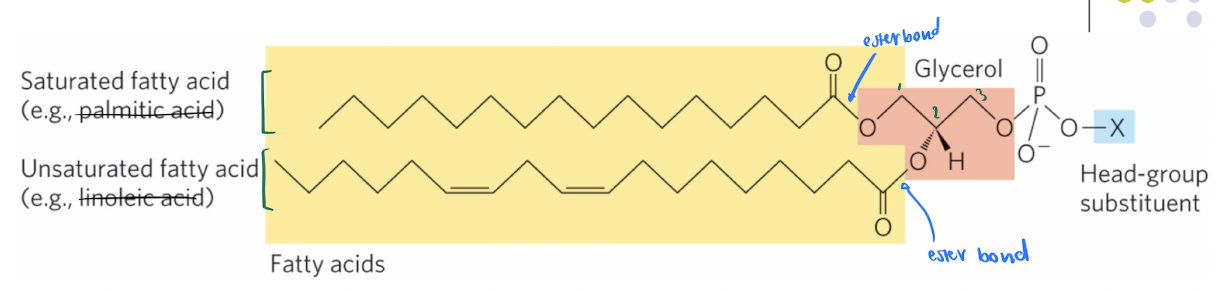
Glycerophospholipids = contain glycerol & phosphate
glycerol-3-phosphate is the central core
glycerol ISNT chiral (its prochiral), BUT glycerol-3-phosphate is
glycerol is a reduced triode structure
fatty acids attach to c1 & c2
polar group attaches to phosphate’s oxygens

Glycerophospholipid Substituents:
fatty acids are attached to c1 & c2 via ESTER linkages - this linkage differs w other classes of membrane lipids (ex. sphingolipids use amide linkages)
fatty acid @ c1 : usually saturated
fatty acid @ c2 : usually unsaturated
unsaturations provide some bendiness & freedom of rotation
a polar substituent is attached to the phosphate: alcohol attached via phosphodiester
determines the “type” of glycerophospholipid

Phospholipids: Types of Glycerophospholipids
note: should be able to identify the structure
→ a polar substituent attached to the lipids phosphate determine the type of glycerophospholipid
Phosphatidic acid = glycerophospholipid w NO additional polar group
charge contribution:
phosphate from glycerol-3-P (G-3-P) contributes -1
head groups contribute + or - charges
result: lipid is negative or neutral
each type also has variations in the lipid groups (fatty acids) attached to c1 & c2
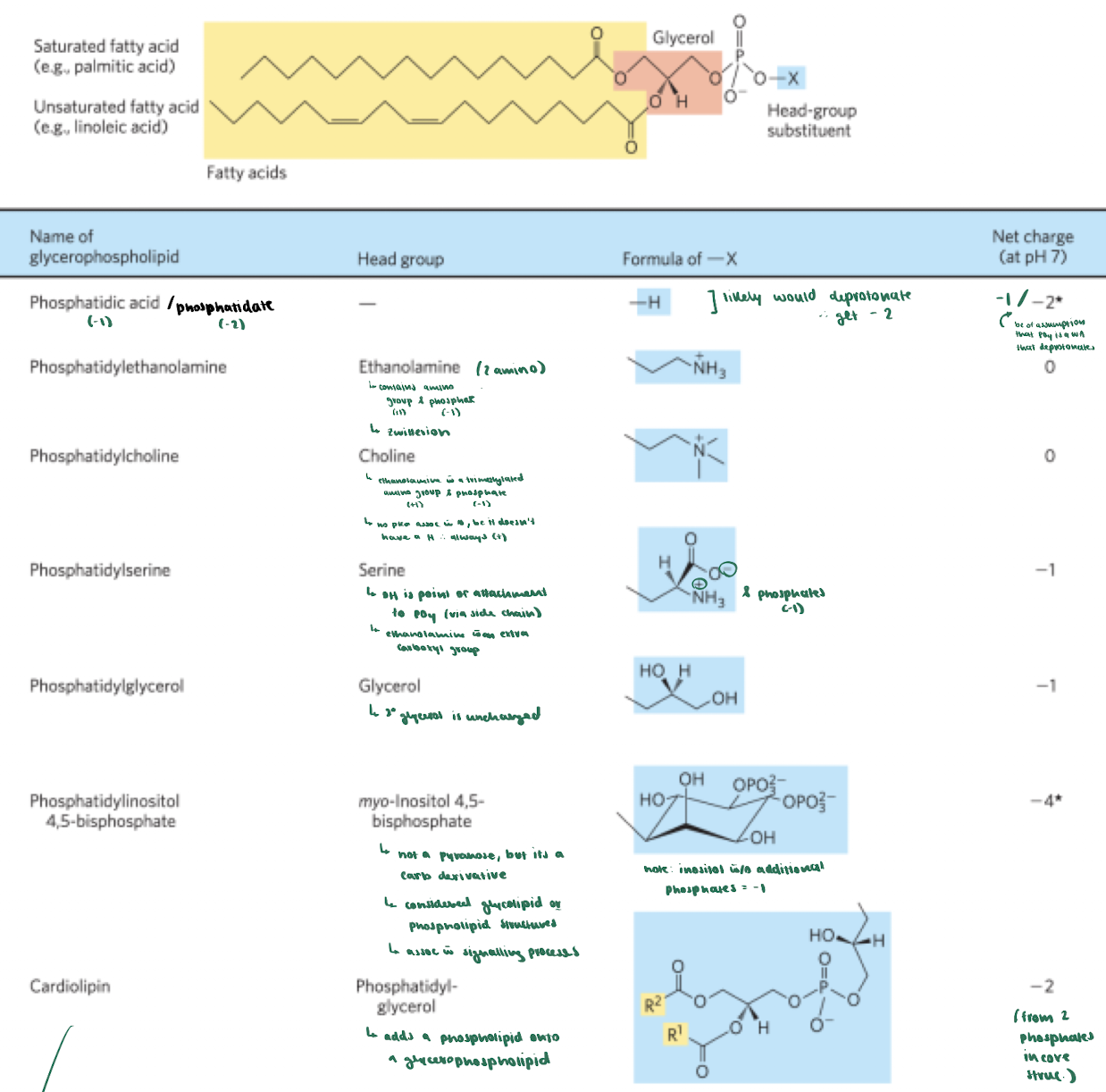
Glycerophospholipid Headgroups
Phosphatidic acid/phosphatidate = -H
charge: (-1) as acid or (-2)
likely deprotonated bc PO4 is a WA, thus (-2)
note; this isn’t a head group, its the name since theres NO head group

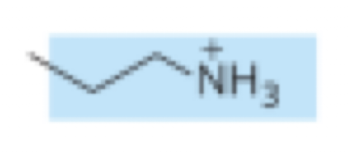
ethanolamine = 2 amino groups
charge: a zwitterion since amino group is +1, phosphate is -1 = 0
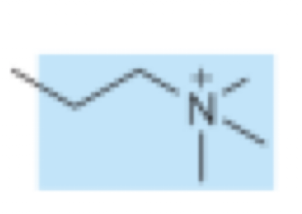
choline = ethanolamine w a trimethylated amino group
no pKa associated w N bc its doesn’t have an H, thus always (+)
charge: amino group is +1, phosphate is -1 = 0
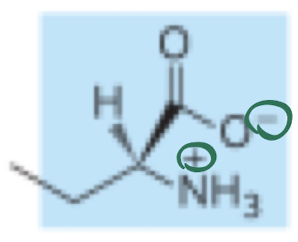
serine = ethanolamine w an extra carboxyl group
OH is point of attached to Po4 via side chain
charge: amino’s +1, carboxyl’s -1, phosphates -1 = -1
glycerol = 3º glycerol is uncharged
charge: phosphate -1 = -1

myo-Inositol 4,5-bisphosphate = glycolipid or phosphiloid structure thats not a pyranose, but its a carb derivative
assoc w signalling process
charge:
inositol w/o additional phosphates = -1
inositol -3, phosphate -1 = -4

phosphatidyl-glycerol = adds a phospholipid onto a glycerophospholipids PO4
charge: 2 phosphate in core structure = -2

ex. Cardiolipin/ Diphosphatidylglycerol = head group adds a phospholipid onto a glycerophospholipid
result: 2 glycerophospholipids attached via a glycerol at their phosphates
R1, R2, R3, R4 of phospholipids are usually Unsaturated in cardiolipin - differs from usual saturation pattern at c1 & c2
role: a significant component of IMM in eukaryotes
important in formation of membranes

→ can interconvert glycerophospholipids: use enzymes to change the head group
ex.
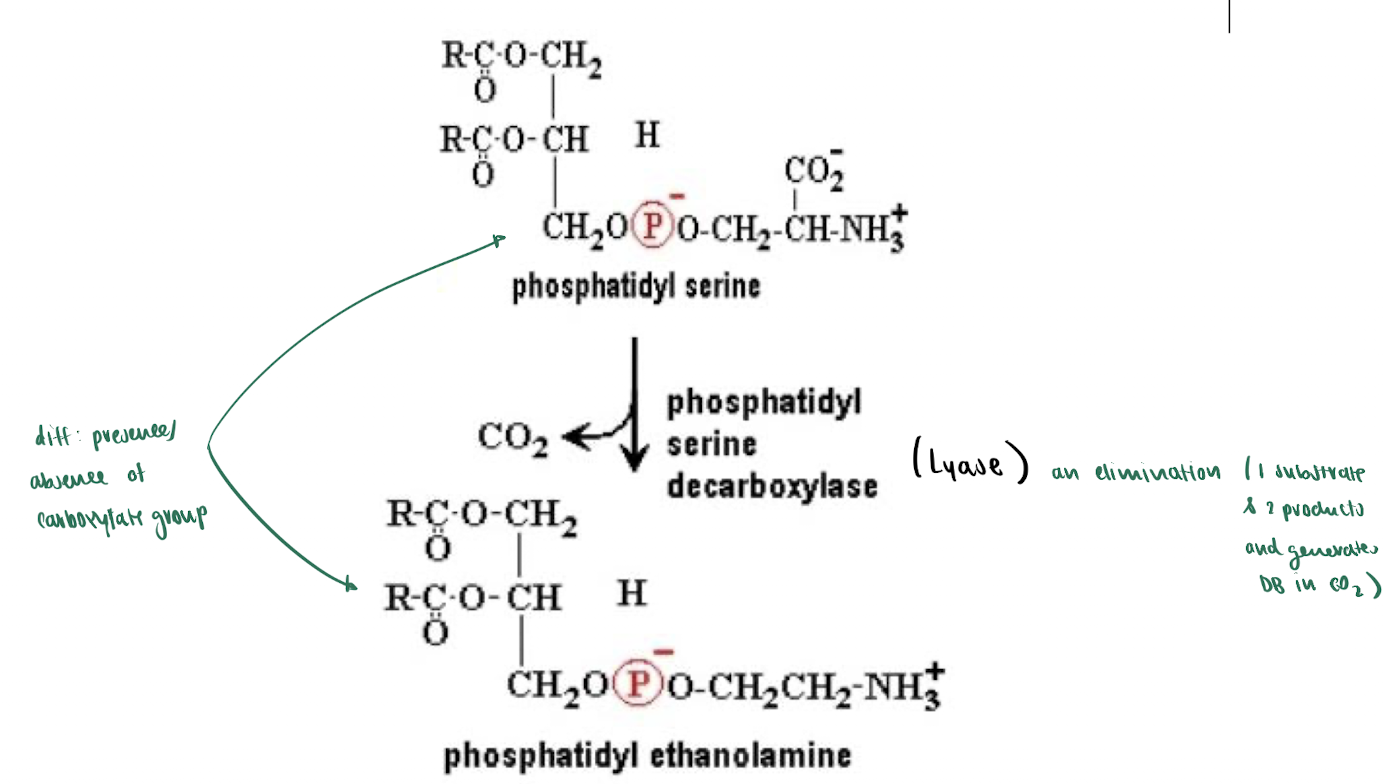
Q. This glycerophospholipid has an average charge of -4 at pH 7.0. How can you explain this?

this glycerophoslipid has an overall -5 charge, however in solution its -4 bc one of the phosphates w a -2 charge is protonated - THUS, one of the pKa’s is higher than pH 7.0, bc it remains pronated
mor eliekly to pronate a PO4 with a -2, than the internal -1
this means this glyceropholpid would have 5 equilibria & one if its functional groups requires a ph above 7.0 to deprontonate

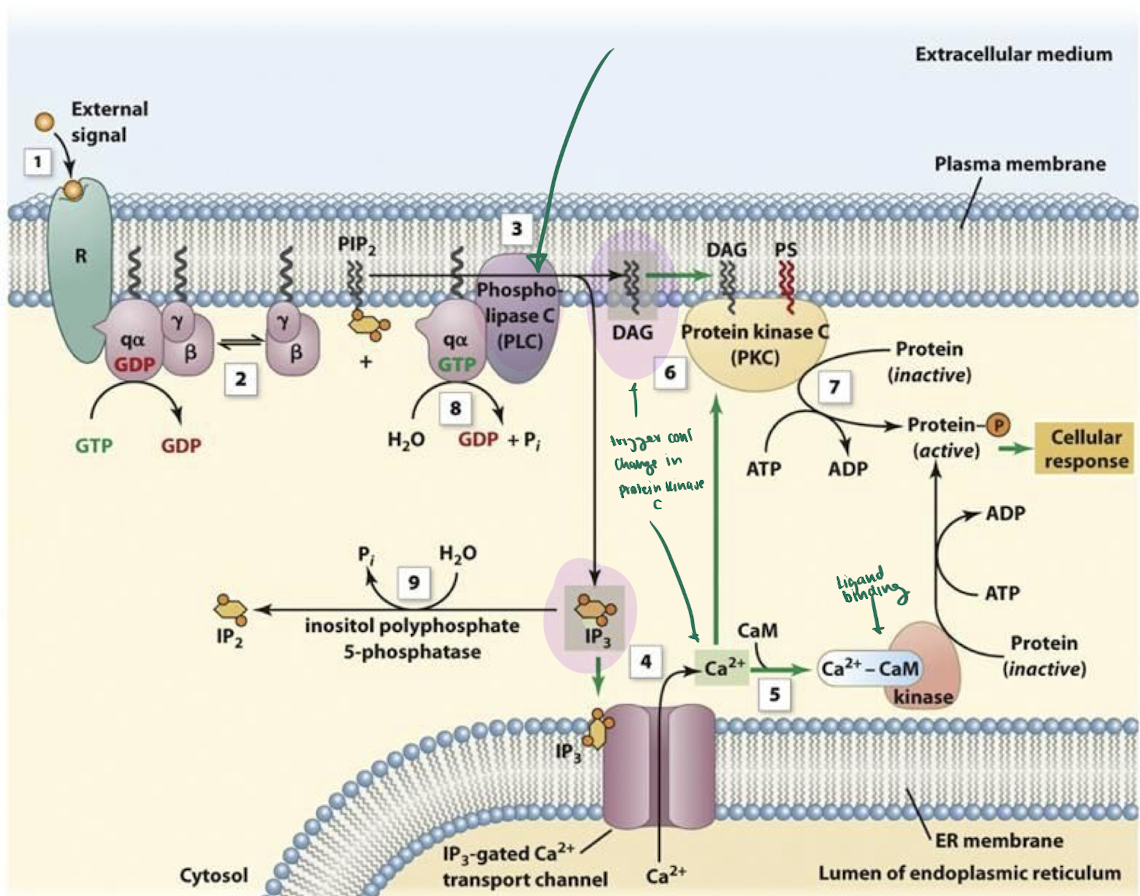
Phospholipids: Glycerophospholipids - Effect of Phospholipases
→ glycerophospholipids are degraded by specific enzymes: phospholipases (hydrolase)
by hydrolyzing bonds in glycerophos
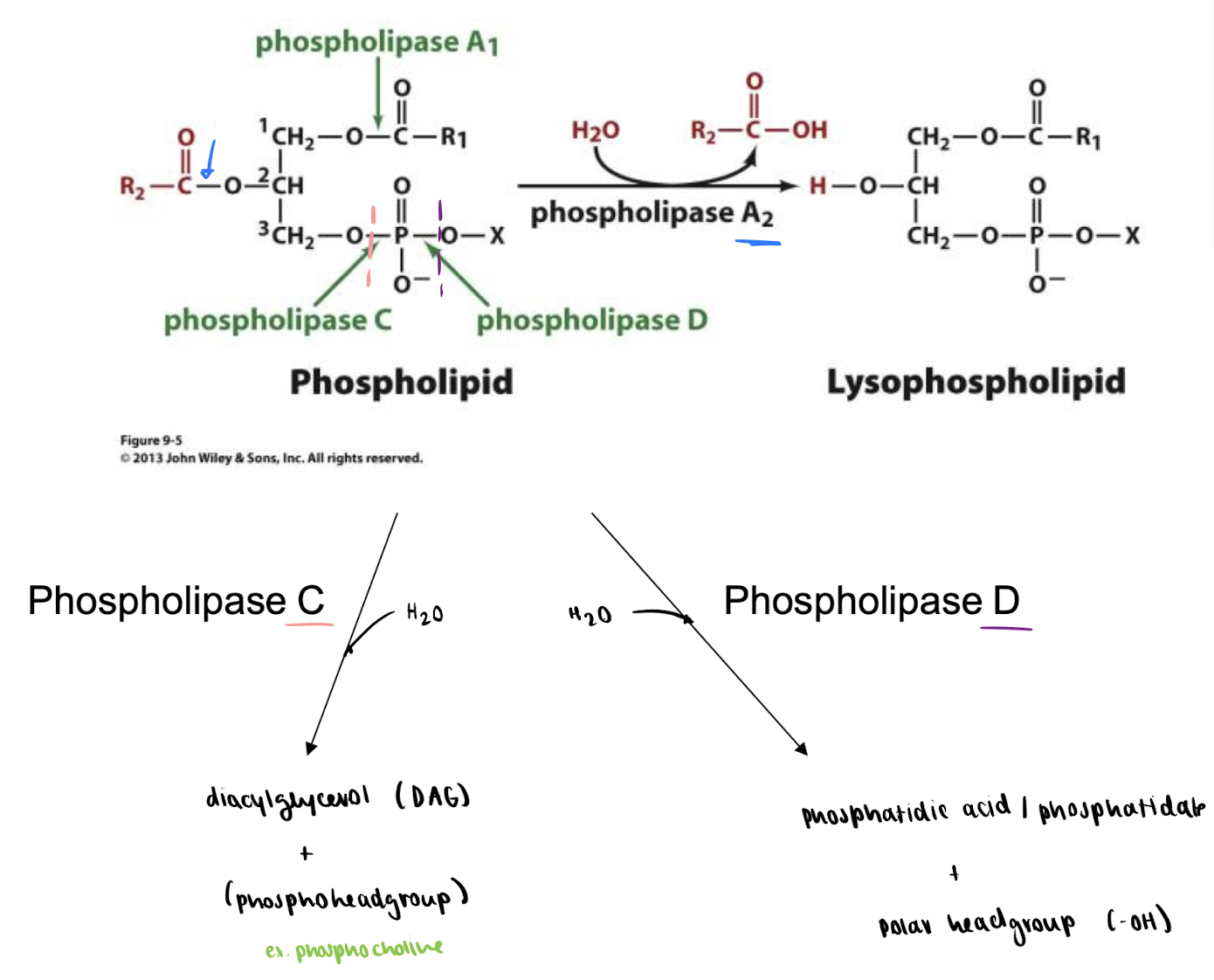
Type-A phospholipases = cleaves acyl group of glycerophospholipids → yields a fatty acid + alcohol (OH)
phospholipase A1 = cleaves FA @ c1
result: c1’s FA is released & left w an OH
thus usually cleaves saturated FA
phospholipase A2 = cleaves FA @ c2
result: c2’s FA is released & left w an OH
thus usually cleaves unsaturated FA
Type-C phospholipases = cleave polar head group on c3 b/w c3’s O & P
result: glycerol attached to 2 FA at c1 & c2 + c3 with an OH + releases P-head group
breaks phosphoester
Type-D phospholipase = cleave polar head group on c3 b/w P & polar head group
result: glycerophospholipid-P is released & head group is removed
breaks phosphoester

result of using phospholipases on glycerophospholipids:
using A2 + H2O → produce lysophospholipid + carboxylic acid group removed
using C + H2O → diaglycerol (DAG) + phosphoheadgroup (ex. phosphocholine)
using D + H2O → phosphatic acid/phosphatidate + polar head group (-OH)
Q.

answer: phospholipase A2, bc this fatty acid is unsaturated it would be found at c2 & A2 cleaves FA @ c2 → releasing it

Phospholipids: Sphingolipids (Sphingomyelin thats phosphate-containing)
Sphingolipids = contain non-glycerol, sphingosine backbone
synthesized from ser (AA) + palmitate (16:0 FA)
non-glycerol, bc it contains a trans DB
a single fatty acyl chain is attached to the sphingosine backbone via an amide bond
unlike glycerophospholipids w an ester bond
contains polar functional groups as head groups that are variable & determine class of sphingolipid
OH of sphingosine backbone attaches to head group
sphingosine backbone W/O FA attached (thus not a ceramide) has a +1 charge

ceramide = core of FA structure that consists of a sphingosine backbone + FA
neutral charge
FA residue is usually saturated
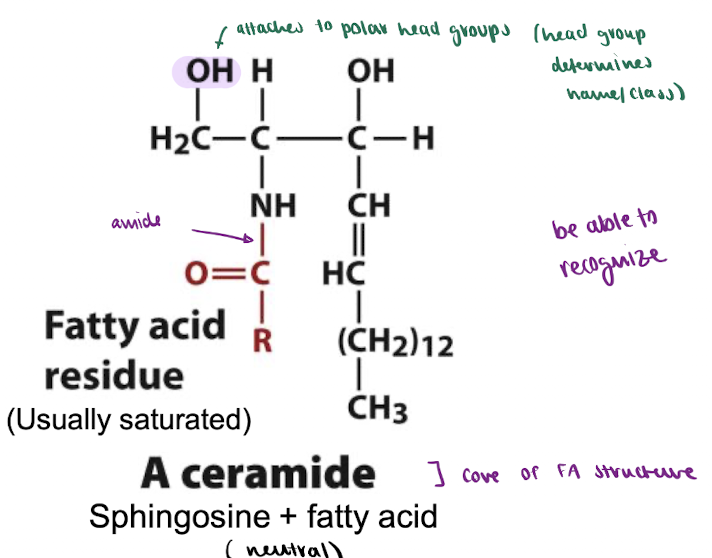
Sphingolipid Structure
sphingosine backbone contains a polar & non-polar region
polar region resembles glycerol, BUT includes an amino group at c2
variable polar group is attached to c1 & determines the class of sphingolipid
Classes of Sphingolipids (based on polar group attached to c1’s OH):
phospholipids: contain phosphate
sphingomyelin = phosphocholine or phosphoethanolamine
head group: choline or ethanolamine

glycolipids: contain 1+ monosac
cerebrosides = monosaccharide (glucose or galactose)
neutral charge & DOESNT contain PO4
globosides = neutral oligosachairde structure (2+ sugars)
neutral charge & DOESNT contain PO4
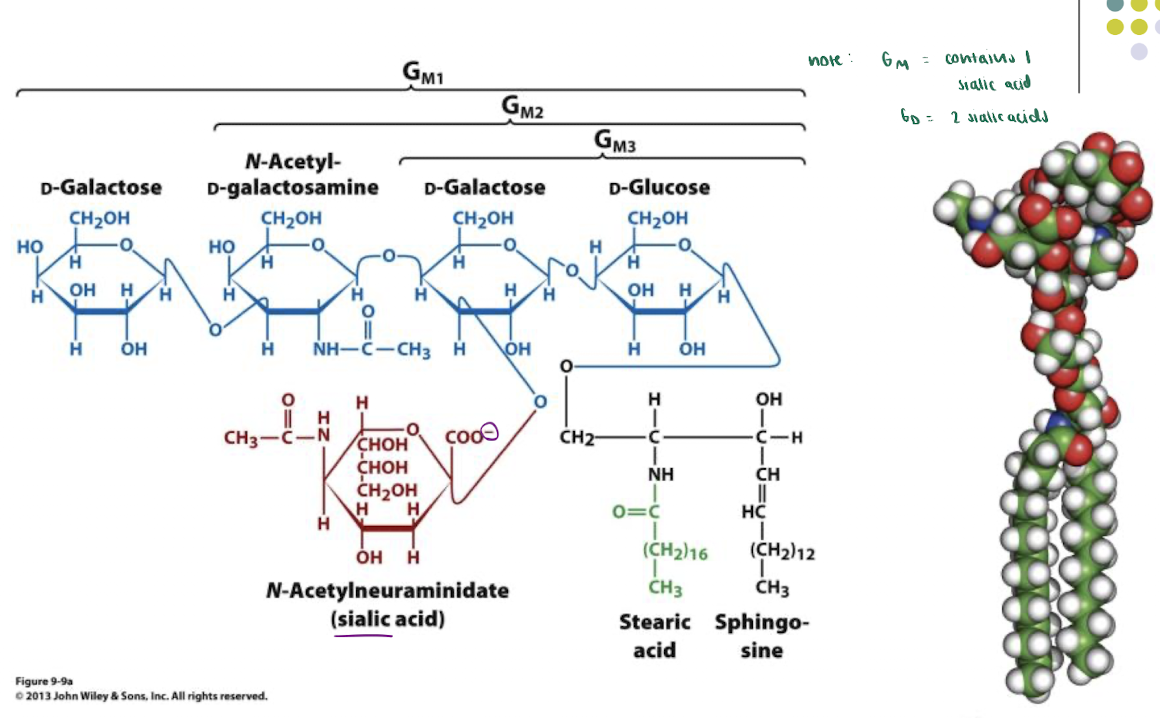
gangliosides = oligosacchairides w 1+ sialic acid
(-) charge bc os squalid acids carboxyl
oligosaccharide head group varies in structure & by the amount of sialic acids it contains
Q. The polar head group shown is found in the sphingolipid sphingomyelin. which glycerophospholipid also contains this headgroup?
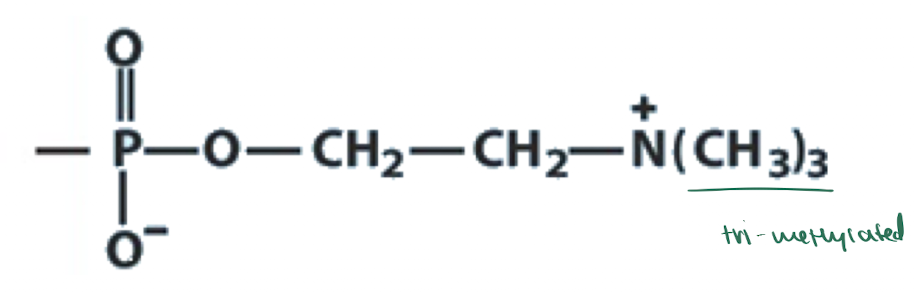
head group: choline bc its an amino group thats tri-methylated
answer: the glcyerophospholipid phosphocholine also contains choline
Glycolipids (class of lipid): Galactolipids
& Sulfolipids (class of lipid)
galactolipids/ sulfolipids:
common in plant cells (cholorpalst inner membranes)
DONT require phosphate - this is an advantage, as they’re not limited by the supply of phosphate
acyl chains are typically derived from 18:2 ∆9,12 (linoleum acid)

Sulfolipids:
may contain negative charges from sulfonates
Galactolipids: have 1 or 2 galactose units at c3 + acyl chains at c1 & c2
acyl chains are typically Unsaturated - differs from usually saturation pattern at c1 and c2
Ether Lipids: Archae Membrane lipids
Ether lipids are characterized by specialized structures:
phospholipids
ether-linked
branched isoprenoid chains instead of FA - important in cholesterol synthesis
branching limits degrees of freedom

→ ether linkages in ether lipids are MORE resistant to hydrolysis in the presence of heat/low pH (extremes)
thus ether lipids are found in archae bc many archae are extremophiles (heat, acid, salt)
useful for PCR & finding proteins at extremes
→ archae membrane lipids are similar to glycerophospholipids bc they contain a glycerol backbone
→ archae membrane lipids can form ring structures: adds conformational rigidity, which decreases rotational freedom & increases stability
Sterol lipids
Sterol lipids = rigid membrane lipids w fused ring systems
rings provide conformational restriction
length is equivalent to a 16:0 fatty acyl group (mid-sized FA)
thus interacts reasonably well w other memb lipids
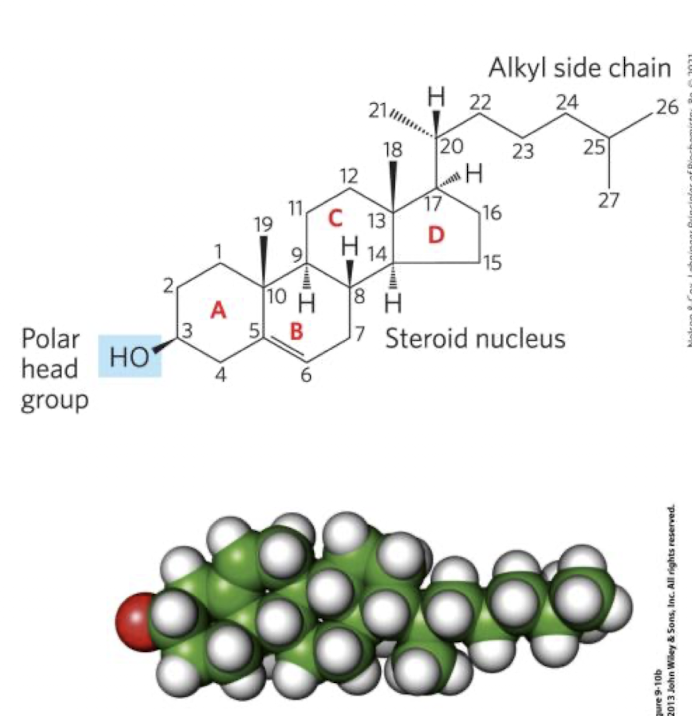
ex. cholesterol - common in mammalian cells (1/3 of membrane)
variations exist in other organisms (plants, fungi)
note: a heterogenous structure helps maintain memb. fluidity (cholesterol is involved in this as a sterol lipid)
Q. How would you’d describe this structure?

contains sphingosine backbone w a fatty acyl chain attached to its N via an amide bond - thus its contains a glycolipid sphingolipid
polar head group: oligosaccharide which contains 1+ sialic acids - thus its a ganglioside
features: amphipathic, contains sialic acid, contains sphingosine, contains glycolipid (sphingosine + acyl chain), contains galactolipid residues
answer: a ganglioside
bc its a sphingolipid whose head group consists of an oligosaccharide containing 1+ sialic acids
Lipid Derivatives & Signals
note: lipids aren’t passive molecules
→ lipid derivative components are classified as either lipid or lipid-associated bc of their overall hydroPHOBICITY
→ lipids may be active emocules involved in reactions (cofactors) or as hormones/signals
ex. DONT memorize, just for connection