ACC401 Chp 3
 Call Kai
 Learn
 Practice Test
 Spaced Repetition
 Match
 Flashcards
 Knowt Play
1/56

There's no tags or description
Looks like no tags are added yet.
57 Terms
Formula for Federal Income Tax on Individuals
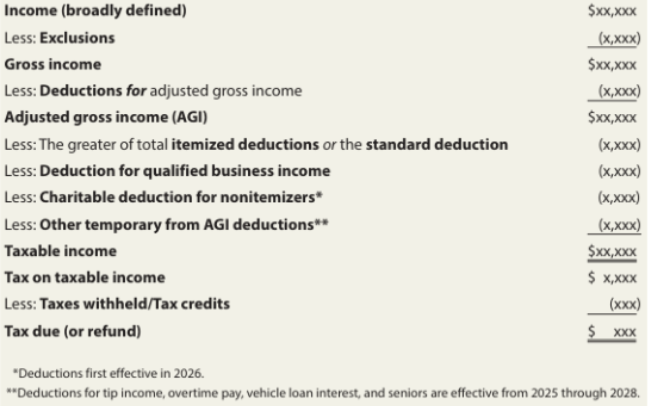
Partial list of Gross Income Items
Alimony (divorces BEFORE 2019)
Compensation for services
Dividends
Interest Income (from savings and/or checking accounts, certificates of deposit)
Embezzled funds
Gains from illegal activities
prizes
Salaries
Bargain purchase from employer
Treasure Trove(found property)
Items included in Gross Income (1/2)
Alimony (divorces before 2019) | Group term life insurance, premium paid by employer (for coverage over $50,000) |
Annuities (income element) | |
Awards | Hobby income |
Back pay | Interest |
Bargain purchase from employer | Jury duty fees |
Bonuses | Living quarters, meals (unless furnished for employer’s convenience) |
Breach of contract damages | |
Business income | Mileage allowance (in certain cases) |
Clergy fees | Military pay (unless combat pay) |
Commissions | Notary fees |
Compensation for services | Partnership income |
Death benefits | Pension distributions |
Debts forgiven | Prizes |
Director’s fees | Professional fees |
Items included in Gross Income (2/2)
Dividends
Embezzled funds
Employee awards (in certain cases)
Employee benefits (except certain fringe benefits)
Estate & trust income
Farm income
Fees
Gains from illegal activities
Gains from sale of property
Gambling winnings
Punitive damages
Rents
Rewards
Royalties
Salaries
Severance pay
Strike & lockout benefits
Supplemental unemployment benefits
Tips & gratuities
Travel allowance (in certain cases)
Treasure trove (found property)
Wages
Partial list of items excluded from Gross Income
Accident & health insurance proceeds
Alimony (divorce AFTER 2018)
Child support payments
Gifts
Inheritances
Life insurance paid on the death of the insured
Gains from sale of principal residence (subject to ceiling)
Interest from state & local bonds
Worker’s compensation benefits
Exclusions from Gross income
Accident insurance proceeds | Life insurance paid at death |
Alimony (divorces after 2018) | Meals and lodging (if furnished for employer’s convenience) |
Annuities (cost element) | |
Bequests | Military allowances |
Child support payments | Minister’s dwelling rental value allowance |
Cost-of-living allowance (for military) | Railroad retirement benefits (to a limited extent) |
Damages for personal injury or sickness | |
Gifts received | Scholarship grants (to a limited extent) |
Group term life insurance, premium paid by employer (for coverage up to $50,000) | Social Security benefits (to a limited extent) |
Veterans’ benefits | |
Inheritances | Welfare payments |
Interest from state and local (i.e., municipal) bonds | Workers’ compensation benefits |
Deductions FOR AGI
Trade or business expenses
One-half of self-employment tax paid
Alimony paid (divorces PRIOR to 2019)
Certain IRA contributions
Capital losses
Adjusted Gross Income (AGI)
Important subtotal: Used to limit certain itemized deductions
Floor(over the floor to claim deductions)
Ceiling (under ceiling to claim deductions)
Deductions FROM AGI
Includes:
The greater of itemized deductions or the Standard deduction
QBI Deduction
Charitable Deduction for Non-Itemizers
Other Temporary “FROM AGI” Deductions
Senior Deduction
Tip Income Deduction
Overtime Pay Deduction
Automobile Loan Interest Deduction
Itemized Deductions
To determine whether to itemize, the taxpayer compares the total standard deduction (the sum of the basic standard deduction and any additional standard deductions) with total itemized deductions.
Taxpayers are allowed to deduct the greater of itemized deductions or the standard deduction. The choice is elective each year.
Standard Deductions (SD)
Total standard deduction = Basic standard deduction + Additional standard deductions
Basic Standard Deduction

Basic Standard Deduction Limit for Person Claimed as Dependent
Limited to the greater of:
$1,350 or
EARNED INCOME + 450 (but not to exceed the basic standard deduction
Additional standard deduction amounts still available
Additional Standard Deduction
For taxpayers 65 y/o or older and/or legally blind
Taxpayer and/or spouse
There would be more than one additional standard deduction if the taxpayer & spouse meet the requirements

Taxpayers Ineligible for Standard Deduction
Married, filing separately (MFS) if either spouse itemizes deductions
Nonresident aliens
QBI Deduction
In general, the deduction for QBI is the lesser of 20 percent of:
Qualified business income.
Modified taxable income (taxable income before the QBI deduction, reduced by any net capital gain).
Deductions FROM AGI
Medical expenses
Certain state, local, & foreign taxes
Home mortgage interest
Charitable contributions
Charitable Deduction for Non-Itemizers
From AGI
Ceiling: $1,000 ($2,000 MFJ)
Cash only
Non-itemizers
Effective 2026
Qualified Tip Income Deduction (1/2)
From AGI
“Qualified tips” - occupations that traditionally & customarily receive tips
Examples: food service, entertainment, hospitality, transportation
Social Security Number
Itemizers & Non-itemizers
Ceiling: $25,000 per tax return
Regardless of filing status
Cash, credit card, or tip-sharing agreement
Voluntary & determined by the customer
Excludes service charges
Qualified Tip Income Deduction (2/2)
Reported on From W-2, Form 1099-K, 1099-NEC, Form 4317
Married taxpayers must file MFJ
Phaseout: $100 for each $1000 over the threshold (begins at $150,000 for single taxpayers; $300,000 for MFJ)
Effective 2025
Expires 2028
Overtime Pay Deduction
From AGI
“Qualified Overtime” - Only pay exceeding regular wages (not tips)
NO tip income
No state-mandated or contractual overtime
Ceiling: $12,500; $25,000 MFJ
Itemizers & non-itemizers
Phaseout: $100 for each $1000 over the threshold (begins at $150,000 for single taxpayers; $300,000 MFJ)
Effective 2025
Expires 2028
Automobile Loan Interest Deduction (1/2)
From AGI
Ceiling: $10,000
Itemizers & non-itemizers
Debt after 12/31/24
New vehicle - taxpayer is original user
Loan secured by vehicle
Vehicle Identification Number (VIN)
Automobile Loan Interest Deduction (2/2)
Vehicle
At least two wheels
Gross vehicle weight rating of less than 14,000 pounds
Manufactured for public roads, &
Final assembly in the U.S.
Phaseout: $200 for each $1,000 over the threshold (begins at $100,000 for single taxpayers; $200,000 for MFJ)
Effective 2025
Expires 2028
Dependency Status
Important to determine:
Deductibility of medical expenses
Head of Household filing status
Certain tax credits (e.g., earned income tax credit, child & dependent tax credits, child & dependent care tax credits)
Dependency Status: Qualifying Child - Relationship test
Taxpayer’s…
son/daughter
Stepchild
eligible foster child (placed with taxpayer by an authorized placement or court order)
Adopted children (includes a child placed with the taxpayer even though the adoption is not final)
Sister/Brother
Half-sister/brother
Stepbrother/stepsister
Grandchild
Nephew/niece
Qualifying Child: Abode/Residence test
“Child” must live with the taxpayers for more than half of the tax year.
Temporary absences: school, vacation, medical care, military service, and detention in a juvenile facility are ignored
Special rules apply in the case of certain kidnapped children
Qualifying Child: Age Test
Under 19 y/o or 24y/o or older & a full-time student
Exception: Disability
“Child" cannot be older than the taxpayer
Qualifying Child: Support Test
Child mustn’t provide more than half of their own support
Includes:
food
shelter
clothing
Medical care
Dental care
Education
Recreation/toys
Transportation
*Scholarships aren’t considered support
Qualifying Child: Joint return test
A dependent cannot file a joint return with spouse unless:
Filing solely for refund of tax withheld
No tax liability due on separate returns
Neither spouse required to file a return
Qualifying Child: Citizenship Test
“Child” is a U.S. citizen and/or resident
Tiebreaker Rules(1/4): One of the persons is the parent
The persons is the parent
Tiebreaker Rules(2/4): Both persons are the parents, & the child lives longer with one parent
Parent with the longer period of residence
Tiebreaker Rules(3/4): Both persons are the parents, & the child lives with each the same period of time
Parent with the higher adjusted gross income (AGI)
Tiebreaker Rules(4/4): None of the persons is the parent
Person with highest AGI
Qualifying Relative: Relationship or member of household test:
Lineal ascendants: parents & grandparents
Certain in-laws:
Son-in-law
daughter-in-law
brother-in-law
sister-in-law
father-in-law
mother-in-law
collateral ascendants: uncles & aunts
Individuals who are related or unrelated to the taxpayer, but
Can cousin
Qualifying Relative: Resident test:
Member of the household (lives with taxpayer for the entire year; relative or non-relative).
Qualifying Relative: Gross Income Test
Includes only taxable income, not nontaxable income
A dependent’s gross income must be less than the exemption amount, $5,300.(2026)
Ex: Scholarships include the taxable portion (amount received for room & board) & exclude the nontaxable portion (amount received for books & tuition)
Qualifying Relative: Support Test
The taxpayer must provide over half of the qualifying relative’s support.
Support includes food, shelter, clothing, medical & dental care, education, recreation, transportation, & similar items
If a “child” is evaluated as a qualifying relative (& is a full-time student), a scholarship received by the child isn’t included for purposes of computing whether the taxpayer furnished more than half of the child’s support. Any other relative being evaluated must include a scholarship as support in making this determination.
Exceptions to Support Test
Multiple Support Agreements
Children of Divorced/Separated parents
Multiple Support Agreements
Allows a group of taxpayers (none of whom provide more than 50% of the taxpayer’s support) to designate one member of the group to claim the individual as a dependent
All taxpayers in the group must satisfy the other dependency requirements (e.g., relationship test) & provide more than 50% of the support.
Any taxpayer in the group that contributes more than 10% of the support is entitled to claim the individual as a dependent
Often used by the children of aged dependent parents when none of the children meet the support test.
Child of Divorced or Separated Parents
Parents with children who are divorced, separated, or unmarried and have been living apart for the last 6 months of the year
Custodial parent: Has custody of the child or children for the greater part of the year and is entitled to claim the dependents.
Can sign a waiver that allows the noncustodial parent to claim the child as a dependent
Exception:
entitled to claim the individual as a dependent had they been married & filed a joint return
Have custody (jointly/singly) of the child/children for more than half of the year.
Qualifying Relative: Joint Return test
potential dependent cannot file joint return
Qualifying Relative: Citizenship test
U.S. Citizen or Resident
Filing Requirements
Individual: 15th day of the 4th month after the year-end
Saturday, Sunday, or legal holiday
Extension of time to file:
6-month extension (Form 4868)
Extension to file, NOT to pay
Filing Requiremnts: Under 65y/o
Gross Income ≥ basic standard deduction
Filing Requirements: 65y/o and older
Gross Income ≥ Basic standard deduction + additional standard deduction for AGE only
Exceptions for Filing Requirements
Taxpayer is claimed as a dependent
Married individual, filing separately
Self-employed individual (income is greater than $400)
Filing Status: Single
A taxpayer who is unmarried, including those legally separated or divorced, and does not qualify for head of household status
Widowed before the tax year & don’t qualify for a
Married Taxpayers
Can file tax returns together (married filing jointly) or apart (married filing separately).
Marital status is determined on the last day of the year.
Example: When one spouse dies during the year, the surviving spouse is considered married to the deceased spouse, before the end of the year.
Filing Status: Married, filing jointly (MFJ)
Enacted in 1948 to establish equity between married taxpayers in common law states and those in community property states.
Marital status is determined on the last day of the tax year, except when a spouse dies during the year. In that case, marital status is determined as of the date of death.
Married at the end of the year & both spouses agree to file one joint return
Marriage penalty
Joint & several liability
Filing Status: Married, filing separately (MFS)
If married individuals file separate returns, each reports only their own income, deductions, and credits
IRC limitations for MFS
If either spouse itemizes deductions, the other spouse also must itemize
The earned income credit & the credit for child & dependent care expenses cannot be claimed.
No deduction is allowed for interest paid on qualified education loans
Only $1,500 of excess capital losses can be claimed by each spouse
Special rules apply to items such as community property income in community-property states
Filing Status: Surviving Spouse (Qualifying widow or widower)
Applies for two years following the death of one spouse if the surviving spouse is maintaining a household for a dependent child (i.e., son, stepson, daughter, or stepdaughter).
Taxpayers filing this status, use the MFG tax rate and standard deduction amounts
Marriage Penalty
The additional tax liability that results for a married couple when compared with what their tax liability would be if they were not married & filed separate returns
The marriage penalty occurs when both spouses earn substantial incomes. Congress reduced it by doubling the standard deduction for married couples and expanding tax brackets below 35%. However, the penalty still affects couples who itemize deductions or earn significant income above the 32% tax bracket.
Filing Status: Head of Household
Criteria: Unmarried, pays for more than 50% of a household and/or maintains a household where taxpayer lives. The dependent, who must be a qualifying child/relative, lives with the taxpayer for more than half of the year.
Exception: Taxpayer maintains a separate home for parents
At least one parent must qualify as a dependent
Abandoned Spouse
A married taxpayer can file as Head of Household if:
Does not file a joint return
Paid > half the cost of maintaining a home
Spouse did not live in the home during the last 6 months of the tax year
Home was principal residence of taxpayer’s child > half of year
Can claim child as a dependent
Kiddie Tax
Designed to prevent parents from shifting investment income to their children to take advantage of lower tax rates.
Unearned income: children under the age of 19 or under 24y/o & a full-time student
Net unearned income taxed at parents’ rates
Net unearned income: unearned income less of $1,350 less greater of $1,350 or itemized deductions directly related to the production of unearned income
Child’s rate applies to the child’s taxable income - net unearned income (taxed at parents’ rates)
Format: Unearned Income – $1350(←Kiddie tax) – $1350 or itemized deductions directly related to earned income subject to kiddie tax discount rate