chapter 27: amines, amino acids and polymers
 Call Kai
 Learn
 Practice Test
 Spaced Repetition
 Match
 Flashcards
 Knowt Play
1/42

There's no tags or description
Looks like no tags are added yet.
43 Terms
How are amines produced?
When one or more of the hydrogen atoms in ammonia is replaced with an alkyl group
What’s a quaternary anime called?
Quaternary ammonium ion (because it has a positive charge)
why can ammonia produce up to four bonds to produce amine?
The nitrogen has a lone pair. When all the hydrogens are replaced it can still form an extra bond due to the lone pairs
What’s the suffix for amines?
-Amine or -amine ion if its a quaternary ammonium ion
What do you do if the amine has more than one type of organic compound attached to it?
You lost the different groups in alphabetical order
How does amine act as a base?
There is a lone pair on the nitrogen so it can form a dative covalent bond with H+ ions making them excellent bases
What are bases?
Proton acceptors
What does amine + acids make?
Ammonium salt
Example of ammonium salt
(NH₄)₂SO₄
(Ammonium sulfate)
What kinda reaction produces alipathic amines?
Nucleophilic substitution
How is a primary amine + ammonium salt produced?
One mol of Haloalkane + two mol of ammonia in ethanol.
Example equation of ammonia reacting with an haloalkane
CH₃CH₂Br + 2NH₃ → CH₃CH₂NH₂ + NH₄Br
Since multiple substitution can occur to produce an amine, how do we ensure only a single substitution occurs?
Ammonia is added in excess or the mixture of products is separated using fractional distillation
How are aromatic amines produced?
Reduction of nitrobenzene using a concentrated hydrochloric acid and a tin catalyst
reagents to convert a nitrobenzene into a phenylamine
Hydrochloric acid and tin catalyst
What does the reduction of nitriles or hydroxynitriles by hydrogenation make?
amines
Reagents to turn a nitrile into an amine?
Hydrogen with a nickel catalyst
What are amides?
Organic compounds containing the amide functional group, –CONH₂, consisting of a carbonyl group (C=O) bonded to an –NH₂ group.
Amine

Amides
(Secondary amide)

What are alpha amino acids?
Organic molecules containing a carboxylic group and an amine group bonded to the same carbon atom
Amino acid general formula
H₂NCH(R)COOH
Why can amino acids act as both a base and acid?
The carboxylic acid can act as a acid and the amine group acts as a bases
What’s a acid?
Proton donor
What does the carboxylic group react with in an amino acid?
It reacts with alkalis
What does the amine group react with in an amine?
With acids
What does an amino acid make when it reacts with an acid?
A salt. The –NH₂ group accepts an H⁺ ion to form –NH₃⁺.
What does an amino acid make when it reacts with a base?
A salt and water. The –COOH group donates an H⁺ ion to the base, forming –COO⁻.
What can an amino acid and an alcohol make together?
An ester (and water) in the presence of concentrated sulphuric acid
When does cis/trans isomerism happen?
Each carbon atom in the C=C bond must have attached two diffrent groups And one group must be hydrogen for bond carbons
When do condensation polymers form?
When a water molecule is removed
Example of two condensation polymers?
Polyester and polyamides
When is polyester formed?
When a dicarboxylic acid and diol react together producing a ester linkage
What’s an ester linkage?
-COO-
Example of polyester
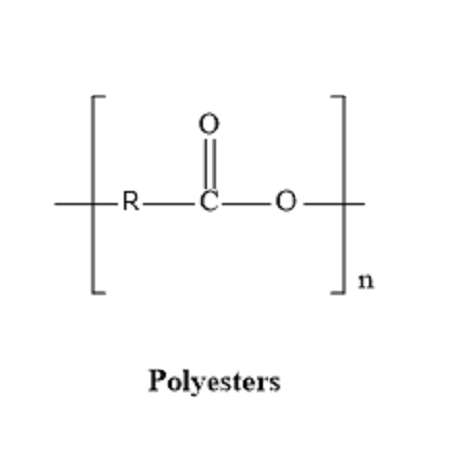
Why are polyester biodegradable?
They can be broken down through hydrolysis due to the polarity within the polymer molecule. Therefore they can be broken down easily in nature by naturally occurring water
What are polyamides?
Polymers bade of dicarboxylic acid and diamine
What’s the link called in a polyamide?
amine linkage
Polyamide
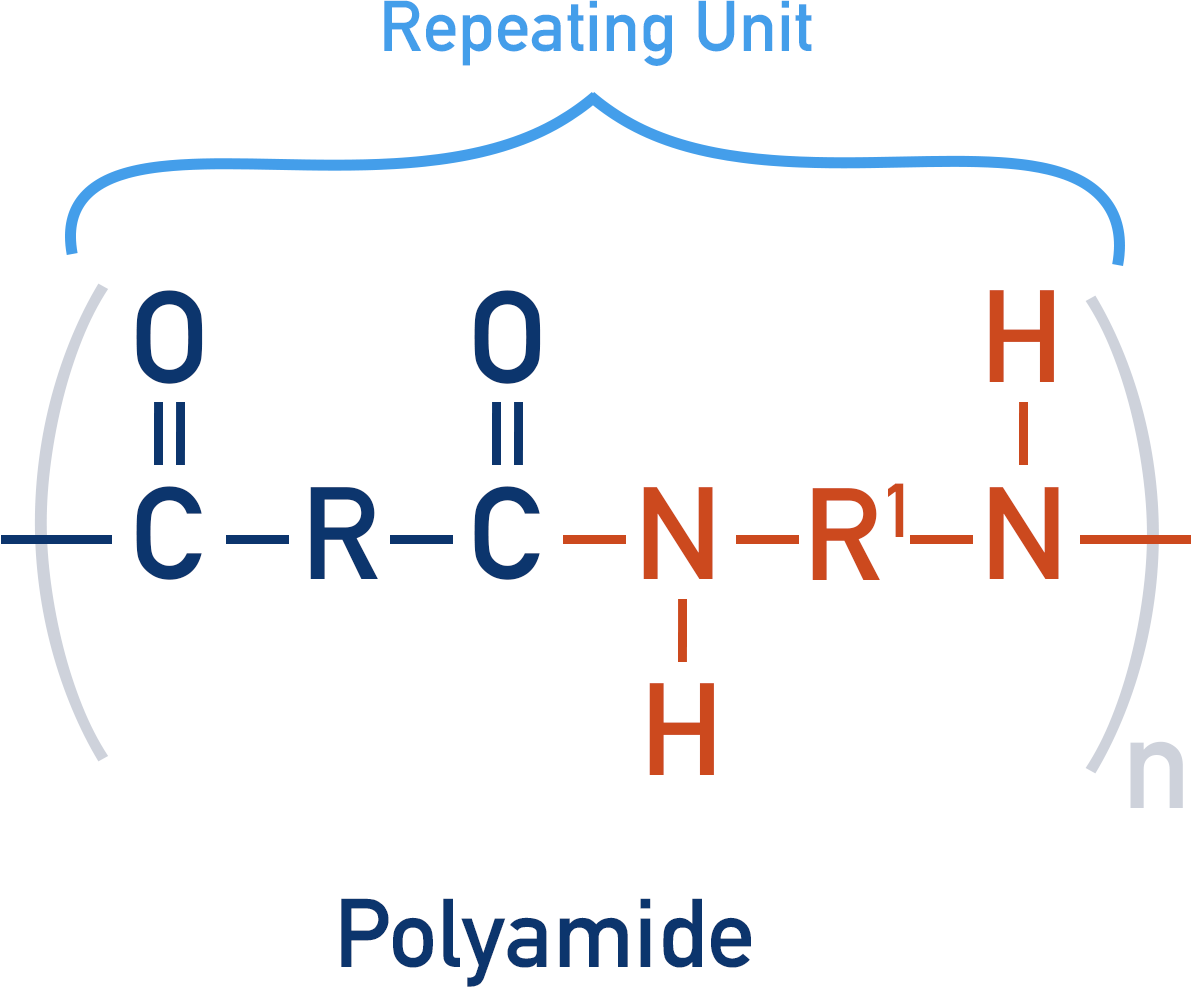
What’s the amide linkage?
-CONH-
which molecule can polymerise by itself?
Amino acids
Water molecule lost in polyester and polyamide?
2nH2O
Water molecule lost in a amino acid polymer?
nH2O