OB EXAM 2
 Call Kai
 Learn
 Practice Test
 Spaced Repetition
 Match
 Flashcards
1/76

There's no tags or description
Looks like no tags are added yet.
77 Terms
HDP - risk factors
Nulliparity, multifetal gestations, maternal age ≥ 35, assisted reproductive technology, hx of HTN disorders, underlying conditions, black/native/alaska, paternal factors
HTN hx- preeclampsia in previous pregnancy, chronic HTN , family hx preeclampsia
Underlying/comorbidities- diabetes, thrombophilia, autoimmune disorder, kidney disease, obstructive sleep apnea, obesity (BMI >30)
Paternal factor- father of previous pregnancy w/ preeclampsia
Common pregnancy complication. Leading cause of pregnancy related death in US
HDP - classification & diagnostic criteria
Chronic HTN- > 130/90 in readings 4hr apart. Occur before 20wk. Dx in pregnancy, last beyond postpartum
CHTN w/ severe feature- in pt w/ preexisting HTN. Sudden change in BP or proteinuria. Incr morbidity mom/fetus
////////////////
Gestational HTN- after 20wk. No proteinuria/severe preeclampsia features. Resolve after pregnancy. 50% get preeclampsia. 140/90 2 reading, 4hr apart
Preeclampsia- after 20wk or in postpartum. proteinuria or evidence of organ injury. Leading cause mom/fetus morbidity/mortality in US. 140/90. Progressive disorder
Preeclampsia w/ severe feature- 160/110 or evidence of worsening organ injury
Eclampsia- tonic clonic seizure in pt w/ preeclampsia. No underlying seizure disorder. Before/during/after birth
HDP - diagnosis of proteinuria
testing- dipstick, 24hr urine, urine protein/ creatine ratio
HDP- organ damage assoc w/ preeclampsia
Kidney- elevated serum creatine
Liver- elevated liver enzymes or severe RUQ pain
Blood- platelets <100,000
Lungs- pulmonary edema
Brain- headache or visual disturbances
HDP- underlying cause of preclampsia
Placenta is root cause.
Poorly developed spiral arteries cause placental perfusion disruption.
Placenta release proinflam protein into maternal circulation.
Endothelial cell dysfx & vasospasm.
Poor tissue perfusion to all organ systems.
Poor organ fx. Maternal ischemia. Damage brain/kidney/liver etc.
Incr peripheral resistance -> incr BP-> incr endothelial cell permeability -> intravascular protein/fluid loss, less plasma volume.
HDP- assessment findings of preeclampsia
Edema, hyperreflexia, clonus, headache, scotoma (spots in vision), blurry/double vision, epigastric pain, RUQ pain
Clonus- neuro condition, involuntary/rhythmic muscle contractions/relaxations
HDP - HELLP syndrome- definition
Variant of preeclampsia. May not have HTN or protein
Hemolysis- elevated LDH, low H/H
Elevated Liver enzyme- ALT/AST 2x normal levels
Low Platelets- <100,000
Renal labs- decr creatine clearance, uric acid >10, incr bilirubin
fetal effects of HDP
Fetal – preterm delivery, stillbirth/fetal demise, growth restriction
Maternal- placental abruption, pp hemorrhage, seizure, infection, cardiomyopathy, long term internal organ damage
mgmt of stable HDP- CHTN, GHTN, PREECLAMPSIA W/O SEVERE FEATURES
Goal- ensure maternal safety & deliver healthy newborn as close to term as possible. BP goal= 140-150/90-100
Home mgmt, 2 clinic vist/wk
Maternal asessment- monitor BP & proteinuria closely
Fetal assessment (activity & growth)- FKCs, NST/BPP, US growth scan
Activity restriction- risk fo rVTE
Regular diet w/o salt restriction
Oral meds if needed- methyldopa, nifedipine, labetalol
Delivery @ >37wk
mgmt of unstable HDP
Preeclampsia w/ severe features- greater risk for pregnancy complications
Hospitalized for thorough evaluation of maternal-fetus status & risk/benefit of delivery
Labs- H/H, platelet, liver enzyme, serum creatine, uric acid
Continuous FHR monitoring, fetal growth & well being exam
Serial BPs. Strict I&O
IV meds to control BP- labetalol, hydralazine
MG sulfate infusion- to prevent eclamptic seizure. DOESN’T control BP. Neuro prophylactic
High alert med. IV secondary infusion/piggyback
SE- feeling warmth/flushing.diaphoresis/burning @ IV site
Give for 24-48hr period
Monitor UO closely as its excreted in urine. If inadequate UO-> Mg toxicity.
UO >30ml/hr indicate adequate renal perfusion
Provide quiet, non stim environment, low lights. Seizure precautions, emergency meds available (hydralazine, labetalol, nifedipine, Mg, Ca gluconate), emergency birth equipment available
s/s of magnesium toxicity- high alert med
Absent/depressed DTRs (deep tendon reflex), decr UO, CNS depression (resp depress & decr LOC)
Antidote- calcium gluconate
mgmt of eclampsia
Eclampsia seizure can occur before/during/after birth
Remain w/ pt & call for help.
Ensure open airway, turn client on side, admin O2 by face mask @ 8-10L/min
Montior fetal heart rate patterns
Start IV. Admin MG sulfate
After seizure ends, insert oral airwat & suction mouth as needed
Prepare for fetus delivery after pt stabilization, if warranted
Document occurrence, client resoponse, & outcome
PP- monitor Mg blood level, vitals, & continue to assess for s/s
diabetes
15.8% of total US population has diabetes
GDM- 9.2% of all pregnancies in US
Risk factors- >35yr, previous GDM, obesity, hx of large infant, family hx of DM, PCOS
Diabetes incidence growing d/t incr in overweight, obesity, & physical inactivity
Diabetes- most common endocrine disorder associated w/ pregnancy
Key to optimal outcome = strict maternal glucose control - euglycemia
primary goal of diabetes mgmt in pregnancy
Importance of strict blood sugar control. Requires freq dose adjustments. More likely to get hypoglycemia
diabetes- classifications & diagnostic criteria
Pregestational- type 1 & type 2
Women w/ pre-existing diabetes
Gestational diabetes mellitus GDM
Class A1 (diet controlled) & A2 (insulin controlled)
More common in hispanic/african american/native/asian.
Likely to recur in future pregnancies. Incr risk of type 2 Dm later in life
Diagnosis- OGTT, 3 hr OGTT
risks of poorly controlled diabetes- maternal & fetal
Maternal- birth complications, HTN, miscarriage, macrosomia, shoulder dystocia, c-section, preeclampsia, polyhydramnios, placental abruption, uterine dysfunction, postpartum hemorrhage, ketoacidosis, infection, perinatal mortality rate 3x higher
Fetal- miscarriage, stillbirth, congenital malformation, delayed fetal lung development, macrosomia, preterm birth, hypoglycemia, perinatal mortality rate 3x higher
diabetes mgmt
Prenatal
Labs- baseline renal fx, A1c (previous 2-6wk), screening for GDM (24-28wk, earlier if risk factors), urine ketones (inadequate calories or carbs)
pt education- BG monitoring, diet, exercise, hypo/hyperglycemia s/s
incr fetal surveilance- frequent fetal growth & well being checks
Meds- metformin, glyburide, insulin. Reduce insulin dose 1st tri, incr in 2nd/3rd tri
Target BG levels during pregnancy:
Premeal or fasting – 60-105
Postmeal/1hr postprandial < 140
Postmeal/ 2hr postprandial <120
OGTT screening & diagnostic tests
1 hr/ 50g oral glucose tolerance teszt OGTT- not fasting
Eat 50g glucose, check BG after 2 hr
negative = <130-140. -> routine prenatal care
Positive = ≥130-140
3 hr/100g OGTT – fasting
Get fasting BG. Eat 100g glucose. Check BG after 1hr, 2hr, 3hr
Positive = 2 + values met/exceeded -> dx w/ GDM
Fasting- >95, 1hr- >180, 2hr- >155, 3hr- >140
Why does the need for insulin increase as pregnancy progresses?
Pregnancy place demands on carb metabolism, cause insulin requirements to change.
As pregnancy continue, maternal insulin requirements can double by end of pregnacy
1st trimester- insulin needs decr d/t incr insulin production by pancreas, & incr peripheral sensitivity to insulin
n/v, decr food intake by mom, & glucose transfer to embryo/fetus contribute to hypoglycemia
2nd/3rd trimester- incr in placental hormones cause insulin resistance state, requires incr insulin dose
Insulin never crosses placenta. Fetus make its own insulin in wk 10 of pregnancy
Fetus will pull glucose from pregnant mother (glucose cross placenta), predispose mom to hypoglycemic rx
After placental delivery, placental hormone levels abruptly decr & insulin requirements decr
Insulin demands incr throughout 3rd trimester, w/ abrupt return to below baseline @ delivery
Breastfeeding mothers require less insulin then nonbreastfeeding mothers
Several hormones excreted by placenta incr insulin resistance -> dx of/ worsening of diabetes in pregnancy
diabetes- intrapartum & postpartum care
Intrapartum
Hourly BG checks. Insulin infusion. May require c-section birth – better to have regional anesthesia
Postpartum
Fetus glucose crosses placenta, insulin doesn’t. Fetus makes own insulin
Exogenous insulin requirement decr substantially – WHY?- lose placental hormones
DM typically resolves after pregnancy, but incr risk of future GDM/type II DM- assess @ 6-12wk postpartum
Encourage breastfeeding= reduces insulin needs d/t carbs used in milk production
@ incr risk of hypoglycemia after breastfeeding, esp in late night feeding sessions. If BG <100, eat 15g carb
Contraception- oral contraceptives caution d/t incr risk of thromboembolism
hyperemesis gravidarum (HG) - definition & care mgmt
NORMAL N/V in PREGNANCY:
n/v complicate 50-80% of all pregnancies
Begins @ 4-10wk ,resolves by 20wk
Incr hCG, GI smooth muscle relax
HG- NOT NORMAL
Excess vomit/dehydration, nutritional deficiencies, electro imbalance, proteinuria, weight loss, ketonuria
0.3-3% pregnancies
Care mgmt
IV correction of fluid/electro imbalance, IV antiemetics, enteral/parenteral nutrition, advance diet as tolerate
Antiemetic drugs- target chemoreceptor trigger zone in brain. Not effective in all pt
Corticosteroids used w/ caution. Avoid in 1st trimester
Antacids, histamine blockers, PPIs- for heartburn/reflux mgmt
Last resort- enteral/parenteral nutrition
SAB (miscarriage/ spontaneous abortion)
< 20 wk gestation
Approx 10% all clinically recognized pregnancies & approx 25% all pregnancies end in miscarriage
Main cause - Half d/t chromosomal abnormality
Other causes- medical disorders, teratogens, low progesterone, antiphospholipid antibody syndrome, uncontrolled diabetes, hypothyroidism, severe iodine deficiency, uterine abnormality
s/s- spontaneous vaginal bleed, cramp/abd pain, blood clots/tissue through vagina
hemorrhage/shock if excess bleeding
Mgmgt-
RhoGAM if Rh negative
Serial ultrasounds & hCG level determine fetal viability/location
Medical/surgical delivery of products of conception – misoprostol/cytotec, mifepristone or D&C
Psychosocial aspects of care- grief counseling
Follow up- watch for infection s/s- fever, tender abd, malodorous vaginal bleeding
Threatened miscarriage- bed rest NOT recommended
ectopic pregnancy
Fertilized ovum implanted outside uterine cavity
Incr hCG, but no intrauterine pregnancy seen on US. 2% pregnancies in USA
@ least 90% occur in uterine/fallopian tube
High risk of reoccurrence
s/s- abd pain, delayed menses, spotting
RISK? Ruptured ectopic pregnancy- high incidence of maternal mortality. Fallopian tube destruction, fertility issues
Blood in abd cavity -> abd/shoulder intense pain, shock s/s
Dz- quantitative β-hCG & progesterone levels. Transvaginal US exam
Mgmt- RhoGAM if Rh negative
Medical- if stable
Methotrexate- hazardous drug, use safe handling
Tx ectopic pregnancy by stopping growth of rapidly dividing embryonic cells, allows body to safely absorb pregnancy over 4-6wk
Avoid foods/vitamins containg folic acid- methotrexate is folate antagonist, folic acid reduce its efficacy & can affect GI absorption of methotrexate
Avoid gas forming foods- methotrexate causes stomach bloating & gas
Avoid sun exposure- photosensitivity rx is known SE
Follow hCG levels serially- should resolve w/n 7wks
Surgical – if unstable
Salpingostomy (remove ectopic & preserve tube), salpingectomy (remove whole tube)
Avoid sexual intercourse until β-hCG level is undetectable
Keep all scheduled follow up appointments
Take no analgesic stronger then acetaminophen
Contact HCP immediately if have severe abd pain- sign of impending/actual tubal rupture
molar pregnancy
Trophoblastic disease- cells that typically develop into placenta/fetus grow abnormally & form tumor
No viable fetus
Risk factors- extremes of ages of reproduction, previous molar pregnancy
s/s- vaginal bleed, larger then normal uterus, anemia, hyperemesis, abd cramp, hyperthyroidism
dx- hcg levels persistently high, TV US
Mgmt- most benign, rule out metastatic disease. Uterine evacuation. Can devlop into choriocarcinoma (close follow up- serial pelvic exam & hCG)
Suction curettage. Remove mass surgically
DO NOT induce labor w/ oxytocic agents or prostaglandin
Postpone pregnancy for 1yr so potential carcinoma is not missed
placenta previa
Placenta implanted in lower uterine segment near/over internal cervical os (opening)
Risk factors- uterine scarring, advanced maternal age, multiparity, smoking
Clinical manifestations- painless, bright red bleeding. Abd soft, non tender
Mom -> excess bleeding, c-section. Abnormal placenta attachment, hysterectomy
Fetus-> preterm, congenital anomalies, IUGR, fetal anemia, oligohydramnios, hypoxemia, stillbirth
dx- US
Mgmt- expectant & active
Expectant- if bleeding stops
Pelvic/modified bed rest, no vag exams. C- section.
Potential emergency- massive blood loss w/ resulting hypovolemic shock can occur quick if bleeding resumes
Active
c-section if excessive bleeding, regardless of gestational age
Blood transfusions. NICU team
High risk for postpartum hemorrhage


placental abruption
Premature separation of placenta
Risk factor- HTN, cocaine/meth, trauma, smoking, hx of previous abruption, uterine anomalies, PPROM, multiple gestation
s/s- dark red vaginal bleeding (can be concealed), abd pain, tender abd, hard/firm abd, freq contractions, shock out of proportion to blood loss
Mom outcome- blood loss, peripartum hysterectomy, death, coagulopathy, need for transfusion, end organ damage, need for c-section
Fetal outcome- hypoxemia, stillbirth, fetal growth restriction, oligohydramnios, preterm birth
Mgmt
Stable- monitor, fetal well being
Unstable- mod to severe bleeding & mother/fetus in jeopardy = immediate delivery, IV access (2 large bores), blood transfusion, stabilization, strict I&O
Rapid crystalloid (LR, NS) infusion. Rate= 3ml for every 1ml blood lost
s/s- hypovolemic (oliguria/anuria) shock, hemorrhagic shock (tachy, hypotension)
Water break early = PROM (premature membrane rupture). Most go into labor w/n 24hr. If break before 37wk, = PProm (preterm premature membrane rupture)

DIC
Disseminated intravascular coagulation
Secondary to another event that triggered coagulation
Placental abruption, amniotic fluid embolism, preeclampsia or eclampsia/HELLP, retained dead fetus IUFD, pp hemorrhage, sepsis, acute fatty liver of pregnancy
s/s- thrombosis signs, bleeding from multiple unrelated sites, petechiae/bruise, hematoma, hypotension, tachycardia
Mgmt-
Labs- platelet, fibrinogen, incr PT/PTT, fibrin split, d-dimer- most low?
Tx underlying cause
Supportive care- volume expansion, blood products, clotting factors, oxygenation, maintain temp, UO
Rapid replacement of blood products & clotting factors
Meds- tranexamic acid TXA, recombinant activated factor VII, fibrinogen conc, prothrombin complex conc
patho- accelerated clotting w/n blood vessels -> incr consumption of platelets & clotting factors -> uncontrollable bleeding
cardiovascular disorders
11.3% pregnancies complicated by cardiovascular disorder. leading cause of perinatal mortality
Diseased heart can’t tolerate incr workload in pregnancy -> heart failure/cardiac decompensation
Mgmt- focus- minimize stress on heart
Prompt tx of coexisitng stressors- emotional, infection, HTN, anemia, hyperthyroidism, obesity
Fever- major cause cardiac decomp in pregnancy
Anticoagulants- heparin/LMWH- large molecule drug doesn’t cross placenta
Monitor fetal well being, maturity, placental sufficiency
Education- decr activity to decr cardiac worload. Nutrition. Infection prevention. Stool softener to avoid valsalva
s/s to report- signs of worsening cardiac fx, can’t perform usual activities, chest pain/pressure, palpitations/ irregular heartbeat
Cardiac decomp s/s- fatigue, SOB, cough, palpitation, edema, basilar lung crackle, incr RR, cyanosis
NORMAL cardio changes in pregnancy:
- incr intravascular volume, decr systemic vascular resistance. Cardiac output 30-45% incr, peak 25-30wk
anemia
Iron deficiency anemia- majority of cases, 75%
Affect 25-50% pregnancies. Require cardiac compensation. Hgb <11g/dl 1st/3rd tri, <10.5g/dl 2nd tri
Hgb <8mg/dl= severe anemia
s/s- fatigue, headache, pallor, tachycardia, lethargy
Incr # iron needed for fetal development
Check serum ferritin & H/H
Mild/mod= 325mg ferrous sulfate PO 2x/day
Prophylactic iron supplementation encourage for all pregnant women to prevent anemia
May be better tolerated if started after 1st tri when nausea subsides
Severe- parenteral iron therapy (iron dextran, iron sucrose, Na ferric gluconate complex) IV or IM (painful)
Blood transfusion for severely anemic women
Most common medical disorder in pregnancy.
Reduce O2 carrying capacity of blood, heart compensate by incr cardiac output, incr heart workload, stress ventricular fx
Don't tolerate childbirth blood loss well
Prenatal effect- poor weight gain, preterm labor, preeclampsia
Postpartum effects- infection, subinvolution (uterus doesn’t go back to normal size), embolism
Labor/delivery issues- dysfx labor (long/difficult), hemorrhage, cardiac failure
Fetal effect- prematurity, poor growth, anemia, poor child development
UTIs
UTIs very common, occur in 20% pregnancies. Most common bacteria = E.coli
Assoc w/ preterm labor. Important to detect to prevent preterm delivery
Asymptomatic bacteriuria- presence of bacteria (>100,000 organism/ml) w/ no s/s
Treat in pregnancy
If untx, 33% develop pyelonephritis
Clean catch urine culture done @ all initial prenatal visits
Tx- ABX- amox,ampi, cephalo, cipro, nitro, trime-sulf
Women w/ persistent/freq recurrences may need suppressive therapy for whole pregnancy= night nitrofur
Cystitis- bladder infection. Can develop into systemic infection
Dysuria, urgency, frequency, low abd/suprapubic pain
Tx- 3 day ABX- amox,ampi,cephalo,cipro,nitrof, trime-sulfa
Phenazopyridine/pyridium- for symptom relief. Stains urine, tears orange
Pyelonephritis (renal infection)- leading cause of septic shock, incr risk for preterm labor
Hospitalization 24-48hr- IV ABX, IVF (to maintain UO >50ml/hr), antipyretics
Prophylactic ABX after resolution
Ceftriaxone. Alt- ampicilin, gentamicin
If no improvement w/n 48-72hr, US to assess for obstruction
Discharge once afebrile/asymptomatic for 24 hr. Complete 14 day ABX course @ home
signs preceding labor
Lightening- 2wk prior in nuilliparas, during true labor in multiparas. Causes return of urinary freq. Easier breathing
Pelviv joints relax- cause low back pain, pelvic discomfort
Braxton hicks- become stronger
Vaginal mucous- incr in #, may be blood tinged (bloody show)
Cervix- softens/ripening & begin effacing/dilating
Membranes- may rupture spontaneously
Weight loss- 1-3pounds from water loss
Surge of energy
GI upset- n/v/d, heartburn
Incr estrogen/oxytocin/prostaglandin, decr progesterone -> strong/regular /rhythmic uterine contractions
stages/phases of labor
Onset of regular contractions to full dilation
Latent phase- effacement, 0-6cm
Low risk women stay at home in this phase
Active phase- more rapid dilation, descent of fetus 6-10cm. Very rapid for multiparas. Can be HTN, incr emotions
Full dilation to birth
Passive descent & rotation ‘laboring down’- not recommended for nullips w/ epidural
Active pushing- typically longer in nulliparas
Nulli w/o epi 3hr, w/ epi 4hr. Multipara w/o epi 2hr, w/ epidural 3hr
Delayed pushing decr time spent pushing & decr # of operative vaginal birth – incr risk of hemorrhage & infection in nulipara w/ epidural
Birth of infant to delivery of placenta
Mgmgt= infuse pitocins after fetus delivered but before placenta delivery, decrs PPH. Provider examine placenta for intactness
Placenta can be donated, sent to pathology, discarded, or saved by mother
Placenta separates w/ 3rd/4th strong contraction after birth, expelled w/ next contraction
Delivery of placenta to 2 hr
assessment of women in labor
Hx- review previous medical/surgical hx including previous pregnancies, prenatal records
Interview- support system, preferences for labor, delivery, pp, & newborn care (birth plan), s/s labor, membrane status, last meal, allergy, meds, substances, photo/video
Physical assessment- affect, general systems overview, vitals, fetal heart rate/contractions, vag exam, leopold maneuver, labs
Labs- UA, CBC (h/h baseline, WBC for infection, platelets prior to epidural) - tests for infection (rapid HIV, Hep B, Rubella, RPR, gonorrhea, chlamydia, rapid GBS) - some STI tests are repeated on admission even if negative during pregnancy (HIV, RPR) - blood type and antibody screen
Assessment frequency incr w/ labor progression & in higher risk pregnancy/labor
Assess- vitals, FHR pattern, uterine activity, maternal appearance/pain/energy/support/nutrition/hydration, vag exam as needed, membrane status, presence of vaginal bleed, effectiveness of interventions
what is leopold’s maneuver used for?
Methods of palpation to determine presentation/position/lie of fetus & aid in location of fetal heart sounds

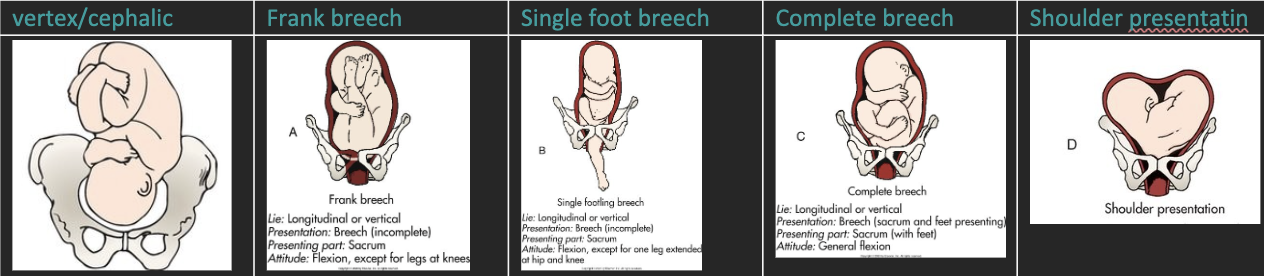
fetal presentation
fetal part entering pelvis first. Preferred= vertex/cephalic
3 types- cephalic/vertex, breech, shoulder
Breech- buttocks first, feet first, or both
fetal lie
relation of fetal & maternal axes. Preferred= vertical/longitudinal
3 types- longitudinal/vertical, transverse/horizontal, oblique/diagonal
Vertex & breech presentations are vertical/longitudinal. fetal spine parallel to maternal spine

fetal attitude
posture- flexed or extended. General flexion easiest to deliver vaginally

fetal position
relationship of reference point on presenting part of fetus to maternal pelvis. Preferred= L/ROA

fetal station
relation of presenting part to ischial spines. Rate of descent in labor important
Engagement- usually @ 0 station, when presenting part passes through pelvic inlet into true pelvis
Pushing starts at 0 to +2 station
Delivery happens when presenting part is on perineum, at station +4 to +5
Ischial spine- narrowest part of pelvis . Station 0?
Ischial tuberosity- relaxation & incr mobility of pelvic joints/k=ligaments in 3rd tri, include symphysis pubis & coccyx
Can cause pain & instability

dilation & effacement
Effacement- gradual shortening & thinning of cervix in labor. Expressed in %
Dilation- gradual enlargement/widening of cervical opening during labor. Expressed in cm
Primary powers- uterine contractions & pressure from presenting part promotes dilation
Scarring of cervix (infection, surgery) can slow dilation
external cephalic version
Doctor manually reposition baby from breech/shoulder into correct position (vertex)
Done in hospital under ultrasound guidance. Done at 34-37wk
Premedicate w/ uterine relaxant like terbutaline. Painful procedure
Risk- placental abruption, cord accident, emergency c section- consent required, non reassuring FHR, prolonged fetal bradycardia, variable decels, fetomaternal bleeding
Usually deliver soon after procedure as baby can revert to previous position
how true labor contractions cause effacement and dilation of cervix
True labor -involuntary contractions, originate at pacemaker points in thickened muscle layers of the upper uterine segment. contractions move downward over the uterus in waves, separated by short rest periods
The primary powers are responsible for the effacement and dilation of the cervix and descent of the fetus
how is vaginal exam data communicated?
Measures cervical dilation, cervical effacement, & fetal station
Cervical dilation. Measure w/ space b/n 2 fingers
Communication: dilation/effacement/station
Ex= 5/80/-2 = 5cm dilated, 80% effaced/-2station
how to know delivery is imminent?
Strong, uncontrollable urge to push, pt more vocal, pt feel onset of contraction
Cervix- fully dilated 10cm, fully retracted, can no longer palpate
Pt- change position more freq to find comfortable pushing position. More focused/rhythmic
Visible perineal change- bulging of perineum, crowning, anus stretch/protrude
Bloody show- brown/blood tinged mucus passed as cervix dilate. Incr # as delivery approaches
what are normal maternal/fetal changes in labor
Maternal- incr WBC/RR/temp/proteinuria/caridac output/HR/BP
Decr- gastric motility (cause n/v), blood glucose
Fetal- fetal lung fluid cleared as infant passes through birth canal,labor cause lung fluid absorption
Fetal PO2 decr, PCO2 incr, pH decr, HCO3 decr
Why are normal ADLs encouraged in labor? What safety precautions should be considered?
Shower/bath- relaxation/pain control
Nutrition- encourage fluids & caloric intake. IVF if NPO, usually LR
Elimination- void q2 hr, catheterize if unable to void, always perform vag exam if pt express urge to defecate
Ambulation- improves contraction intensity, shortens labor duration, help w/ pain control, reduces rate of operative delivery
freq position changes (q30-60min) & upright positions for bedbound
Lateral/hands+knees facilitate rotation of fetus into OA position
Immediate care of newborn after delivery – what is most important? respirations
Dedicated newborn nurse for each infant-NRP certified
Brief assessment- APGAR
Prevent hypothermia- skin to skin, warm blanket, cap
Identification- bands matching mother & support person to infant
Promote early breastfeeding during infant’s initial alert state. Sleep for many hrs after
Skin to skin prone on mom’s abdomen
Delay cord clamping 1-5min after birth- transfers 30% of fetal-placental volume (stem cells, RBCs, whole blood)
Infant reach 80% O2 @ 5min, & 85-95% @ 10min
benefits of skin-to-skin care
Positive bonding, incr breastfeeding, infant cardiorespiratory stability, infant temp stability, incr BG levels
mgmt during 4th stage
1st 2hrs after birth
Obtain cord blood sample to check newborn blood type (from cord attached to placenta)
Blood banking from cord blood- predetermined, optional
Genital trauma- perineal, vaginal, periurethral, cervical lacerations; episiotomy; bruise, edema, hematoma
Usually worse in primiparas
Lacerations(1-4degree) repaired by provider (pain mgmt prn), then perform perineal hygiene, apply ice
Disposition of placenta?
Assess BP, pulse, fundus, lochia every 15min
Assist w/ bladder emptying
Reassess perineum
Rest, bonding nutrition
cardinal movements labor
engagment/descent, flexion, internal rotation, extension, restitution/ external rotation, external rotation/expulsion
nonpharmacologic pain mgmt options
Relaxation/ breathing technique, effleurage/counterpressure, touch/massage, hot/cold, acupressure/acupunction (pain relief & labor induction/augmentation), TENS, hydrotherapy, intradermal water block, aromatherapy (rose/ jasmine/lavender), music, hypnobirthing
risks of using opiods for pain mgmt during labor
Crosses placenta, watch for resp depression in mom & fetus
Prefer those w/ short half life
Fentanyl- common. Rapid onset & short half life. Admin IV/epidural/intrathecal
epidural
Ability to deliver continuous infusion
Goal is T10/umbilicus for vaginal delivery; T6/below breasts for c section. Too high level can cause resp paralysis
Continuous fetal monitoring, monitor level of block, bladder emptying, assist w/ ambulation, fluid bolus prior to procedure, incr freq of vitals esp hr/bp, incr time for pushing, lower dose during pushing if needed
Routine -Position on side to prevent vena cava/aorta compression. Alt side every hr
Assess/doc resp status every hr 1st 24hrs. Prevent hypotension (IV hydration, displace uterus to side)
SE- n/v, diminished peristalsis, pruritus, urinary retention, delayed resp depression
Comp- hypotension – mgmt= LION, Trendelenburg, vasopressor (ephedrine, phenylephr), monitor vitals, 1to1 care
Lateral position, incr IVF, O2 10L/min via face mask, elevate legs
Spinal headache- mgmt= supine, dim lights/noise, caffeine, analgesics (fioricet), PO/IVhydration, blood patch
Contra- active/anticipated serious maternal hemorrhage, maternal hypotension, maternal coagulopathy, spinal injury, infection @ injection site, incr intracranial pressure, allergy to anesthetic drug, maternal refusal/inability to cooperate, some types of maternal cardiac condition
Platelet level needs to be >100k
general anesthesia indications
Used for some c section delivers
Indication= contraindication to spinal/epidural, emergency delivery w/o time to place/dose spinal/epidural
IUGR risk factors
Poor uteroplacental perfusion d/t HTN, poor nutrition, smoking, inadequate maternal weight gain
Substance use, diabetes, renal/cardiac disease, chronic infection, IUGR hx, multifetal
preterm labor
Leading cause of perinatal death. Occurs @ 20-36.6wk gestation
Uterine contractions & cervical change or presentation w/ cervix @ 2cm
Fetal prognosis improves each wk of pregnancy
Cause- infection, maternal med hx, lifestyle, domestic violence, congenital anomalies, multiple fetus, maternal structural anomaly, stress, decr progesterone, genetic predisposition, prior PTL, vaginal bleeding, uterine anomaly, assistive reproductive technology, substance use, underweight, obesity, limited PNC, social determinants
s/s- vaginal discharge change, pelvic/lower abd pressure, constant low backache, abd cramp, regular contractions (often painless), ruptured membranes
Risk factors- DM, HTN, preeclampsia, previous c/s, cholestasis, placental abruption/previa, seizure, thromboembolism, connective tissue disorder, asthma/chronic bronchitis, maternal HIV/ active herpes infection, obesity, smoking, old age, fetal compromise, poor fetal growth, abnormal NST/BPP, extra/few amniotic fluid, birth defect, multifetal complications
Prevention- preconception counseling, progesterone supplement (16-36wk, 40% in preterm birth), lifestyle mod, monitor cervical length, cerclage (suture. Prophylactic or rescue. Remove before labor?)
Tx- transfer to facility w/ NICU if stable
Glucocorticoid- betamethasone/dexamethasone b/w 23-36.6wk. Matures fetal lungs, decr IVH/NEC/death
Tocolytics (smooth muscle relaxant)- terbutaline. Give w/ corticosteroid therapy for 48hr
Magnesium sulfate prior to 32wk- reduce neonate cerebral palsy/neuroprotection. Also use as tocolytic
Antibiotics- prevent/tx infection- GBS/e.coli-ampicillin
preterm labor treatment medications
Nifedipine (procardia/adalat)- ca channel blocker, reduces contractions. SE- tachycardia, hypotension.
Contra- intrauterine infection, HTN, heart disease.
Mg sulfate- cns depressant, smooth muscle relaxant. Neuroprotective effect for mom& fetus. Decr seizure risk in mom & decr cerebral palsy incidence in preterm fetus.
Toxicity -> mom/baby resp & neuro depression, hypotonia, poor suck
Terbutaline (brethine)- smooth muscle relaxant & bronchodilator. Don't use >24hr d/t adverse mom cardia effect, esp tachycardia. Typically used to stop contractions initially in preterm labor & labor emergencies. subQ
Common use- tx tachysystole in labor, suppress contraction prior to c/s. Used initially in preterm labor d/t fast action. Used in maternal transfer to higher level facility.
Contra- known/suspected heart disease, preeclampsia w/ severe feature, eclampsia, DM, hyperthyroidism, mom fever, fetal tachycardia, chorioamnionitis s/s.
Indomethacin/nsaid- suppress PTL by block prostaglandin. 1st line tocolytic. For pt <32wk
Contra- limit to 2/3days of use d/t severe SE
PROM/ PPROM
PROM- prelabor membrane rupture- occur before onset of labor @ any gestational age
PPROM- preterm PROM- rom prior to 37wk. D/t weakening of membranes often from infection or incr pressure (multiples, polyhydramnios, contractions)
Complication- infection, cord compression, prolapse
Mgmt
Delivery at term. Delivery >34wk cuz risk of infection outweigh benefit of prolonged pregnancy.
>32wk- determine pulm maturity, then deliver to prevent cord compression
Conservative/expectant mgmt
<32wk- risk of decr maturity outweigh infection risk
daily fetal assessment, monitor for labor, infection s/s, abruption
Same tx as PTL: 7 day ABX ampicillin, steroids, mg sulfate
main considerations for preterm delivery & for fetal/neonatal death
preterm
Prevent intracranial hemorrhage, may delive through cervix not fully dilated, may deliver precipitously in breech but c/s still recommended, resuscitation personel & equip, transfer after stabilization of neonate if can’t transfer before delivery
Death
Family & interprofessional team mgmt plan.
Grief support, memories, time w/ infant, disposition of infant, funeral/memorial service
GBS & chorioamnionitis
Bacterial infection of amniotic cavity
Common cause- vaginal bacteria ascend into amniotic cavity
s/s- maternal fever, mom/baby tachycardia, uterine tender, foul/purulent fluid
Risk factors- long labor, prolong ROM, multiple vag exams, internal monitoring, genital infection, young maternal age, low socioeconomic, nulliparity
Comp- dysfx labor -> c/s, maternal wound infection, neonatal infection, PPH
Prevention- GBS prophylaxis during labor (penicillin G for GBS + moms)
Active mgmt of labor, induction if PROM. ABX in PTL & PPROM
Tx- antipyretic (IV acetaminophen), IV broad spectrum ABX (amp, gent, clinda in c/s), delivery
Affects 5% term birth, 25% preterm. Prolonged ROM >18hr
Lead to neonatal infection/cns damage/death- pneumonia, bacteremia, meningitis
pst term fetal complications. post term = >42wk
Fetal comp- macrosomia (-> birth injury, shoulder dystocia, operative birth), oligohydramnios (-> cord compression),meconium fluid (-> aspiration), aging placenta (-> hypoxemia, stillbirth)
Maternal comp- labor dystocia, perineal injury, infection, PPH, c/s, assisted vag delivery
meconium in amniotic fluid
Cause- normal as gestation age advances. Incr after 38wk & w/ breech presentation
Result of hypoxia induced peristalsis & sphincter relaxation
Umbilical cord compression- induced vagal stimulation
Risks- meconium aspiration syndrome in newborn -> severe pneumonia
Interprofessional team for neonatal resuscitation
obesity assoc risks
Incr rate of preexisting conditions- chronic HTN, type 2 DM
Incr pregnancy risks- gest HTN, gest DM
Incr fetal risks- SAB, stillbirth, macrosomia, congenital anomaly
Incr L/D risk- postterm, long labor, c/s, induction
Incr PP risk- VTE, wound infection, PPH
causes of dysfunctional labor
Cause- ineffective contractions/pushing, abnormal fetal presentation/position, pelvic structure, CPD (cephalopelvic disproportion)
Chorio can cause ineffective contractions
Dystocia- lack of progress in labor (dilation/descent)
Dysfx labor- long, difficult, abnormal
Risk for c/s
causes of precipitous delivery
Labor <3hr
Assoc w/ - abruption, tachysystole, maternal drug use (cocaine), uterine rupture, vag laceration, amniotic fluid embolus, PPH
Length of labor decr w/ incr # previous deliveries
Fetal comp-hypoxia, intracranial trauma, facial bruising
Incr risk for out of hospital delivery
complications assoc w/ multifetal pregnancies/ deliveries
Fetal comp- preterm, abnormal presentations, IUGR, twin to twin transfusion
Twin2twin- prenatal condition, twins share unequal # of placenta;’s blood y supply, fetuses grow @ different rates. 70% identical twins share placenta, 15-20% of them affected by twin2twin
Maternal comp- HTN, anemia, PPH, abruption, high rate c/s
Nurse for each newborn @ delivery
Breech
Risk factors- abnormal # amniotic fluid, uterine abnormalities, pelvic abnormalities, alcohol, anticonvulsants, placenta previa, multiple fetuses, fetal anomaly, IUGR, short cord, preterm delivery, genetic disorders (trisomies)
Comp- cord prolapse, head entrapment, head/arm trauma
c/s recommended. EFM US placed above umbilicus. Incidence decr as gestation incr
induction of labor
25% of births. Indicated vs elective
Elective @ 39wks to prevent prematurity (dates +/- 2 wks)
Verify fetal position/presentation, placenta position, & gestational age. Bishop score (cervical status)
IV oxytocin & amniotomy most common methods
Cervical ripening agents- misoprostol (cytotec), dinoprostone (cervidil)
Prostaglandins. Soften/thin cervix prior to dilation. Can also begin spontaneous labor, decr induction time/ oxytocin #.
Mechanical dilation- foley bulb. Not as effective as meds. Foley w/ 30-50ml inserted through cervix, releases endogenous prostaglandins. Falls out when 3cm dilated
Membrane sweeping- releases oxytocin & prostaglandins. Separates membrane from cervix wall w/ 1 finger in cervix. Safe, effective, done in office
self induction- intercourse, nipple stimulation, walking. Stim oxytocin
amniotomy
AROM- artificial rupture of membranes. Performed by provider only. Labor w/n 12hr of ROM. AROM decr labor 2h
Fetus should be engaged in pelvis & verified vertex. Monitor EFM during/after procedure
Risk- chorio, cord prolapse, variable decels w/ cord compression
Indication- induce labor when cervix ripe, augmnet labor when labor progress slows. Often use w/ oxytocin
Contra- active maternal infection, fetal positiong- presenting part must be engaged & well applied to cervix
Monitos- FHR, amniotic fluid color/#/odor, mom temp, infection s/s, limit vag exam
oxytocin
Risk- uterine tachysystole, abruption, rupture, c/s, PPH, fetal acidemia
Hormone made by posterior pituitary gland. Stim uterine contraction & aids in milk let down
Synthetic oxytocin(pitocin) used to induce/augment labor.
Titrated med- goal= consistent contraction w/ adequate intensity
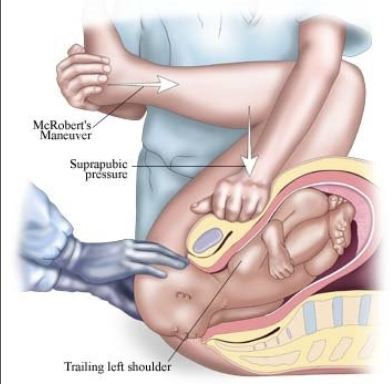
shoulder dystocia
Inability to deliver shoulders after birth of head
Risk factors- maternal obseity, macrosomia, prolonghed 2nd stage, diabetes, instumental delivery
Fetus comp- hypoxia, permament brain injury, death, birth injury (brachial plexus injury -> brachail/erbs/facial palsy; clavical/humerus fracture)
Mom comp- PPH, vag/perineal/rectal injuries
Mgmt- call for additional help. Under provider direction :
mcrobert’s maneuver, suprapubic pressure, maternal reposition to hands/knees
Avoid fundal pressure.
cord prolapse
Cord falls below presenting part. Immediate mgmt & delivery
Risk factors- fetal malpresentation, lack of engagement of presenting part, polyhydramnios, abnormal placentaion, abnormally long cord, small fetus
Often when membrane rupture- can be seen or unseen. Life threatening
FHR- abrupt, severe, variable decels or bradycardia from cord compression
Mgmt- monitor FHTs. IV fluid bolus. Prepare for emergency c/s unless vag delivery imminent
Gloved hand in vagina pushes fetus upward & off cord
Knee-chest position uses gravity to shift fetus out of pelvis. Elevate hips w/ 2 pillows. trendelenburg
operative vaginal birth- vacuum, forcep
Indication- prolonged 2nd stage, maternal exhaustion, nonreassuring FHR tracing, fetal head must be engaged (@ least 0 station)
Risks- maternal trauma (vag/cervical laceration, urinary retention, hematoma)
Infant trauma- bruise/abrasion, facial palsy, subdural hematoma, cerebral irritation (seizure, lethargy, incr irritability, poor feeding), jaundice
Vacuums easier to place & require less pain control. Must have full dilation, empty bladder, engaged presenting part, ROM, no CPD. Neonatal risks incr w/ # of popoffs, stay w/n recommended pressure zone
cesarean delivery
Preserve well being of mom/infant. Schedule/unplanned
Indication- previous c/s, inadequate labor progress, maternal medical condition, placental malposition, placental abruption, placental insufficiency causing fetal intolerance of labor, fetal malpresentation, multifetal gestation, congenital anomalies, active genital HSV, high HIV viral load, eclampsia
Comp- anesthesia exposure, hemorrhage, bowel/bladder injury, amniotic fluid embolus, infection, VTE
definition & risks of TOLAC
Trial of labor after c/s. Vag birth after c/s
Overall success rate= 60-80%. Strong predictors of successs= prior vag birth & spontaneous labor
Contra- high risk for uterine rupture, cephalopelvic disproportion
Informed consent. Conservative induction agents, close monitoring during induction
Risk- uterine rupture @ old scar
uterine rupture
Main risk factor= previous uterine scar
Other risk factos- trauma, grand multiparity, overdistention (multifetal, macrosomia, polyhydramnios). Previous rupture, uterine perforation from instrument
s/s- cat II/III FHR tracing, sharp abd pain, bright red vaginal bleeding, hypovolemic shock, abrupt FHR decel, late/variable decl, absent variability
amniotic fluid embolus
Anaphylactoid syndrome of pregnancy- exact cause unknown. Rare, unpreventable
Sudden resp/cardio collapse w/ coagulopathy
Acute onset of hypotension, hypoxia, hemorrhage
Mgmt- O2, maintain CO, correct coagulation, monitor, c/s prepare, emotional support
If mother survive, transfer to ICU. Neonate mortality 20-60%- those who survive have high morbidity-neuro
Neither embolism or amniotic fluid related