L10 Prostate Cancer
 Call Kai
 Learn
 Practice Test
 Spaced Repetition
 Match
 Flashcards
 Knowt Play
1/40

There's no tags or description
Looks like no tags are added yet.
41 Terms
What is the incidence of prostate cancer?
2nd most common cancer, 2nd leading cause of cancer death in the US
1 in 8 men will be dx w prostate cancer
Who are at high risk of prostate cancer?
african american
men w first degree relative dx with prostate cancer at age <65 yrs (african american x2 > caucasian > asian)
What are the genetic risk factors of prostate cancer?
tumor suppressor genes:
BRCA1/2 20-40% risk , 15% preval
TP53
ongogenes
BCR-ABL; HER2
What are the dietary risk factors of prostate cancer?
high meat and high fat intake
dec 1,25 dihydroxy vitamin D intake
African American men are at 2.5x higher risk of mortality from prostate cancer compared to non-Hispanic white men. BUT if there a difference when full adjust for other factors?
NO difference when fully adjusted for age, stage, insurance status, therapy received, socioeconomic status, access to healthcare
List social determinants assoc w prostate cancer mortality
social support
neighborhoods
insurance status
access to screening and healthcare
adherence
describe the prostate gland
located betw bladder and penis
Urethra passes through the prostate
Prostate gland cells produce seminal fluid, a glycoprotein that aids sperm motility
growth is dependent on testosterone
Look at pathophys of prostate gland

Digital Rectal Exam (DRE) is not specific for prostate cancer and is not routinely recommended due to no evidence being beneficial for screening. What symptoms are consider normal and prostate cancer
normal: firm, but movable
prostate cancer: hard, lumps, inability to move
Prostate specific antigen (PSA) is a value used during prostate cancer screening. What value requires further evaluation? (not a cancer specific marker)
PSA >4ng/mL
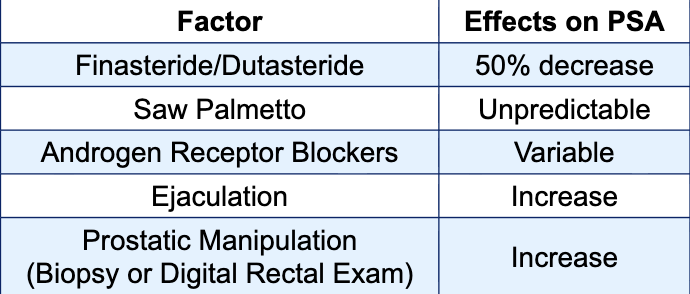
Which drugs affect PSA?
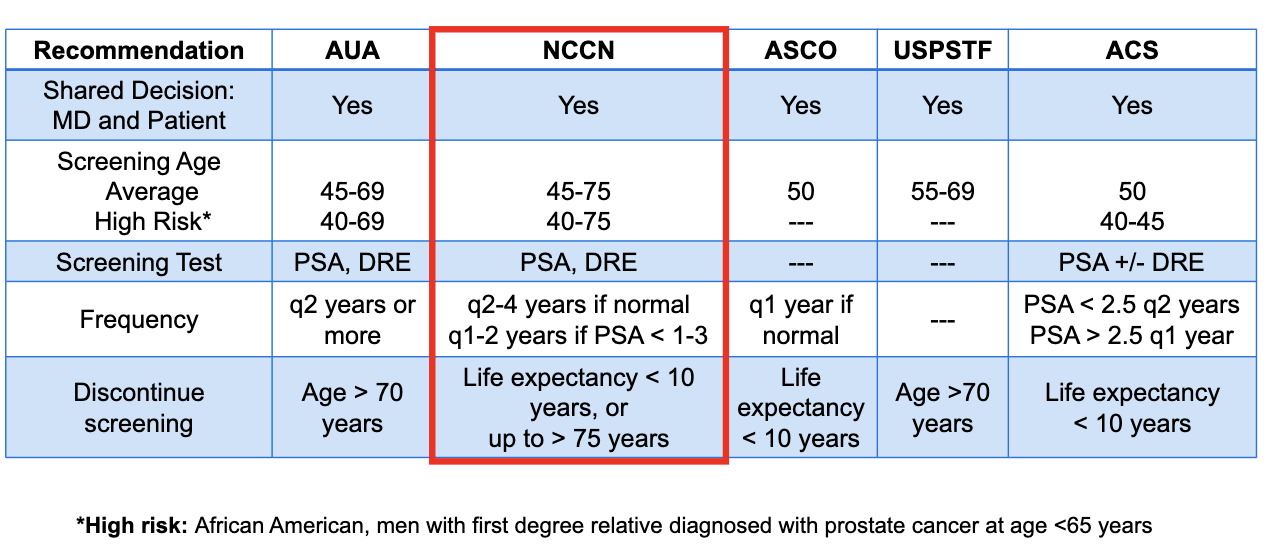
NCCN screening recommendations
pt experiences symptoms such as difficult/painful/frequent urination, blood in urine or semen, impotence. What do they have?
localized prostate disease (otherwise usually asymptomatic)
pt experiences bone metastases (such as pain in back/hips/upper thighs, weakness/numbness in legs and feet from spinal cord, and fractures), lung or liver metastases. What do they have?
advanced/metastatic prostate disease
What is used for dx of prostate cancer?
gold standard: prostate biopsy
PSA
genetic testing
What is involved in the work up of prostate cancer?
Physical examination
Digital rectal exam
Estimate life expectancy
PET/CT
MRI
PSMA PET
tumor grade is based on
most common histologies seen on biopsy
gleason score is
most common grade + second most common grade

prostate cancer staging is based on what?
TNM staging:
size of tumor (T)
lymph node involvement (N)
metastases present (M)
PSA levels
Gleason grade group
What are the 3 stages of prostate cancer?
Localized (Any T, N0, M0)
Regional (Any T, N1, M0)
Metastatic (Any T, Any N, M1)
What is the initial treatment for localized/regional prostate cancer?
observation or active surveillance
radiation
surgery
androgen deprivation therapy (ADT)
surgical castration
pharm castration
What is the goal for observation vs active surveillance?
observation: maintain quality of life by avoiding non-curative treatment
active surveillance: actively monitoring expectation to deliver curative therapy if the cancer progresses (may act upon)
pt has low to favorable intermediate risk disease and a <10 year life expectancy. Should they undergo observation or active surveillance?
observation (preferred pts)
pt has low to favorable intermediate risk disease and a >=10 year life expectancy. Should they undergo observation or active surveillance?
active surveillance (preferred pts)
What should be monitored in observation vs active surveillance?
observe: PSA, DRE, S every 12 mo
act surveill: PSA no more than q6mo; DRE and biopsy no more than q12mo
What are the advantages of observation and active surveillance?
avoid possible ADE assoc w treatment
maintain quality of life
What are the disadvantages of observation?
risk of progression of disease
inc pt anxiety
What are the disadvantages of active surveillance ?
missed opportunity for cure
treatment delay
icnreased pt anxiety
pt is in low risk group (OR favorable intermediate risk) and has a long life expectancy (>=10yrs) What should you treat them with?
active surveillance
radiation therapy (RT)
radical prostalectomy (RP)
pt is in low risk group and has a short life expectancy (<10yrs) What should you treat them with?
observation
pt is in favorable intermediate risk group and has a short life expectancy (5-10yrs) What should you treat them with?
observation and RT
pt is in unfavorable intermediate risk group and has a long life expectancy (>10yrs) What should you treat them with?
RP
RT + androgen deprivation therapy (ADT) 4-6mo
pt is in high/very high risk group and has a long life expectancy (>5yrs or sympt) What should you treat them with?
RT + ADT (1-3yrs)
very high only: RT + ADT + abirateron (2yrs)
RP ± pelvic lymph node disecction (PLND)
pt is in unfavorable intermediate risk group and has a short life expectancy (5-10yrs) What should you treat them with?
RT + ADT (4-5 mo)
observation
pt is in high/very high risk group and has a long life expectancy (<5yrs or asympt) What should you treat them with?
observation
RT ± ADT
pt has regional prostate cancer (any T, N1, M0) and has a long life expectancy (>5 yrs or sympt). How should you treat them?
RT + ADT + abiraterone (2yrs)
RT + ADT (2-3yrs)
ADT ± abiraterone
RP
pt has regional prostate cancer (any T, N1, M0) and has a short life expectancy (<=5 yrs or asympt). How should you treat them?
RT ± ADT
observation
radiation therapy is indicated for local, regional, and metastatic disease. What are the types of radiation?
External beam radiation therapy
Stereotactic body radiotherapy
Internal radiation therapy
Brachytherapy: radiation seeds injected into the prostate
What are the types of surgery?
Radical prostatectomy
Pelvic lymph node dissection
What are the ADE of radiation and surgery?
Frequent and obstructive urination, incontinence, abdominal cramping, bowel dysfunction, rectal bleeding, sexual dysfunction, proctitis