Learn: Teas chemistry basics
 Call Kai
 Learn
 Practice Test
 Spaced Repetition
 Match
 Flashcards
 Knowt Play
1/39

There's no tags or description
Looks like no tags are added yet.
40 Terms
What is an atom?
Smallest particle of an element
What are the 3 main subatomic particles?
protons, neutrons, electrons
What is the charge of a proton?
positive +1
What is the charge of neutron?
neutral 0
What is the charge of an electron?
negative -1
Where are protons located?
inside the nucleus of an atom
Where is the neutrons located?
inside the nucleus of an atom
Where is the electron located?
electron cloud outside the nucleus
what is the atomic number?
the number of protons in an atom
How do you find the mass number?
protons + neutrons
how do you calculate the number of neutrons?
Atomic Mass - Atomic Number = # of Neutrons
In a neutral atom, how does the number of protons compare with electrons?
The number of protons equal the same amount of electrons
What is an isotope?
Atoms of the same element that have different numbers of neutrons
What is a ion?
an atom or molecule with a net electric charge due to the loss or gain of one or more electrons.
What is a cation?
A positively charged ion
What is an anion?
A negatively charged ion
What is an element
a Substance that contains only ONE type of atom.

What is a compound?
2 or more elements chemically combined
What is a molecule?
A group of atoms bonded together (2 or more)
Is every molecule a compound?
No. A molecule such as O₂ contains only one element.
What is a mixture?
A physical combination of substances that are not chemically bonded together.
What is a homogeneous mixture?
a mixture that is the same throughout
What is a heterogeneous mixture?
a mixture in which the composition is not uniform throughout
What is the difference between a compound and a mixture?
Compounds are chemically bonded in fixed proportions; mixtures are physically combined and can have variable proportions.
What does a period represent on the periodic table?
A horizontal row.

What does a group or family represent on the periodic table?
A vertical column containing elements with similar chemical properties.

Where are most metals located on the periodic table?
On the left side and in the center.
Where are most nonmetals located on the periodic table?
On the right side of the periodic table, with hydrogen as an exception.

What are metalloids?
elements that have some properties like metals and some like nonmetals
What are valence electrons?
electrons in the outermost shell
Why do atoms form chemical bonds?
To become more stable
What is a physical property?
a characteristic that can be observed or measured without changing the identity of the substance

What is a chemical property?
the ability of a substance to undergo a specific chemical change
What is a physical change?
A change in which the form or appearance changes, but no new substances are formed

What is a chemical change?
A change in matter that produces one or more new substances
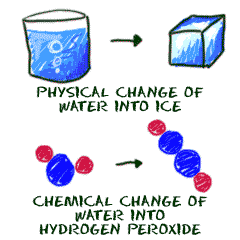
Give two examples of physical changes
Ice Melting and boiling water
Give two examples of chemical changes
wood burning, iron rusting
What does the law of conservation of mass state?
matter cannot be created or destroyed
Which particle determines the identity of an element?
The number of protons in the nucleus of an atom determines the identity of an element.
Which is a homogeneous mixture?
A. Oil and water
B. Granite
C. Salt water
D. A bowl of cereal
C. Salt water (becomes mixed all the way through)