Quant Methods
 Call Kai
 Learn
Learn Practice Test
 Spaced Repetition
 Match
Match Flashcards
 Knowt Play
1/62

Earn XP
Description and Tags
Name | Mastery | Learn | Test | Matching | Spaced | Call with Kai | Chat |
|---|
No analytics yet
Send a link to your students to track their progress
63 Terms
What is the difference between fixed and dynamic populations?
fixed - membership is defined based on some event
that happens once, permanent
dynamic - membership is defined as being in a state or
condition, transient
What is a subset of the source population called?
a study sample
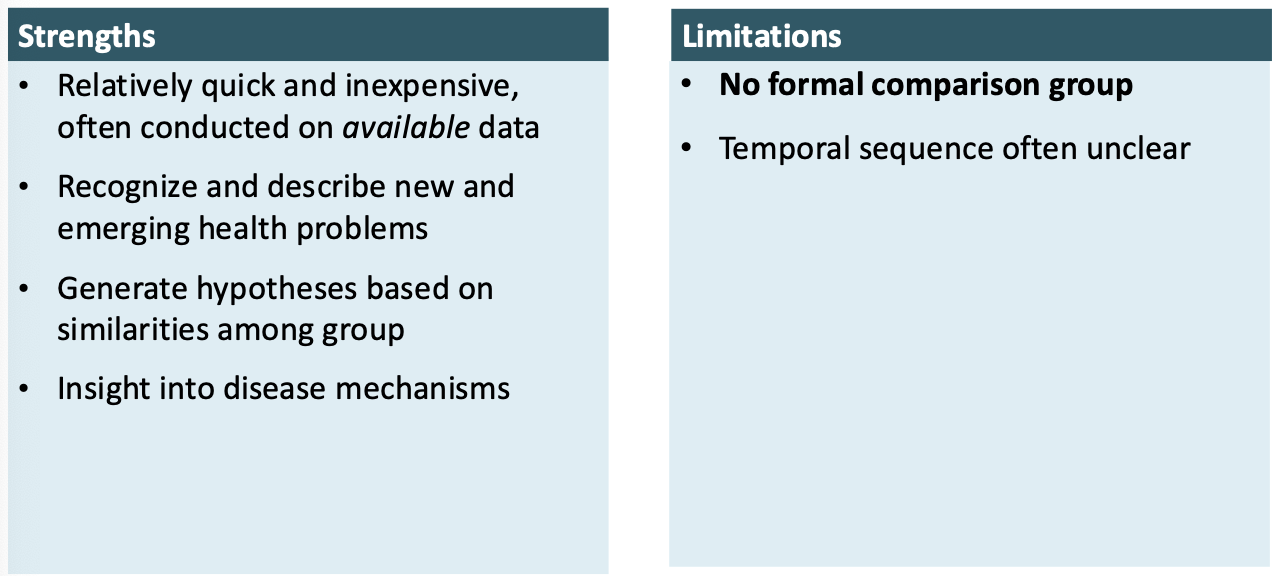
What is a case report vs case series?
case report - a detailed report on one individual with a new or unusual health outcome
case series - a detailed report on a single group with a new or unusual health outcome
What are the strengths vs limitation of case report and case series?
What is a cross-sectional study?
a study that compares current exposure status to current disease status at a single point in time
What are the strengths and limitations of a cross-sectional study?

What is an ecologic study?
a study that examines associations between exposures and outcomes on a population level
What are the strengths and limitations of an ecologic study?

What is an ordinal variable type?
more than 2 ranked responses
A questionnaire has responses that participants have to choose between low income, median income, or high income. What type of variable is this?
ordinal
What is a categorical variable type?
responses are grouped and unordered
A survey asking about hair color is using what type of variable?
categorical
What is a continuous variable?
assumes any numerical value between a minimum and maximum
An acid burn is an example of what exposure?
acute
Outdoor air pollution is an example of what exposure?
chronic
Genetics and ancestry and what type of exposure?
constituent
Marital status, diet, and smoking are all examples of what exposure?
time-varying
What is a limitation of a cross-sectional study in regards to exposure?
will not catch a time-varying exposure since it is at a single point of time
What are the 3 major exposure routes?
inhalation
ingestion
dermal (skin) contact
Exposure variables can be cateogorized into what?
continuous
dichotomous
ordinal
categorical
Non-smoker, light smoke, and heavy smoker would be categorized into what?
ordinal
Racial groups would be categorized into what?
categorical
What is the difference between critical window and induction time?
critical window - when is exposure relevant during life course
induction time - time lag between the exposure and the biological onset of disease
If the same amount of a contaminant is ingested by two people of different body weights, who would have the higher concentration of contaminant?
the smaller person
The first and second trimesters of pregnancy in regards to a Zika virus infection are considered what?
critical window
What is the difference between induction time and latent period?
induction time - period between exposure and disease beginning
latent period - interval between when disease begins and diagnosis
What shortens the latency period and why?
screen-detected cases because one is not waiting until apparent symptoms
What is an exposure assesment?
an applied science for measuring human contact with an exposure of interest
What is the difference between reliability and validity?
reliability = consistent answers every time
validity = is it related to other measures
What is an exposome?
measure of all the exposures of an individual in a lifetime
and how those exposures relate to health
What is prevalence?
proportion of people who have a condition at a specified point in time
What is cumulative incidence (risk)?
proportion of at-risk people who develop a condition during a specified time period
What is incidence rate?
speed at which at-risk people develop a condition during a specified time period
What are the characteristics in common for measuring disease frequency?
# of cases / size of population
measured in source population of interest
What is the equation for prevalence?

What are the units for prevalence?
no units, cancels out
In 2016, there were 21 million adults with Type 2 Diabetes out of a total of 244,186,465 adults in the U.S. What was the prevalence of Type 2 Diabetes in adults in the U.S. in 2016?
21 000,000 / 244,186,465 = 8.6%
In 2018, a survey was conducted of 1,891 children 12-23 months of age in Zambia. Among these children, 1,719 reported receiving the measles vaccine. What was the prevalence of measles vaccination among these 12-23 month-old children in Zambia in 2018?
1719 / 1891 = 90.9%
How do you calculate cumulative incidence (risk)?

What are the units for risk?
no units
What does “at risk” mean?
theoretically capable of developing diasese
If you currently have a condition are you at risk for that certain condition?
no
In a cohort of pregnant women receiving prenatal care at BMC during a 1-year period from 2014-2015, there were 252 deliveries. Of these newborns, 13 were classified as low birthweight (<2,500 grams). What was the 1-year cumulative incidence (risk) of low birthweight in this group?
13 / 252 = 5.2%
Suppose we want to estimate the cumulative incidence (risk) of low birthweight in first pregnancies. Of the 252 deliveries, 67.1% of infants were a first pregnancy. Of these newborns, 11 were classified as low birthweight. What is the 1-year cumulative incidence (risk) of low birthweight for first pregnancies?
252 x 0.671 = 169.092 —> 11 / 169.092 = 6.5%
What are the limitations of cumulative incidence?
no loss to follow up
does not consider time of occurrence
How do you calculate incidence rate?

What are the units for incidence rate?
1/time or cases/person-time
What is person-time?
amount of time each study participant is under observation
In an open cohort of children under 5 in the UK, the effect of socio-economic deprivation on injury was examined from 1990-2009. A total of 20,668 fractures, 15,796 burns, and 10,155 poisonings were reported over a total of 2,725,000 person-years. What was the incidence rate of burns among children under 5 in the UK from 1990-2009?
15,796 / 2,725,000 = 0.00579 x 1000 = 5.8 burns/1000 person years
When would you look at absolute measure vs relative measure?
absolute - quantifies excess risk of disease in exposed group compared to unexposed group; measure of public health impact
relative - quantifies the relative risk of disease in exposed group compared to unexposed group; measure of strength or magnitude of association
How do you calculate prevalence difference (PD)?
PE – PU
How do you calculate risk difference (RD)?
RE – RU
How do you calculate incidence rate difference (ID)?
IRE – IRU
If there is NO ASSOCIATION between the exposure and disease, then the RD_____?
RD = 0
If the exposure is associated with INCREASED RISK of disease then the RD ____?
RD > 0
If the exposure is associated with DECREASED RISK of disease then the RD ______ ?
RD < 0
What is the prevalence ratio?
PE / PU
What is risk ratio?
RE / RU
What is incidence ratio?
IRE / IRU
If there is NO ASSOCIATION between the exposure and disease, then the RR ___?
RR = 1
If the exposure is associated with INCREASED RISK of disease, then the RR ____ ?
RR > 1
If the exposure is associated with DECREASED RISK of disease, then the RR ____ ?
RR < 1