Quiz 1B Math
 Call Kai
 Learn
 Practice Test
 Spaced Repetition
 Match
 Flashcards
 Knowt Play
1/27

There's no tags or description
Looks like no tags are added yet.
28 Terms
Horizontal Case 1
the leading terms have the same degree (n=d)
result: horizontal asymptote that is the ratio of the leading term coefficients y= a/b
Horizontal Case 2
the denominator dominates the numerator (n<d)
result: horizontal asymptote of y=0
Horizontal Case 3
the numerator dominates the denominator (n>d)
result: NO HORIZONTAL ASYMPTOTE
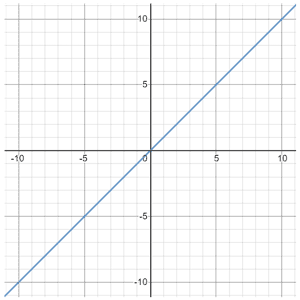
y=x
y = x2

y=x3

y= 1/x

for rational funcs the denominator
can’t equal 0
Degrees divided
subtraction
Special cases
the degree of the numerator is exactly 1 more than the degree of the denominator
result: oblique(slant) asymptote
Slant asymptote is long division (ignore remainder)
vertical asymptote
set denominator equal to zero
BUT if the factor cancels out its a hole
finding x-intercepts/zeros
this will be found in the numerator
when finding domain for rational functions
ALWAYS at the denominator for this info
Binomial theorem
(a+b)²= (a+b)(a+b)= a²+2ab+ b²
Pascel triangle hint
when you choose what row you’re using label each first variable from greatest to least
label each 2nd variable from least to greatest
ex. (x+2)² would be mean the 2nd “variable is 2” and the 1st one is x
Additive: Vertical translations (k)
up+k or down-k
Additive: Horizontal translation (h)
(x+h) or (x-h) then you flip sign
Multiplicative: Vertical (a)
Vertical dilation by a factor of a is simple multiplication
Multiplicative: Horizontal (b)
Horizontal dilation by factor of 1/b ( divide by b)
g(x)= f(bx)
note: b is inside
a-value
vertical reflection across x axis for a<0
vertical dilation by factor of a
(x-a)2
bounces (quadratically)
(x-a)3
squiggle (cubically)
odd degree (x3)
end behavior opposite
even degree (x2)
end behaviors are the same
positive leading coefficients
up on the right
negative leading coefficients
down on right
transformations of polynomial function
F(x)= a f[b(x-h)]+k