Chapter 12 Mendel Genetics review
 Call Kai
 Learn
 Practice Test
 Spaced Repetition
 Match
 Flashcards
 Knowt Play
1/105

Earn XP
Description and Tags
Mendel Genetics
106 Terms
Gregor Mendel
An 19th-century Austrian monk and scientist widely recognized as the "Father of Genetics"
Through his meticulously documented, quantitative experiments cross-breeding garden pea plants (Pisum sativum), Mendel disproved the prevailing "blending inheritance" hypothesis
He established that traits are inherited as discrete, unchanging units of information (which he called "particulate factors," known today as alleles)
His definition and significance center on his quantitative experiments with garden pea plants, which disproved the blending theory of inheritance and established that traits are passed down as discrete units (now called genes)

Gregor Johann Mendel (1822–1884)
the father of genetics
Family farm in Austria gardened and studied beekeeping - Too sickly to farm
Studied philosophy and became a friar
Entered the Augustinian Saint Thomas Abbey -
trained to become a priest and taught scienceSent to the University of Vienna to study
Returned to the abbey - taught while studying
heredity

Genetics
Study how traits are passed from parent to offspring
the scientific study of genes, genetic variation, and the transmission of traits (heredity) from parents to offspring through DNA
the scientific study of genes, genetic variation, and heredity—how traits are passed from parents to offspring through DNA

Traits
Physical characteristic
any distinct, observable, or measurable characteristic of a living organism, such as physical appearance, biochemical makeup, or behavior
a specific, observable, or measurable characteristic of an organism. It is the physical, biochemical, or behavioral expression resulting from the interaction between an organism's genetic makeup (genotype) and its environment

Alleles
Two or more forms of a gene (example: hair color)
a specific variant or alternative form of a gene found at the same locus on homologous chromosomes
Gene: a segment of DNA located at a specific position (locus) on a chromosome that codes for a trait (such as flower color or eye color)
Allele: the specific "flavor" or DNA sequence variation of that gene. For example, the gene is eye color, and the alleles are the specific versions that code for blue eyes or brown eyes

Dominant alleles
The characteristics of one gene dominates another gene
a variant of a gene that is fully expressed in the phenotype of a heterozygous individual, masking the effect of the paired recessive allele
When one allele masks or overrides the expression of another allele at the same locus, it is considered dominant
Homozygous Dominant (AA): carries two dominant alleles; exhibits the dominant trait
Heterozygous (Aa): carries one dominant and one recessive allele; exhibits the dominant trait because the dominant allele masks the recessive one

Recessive alleles
The characteristics only seen if two copies of genes are
present (bb but Not Bb)
A recessive allele is written with a lowercase letter (e.g., a). It only determines the organism's physical trait (phenotype) if two copies are inherited—one from each parent (aa)
an allele whose phenotypic effect is masked or not expressed when a dominant allele for the same gene is present; it is only expressed in the phenotype when an individual is homozygous recessive (aa)
Carriers: an individual who is heterozygous (Aa) carries one dominant and one recessive allele. They display the dominant phenotype but act as a carrier who can pass the recessive allele to their offspring

Recessive alleles
The characteristics only seen if two copies of genes are
present (bb but Not Bb)
Dominant alleles
The characteristics of one gene dominates another gene
a variant of a gene that is expressed in the phenotype when present in a heterozygous individual, masking the effect of the recessive allele
Alleles
Two or more forms of a gene (example: hair color)
A gene is a segment of DNA that codes for a trait (such as hair or eye color), whereas an allele is the specific flavor or DNA sequence variation of that gene (such as blue versus brown eyes)
a specific variant or alternative form of a gene found at the same locus on homologous chromosomes

Genotype
The genes (example: bb, Bb, BB)
an organism's complete set of genetic material or the specific combination of alleles it carries for a gene or set of genes
an organism’s complete set of genetic material, specifically the combination of alleles (different versions of a gene) it inherits for a specific trait or loc
Representation: usually written as pairs of letters representing alleles (e.g., AA, Aa, or aa). Capital letters indicate dominant alleles; lowercase letters indicate recessive alleles
Examples:
Genotype: Gg (green gene dominant over yellow)

Phenotype
The physical appearance (color, size, texture)
an organism's observable and measurable traits (such as physical appearance, biochemical activity, physiology, or behavior) that result from the interaction between its genetic makeup (genotype) and the environment
Genotype is the specific set of alleles or DNA sequence an organism carries (e.g., AA, Aa, or aa)
Phenotype is the expressed trait (e.g., purple flowers, blood type, or height)
Phenotype
The physical appearance (color, size, texture)
an organism's observable and measurable traits (such as physical appearance, biochemical activity, physiology, or behavior) that result from the interaction between its genetic makeup (genotype) and the environment
Phenotype : green, round, smooth
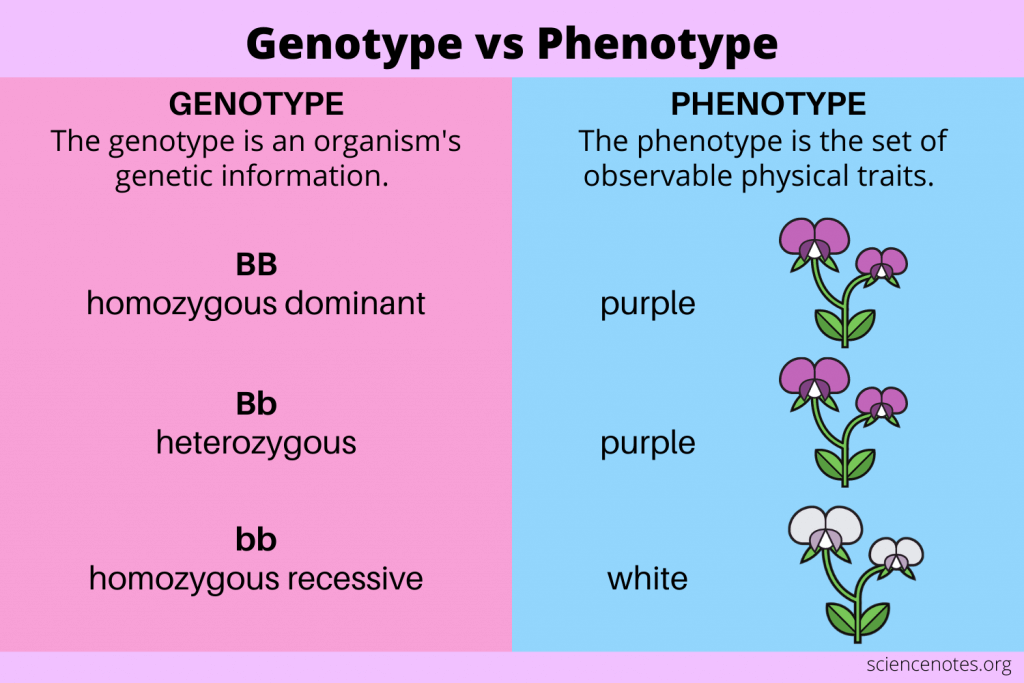
Genotype vs. Phenotype
A genotype is an organism's complete set of inherited alleles or genetic makeup, while a phenotype is the observable physical, biochemical, or behavioral trait that results from how that genotype is expressed
Genotype: the genes (example: bb, Bb, BB)
Phenotype: the physical appearance (color, size, texture)
Examples:
Genotype: Gg (green gene dominant over yellow)
Phenotype : green, round, smooth

Homozygous
Two copies of same gene (bb, BB)
Having two identical alleles for a specific gene at the same locus on homologous chromosomes
Homozygous Dominant: possessing two dominant alleles (e.g., EE or PP). The dominant phenotype is expressed
Homozygous Recessive: possessing two recessive alleles (e.g., ee or pp). The recessive phenotype is expressed because there is no dominant allele to mask it

Heterozygous
Two different alleles (Bb, Ss)
having two different alleles for a specific gene locus on homologous chromosomes (represented as Aa or Bb)

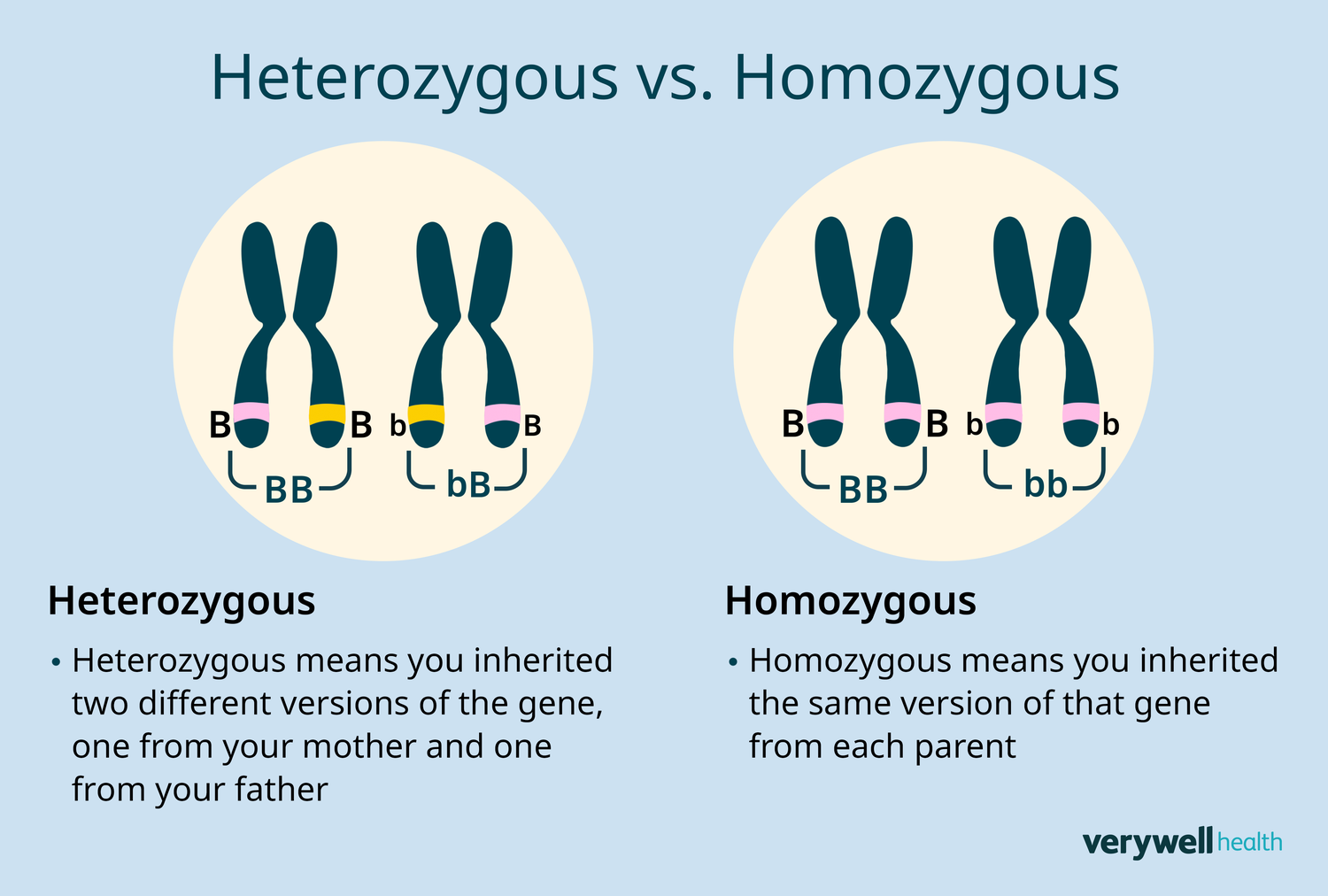
Homozygous vs. Heterozygous
Homozygous: two copies of same gene (bb, BB)
Heterozygous: two different alleles (Bb, Ss)
Monohybrid
A cross using one trait (color)
a genetic breeding experiment that tracks the inheritance of a single gene (and thus one specific trait, such as flower color or plant height) between two parents
a cross focusing on one character/trait controlled by a single gene locus
a genetic cross between two organisms tracking a single trait (one gene)

Genetics
Studies how traits are passed from parent to offspring
the scientific study of genes, heredity, and the variation of traits in living organisms
the study of heredity (the transmission of biological traits from parents to offspring) and genetic variation (the differences in DNA sequences and traits among individuals in a population)

Trait
Physical characteristic
a specific, observable or measurable characteristic of an organism. Traits result from the expression of genes, the interaction of alleles, and environmental influences

Gene
Fragment of DNA that codes for a trait
a specific sequence of DNA nucleotides located at a particular position (locus) on a chromosome that codes for a functional product—typically a protein or functional RNA—which influences an organism's traits

Alleles
Two or more forms of a gene (example: hair color)
a specific variant or alternative form of a gene located at a specific position (locus) on a chromosome
a gene is a sequence of DNA that codes for a specific protein or functional RNA trait (e.g., flower color or eye color). An allele is the particular "flavor" or version of that gene (e.g., a purple allele W vs. a white allele w)
two or more forms of a gene

What is another example in humans of different alleles?
Another classic human example of different alleles for a single gene is sickle cell disease (and the normal hemoglobin gene), which involves the normal hemoglobin allele Hb^A and the mutant sickle-cell allele Hb^S
Hb^A (Normal Allele): Codes for the standard, functional beta-globin protein that keeps red blood cells round, flexible, and efficient at carrying oxygen.
Hb^S (Mutated / Sickle-Cell Allele): Contains a single point DNA mutation that swaps one amino acid (glutamic acid is replaced by valine at position 6)
Would the genes be in same chromosome?
Yes, the genes for different alleles of the same gene are located on the same chromosome type (homologous chromosomes), at the exact same location (locus)
Yes, they are on the same chromosome (Linked Genes): If two genes are physically located on the same chromosome, they are considered linked genes. Because they are close together, they tend to travel together during meiosis and violate Mendel’s Law of Independent Assortment.
No, they are on separate chromosomes (Unlinked Genes): If two genes are located on different chromosomes (or are so far apart on the same chromosome that they undergo crossing over 50% of the time), they assort independently
Linked genes
Genes located close together on the same chromosome that tend to be inherited together during gamete formation
Violation of Independent Assortment: unlike Mendel’s Law of Independent Assortment—which states that genes on separate chromosomes assort independently—linked genes stay physically connected on the same chromosome and do not sort independently
Unlinked genes
Genes that are located either on different chromosomes or far apart on the same chromosome, causing them to assort independently during meiosis
Independent Assortment: unlinked genes follow Mendel’s Law of Independent Assortment. Alleles of one gene sort into gametes independently of alleles for another gene
Genes
Dominant: its trait/characteristics dominates recessive gene
Recessive: characteristics only seen if two copies of genes are present (bb but Not Bb)
What is a recessive gene?
A variant of a gene whose phenotypic expression is masked or hidden when a dominant allele is present in a heterozygous pair (Aa)
A recessive trait is only expressed in the phenotype when an organism is homozygous recessive (carries two identical copies of the recessive allele, written as lowercase letters like aa)
Carrier State: an individual who is heterozygous (Aa) inherits one dominant allele and one recessive allele. They display the dominant trait but act as a carrier who can pass the recessive allele to their offspring

Genotype
An organism’s underlying genetic makeup—specifically, the combination of alleles it carries for a given gene or set of genes
Genotype: the genes (example: bb, Bb, BB)
Gg (green gene dominant over yellow)
Why does the genotype have two letters?
A genotype has two letters because diploid organisms inherit two copies of each gene (one allele from each parent) located on a pair of homologous chromosomes
because diploid organisms inherit two copies of each gene (one allele from each parent) located on a pair of homologous chromosomes
What does the capital letter in a genotype show?
A capital letter in a genotype shows a dominant allele
Dominant Allele: an uppercase letter (such as A or P) represents an allele that masks the presence of a recessive allele when inherited
Phenotype Expression: the physical trait coded by a dominant allele will show up in the organism's appearance (phenotype) if at least one capital letter is present in the genotype (e.g., homozygous dominant like AA or heterozygous like Aa)

Phenotype
Physical appearance (color, size, texture)
an organism's observable or measurable trait (such as physical appearance, biochemical properties, or behavior) that results from the interaction between its genotype (genetic makeup) and its environment
what you can actually see, measure, or detect about an organism: its eye color, height, fur pattern, enzyme activity, or flower color. It's the physical expression of the genetic instructions an organism carries
Examples:
Genotype: Gg (green gene dominant over yellow)
Phenotype : green, round, smooth
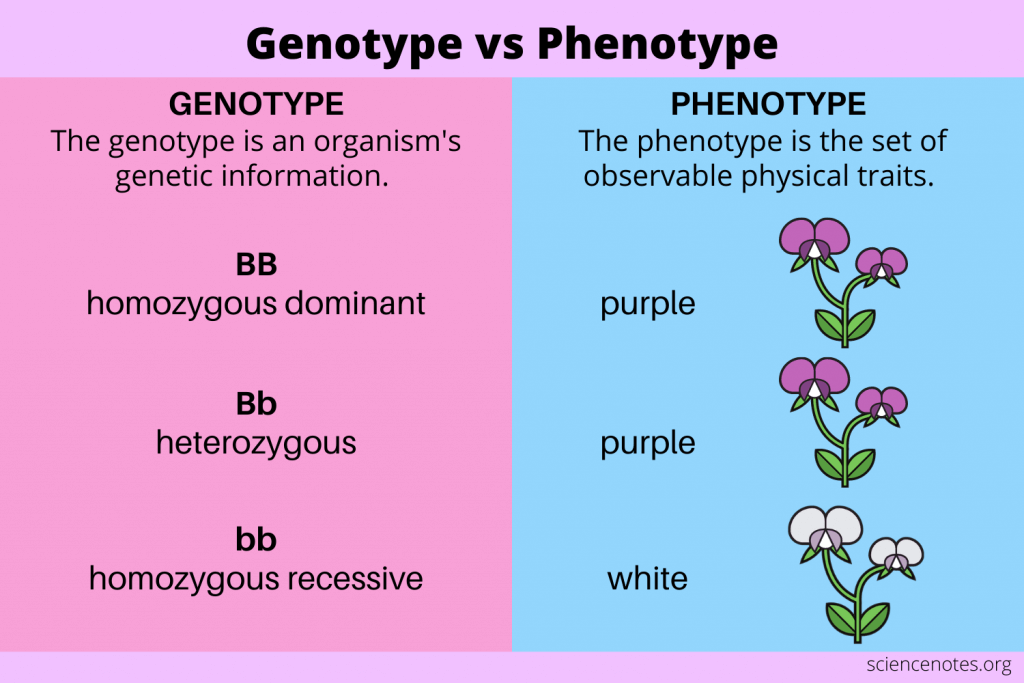
Genotype types
Homozygous: two copies of same gene (bb, BB)
Heterozygous: two different genes (Bb, Ss)

Homozygous
Two copies of same gene (bb, BB)
an organism has two identical alleles for a specific gene locus on its homologous chromosomes
Homozygous dominant: Two dominant alleles (e.g., AA or PP)
Homozygous recessive: Two recessive alleles (e.g., aa or pp)
True-Breeding: Homozygous organisms are "true-breeding" because they pass down the exact same allele to every gamete they produce. For example, an AA parent contributes an A allele 100% of the time during meiosis

Heterozygous
Two different genes (Bb, Ss)
having two different alleles for a specific gene—one inherited from the biological mother and one from the biological father
Written with one uppercase (dominant) letter and one lowercase (recessive) letter, such as Rr or Bb
Complete Dominance: In a standard Mendelian cross with complete dominance, the dominant allele masks the recessive allele, meaning the phenotype (physical trait) matches the homozygous dominant individual (e.g., Rr looks identical to RR)
The Carrier Role: a heterozygous individual is a carrier of the recessive allele, allowing recessive traits to "skip a generation" and reappear in future offspring

Monohybrid cross
A genetic cross that tracks the inheritance of a single gene and its contrasting alleles between two parent organisms
It examines how one specific trait (such as flower color or plant height) is passed down from parents to offspring
cross using one trait (color)
It serves as the experimental foundation for Mendel's Law of Segregation, which states that the two alleles for a gene separate during gamete formation so each gamete carries only one allele

Dihybrid cross
A cross using two traits (color and height)
a breeding experiment that tracks the simultaneous inheritance of two different traits controlled by two distinct genes (e.g., AaBb × AaBb)
Gamete Formation: Each heterozygous parent produces four unique gametes (using the FOIL method: First, Outside, Inside, Last—for example, AB, Ab, aB, ab)
Punnett Square: Uses a 4 × 4 grid (16 possible offspring combinations) to track the allele combinations
Classic Phenotypic Ratio: When genes assort independently (Mendel's Law of Independent Assortment) on separate chromosomes, a standard complete dominance dihybrid cross yields a 9 : 3 : 3 : 1 phenotypic ratio in the F₂ generation
Phenotype ratio for dihybrid crosses
The standard phenotypic ratio for a dihybrid cross between two heterozygous individuals (AaBb x AaBb) is 9:3:3:1
Out of 16 total offspring in a (4×4) Punnett square, the traits break down as follows:
9/16 show both dominant traits (e.g., A_B_)
3/16 show the first dominant and second recessive trait (e.g., A_bb)
3/16 show the first recessive and second dominant trait (aaB_)
1/16 show both recessive traits (e.g., aabb)
Types of crosses
Monohybrid: a cross using one trait (color)
Dihybrid: cross using two traits (color and height)

Monohybrid cross ratios
In a standard monohybrid cross (crossing two heterozygous organisms for a single trait with complete dominance), the expected ratios are:
Genotypic Ratio: 1 : 2 : 1
1 Homozygous dominant (YY or BB)
2 Heterozygous (Yy or Bb)
1 Homozygous recessive (yy or bb)
Phenotypic Ratio: 3 : 1
3 Dominant phenotype (showing the physical trait)
1 Recessive phenotype (showing the hidden trait)

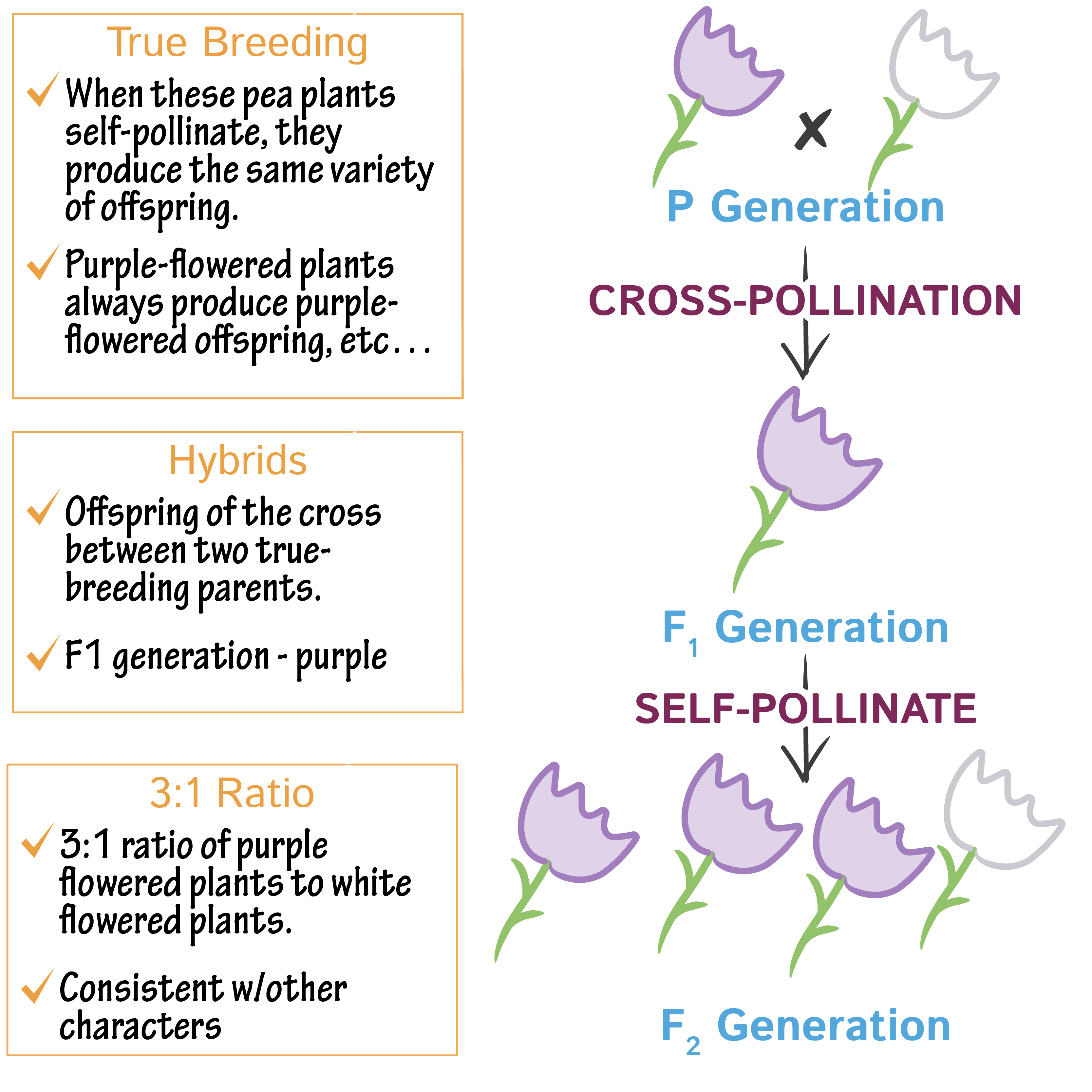
True breeding
Parents that have the same traits always produce offspring with the same traits
organisms that consistently pass the same phenotypic traits to all offspring across multiple generations of self-pollination or breeding
True-breeding individuals are homozygous for the trait(s) in question, meaning they carry two identical alleles (either homozygous dominant, like PP, or homozygous recessive, like pp)
Phenotype: Because they are homozygous, they produce only one type of gamete, ensuring that 100% of the offspring share the exact same physical appearance (phenotype) as the parents
No, true-breeding individuals cannot be heterozygous

True breeding
Parents that have the same traits always produce offspring with the same traits
an organism (often a plant or animal) that, when self-fertilized or crossed with another of the same genotype, consistently produces offspring with the same phenotypic traits over many generations
True-breeding individuals are homozygous for the trait(s) in question, meaning they carry two identical alleles (either homozygous dominant, like PP, or homozygous recessive, like pp)
Phenotype: Because they are homozygous, they produce only one type of gamete, ensuring that 100% of the offspring share the exact same physical appearance (phenotype) as the parents
No, true-breeding individuals cannot be heterozygous

Why Mendel used pea plants
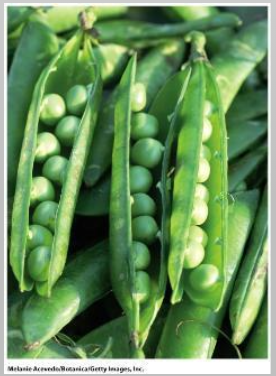
Simple traits – flower color, seed shape, seed color etc
True breeding traits
Monoecious (male and female in one flower – easy to cross)
Short generation times

True breeding organism
An organism that, when self-fertilized or crossed with another of the same genotype, consistently produces offspring with the exact same phenotype over multiple generations
Genetic Basis: True-breeding individuals are homozygous for the specific trait(s) in question (meaning they carry two identical alleles, such as
PPorpp, orRRorrr)Parental (P) Generation: In Mendelian genetics, true-breeding parents make up the initial parental (P) generation
Monohybrid & Dihybrid Crosses: Crossing two different true-breeding lines (e.g., homozygous dominant
RR× homozygous recessiverr) produces a hybrid F1 generation that is heterozygous (Rr)
Monoecious
An organism that has both male and female reproductive organs within the same individual
In botany, a monoecious plant species possesses separate male and female flowers (or cones) on the exact same plant. The flowers themselves are "imperfect" (unisexual), meaning an individual blossom contains only male or only female parts, but the overall organism contains both
pea plants

Generation times
Generation time is the time required for a population of cells or organisms to double in number, or the average time between two consecutive generations in a life cycle
Mendel’s notation system
P: parent generation of true breeding plants
F1: first generation of offspring from a cross
between parents (brothers and sisters)F2: second generation produced by crossing 2 F1 individuals with each other
Siblings: brothers and sisters
Mendel’s notation system
P: parent generation of true breeding plants
F1: first generation of offspring from a cross
between parents (brothers and sisters)F2: second generation produced by crossing 2 F1 individuals with each other
Siblings: brothers and sisters
Parent generation (P)
Parent generation (or P generation) refers to the initial cross of two genetically distinct, true-breeding individuals used to study how traits are passed down to offspring
P: parent generation of true breeding plants
True-Breeding (Homozygous): The organisms in the P generation are homozygous for the trait being studied. This means that if they self-fertilize or mate with an identical organism, they will always produce offspring with the exact same trait
Genotypic Contrast: In a standard Mendelian monohybrid cross, one parent is homozygous dominant (AA for purple flowers) and the other is homozygous recessive (aa for white flowers)
The Starting Point: The P generation is the starting point of a genetic lineage. Their immediate offspring make up the F₁ generation (first filial generation), which are entirely heterozygous (Aa)

Parent generation (P)
Refers to the initial pair of genetically distinct individuals that are crossed to study the inheritance patterns of specific traits in their offspring
True-Breeding Lines: In classical Mendelian genetics experiments, the individuals in the P generation are typically homozygous (true-breeding) for the trait being studied, meaning one parent carries two dominant alleles (AA) and the other carries two recessive alleles (aa)
Starting Point of Crosses: Crossing the P generation produces the F1 generation (first filial generation), which consists entirely of hybrids (heterozygotes, e.g., Aa)

F1 generation
First generation of offspring from a cross between parents (brothers and sisters)
the initial offspring resulting from a cross-breeding or mating of a parental (P generation) set of organisms
In a classic Mendelian monohybrid cross between two true-breeding (homozygous) parents with contrasting traits, all individuals in the F1 generation are heterozygous (carrying one dominant and one recessive allele, e.g.,Tt)
F2 generation
Second generation produced by crossing 2 F1 individuals with each other
the offspring produced by crossing two individuals from the F1 generation
Monohybrid Cross Ratios: When crossing two heterozygous F1 individuals (Aa x Aa), the F2 generation typically yields:
Phenotypic Ratio: 3:1 (dominant to recessive).
Genotypic Ratio: 1:2:1 (25% homozygous dominant [AA], 50% heterozygous [Aa], and 25% homozygous recessive [aa])

F1 generation
First generation of offspring from a cross between parents (brothers and sisters)
the initial offspring resulting from a cross-breeding or mating of a parental (P generation) set of organisms
In a classic Mendelian monohybrid cross between two true-breeding (homozygous) parents with contrasting traits, all individuals in the F1 generation are heterozygous (carrying one dominant and one recessive allele, e.g.,Tt)
If two True breeding Purple pea plants are crossed what percent of F1 will be purple?
100% of the F1 generation will be purple
Parent Generation (P): Crossing a true-breeding (homozygous) purple-flowered pea plant (PP) with another true-breeding purple-flowered pea plant (PP) means both parents can only pass on the dominant purple allele (P)
F1 Generation (F1): All offspring will have the genotype (PP) and express the purple phenotype

Monohybrid cross - (homozygous dominant/recessive parents)
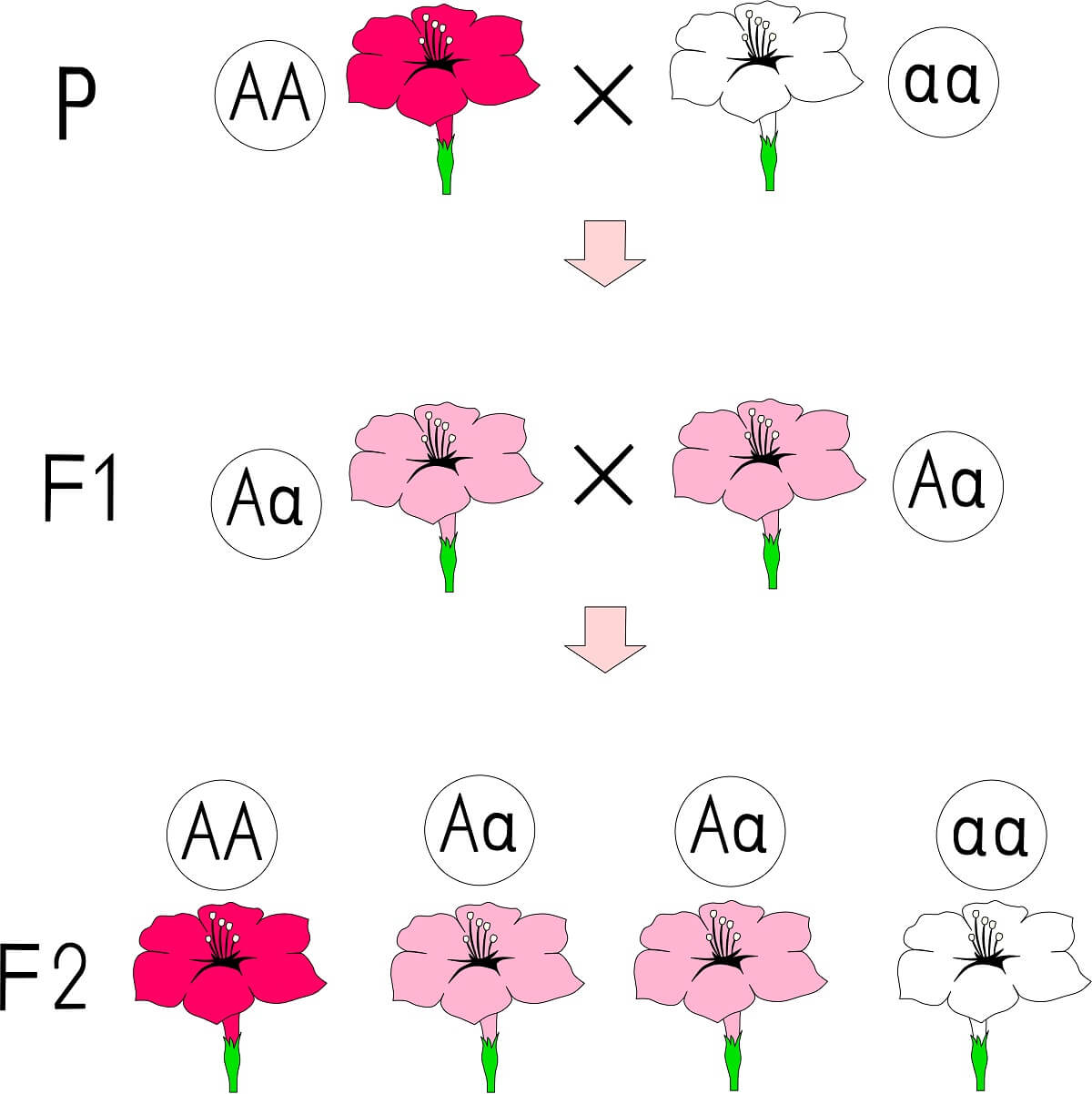
Mendel crossed parent plants that differed in one trait to produce hybrids to see what traits were inherited
True breeding purple (AA) x True breeding white (aa) = 100% heterozygous (Aa) F1 generation
A monohybrid cross between a homozygous dominant parent (AA) and a homozygous recessive parent (aa) results in 100% heterozygous (Aa) offspring in the first filial (F₁) generation, all expressing the dominant phenotype
Results of the F₁ Generation
Genotypic Ratio: 100% heterozygous (Aa)
Phenotypic Ratio: 100% dominant trait expression

Monohybrid cross - (homozygous dominant/recessive parents)
Mendel crossed parent plants that differed in one trait to produce hybrids to see what traits were inherited
True breeding purple (AA) x True breeding white (aa) = 100% heterozygous (Aa) F1 generation
A monohybrid cross between a homozygous dominant parent (AA) and a homozygous recessive parent (aa) results in 100% heterozygous (Aa) offspring in the first filial (F₁) generation, all expressing the dominant phenotype

What does this result tell you about the white phenotype ?
Based on the cross shown in the image, the white phenotype is a recessive trait
P Generation: both parents are true-breeding, meaning they are homozygous. The purple flower has two dominant alleles (PP), and the white flower has two recessive alleles (pp)
Offspring (F1 generation): when crossed, all offspring inherit one allele from each parent, making them heterozygous (Pp)
Because every plant in the F1 generation displays the purple phenotype, the purple allele completely masks (dominates) the white allele. Therefore, purple is the dominant trait, and white is recessive

When crossing two F1 heterozygotes (Aa x Aa)
Phenotypic Ratio: 3:1 (3 dominant phenotype : 1 recessive phenotype)
Genotypic Ratio: 1:2:1 (1 homozygous dominant AA: 2 heterozygous Aa: 1 homozygous recessive aa)
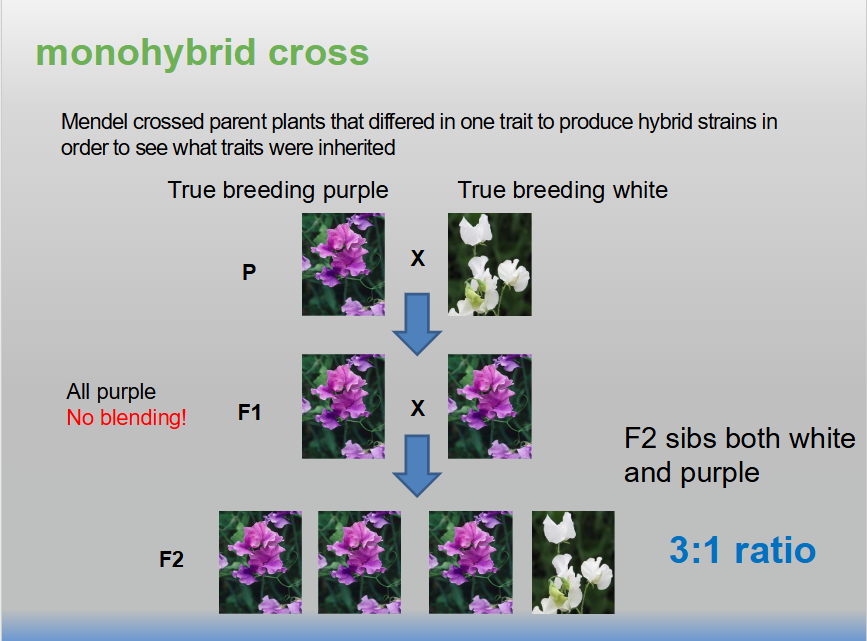
When crossing two F1 heterozygotes (Aa x Aa)
Phenotypic Ratio: 3:1 (3 dominant phenotype : 1 recessive phenotype)
Genotypic Ratio: 1:2:1 (1 homozygous dominant AA: 2 heterozygous Aa: 1 homozygous recessive aa)

If you cross a Purple pea plant with a White pea plant, all the first generation (F1) will be purple. If you then cross two F1 plants and you get 400 F2 plants, approximately how many will be Purple and how many will be white?
In the F2 generation, approximately 300 plants will be Purple and 100 plants will be White
P Generation (Parents): a true-breeding purple plant (PP) crossed with a true-breeding white plant (pp) produces all purple offspring (Pp) in the F1 generation. All F1 plants are heterozygous hybrids
F1 Cross (Pp x Pp): crossing two heterozygous F1 plants yields a classic 1:2:1 genotypic ratio (1 PP : 2 Pp : 1 pp)
F2 Phenotypic Ratio: because the purple allele (P) is dominant over the white allele (p), both PP and Pp plants look purple. This results in a phenotypic ratio of 3 Purple : 1 White (or 75% dominant, 25% recessive)

Conclusions from monohybrid crosses:
Some traits were dominant: hide other traits
Some traits were recessive hidden by dominant trait
The recessive trait passed through the F1 to the F2
F2 ratios of 3:1 dominant to recessive trait suggested that the F1 still carried one allele for purple and one allele for white trait
Some useful, modern terms
Gene: DNA sequence that encodes information for a trait
Wild-type allele: the most common allele in a population
Gene
DNA sequence that encodes information for a trait
a specific segment of DNA that contains the instructions to build a functional product, usually a protein or a non-coding RNA molecule, and serves as the basic unit of heredity
Wild-type allele
The standard, normal version of a gene that is most commonly found in natural populations and produces the expected, typical phenotype
the most common allele in a population
wild-type refers to the typical phenotype or genotype of an organism as it occurs naturally. It's the baseline reference you compare against to detect and classify mutations
Mendel’s First Law - Law of Segregation
Each parent carries 2 alleles for each trait
The alleles separate during meiosis so that each parent passes only one allele to each of their gametes
Genes are recombined randomly during fertilization to produce offspring
To test this hypothesis, he reasoned that each F1 monohybrid should have one of each alleles and he devised a test cross to prove it
Law of Segregation
Mendel’s first law—known as the Law of Segregation—states that the two alleles for each gene separate during gamete formation so that each sperm or egg cell receives only one allele
Law of Segregation: diploid organisms carry two copies (alleles) of every gene. These two alleles split (segregate) from one another when gametes (sperm and eggs) form
Meiotic Basis: this separation happens physically during Anaphase I of meiosis, when homologous chromosomes pull apart to opposite poles
Random Fusion: at fertilization, two gametes combine to restore the diploid state, giving the new offspring one allele from each parent
Monohybrid Crosses: this principle explains why crossing two heterozygous parents (Rr x Rr) typically yields a 3:1 dominant-to-recessive phenotypic ratio in the F2 generation
Test cross
A genetic experimental method used to determine the unknown genotype of an organism that displays a dominant phenotype
an experimental cross used to determine the unknown genotype of an organism expressing a dominant phenotype
The individual with the unknown genotype (which could be homozygous dominant, e.g., AA, or heterozygous, e.g., Aa) is bred with an individual that is homozygous recessive (e.g., aa) for the trait being studied
By observing the phenotypes of the resulting offspring, you can deduce whether the mystery parent carries a hidden recessive allele.

Probability
Chance events are described by probability
Probability is given as a fraction or decimal 0 to one. It can also be from 0% to 100%
probability is defined as the mathematical measure of the likelihood that a specific genetic event will occur. It is calculated by dividing the number of ways a specific outcome can happen by the total number of possible alternate outcomes
Probability of 0
A probability of 0 (or a probability equal to 0) means that an event is impossible and cannot occur under the specified conditions
A probability of 0 means an event will not happen and is not due to chance at all
Example: If you cross a homozygous dominant tall pea plant (TT) with another homozygous dominant tall pea plant (TT), the probability of getting a short offspring (tt) is 0. Because neither parent carries the recessive allele (t), it is genetically impossible for that trait to appear in the F1 generation
Probability of 1
A probability of 1 means an event is certain to happen (a 100% chance of occurrence
A probability of 1 means an event will happen and not due to chance
Scale of Probability: In genetics and statistics, probabilities range from 0 (impossible/will never happen) to 1 (certain/will definitely happen)
Anything that is chance ranges between 0 and 1
Probability basics
A probability of 0 means an event will not happen and is not due to chance at all
A probability of 1 means an event will happen and not due to chance
Anything that is chance ranges between 0 and
Example, the chance of flipping coin landing with heads up is ½ ( or 0.5, or 50%)
Chance
The likelihood or mathematical measure that a specific event will occur, expressed as a value between 0 (impossible) and 1 (certain), or as a percentage from 0% to 100%
Gamete formation acts like a coin toss. Each allele has a random chance of separating and entering a gamete due to independent assortment and segregation
Anything that is chance ranges between 0 and 1
Example, the chance of flipping coin landing with heads up is ½ ( or 0.5, or 50%)
Multiplicative law of simple probability
The overall chance for two independent random events to
occur in exact order is equal to the product of their individual
probabilities
Example:
The chance of rolling a 5 on a dice is 1/6
The chance of rolling a 4 on a dice is 1/6
So, the overall chance of rolling exactly a 5 on the first
dice and then a 4 on the second dice is: 1/6 X 1/6 = 1/36

Multiplicative law of simple probability
The multiplicative law of probability (also called the multiplication rule or product rule) states that the probability of two or more independent events both occurring together is equal to the product of their individual probabilities
Formula
P (A and B) = P (A) x P (B)
P(A) = Probability of event A happening
P (B) = Probability of event B happening
P (A and B) = Probability of both events happening simultaneously
So, the overall chance of rolling exactly a 5 on the first
dice and then a 4 on the second dice is:
• 1/6 X 1/6 = 1/36

The Multiplicative Law
If events A and B are independent, the probability
that they will occur together A and B, is (A) x (B)
Example: probability of drawing the queen of hearts, Q and H
P(Q) = 4/52
P(H) = ¼
P(Q) x P(H) = 4/52 x 1/4 = 1/52
Additive Law of Simple Probability
When there are more than one way for a chance outcome to occur, the overall probability is the sum of the individual events
Example:
If one can win by rolling a 4 or a 5 with one dice, then
the overall chance of winning is:The chance of rolling a four is 1/6
Or the chance of rolling a five is also 1/6
So, the overall chance is 1/6 +1/6 = 2/6 = 1/3

Additive Law of Simple Probability
The additive law of simple probability (also known as the sum rule) states that the probability of either one of two mutually exclusive events occurring is equal to the sum of their individual probabilities
Mutually Exclusive Events (cannot happen at the same time):
P (A or B) = P(A) + P(B)
Key trigger word: "OR" means add
When to use multiplicative vs. additive law of probability
Use the multiplication rule (product rule) for "and" scenarios involving independent events, and use the addition rule (sum rule) for "or" scenarios involving mutually exclusive events
Multiplicative Law:
The probability that two or more independent events will occur together. The outcome of one event does not affect the outcome of the other
Key Word: "AND”
Formula: P (A and B) = P(A) x P (B)
Additive Law:
The probability that any one of two or more mutually exclusive events will occur. Events are mutually exclusive if the occurrence of one prevents the other from happening at the same time
Key Word: "OR"
P (A or B) = P (A) + P (B)
If you can win by rolling a 4, a 5 or a 6 with one dice, then the overall chance of winning is:
The overall chance of winning is 50% (or 1/2)
A standard six-sided dice has 6 possible outcomes (1, 2, 3, 4, 5, or 6)
You have 3 winning outcomes (4, 5, or 6)
3/6 simplifies to 1/2, which equals a 50% probability
Symbols for pedigrees
Squares: represent males
Circles: represent females
Filled/Shaded Shapes: individuals who express the trait or disorder (affected phenotype)
Empty/Unshaded Shapes: individuals who do not express the trait (unaffected phenotype)
Half-shaded Shapes: heterozygous carriers who do not show the trait themselves, but carry one recessive allele
Horizontal Line Between Male & Female: a marriage, mating, or reproductive union
Vertical Line Descending from Parents: a line of descent showing their children (connected by a horizontal sibling line)
Roman Numerals (I, II, III): designate specific generations

Pedigree symbols
Square: males
Circle: females
Shaded square: affected male
Shaded circle: affected female
Unshaded square: normal male
Unshaded circle: normal female
Probability rules can be used with pedigrees to make
genetic predictions

Dihybrid cross
A genetic mating experiment between two organisms that are heterozygous for two different traits (AaBb x AaBb)
Each heterozygous parent (AaBb) produces four unique gametes in equal proportions (AB, Ab, aB, ab), which can be mapped using the FOIL method (First, Outer, Inner, Last)
P generation: cross parents with two different traits.
Traits were seed shape (round or wrinkled) and seed color (yellow or green)P generation homozygotes: YYRR X yyrr
F1 double heterozygotes these are dihybrids: YyRr X YyRr
9:3:3:1 F2 dihybrid cross ratio

Dihybrid cross ratio
A dihybrid cross is a genetic cross between two organisms that are both heterozygous for two different traits (AaBb x AaBb)
9:3:3:1 is the standard phenotypic ratio in the (F2) generation when complete dominance is present at both gene loci and the genes assort independently
Out of 16 total possibilities in a (4 × 4) Punnett square
9/16 show both dominant traits (A_B_)
3/16 show the first dominant and second recessive trait (A_bb)
3/16 show the first recessive and second dominant trait (aaB_)
1/16 show both recessive traits (aabb)
Dihybrid cross ratio of 9:3:3:1

Mendel’s Second Law: The Law of Independent Segregation
Mendel's second law is the Law of Independent Assortment, which states that the alleles of two (or more) different genes sort into gametes independently of one another during gamete formation
If you count for each trait individually you will see each still gives a 3:1 ratio as in monohybrid
crosses. This led Mendel to conclude that traits were inherited independently from one
anotheralleles of two or more different genes sort into gametes independently of one another during meiosis

Mendel’s Laws
The law of Dominance: In a heterozygote, one allele dominates (masks) the presence of another
The law of Segregation: In a heterozygote, two
different alleles segregate from each other during the
formation of gametes
The Law of Dominance
In a heterozygote, one allele dominates (masks) the presence of another
In a heterozygous individual (having two different alleles for a trait), the dominant allele is exclusively expressed in the phenotype, while the recessive allele is masked or hidden
The law of segregation
In a heterozygote, two different alleles segregate from each other during the formation of gametes
states that diploid organisms carry two alleles for each gene, and these two alleles separate (segregate) during gamete formation (meiosis) so that each sperm or egg receives only one allele
A diploid parent has two alleles for a single gene (e.g., Rr). Through meiosis, these alleles separate so gametes become haploid, carrying only one allele (R or r)
The law of segregation is driven by the separation of homologous chromosomes during anaphase I of meiosis
Random Fusion: At fertilization, two haploid gametes fuse randomly, restoring the diploid state (two alleles per gene) in the offspring
Mendel’s 3 Laws
Mendel's three core principles describe how hereditary factors (genes and alleles) are passed from parents to offspring during meiosis
Law of Dominance: when an organism is heterozygous (carrying two different alleles, such as Aa), the dominant allele completely masks the recessive allele in the phenotype (physical appearance)
Law of Segregation: during gamete formation (specifically in anaphase I of meiosis), the two alleles for each gene separate (segregate) so that each sperm or egg cell receives only one allele per gene
Law of Independent Assortment: alleles of two or more different genes sort into gametes independently of one another. In other words, the inheritance of one trait does not influence the inheritance of another trait
Incomplete dominance
A non-Mendelian pattern of inheritance where neither allele is completely dominant over the other, causing the heterozygote to display an intermediate phenotype that blends the two parental traits
In a heterozygous individual (C^R C^W), the resulting physical trait is a mix or average of both homozygous conditions rather than masking one allele completely
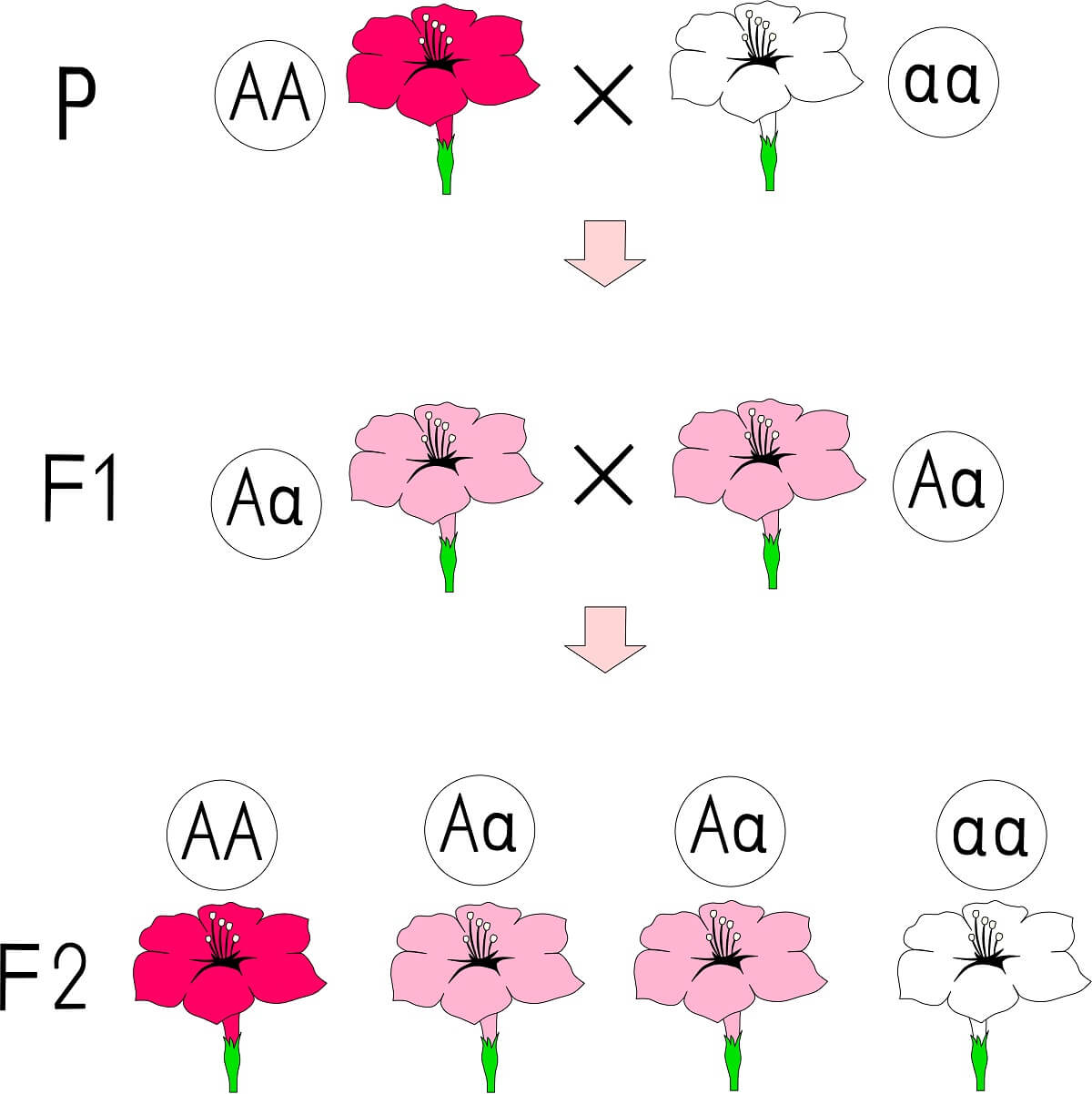
Example: Crossing a true-breeding red snapdragon (C^R C^R) with a true-breeding white snapdragon (C^W C^W) produces 100% pink-flowered offspring (C^R C^W)

Incomplete dominance example
A non-Mendelian pattern of inheritance where neither allele is completely dominant over the other, causing the heterozygote to display an intermediate phenotype that blends the two parental traits
a non-Mendelian inheritance pattern where neither allele is completely dominant over the other, causing the heterozygote to display an intermediate (blended) phenotype
RR = red
WW = white
RR x WW
RW = pink

Incomplete dominance - snapdragons
A non-Mendelian inheritance pattern where neither allele is completely dominant over the other, causing the heterozygote to display an intermediate (blended) phenotype
Consider Snapdragons
Cross a red flower with a white flower
Result: all pink F1 heterozygotes
If you then cross pink F1 sibs you get an F2 that has the following ratio of phenotypes:
1 red: 2 pink: 1 white
