oct 9th TCA cycle: components and energy output
 Call Kai
 Learn
 Practice Test
 Spaced Repetition
 Match
 Flashcards
 Knowt Play
1/27

There's no tags or description
Looks like no tags are added yet.
28 Terms
glycolysis, what makes what?
glucose → 2 pyruvate
pyruvate has how many carbons?
3 carbon
is a 3 carbon molecule
NAD⁺ accepts electrons → NADH
NAD+ is the oxidized form and NADH is what was reduced
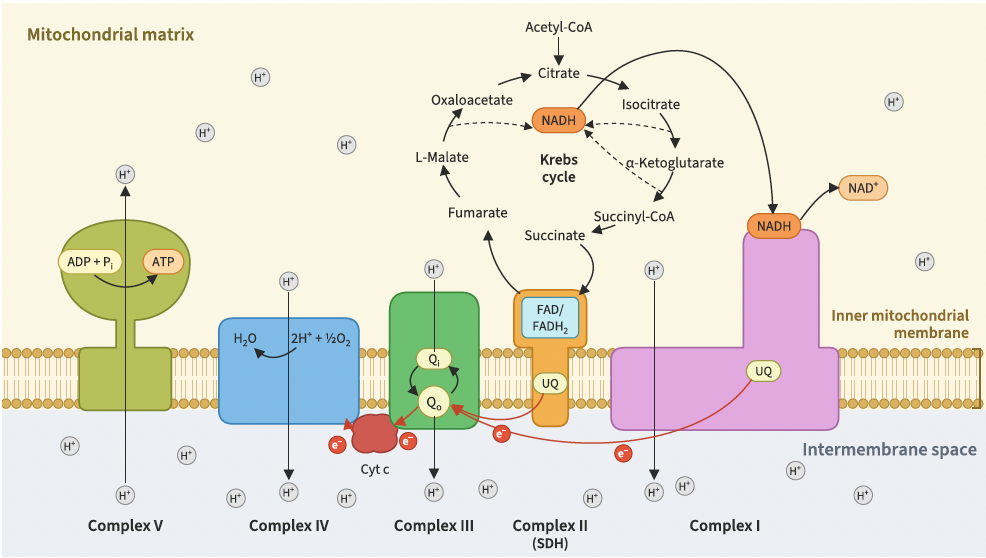
Mitochondrial NADH → Complex I
Complex I (NADH:ubiquinone oxidoreductase) is the first and largest multi-subunit enzyme of the mitochondrial electron transport chain. It catalyzes the transfer of electrons from NADH to ubiquinone (Coenzyme Q) while pumping protons across the inner mitochondrial membrane.
Complex II receives succinate-derived electrons
1 NADH ≈ 2.5 ATP, FAD-linked pair ≈ 1.5 ATP
stage 1 acetyl-CoA production

stage 2 acetyl-CoA oxidation

stage 3 electron transfer and oxidative phosphorylation

The PDH Complex Catalyzes an Oxidative Decarboxylation

clinical link: thiamine deficiency
at risk: alcohol use disorder, PN without vitamins, vomiting after bariatric surgery
Low TPP → PDH slows → more pyruvate goes to lactate → blood lactate may rise
give thiamine before or with IV dextrose:
glucose metabolism increases demand for thiamine-dependent enzymes
A patient with persistent vomiting after weight loss surgeryhas elevated lactate. She receives IV thiamine, and her lactate falls over the next day. What best explains the fall?
A.Thiamine inhibits LDH, so less lactate is formed
B.Thiamine improves oxygen delivery, so the ETC runs faster
C.Thiamine converts lactate directly to glucose in the liver
D.Thiamine restores PDH activity, so more pyruvate becomes acetyl-CoA
D
TCA cycle image

succinate dehydrogenase is complex II
A mechanically ventilated patient is receiving more IV dextrose calories than needed. The nutrition team reduces the excess dextrose delivery.
Which change most directly explains why this can reduce CO₂ production?
A. Less pyruvate is oxidized by PDH and the TCA cycle.
B. Less NADH is oxidized by Complex I.
C. More pyruvate is converted to lactate.
D. More acetyl-CoA is converted back to glucose.
A
A patient receiving a prolonged, high-dose sodium nitroprusside infusion develops lactic acidosis. Cyanide released during drug metabolism inhibits Complex IV.
Which change is expected in the mitochondria?
A. Increased NAD⁺ availability and faster TCA-cycle flux
B. Increased NADH/NAD⁺ ratio and slower TCA-cycle flux
C. Increased oxygen consumption at Complex IV
D. Increased conversion of acetyl-CoA to pyruvate
B
Where are the important products made?
isocitrate →
→ ⍺-KG: NADH + CO2
Where are the important products made?
⍺-KG →
→ succinyl-Coa: NADH + CO2
Where are the important products made?
succinyl-CoA →
→ succinate: GTP
Where are the important products made?
succinate →
→ fumarate: FAD-linked electrons
Where are the important products made?
malate →
→ oxaloacetate: NADH
One acetyl-CoA → 3 NADH + 1 FADH₂ + 1 GTP + 2 CO₂
More glucose oxidation → more carbon passing through PDH/TCA → more CO₂ produced
FADH₂ stays bound to SDH; its electrons pass to Q at Complex II.
One acetyl-CoA:
3 NADH ×2.5 = 7.5
1 FADH₂ ×1.5 = 1.5
1 GTP = 1
≈10 ATP
Oxidation of one pyruvate through PDH + the TCA cycle yields ≈12.5 ATP
What controls TCA-cycle flux?
Flux is the rate at which molecules move through a pathway
ATP demand
Mitochondrial NADH/NAD⁺ ratio
Availability of acetyl-CoA and TCA-cycle intermediates
Why does ATP demand increase TCA-cycle flux?
ATP use rises → ADP increases which leads to
ATP synthase activity and electron transport increase which leads to
More NADH is oxidized to NAD⁺ which leads to
TCA-cycle flux increases
Why does the TCA cycle depend on the ETC?
PDH and three TCA-cycle reactions require NAD⁺.
The ETC reoxidizesmitochondrial NADH to NAD⁺.
Blocking the ETC increases NADH/NAD⁺ and slows PDH and the TCA cycle.
More pyruvate may be converted to lactate. LDH regenerates NAD⁺ so glycolysis can keep running.
Nitroprusside can release cyanide, which inhibits Complex IV.
TCA intermediates are also used elsewhere

Why does the liver make ketone bodies during fasting?
Fatty-acid oxidation supplies acetyl-CoA and NADH.
Gluconeogenesis draws oxaloacetate away from the cycle.
High NADH/NAD⁺ also favors conversion of oxaloacetate to malate.
When acetyl-CoA production exceeds the cycle's capacity to oxidize it, the liver makes ketone bodies.
During prolonged fasting, the brain can use ketone bodies as fuel. Long-chain fatty acids are not a significant direct fuel source for the brain.
Ketone bodies can be converted to acetyl-CoA without requiring the PDH reaction
A child has pyruvate dehydrogenase (PDH) deficiency, an inherited condition in which PDH works poorly. He has repeated episodes of lactic acidosis. A ketogenic diet (very low carbohydrate, high fat) is started, and his lactate falls. What best explains the fall?
A. The diet restores normal PDH activity
B. Ketone bodies are converted to pyruvate
C. Less carbohydrate is converted to pyruvate, and ketone bodies can provide acetyl-CoA without PDH
D. Fatty acids remove lactate directly from the blood
C
A patient receiving a prolonged, high-dose sodium nitroprusside infusion develops lactic acidosis. Cyanide released during drug metabolism inhibits Complex IV.
Which change is expected in the mitochondria?
A. Increased NAD⁺ availability and faster TCA-cycle flux
B. Increased NADH/NAD⁺ ratio and slower TCA-cycle flux
C. Increased oxygen consumption at Complex IV
D. Increased conversion of acetyl-CoA to pyruvate
B