ANT 200 Midterm #1
 Call Kai
 Learn
Learn Practice Test
 Spaced Repetition
 Match
Match Flashcards
 Knowt Play
1/86

There's no tags or description
Looks like no tags are added yet.
Name | Mastery | Learn | Test | Matching | Spaced | Call with Kai | Chat |
|---|
No analytics yet
Send a link to your students to track their progress
87 Terms
lecture 2
2
Tinbergen’s 4 questions
mechanism (causation): how trait works
function (adaptive): why is behavior adaptive
ontogeny (development): how has this behavior developed
phylogeny (evolution): why did this trait evolve
tinbergen’s questions with capuchin monkeys
mechanism: seeing a nut activates feeding motivation in head, chooses a rock based on nut density
function: allows higher energy foods to be consumed
ontogeny: young C develop through maturation, practice, and watching
phylogeny: has deep roots in capuchins, exists in other populations
capuchins populations
sapajus: long term documentation of tool use
cebus: recently started using stone tools
behavior
the way an organism acts in response to an internal or external stimuli
behaviorism (american)
idea that everything is learned and can turn any child into anything
regardless of species, all organisms start as blank slate, all interactions and behavior are learned behavior
behaviorism laws
equipotentiality: any 2 stimuli can be associated regardless of nature through experience
animal behavior is respondent or operant
respondent: involuntary response to stimuli
operant: associate a voluntary response to reward/consequence
worked w rats in labs
operant vs classical/respondent conditioning
operant: from Skinner
reinforcement/punishment, voluntary actions are evoked
classical/respondent: from Pavlov
neutral stimulus w unconditioned stimulus
umwelt
perceptual world in which each organism exists and acts in
ethology/ethologists (tinbergen) (european)
‘watched and wondered’
worked w birds, insects, fish
emphasized:
naturalistic observation
comparisons across species
function and evolutionary history of behavior
karl von frisch
studied bees and found that they have color vision and can communicate through dancing
konrad lorenz
studied imprinting w ducks
niko tinbergen
studied instinct within baby herring gulls that peck at red in mother’s jaw
fixed action pattern: instinctive behavior that are highly stereotyped, instinctive behavior like parenting/mating
charles henry turner
experimented w bees, ants, wasps to demonstrate learning and memory in insects
studied bee color and pattern discrimination, conditioning in insects
he was black and his efforts were ignored for white counterparts
margaret morse nice
studied territory, courtship, song, reproduction, and life of sparrows
ignored for being a woman
zing-yang kuo
studied development of behavior and how experience shapes actions, diff btw innate and learned behavior on cats & rats
ignored for being chinese
robert yerkes & Lorenz
eugenics and nazi linked from taking info from animal experiments to humans
evolution
change in genetic material of a population over time
NS
genetic drift
mutation
gene flow
natural selection
individuals w traits that are better adapted to their environment will by more likely to survive and reproduce
variation
heritable variation
random breeding
lamarck
theory of use and disuse
mechanisms for variation
mutation
recombination/mating
gene flow
directional selection (NS)
selection favoring one phenotype, either/one side of graph

stabilizing selection (NS)
selection favoring intermediate phenotype, middle of graph

disruptive selection (NS)
selection favoring extreme phenotypes, both sides of graph

genetic drift
bottleneck effect
founder effect
lecture 4
4
levels
kingdom → phylum → class → order
primitive traits
traits inherited from a distant ancestor
derived traits
shared traits due to a recent common ancestor that sets taxa apart
distinguishing traits
pentadactylism: 5 digits on hands and feet
elongation of fingers and toes
opposable thumb
nails instead of claws
stereoscopic vision: forward facing eyes (better depth perception and predation ability)
color vision (mammals are dichromats, primates are trichromats)
snout reduction → large brain
lengthening of life history traits
phylogeny
evolutionary history of a group
taxon/taxa: grouping more closely related to another at the exclusion of others
branch: line representing an evolutionary lineage
node: point where branches
order → suborder → blah picture memorize

strepsirhines splits into ?
splits into lemuroidea & lorisoidea
long, wet snouts
eyes reflect light
noturnal & solitary
small brains & body
fast life history
lemuroidea
small bodied
diurnal
dependent on scent
social
female dominated
lorisoidea
small
omnivore
nocturnal
solitary
arboreal
venomous
catarrhines
splits cercopithecoidea & hominoidea
hominoidea splits into hylobatidae & hominidae (apes & people)
primates
splits into strepsirhine & haplorhine
strepsirhine (lemurs and lorises)
long, wet nose
nocturnal
eyes reflect light
small body & brain
fast life history
haplorhine (monkeys and apes)
short snouts
dry nose
diurnal
large body & brain
slow life history
haplorhine splits into?
splits into
tarsoidea: small, carnivorous, nocturnal, arboreal, solitary
ceboidea: new world monkey, prehensile tail, arboreal, flat nose
ex: capuchins
catarrhines: cercopithecoidea & hominoidea
old world monkeys: hooked noses, terrestrial, no tail, social
cercopithecoidea & hominoidea —> catarhines
cercopithecoidea: old world monkeys, small, narrow chested, fixed shoulders, quadrupedal, above branch locomotion
hominoidea: no tail, large body and chest, flexible shoulder, brachiator below branch, big brains
hominoidea
splits into
hylobatidae: gibbon & siamang
hominidae: pongo(orangutans), gorilla, pan(bonobos & chimpanzee), homos → tool use, culture, communication
chimpanzee
large bodied
omnivores
females leave social group
hunt, territorial
bonobos
smaller, slender
herbivore
female dominant
less aggressive than chimps
GAYYYYYY
lecture 5
5
Understand and describe the key patterns in human evolution
a. Articulate the key differences between current and past understanding of these patterns
2. Describe the adaptive suites of early hominins, Australopithecus, and Paranthropus
3. Understand the differences between taxic and morphological diversity (or, to use some jargon, diversity and disparity)
4. Discuss the tension between diversity and disparity, and the role that new discoveries play in resolving this tension
early hominins
knuckle walking, small brains & bodies
austrolopiths (group of early hominids)
ape like:
small brain, prognathic (outward jaw), long arms
human like:
thick enamel, loss of Cp3 honing complex (tooth), forward foramen magnum (where brain & spinal cord connect), round pelvis
had a diamond face shape, dimorphic canines, large postcanine dentition, sexual dimorphism, wide stance
paranthropus (group of hominids)
sagittal crest, dished face, flat face, large temporal fossae, strong postorbital constriction, large back teeth (postcanine) & tiny front dentition
lots of chewing
macroevolution
origin, maintenance, and loss of bioD above species level
how new brains form, expand, and disappear
taxic/classic diversity
how many species are there
morphological diversity / disparity
how different are these species
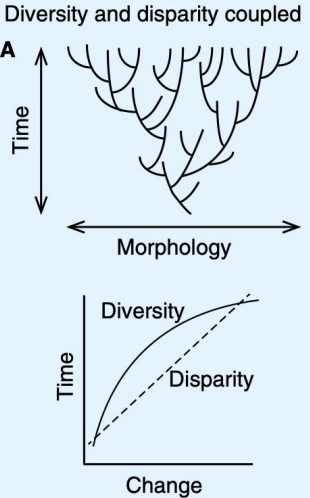
diversity & disparity uncoupled
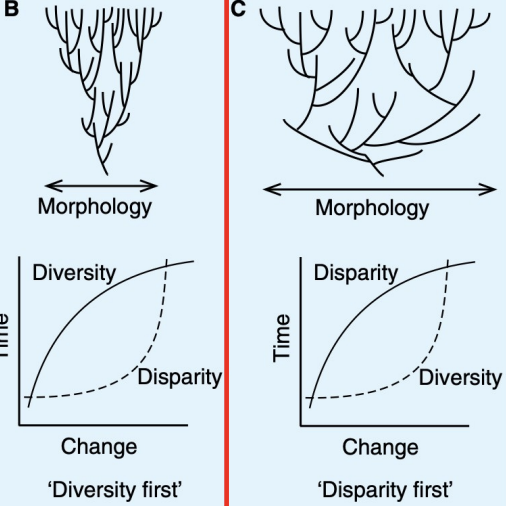
tension btw diversity & disparity
we use morphology to identify species
thru history more diversity than disparity exists but some new discoveries increase disparity (increases in diversity have outpaced increases in disparity)
morphology must demonstrate a difference in niche
Lecture 6
6
some animals have diff levels of disparity vs diversity
malagasy mouse lemurs: low disparity, high diversity
australopithecus: med disparity, high diversity (both have increased since the 90s)
genus homo
bipedal, opposable thumb
smart with smooth skull
small teeth, large body
tool user, human feet
remarkably anatomically homogenous
history of genus → 3 stages
early homo: mixture of traits of homo habilis & rudolfensis
homo erectus: spread from africa to eurasia, tools, fire, big brain
late homo: large brain & body, complex stone tool use, symbolism, extinctions
adaptive introgression
introgression from denisovan to homo sapiens
could live in higher altitude, low O2 conditions
cognition in homosapiens vs neaderthals
homo:
larger cerebellar hemispheres→ attention, cognitive flexibility, language, memory
developed FOXP2: mutations in gene develop speech apraxia
neanderthals:
larger occipital regions, better vision
also have FOXP2
Lecture 7
7
why primate brains change
selective pressure to increase brain size (cranial capacity): volume of inside of the skull
diff in brain structure
brain size
absolute brain size: measurement of animal’s brain unit
relative brain size: brain size relative to overall brain size, directly related to cognition
allometry
study of how one part of organism grows in relation to whole other organism/another part
departures for expected growth patterns from allometry shows evidence a trait is under selection
in mammals brain size increases at slower rate than (- allometry)

encephalization quotients
how much brain size of a species differs from the expected brain size
>1 → larger brain than expected
<1 → smaller than expected
primates have largest EQs and greatest increase in EQ among mammals
triune brain model: divides human brain into 3 evolutionary layers
reptilian brain: brainstem & cerebellum → instinctive survival (HR, breathing)
paleomammalian brain: limbic system → emotion, memories, attachment
neomammalian brain: neocortex → reasoning, language, planning
all vertebrates have same general brain layout
hindbrain: basic life support, movement, coordination
medulla, pons, cerebellum
midbrain: orienting, attention, movement
visual and auditory info, responses, pain regulation
forebrain:
olfactory, thalamus, basal ganglia
cerebral neocortex: thin layer covering cerebral hemispheres→ learning, memory, decision-making
evolution in primate brain
reduction in olfactory bulb
cortical expansion and folding
expansion of prefrontal cortex
increased connectivity→ integration across brain regions
occipital lobe
visual perception
parietal lobe
tactile perception, understanding, movement
temporal lobe
hearing, memory, identity
frontal lobe
cognitive function, concentration, problem-solving, planning, learning, abstract thought
brains are 2% of body weight but
require 20% of energy
are adaptive
ecological intelligence & social intelligence hypothesis
ecological: large brains evolved from necessity to locate & extract food, advance cognitive traits
frugivores have bigger brains than folivores, chimps eat fruits/nuts, bonobos eat herbs
social: large brains evolved as response to living in big/complex groups
kin recognition, relationships/friendships, empathy, social learning
both are true, diff processes shape diff cognitive domains
why did primate brains change?
expansive tissue & cultural intelligence hypothesis
expansive tissue: large brains require more energy → cooking, better diets, food sharing
cultural intelligence: social learning, behavioral innovation, tool use helped evolve brain → understanding space, causality, communication
all correct
why did human brain change?
lecture 8
8
Nervous system structure and function: • 2 systems • Neurons • Nonneuronal cells • Brain structure and function • 4 subsections of the brain • Cortical fields
How does the brain perceive stimuli? • in this lecture, visual stimuli? • How does phylogeny shape the brain? • How does ontogeny shape the brain? • in this lecture, cortical visual processing
nervous system
peripheral nervous system
nerves
central nervous system
brain & spine
vision
photoreceptor → bipolar cell→ ganglion cell → (optic nerve) → lateral geniculate nucleus → primary visual cortex
neuron
fundamental unit of brain, cell, transmits electrical(AP)/chemical(NT) signals
myelin sheath: insulation
nodes of ranvier: gaps in myelin
info in AP is encoded in frequency not amplitude

neuron types
75% are pyramidal neurons
bipolar, unpolar, multipolar neurons
nonneuronal cells
astrocytes: satellite cell in PNS
oligodendrocytes: schwann in PNS → creates myelin
microglia
ependymal cells
4 components of brain anatomy
white matter: grey cell bodies, white axons
limbic systems: thalamus, hippocampus, hypothalamus, amygdala
cerebral cortex
brain stem & cerebellum
hindbrain
brainstem: medulla & pons & midbrain
basic life support
cerebellum
movement and coordination
limbic system (PHATH)
pituitary: hormone releasing
hippocampus: memory
amygdala: emotion
thalamus: sensory & motor system
hypothalamus: feeding, fleeing, fighting, reproduction
white matter
white because of myelin
neural communication
learning/skills
cognitive function
brain development
cerebral cortex
occipital lobe
temporal lobe
frontal lobe
parietal lobe