PSK4U Anatomy and Movement
 Call Kai
 Learn
 Practice Test
 Spaced Repetition
 Match
 Flashcards
 Knowt Play
1/140

Earn XP
Description and Tags
All the anatomical movements, axis, planes, bones, joints and muscle stuff!!! basically the building blocks for movement.
Name | Mastery | Learn | Test | Matching | Spaced | Call with Kai | Chat |
|---|
No analytics yet
Send a link to your students to track their progress
141 Terms
Anatomy
Derived from the Greek word meaning "to cut up, cut open" or "to dissect"
→ The study of human structure
Anatomy Act of 1832
Provided for an adequate and legitimate supply of corpses for study.
→ Unclaimed corpses were allowed to be studied for science!
Corpse snatchers
In the past people needed bodies to dissect and study, murder and corpse snatching was turned to as a solution until the Anatomy Act of 1832.

Anatomical Planes
Anatomical planes relate to positions in space and are at right angles to one another.
→ Sagittal
→ Transverse
→ Frontal
Anatomical Axes
Axes are used to describe how rotation of the body takes place.
→ Horizontal axis (East - West)
→ Longitudinal axis (North - South
→ Antero-Posterior axis (Anterior - Posterior)

Standard Anatomical Position (SAP)
The head is upright and points forward.
The elbows are fully extended.
The palms of the hands face forward, this is called supination.
Standing straight up.
The legs are straight with no bend in the hip or knee.
The feet point straight ahead.
All movement starts from this, or in reference to this standard anatomic position.

Midline
The line that divides our body equally into two from our head - spine down (can divide body parts by a midline separately too).

Medial
Movement towards the median plane or midline.
→ The little finger lies medial to the thumb.

Lateral
Movement away from the median plane or midline.
→ the little toe lies lateral to the big toe.

Superior (cephalic)
Above
→ the head is superior to the trunk.

Inferior (caudal)
Below
→ the knee is inferior to the hip.

Anterior
To the front or in front
→ your nose is anterior to your ears.

Posterior
To the rear or behind
→ your ears are posterior to your nose.

Proximal
Close to the trunk or root of the limb
→ The wrist is proximal to the hand (closer to your body limb attachment or the shoulder which attaches the arm to our trunk).

Distal
Away from the trunk or root of the limb
→ The foot is distal to the knee (further from the limb's attachment to the body).

Superficial
Close to the surface of the body or skin
→ The ribs are superficial with respect to the heart.

Deep
Away from the body surface or skin
→ The heart is deep with respect to the rib cage.

Flexion
Describes a bending movement that decreases the angle between a segment and its proximal segment.
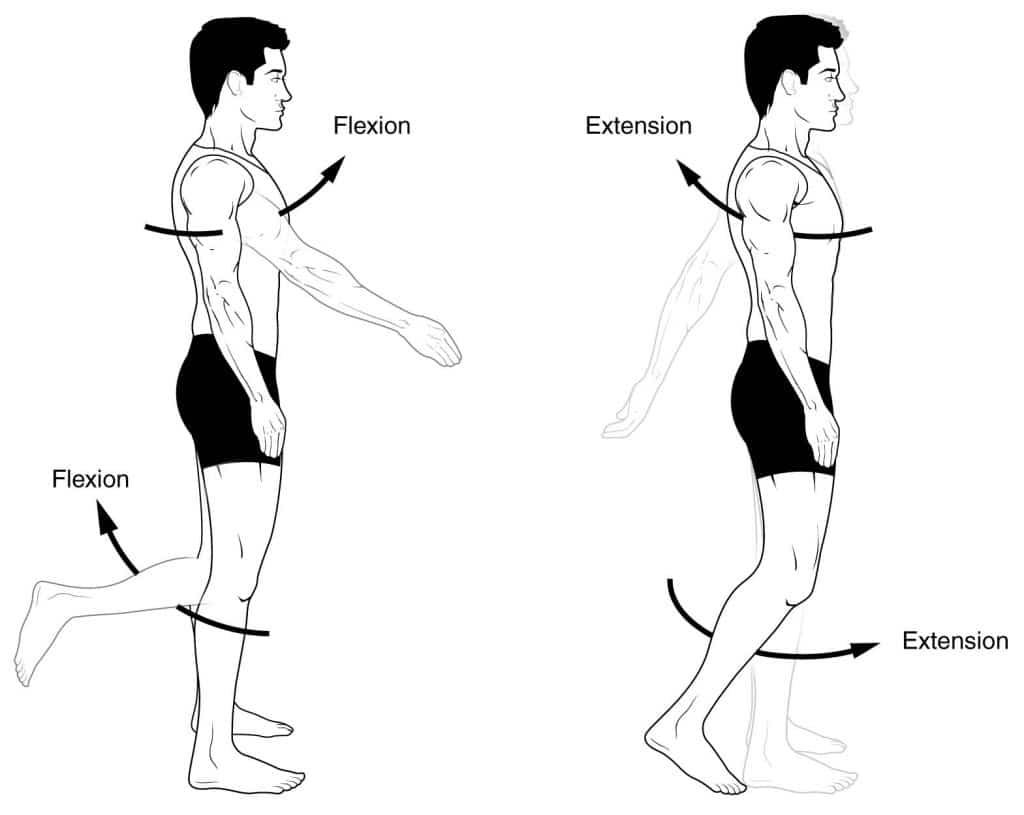
Extension
It is the opposite of flexion, describing a straightening movement that increases the angle between body parts.
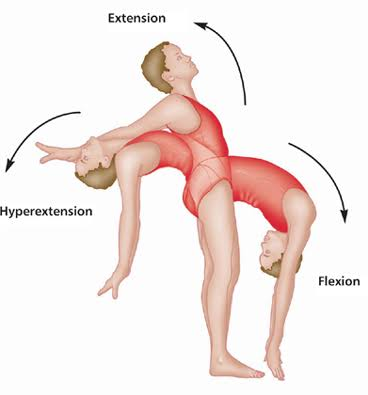
Hyperextension
Excessive joint movement in which the angle formed by the bones of a joint is extended beyond its normal, healthy range of motion or anatomical position start.
Flexion, extension and hyperextension all affect what?
The angle between two parts of the body.
Flexion, extension and hyperextension occur in which plane?
Sagittal
Flexion, extension and hyperextension occur on which rotational axis?
Horizontal (forwards, backwards)

Lateral Rotation
Rotational movement away from the midline, rotate outwards.
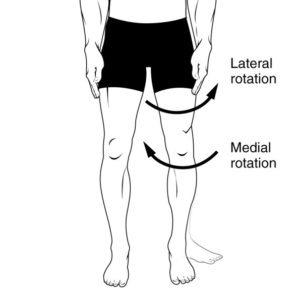
Medial Rotation
The rotational movement towards the midline, rotate inwards.

Axial Rotation
Rotational movement of the axial skeleton. (whole skeleton spin).

Abduction
Refers to a motion that pulls a structure or part away from the midline of the body.

Adduction
Refers to a motion that pulls a structure or part toward the midline of the body, or towards the midline of a limb.
Abduction and adduction are what type of motions?
That move a structure away from or towards the center of the body or a limb.
Abduction and adduction occur within which plane?
Frontal
Abduction and adduction occur on which rotational axis?
Antero-Posterior

Elevation
Refers to movement in a superior (upward) direction.
→ Shrugging shoulders up

Depression
Refers to movement in an inferior (downward) direction, the opposite of elevation.

Dorsiflexion
Occurs where the toes are brought closer to the shin, toes pointed up. This decreases the angle between the dorsum of the foot and the leg.
→ when walking on the heels the ankle is described as being in dorsiflexion.
→ When holding a door open with your heel

Plantar flexion
Its the movement which decreases the angle between the sole of the foot and the back of the leg, toes pointed down.
→ The movement when depressing a car pedal or standing on the tiptoes can be described as plantar flexion.
→ When you plant your feet, toes first.
→ Standing on your tippie toes
Dorsiflexion and Plantar flexion are specific to?
The ankle, flexion and extension of the foot.

Supination
occurs when the forearm or palm are rotated outwards. (thumb rotates laterally)
→ Think of holding soup

Pronation
A rotational movement where the hand and forearm are turned inwards. (Thumb is rotated medially)
→ Think of people putting their hands on one another for a PRO team
Pronation and Supination are?
Rotation of the (from the elbow NOT shoulder) forearm so that in the standard anatomical position the palm or sole is facing anteriorly (supination) or posteriorly (pronation).

Inversion
Is the movement of the sole towards the median plane, toes inward.
→ inversion describes the motion when an ankle is twisted.

Eversion
Is the movement of the sole of the foot away from the median plane, toes out.
Inversion and Eversion are specific to?
Movements that tilt the sole of the foot away from (eversion) or towards (inversion) the midline of the body.

Circumduction
Example of joints that move in a circular round motion
Head
Shoulder
Hips
Combines flexion, extension, abduction and adduction.
Circular rotation or drawing circles with a limb(NOT JOINT ROTATION).

Transverse plane
"divides" the body into superior (upper) and inferior (lower) segments (up down divider).
→ Rotational movements on the longitudinal axis are on the transverse plane.

Sagittal plane
"divides" the body into medial and lateral segments, or left and right sides (left right divider).
→ Up, down, forward and backwards movements on the horizontal axis are on the sagittal plane.

Frontal plane
"divides" the body into anterior (front) and posterior (back) segments (front and back divider).
→ Sideways movements(cartwheel, lateral raises) like there is a glass pane in front and behind you, movements along the antero-posterior axis are on the frontal plane.

Longitudinal Axis
Axis is in a "north-south" relationship to the anatomical position.
→ The line from your head to your toe(can apply to any joint or body part specifically too).
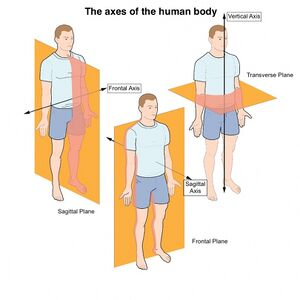
Horizontal Axis
Axis is in an "east-west" relationship to the anatomical position.
→ The line from left to right. (can be for any joint)

Antero-Posterior
Axis is in a “front-to-back” relationship to the anatomical position.
→ The line from your back to your front, kind of a stick going through you (can apply to any joint).
What is the radius to the ulna in supination?
The radius is lateral to the ulna

What is the radius to the ulna in pronation?
The radius rotates around the ulna in pronation.

For a movement to move through an anatomical plane it must?
Break the invisible glass of that plane.
→ Jumping jacks occur within the frontal plane (dont break the glass), but they go through the sagittal plane (break the glass).
For a movement to occur within a plane it must?
Not break the invisible glass of that plane.
→ Lunges occur within the sagittal plane(within the glass), but through the frontal plane (break the glass).
What movements occur within the transverse plane?
Rotation of extremities, axial rotation

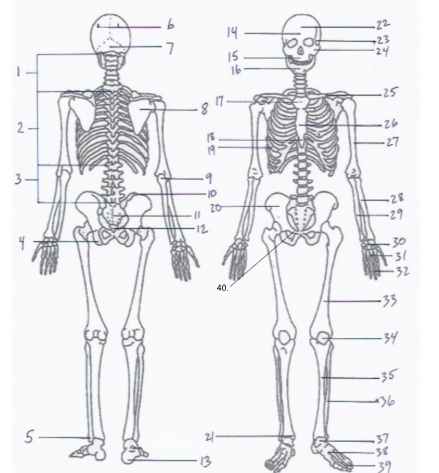
What bone is 1?
Cervical vertebrae (C1 - C7)

What bone is 2?
Thoracic Vertebrae (T1 - T12)
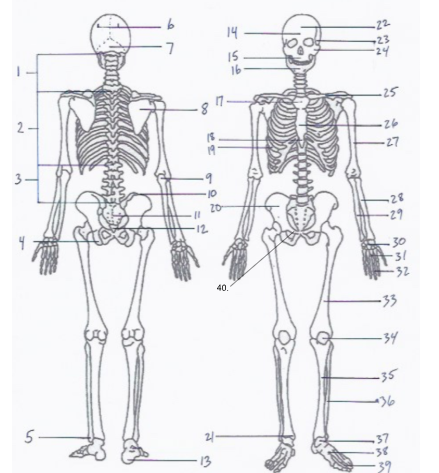
What is bone 3?
Lumbar vertebrae (L1 - L5)

What do 1,2 and 3 make up?
The vertebral column.
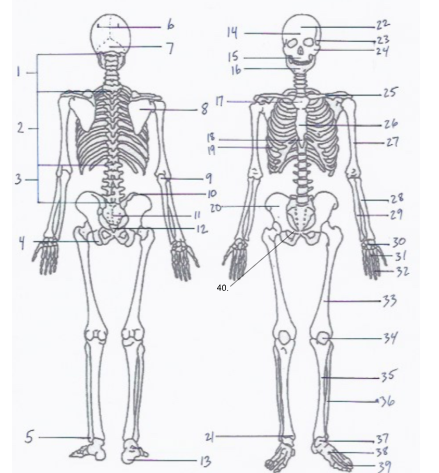
What is 4?
Ischium
→ sit bones

what is 5?
Lateral malleolus
→ outer ankle bone

what is 6?
parietal bone
→ upper back skull

what is 7?
Occipital bone
→ lower back skull
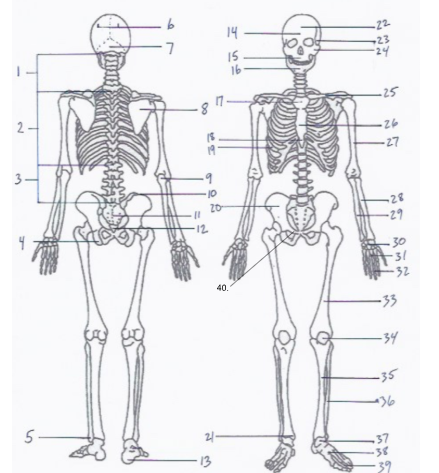
what is 8?
Scapula
→ shoulder blades

what is 9?
Olecranon
→ elbow

what is 10?
Iliac crest

what is 11?
Sacrum

what is 12?
Coccyx
→ tail bone

what is 13?
Calcaneus
→ heel

what is 14?
Frontal bone
→ forehead

what is 15?
Maxilla
→ upper jaw (MAX is up)

What is 16?
Mandible
→ lower jaw

what is 17?
Manubrium
→ upper sternum

what is 18?
Xiphoid complex
→ lower sternum

what is 19?
ribs

what is 20?
ilium

what is 21?
Medial malleolus
→ inner ankle bone
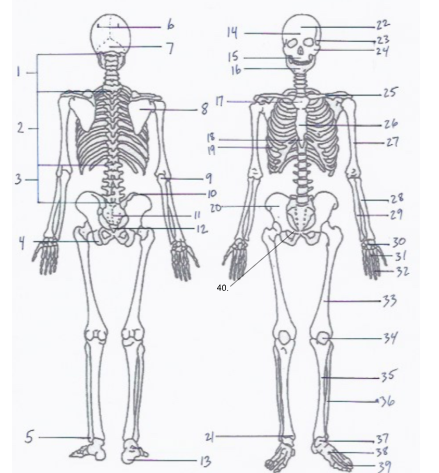
what is 22? (general term)
Cranium

what is 23?
Temporal bone
→ think your temples.

what is 24?
Zygomatic bone
→ cheek bones

what is 25?
Clavicle
→ collar bone
what is 26?
Sternum
→ chest bone

what is 27?
Humerus
→ upper arm

what is 28?
Radius
→ lateral to the ulna in supination
→ rotates

what is 29?
Ulna

what is 30?
Carpals
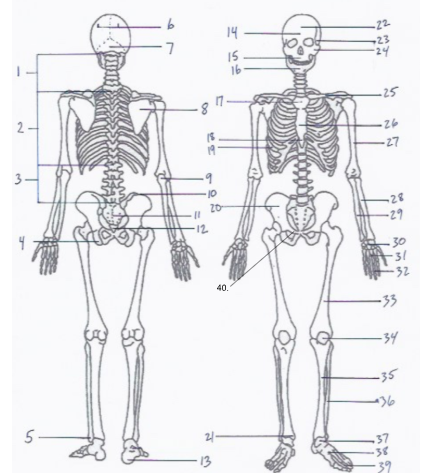
What is 31?
Metacarpals

what is 32?
Phalanges

what is 33?
Femur
→ Thigh bone
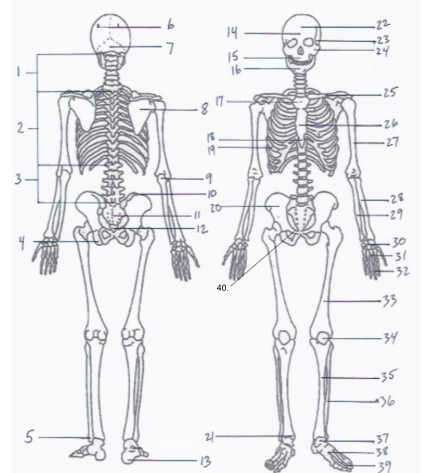
what is 34?
Patella
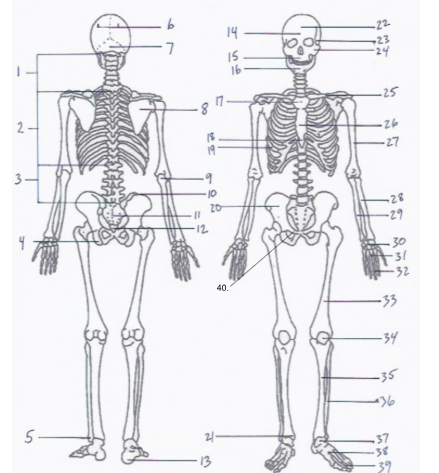
what is 35?
Tibia

what is 36?
Fibula
→ flimsy fibula

what is 37?
Tarsals

what is 38?
metatarsals

what is 39?
Phalanges

what is 40?
Pubis
Name the 5 functions of our skeletal system
Structural support
Protection
Stores minerals
Movement
Produces cells
Name the types of bones (and a function)
Long bone
Functions as a lever
Short bone
Cube shaped
Flat bone
Protection of organs
Irregular bone
Muscle attachment
sesamoid bone
Reducing tension

Difference between male and female skeletal structure
Men: thicker and longer arms and legs
Women: wider pelvis
How many bones do we have?
206
What are the two main skeletal structures?
Axial skeleton
Appendicular skeleton
