Lec 7 and 8 - Innate Immune Cells
 Call Kai
 Learn
Learn Practice Test
 Spaced Repetition
 Match
Match Flashcards
 Knowt Play
1/134

There's no tags or description
Looks like no tags are added yet.
Name | Mastery | Learn | Test | Matching | Spaced | Call with Kai | Chat |
|---|
No analytics yet
Send a link to your students to track their progress
135 Terms
Remember the 5 paradigms of the immune system from last lecture? Which will we be focusing on now?
Sensing
Specialization
Reaction
Regulation
Memory

So we know how cells SEE their targets, but now we’re going to talk about how they …
…how they GET to their targets.
What are the innate immune cells?
innate lymphoid cells
innate lymphoid cell
NK cells
granulocytes
neutrophils
eosinophil
mast cells
basophils
mononuclear phagocytes
monocytes
macrophages
dendritic cells

A neutrophil is a type of [what cell category?]….
…of GRANULOCYTE!

In a neutrophil, what are the sacs you see?
multiple nuclei!
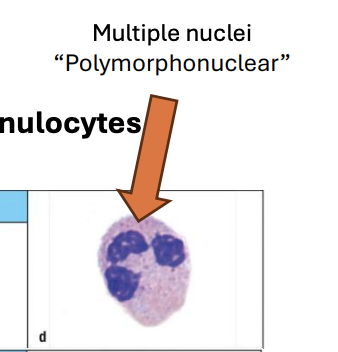
Multiple nuclei AKA
polymorphonuclear

In a basophil, what are all the dots you see?
granules!

A monocyte is a type of [what cell category?]…
.. a mononuclear phagocyte!
T/F: The nucleus of a monocyte is single lobed.
true!

How are immune cells born? Most immune cells come from the…
from the bone marrow!
Most immune cells come from the bone marrow, except for…
…except for sentinel macrophages!
Where do sentinel macrophages come from then if not the bone marrow?
sentinel macrophages in many tissues come from yolk sac/fetal liver.

T/F: So sentinel macrophages only renew through self-replication (not being born).
true!
How are immune cells born? The process is called:
hematopoiesis! the generation of both red and white blood cells
hemato = blood
poiesis = generation
Immune cells born in the bone marrow are called ______ stem cells.
Immune cells born in the bone marrow are called Hematopoietic stem cells (HSC cells).

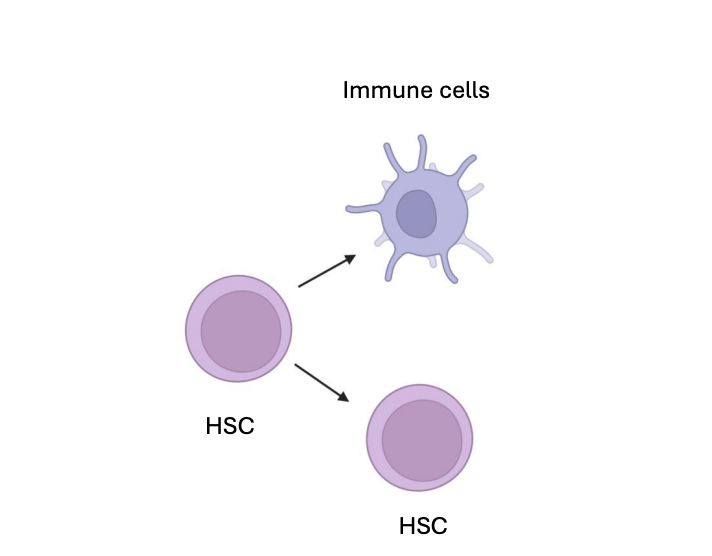
Hematopoietic stem cells (HSC cells) generate immune cells while self-renewing.
….
HSCs are multipotent, meaning they create cells of MANY different types. What is the property of stem cells being able to renew (self replicate) and differentiate/specialize called?
stemness!


What precursor gives rise to adaptive and innate immune lymphocytes?
The Common Lymphoid Precursor (CLP)!


Let’s learn more about the macrophage (a mononuclear phagocyte). What is its origin?
existing ones in the tissues come from the yolk sac/fetal liver
those induced by inflammation (those that need to be made in a pinch) come from bone marrow via monocytes
Do monocytes make macrophages?
yes! monocytes circulate in blood —> once they move into tissues, they specialize into macrophages!

Let’s learn more about the macrophage (a mononuclear phagocyte). Where is it found?
it’s sentinel in all tissues
it can be induced from blood via monocytes!
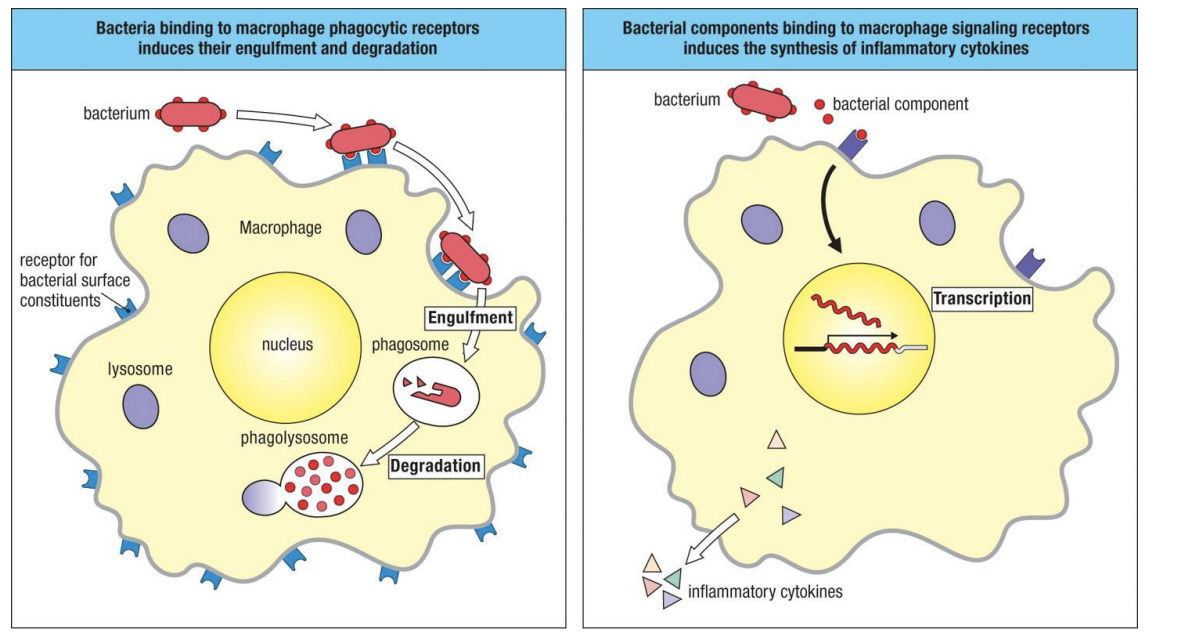
Let’s learn more about the macrophage (a mononuclear phagocyte). What does it do?
kills pathogens via phagocytosis
produces cytokines
Pattern Recognition Receptor (PRR) recognizes PAMP on bacterial cell
Engulfs bacteria into phagosome
Fuses into phagolysosome (the lysosomes contain killing products)
Signalling cascade via cyto/chemokines

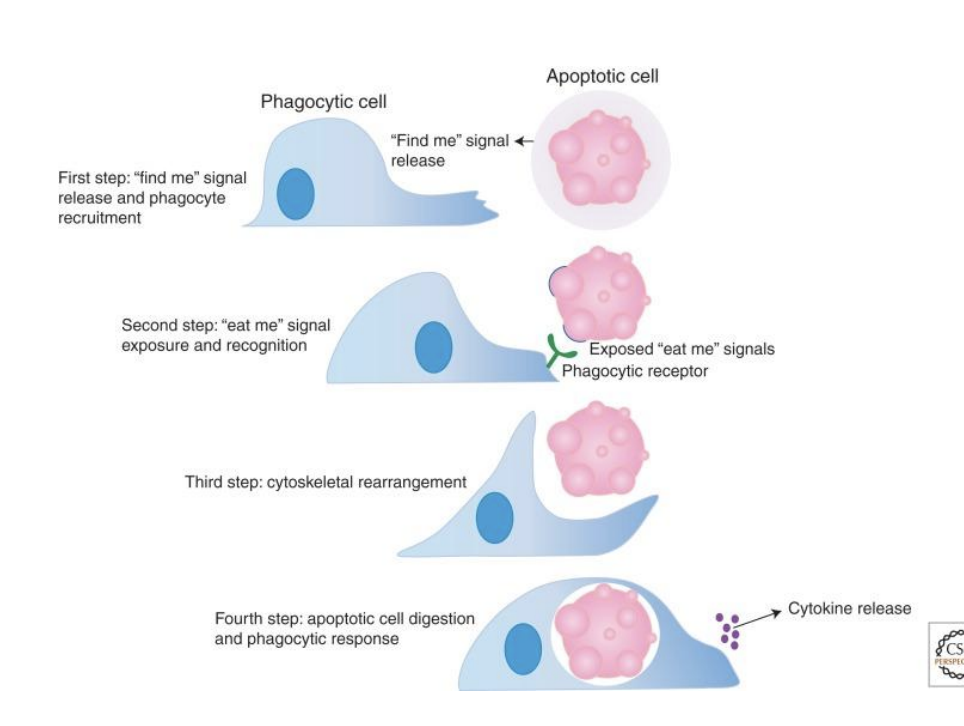
T/F: Macrophage killing via phagocytosis is stronger than neutrophil killing.
FALSE! Neutrophil killing > macrophage killing

What are the granule products of a macrophage’s killing?
reactive oxygen species (ROS)
enzymes (lysozymes, lipases, nucleases, etc)
acidification

Macrophages produce cytokines. What do these cytokines do when released locally?
Macrophage cytokines released locally will recruit other immune cells towards the infection (chemokines) and activate more potent function in both adaptive + innate immune cells.

Macrophages produce cytokines. What do these cytokines do when released systemically?
Macrophage cytokines released systemically will cause fever and induce more liver-derived proteins like complement, etc.
How do macrophages help maintenance of healthy tissues?
i.e., what do macrophages do during perfectly healthy homeostasis?
Macrophages clear away dead cell, produce ECM, produce growth factors, support angiogenesis (making of new blood vessels), support wound healing.
What are the 2 types of macrophages?
M1 = killer macrophages
M2 = healer macrophages

How do macrophages decide to either specialize into killers (M1) or healers (M2)?
it depends on what cytokines stimulate it!


The act of Cytokine stimulation to turn (for example) macrophages into either (ex.) killers (M1) or healers (M2) is called:
CYTOKINE POLARIZATION
What do killers (M1) macrophages do?
they have increased capacity to detect and engulf pathogens, and increased products to kill pathogens!
What do healers (M2) macrophages do?
they have increased capacity to detect cellular debris, and increase production of molecules to promote wound healing!
T/F: Macrophages today are considered either killer (M1) or healer (M2).
false! today it’s actually a spectrum between the two!

Let’s learn more about the dendritic cells (a mononuclear phagocyte). What is its origin?
Dendritic cells come from the bone marrow.
Let’s learn more about the dendritic cells (a mononuclear phagocyte). Where does it go?
dendritic cells are sentinels in all barrier tissues (mucosa, skin)
they go to lymphoid organs (lymph nodes, spleen)
Let’s learn more about the dendritic cells (a mononuclear phagocyte). What does it do?
activates adaptive immunity!
Dendritic cells act as immune system lookouts that detect danger signals from pathogens (PAMPs) or damage (DAMPs)
Let’s learn more about the dendritic cells (a mononuclear phagocyte). What does it have to have on its surface to activate T cells?
Dendritic cells express MHC, and CD80 & CD86 (co-stimulatory proteins) on their surface ! It binds to T cell receptors to activate T cellls!
CD80 and CD86 (co-stimulatory proteins on the surface of dendritic cells) only turn on when there is danger. Danger as in _________ or __________________.
Danger as in PAMPs (Pathogen-Associated Molecular Patterns) or DAMPs (Damage-Associated Molecular Patterns).
Dendritic cells express MHC, and CD80 & CD86 (co-stimulatory proteins) on their surface ! It binds to T cell receptors to activate T cellls!
The T cells become activated only because the dendritic cell is PRESENTING the proof of infection to the T cell stuck to the [CD80 / CD86 / MHC] molecule.
The T cells become activated only because the dendritic cell is PRESENTING the proof of infection to the T cell stuck to the MHC molecule.

Dendritic cells activate adaptive immunity when you have an infection etc. But what about when the body is in perfectly healthy homeostasis — how do they they prevent the immune system from attacking your body's own healthy cells?
Immature dendritic cells constantly sample normal self-antigens and display them on MHC molecules (Signal 1), but they express very low or no CD80/CD86 (Signal 2). You need both to activate killer T cells.
Instead the T cell becomes permanently unresponsive/paralyzed and triggers its own apoptosis. The T cell turns into a Regulatory T Cell (Treg), which actively suppresses other immune cells from attacking healthy tissue.

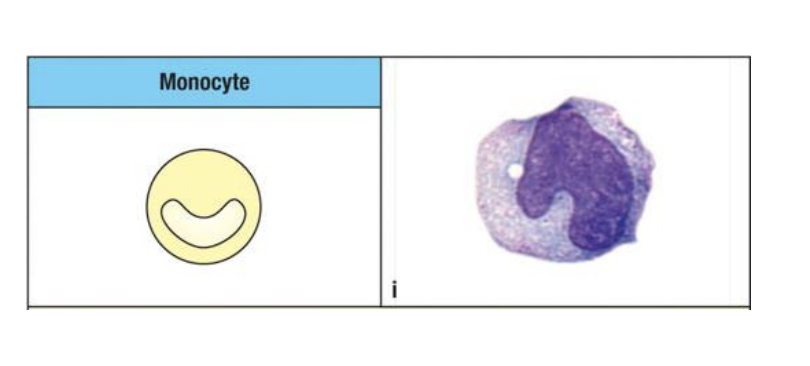
Let’s learn more about the monocytes (a mononuclear phagocyte). What is its origin?
monocytes come from bone marrow!

Let’s learn more about the monocytes (a mononuclear phagocyte). Where do they go?
Monocytes go to the blood and get recruited into tissues during an inflammatory response!
Rem. once it enters a tissue —> specializes into a macrophage

Let’s learn more about the monocytes (a mononuclear phagocyte). What do they do?
phagocytose!
differentiate into other cells!
So monocytes differentiate into other cells. They’re basically circulating precursors. What are these cells it turns into?
Monocytes differentiate into macrophages and dendritic cells!

How do monocytes know WHEN to differentiate into macrophages and dendritic cells?
cuz once a monocyte enters a tissue, it follows local cues (cytokines etc and also local context (inflammation, healing, etc)

Ok now let’s learn more about the granulocytes!
…
T/F: Basophil, eosinophil, neutrophil (granulocytes) get their names from blood staining.
true!
Hematoxylin is positively charged, it binds neg / acidic stuff like DNA.
Eosin is negatively charged, it stains pos / basic stuff in cytopasm / connective tissue.
Rem. phil = loving (hydrophilic, pedophilic etc)
…

Let’s learn more about the neutrophils (a granulocyte). What is its origin?
neutrophils come from the bone marrow
Let’s learn more about the neutrophils (a granulocyte). Where do they go?
neutrophils circulate in blood and rapidly get recruited into tissues during inflammation
Let’s learn more about the neutrophils (a granulocyte). What do they do?
neutrophils phagocytosis and NETose!
What is NETosis?
Hint: suicide bomber!
a specialized form of cell death used by neutrophils where they eject their own DNA into the extracellular space to form sticky, web-like structures called Neutrophil Extracellular Traps (NETs) that trap pathogens.
then the pathogen burns to death in the web because of the caustic materials lining the DNA.


T/F: Only neutrophils are capable of NETosis (the web expulsion).
false! other cells do it too but it’s best understood in neutrophils
macrophages - METosis
eosinophil - EETosis
T/F: Neutrophils are not very effective killers.
false!
neutrophils are VERY effective killers. they express many PRRs (pathogen recognition receptors).
they also express complement receptors (CR3/CR4) to detect complement on pathogens
—> potently destroy material that they phagocytose


WHY are neutrophils such strong killers?
cuz neutrophils store toxic molecules in their granules! they have 4 different types of granules with diff molecules inside each (defensins, other AMPs, potent cleaving enzymes, ROS, acidification, lactoferrin to steal iron from pathogens)
T/F: Neutrophils get phagocytosed by macrophage after?
true!


Neutrophils are like the HULK, they’re super crazy violent and reckless. They release tons of very toxic products, create massive nets —> TOO MUCH COLLATERAL DAMAGE.
How are neutrophils regulated?
dont worry, neutrophils have a very short lifespan (5 days) and also die shortly after killing.
also neutrophils only enter healthy tissue after inflammation, not typically there.

Let’s learn more about eosinophils (a granulocyte). What is their origin?
eosinophils come from bone marrow!

Let’s learn more about eosinophils (a granulocyte). Where do they go?
eosinophils circulate in blood and become sentinels in some mucosal tissues (intestine, uterus)

Let’s learn more about eosinophils (a granulocyte). What do they do?
eosinophils kill massive parasites by releasing toxic granules (degranulation)
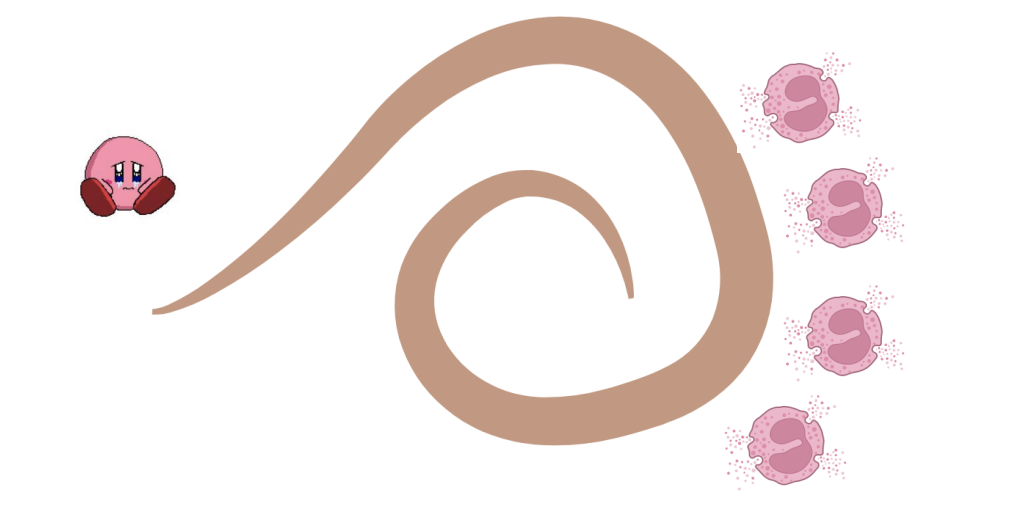
Eosinophils kill massive parasites by releasing toxic granules (degranulation). Why? Why not just phagocytose (eat) it?
cuz parasites are too big to eat! so instead degranulation helps destroy the outside of the parasite (shoot toxic granules onto the outside of the parasite)
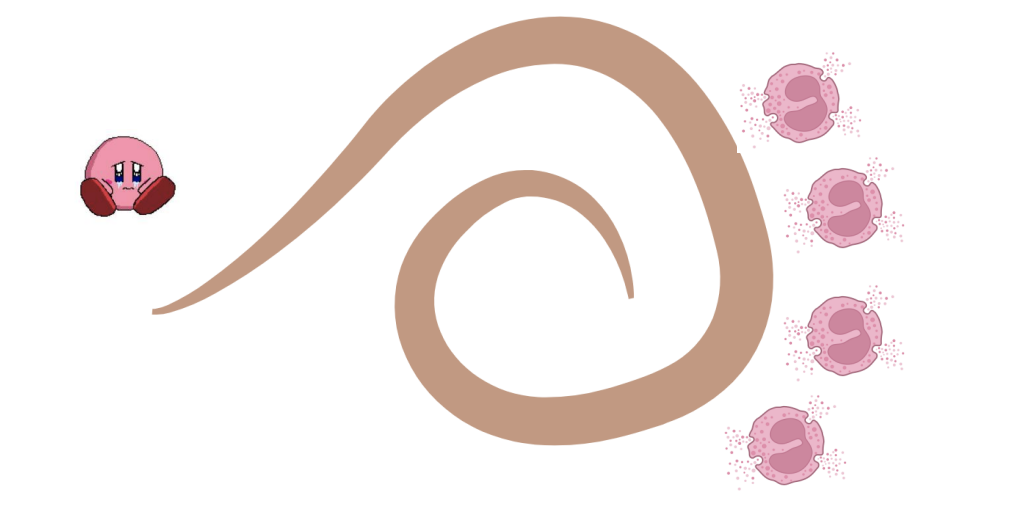
Ok so we know that eosinophils kill parasites via degranulation when there is infection, but what about their role when body is perfectly healthy homestatic?
Eosinophils use their granule products to remodel tissues (granule proteases digest ECM —> allows new deposition —> produces growth factors like VEGF which supports angiogenesis).
they essentially renovate tissues as they constantly wear and tear


T/F: Mice without eosinophils are perfectly fine.
false! Mice without eosinophils have smaller intestinal villi. Resulting in poorer nutrient uptake, and overall worse tissue function.


Let’s learn more about mast cells (a granulocyte). What is their origin?
Mast cells come from the bone marrow. BUT note that their hematopoiesis is not well understood…

Let’s learn more about mast cells (a granulocyte). Where do they go?
Mast cells are found in all tissues! often near vessels and nerves.

Let’s learn more about mast cells (a granulocyte). What do they do?
Mast cells release toxic granules (degranulation) and produce mediators (cytokines, lipids)
Degranulation means the release of…
…toxic granules!
Who discovered mast cells?
Paul Erlich! He called mast cells “MASTZELLEN” which is german for fattening / feeding!

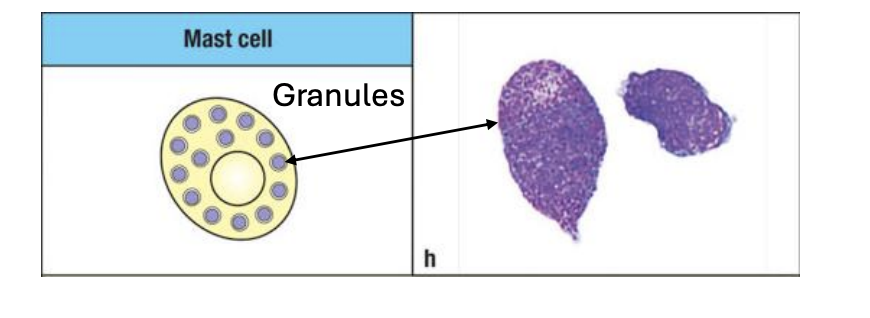
Mast cells are packed with pre-formed (already existing and ready) mediators in granules. What are the two types of mediators they carry?
Vasoactive products (acts on blood vessels)
histamine
heparin
Enzymes (break down tissue and matrix components)
CPA3
chymase
tryptases
T/F: Only eosinophils clear parasites.
FALSE! MAST CELLS ALSO clear parasites.

Besides mast cells also clearing parasites, what dangerous thing do they also fight?
Hint: venom…
Mast cells also degrade venoms!


What is the danger of venoms to us?
Venoms contain potent enzymes that cleave our proteins and/or the phospholipids that make up our cell membranes ☹

How do mast cells degrade venoms?
Mast cell CPA3 (one of the granule products) targets and destroys these venomous enzymes!

How are mast cells activated?
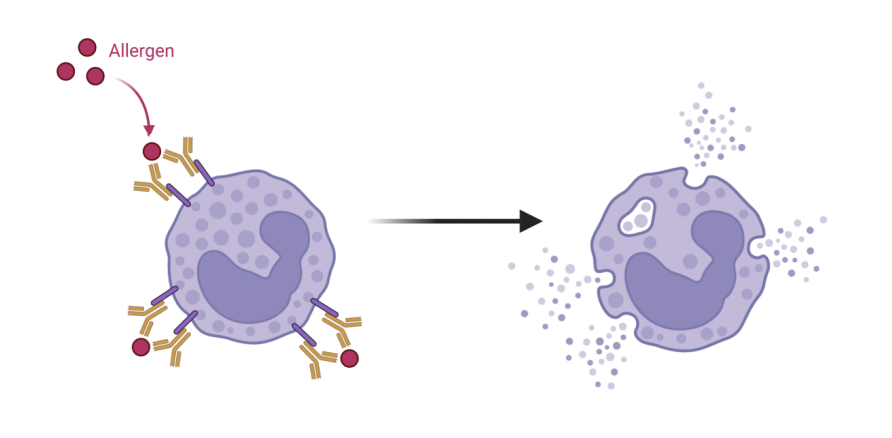
allergens and pathogens activate mast cells!
if an allergen cross links to a mast cells IgE antibodies, mast cell knows it must degranulate!

Why are mast cells known to drive allergic reactions?
because mast cells are essentially tiny explosive landmines loaded with histamine (rem. a mediator in its granules) and other stuff….
Histamine causes vascular leakage (—> edema), inflames airways, produces mucus, causes hives/itching, and induces vomiting cramps and diarrhea!

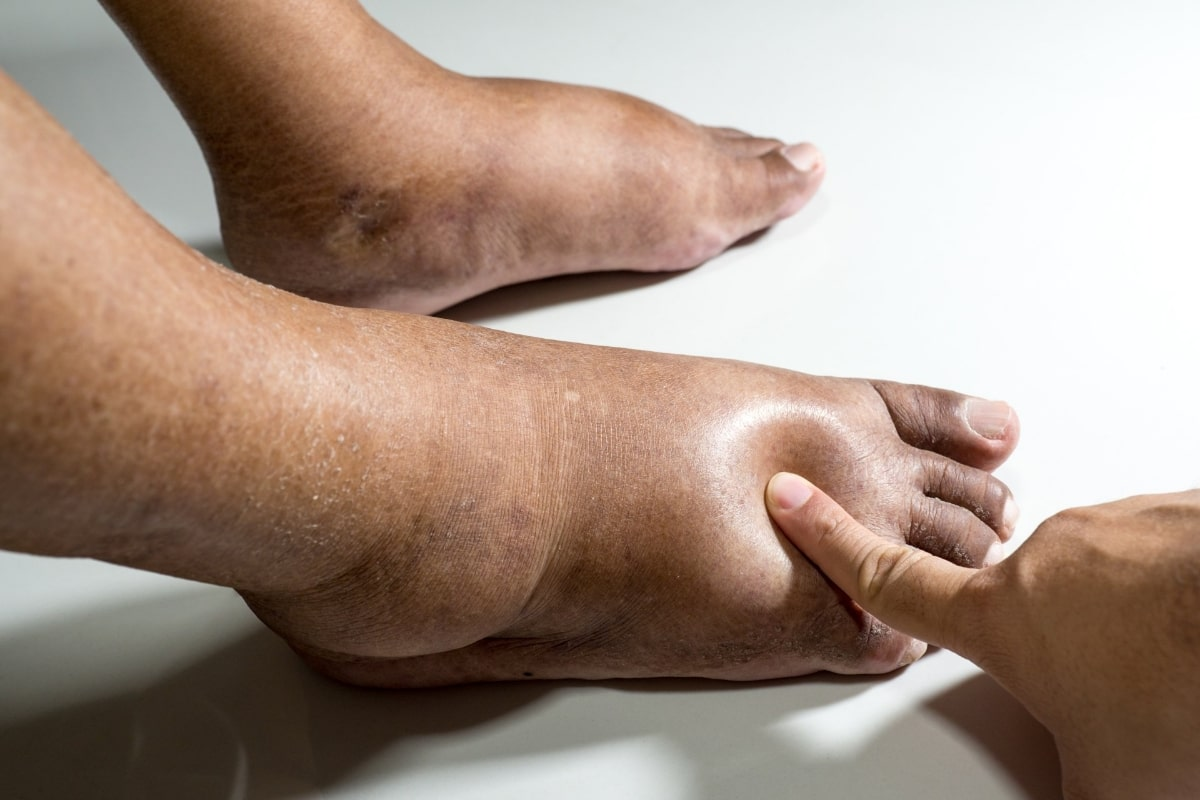
Edema = ?
Edema = swelling caused by fluid trapped in your body's tissues
What do mast cells do during perfectly healthy homeostasis?
Mast cells also remodel tissues with their enzymatic granule products, and also regulate blood pressure with their vasoactive granule products.


During homeostasis, mast cells are most often found in close proximity to blood vessels. Why?
cuz their vasoactive granule products are involved in regulating blood pressure!

If you know someone whose skin shows lines after you draw your fingers along them, this indicates malfunctioning _____ cells!
If you know someone whose skin shows lines after you draw your fingers along them, this indicates malfunctioning mast cells!
As in the mast cells are causing a local allergic rxn (hence the itchiness).


Let’s learn more about basophils (a granulocyte). What’s their origin?
bone marrow!

Let’s learn more about basophils (a granulocyte). Where do they go?
basophils circulate in blood and can be recruited to tissues

Let’s learn more about basophils (a granulocyte). What do they do?
basophils also release toxic granules (degranulation) and produce mediators (cytokines, lipids)
T/F: All granulocytes release toxic granules
true!
Like mast cells, basophils also….
Like mast cells, basophils also bind IgE and degranulate in response to allergens.
Like eosinophils, basophils also…
Like eosinophils, basophils also can be recruited into tissues in the context of parasite infections.

T/F: Basophils are not very well understood. As in we don’t know how well basophils contribute to allergic rxns (than mast cells) nor how well they contribute to helminth parasite attacks (than eosinophils).
true!
Do we know what basophils do during homeostasis?
nope 😕
I.e., Basophils are mysterious like the graffiti artist
Banksy


Now let’s learn more about innate lymphoid cells (ILCs) (an innate lymphoid cell). What is its origin?
ILCs come from the bone marrow!

Now let’s learn more about innate lymphoid cells (ILCs) (an innate lymphoid cell). Where do they go?
ILCs localize as sentinels in tissues
ILCs localize as sentinels in tissues, especially ________ tissues.
ILCs localize as sentinels in tissues, especially barrier tissues.

Now let’s learn more about innate lymphoid cells (ILCs) (an innate lymphoid cell). What do they do?
ILCs produce cytokines!
To understand ILCs, we need to understand the 4 major effector (rxn) modules of immunity. What are they?
Cytotoxicity
Intracellular immunity (Type 1)
Mucosal and barrier immunity (Type 2)
Extracellular immunity (Type 3)

T/F: The 4 major effector (rxn) modules of immunity only exist in innate immunity.
FALSE! these modules exist across both innate and adaptive immunity.
![<p>The cytotoxicity effector module eliminates [viruses / pathogens inside cells / parasites / bacteria + fungi].</p>](https://assets.knowt.com/user-attachments/7fc2f122-e6e2-4210-ab44-47bd095740d2.png)
The cytotoxicity effector module eliminates [viruses / pathogens inside cells / parasites / bacteria + fungi].
The cytotoxicity effector module eliminates viruses.
![<p>The intracellular immunity (Type 1) effector module eliminates [viruses / pathogens inside cells / parasites / bacteria + fungi].</p>](https://assets.knowt.com/user-attachments/dbf4cf6c-4ab1-47ed-a95b-5ed9627f462d.png)
The intracellular immunity (Type 1) effector module eliminates [viruses / pathogens inside cells / parasites / bacteria + fungi].
The intracellular immunity (Type 1) effector module eliminates pathogens inside cells.
![<p>The mucosal and barrier immunity (Type 2) effector module eliminates [viruses / pathogens inside cells / parasites / bacteria + fungi].</p>](https://assets.knowt.com/user-attachments/b6d5fdd6-072c-4e56-b5b8-a252cb4a28d0.png)
The mucosal and barrier immunity (Type 2) effector module eliminates [viruses / pathogens inside cells / parasites / bacteria + fungi].
The mucosal and barrier immunity (Type 2) effector module eliminates parasites.
![<p>The extracellular immunity (Type 3) effector module eliminates [viruses / pathogens inside cells / parasites / bacteria + fungi].</p>](https://assets.knowt.com/user-attachments/64961f5d-f45d-4fb7-854c-3bb0113c5a68.png)
The extracellular immunity (Type 3) effector module eliminates [viruses / pathogens inside cells / parasites / bacteria + fungi].
The extracellular immunity (Type 3) effector module eliminates bacteria + fungi.
What is the type 1 effector module?
intracellular immunity

What is the type 2 effector module?
mucosal and barrier immunity
