PT 759 - Neural Aspects of Pain Processing
 Call Kai
 Learn
 Practice Test
 Spaced Repetition
 Match
 Flashcards
 Knowt Play
1/78

There's no tags or description
Looks like no tags are added yet.
79 Terms
What is pain?
An unpleasant sensory or emotional experience associated with actual or potential tissue damage
Are pain and nociception the same phenomena?
No, can have nociception without pain (needs to be processed to experience pain)
What is the definition of pain?
A perception and the emotional response to this perception
What are the different types of pain?
Mechanical pain (physical damage)
Referred pain (visceral pain elsewhere)
Neuropathic pain (damage of nerve)
Chronic pain (dysfunction of pain matric)
Fast mechanical pain uses what type of fibers?
Fast Aδ fibers
Fast mechanical pain goes where?
Thalamus and somatosensory cortex (I and II)
Slow mechanical pain connects to which system?
Medial/divergent pain system
What is the function of deep pain in muscles and joints?
To encourage rest of damage tissue
Referred pain most often occurs with what?
Visceral damage

Why does visceral pain cause pain to be felt elsewhere?
Collaterals from visceral pathway synapse on second order neuron of in spinal cord

What is the pain matrix?
Brain structures that process and regulate pain info
What is the function of the pain matrix?
Perceive pain, react to it physically and emotionally, and make sense of it cognitively
In the absence of pain, what can the pain matrix do?
Create pain perception without nociceptive input
Understanding of pain requires consideration of what?
Discriminative
Motivational-affective
Cognitive-evaluative components
The discriminative aspect of the pain matrix refers to what?
Ability to localize site, intensity and timing of damage or potential damage
Which pain system is the discriminative aspect of the pain matrix in?
Lateral pain system
The motivational-affective aspect of the pain matrix refers to what?
Effects of pain experience on emotions and behavior, includes increased arousal and avoidance behavior
Which pain system is the motivational-affective aspect of the pain matrix in?
Medial pain system
What does the cognitive-evaluative aspect of the pain matrix refer to?
Meaning that the person ascribes to pain
The top-down response of the pain matrix can result in which two potential responses?
Antinociception (inhibition of pain)
Pronociception (amplification of pain)
Pain is controlled by individuals how?
Through the gate theory of pain (use other stimuli to the affected area to mask or reduce the level of pain perceived)

Give an example of an individual using gate theory to mask pain?
If you stub your toe then rub it to make it feel better

Why does rubbing your toe after stubbing it reduce pain levels perceived?
Aβ activity can dominate over the activity of nociceptors

How does Aβ activity dominating reduce pain levels?
They stimulate interneurons in the dorsal horn to release enkephalin NTs which inhibit nociceptive signals

What is the net effect of Aβ activity dominating over nociception?
Suppression of pain response

What is a counter-irritant mechanism?
Using a secondary sensory cue that is also an irritant (ex. ice pack) to block pain

Empirical evidence shows that noxious cold stimuli (counter-irritant) activates which pathway?
Activates the central pain modulation pathways (CPM)

What evidence suggests that ice packs act centrally and not just locally?
Effect goes beyond where ice is applied and reduces pain at alternate location
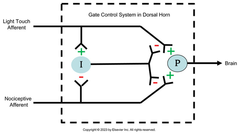
What are the three states of processing of nociceptive input?
Normal
Suppressed (nociception inhibited)
Sensitized (nociception amplified)

A sensitized state is part of what?
Central sensitization
After an acute tissue injury, central sensitization is triggered by what?
Gets triggered by peripheral sensitization in nociceptive afferents
In peripheral sensitization what happens to the nociceptors?
They become highly reactive to any stimulus
What effect does peripheral sensitization create at the site of acute tissue injury?
Amplified response if reactivated sending a strong signal and create more pain than normal (Hyperalgesia)
What antinociception?
Suppression of pain in response to stimulation that would normally be painful

How is antinociception activated?
The cerebral cortex can activate pain suppressing mechanisms via descending corticoperiaqueductal tracts

What are the parts of the brainstem that provide intrinsic antinociception?
Rostral ventromedial medulla (RVM)
Periaqueductal gray (PAG) in midbrain
Locus coeruleus in the pons
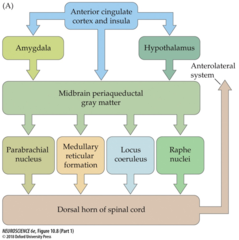
Brainstem activity has what effect on the perception of pain?
Can decrease the perception of pain

Periaqueductal gray activity has what effect on the nociceptive pathways?
Increase or decrease inhibition of nociceptive pathways
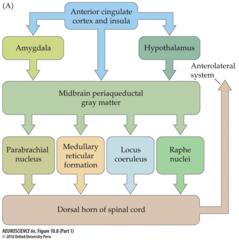
What are endogenous opioids?
Chemicals produced by the body that activate antinociceptive mechanisms (enkephalins, dynorphin, β-endorphin)
What effect does stress have on the antinociception system?
Stress during an emergency or competition triggers the antinociception systems
Which endorphin is the most potent and can last for hours?
β-endorphins
How many different sites/levels can antinociception occur at?
5 levels or sites
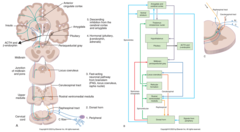
Where is level 1 of antinociception?
In the periphery

Where is level 2 of antinociception?
In the dorsal horn

Where is level 3 of antinociception?
In fast-acting neuronal descending system

Where is level 4 of antinociception?
In the hormonal system

Where is level 5 of antinociception?
In the amygdala and cortical level

Be able to explain the photos where the different sites of antinociception are.

Nociception can be amplified biologically by what in the periphery?
Edema and endogenous chemicals can sensitize free nerve endings in the periphery
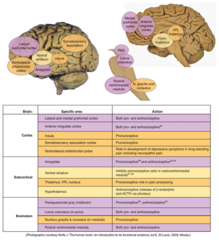
The pronociception pain matrix can do what in the absence of pain?
Produce pain perception in the absence of nociceptive input

Know which areas of the brain produce antinociceptive inputs, pronociceptive inputs, or both inputs.

What is acute pain?
Pain that last a short period of time and resolves once stimulus is removed (or heals)
Acute pain is detected by what?
Nociceptors
What is chronic pain?
Pain that lasts more than 3 months with no indication of which neuropathological processes are occurring
What is primary chronic pain?
Chronic pain arising independently of other conditions
What is secondary chronic pain?
Chronic pain arising as a consequence of another condition
In an individual with chronic pain, is the area in pain the disease?
No the pain syndrome is the disease
In chronic pain, what creates pain in the absence of tissue damage?
Neural dysfunction
What are the causes of secondary chronic pain?
Continued nociception stimulation from tissue injury (ex. pain from cancer)
Maintained signaling after healing
Damage to somatosensory system
What is the main mechanism underlying chronic pain?
Central sensitization
What can chronic pain and central sensitization lead to?
Lasting changes in neural processing (negative neuroplasticity, and cortical reorganization)
What is central sensitization?
A disturbance in central pain processing that creates enhanced excitability (or reduced inhibition) of central pain pathways
What effect does central sensitization have on 2nd order neurons?
Creates a winding up phenomenon where they are primed to fire at normal input
What other mechanisms does central sensitization have as pain shifts from acute to chronic?
Reduced activity in descending inhibitory tracts
Increased activity in descending faciliatory tracts
What are the signs and symptoms of central sensitization?
Dysesthesias
Hyperalgesia
Allodynia
Chronic primary pain syndromes are due to what?
Central sensitization
What are four of the most common chronic primary pain syndromes?
Fibromyalgia
Migraine
Complex regional pain syndrome
Chronic non-specific low back pain
Chronic secondary pain syndromes are caused by what?
An underlying disease or specific injury
Pain in an individual with chronic secondary pain syndrome may be driven by what?
Damage to nerves in arm
Active inflammation as a result of tissue damage
Sensitization of the central nociceptive system
(each may be amplifying or generating pain)
What is neuropathic pain?
Pain arising as a direct result of a lesion or disease affecting the somatosensory system
(type of secondary chronic pain)
Neuropathic pain can arise from abnormal neural activity where?
In the periphery, dorsal horn, brainstem or cerebrum
Compression of a nerve (carpal tunnel) is an example of which type of pain?
Neuropathic pain
What are small fiber neuropathies?
Partial demyelination of somatosensory fibers or loss of dorsal horn neurons
Small fiber neuropathies lead to what sensations?
Burning, shooting pains in dermatomal distribution
What type of pain is phantom limb sensation and pain?
Neuropathic pain
Phantom limb sensations and pain could be caused by what?
Absence of stimuli making central pathways overreactive
Phantom limb sensations and pain are often correlated with what?
An overlap in cortical representations (signals of face take over hand)
How can phantom limb sensations and pain can be treated with what?
Mental practice and mirror therapy
What is neuropathic central pain?
Pain in a body region that is demyelinated due to central lesion