Diseases of the Equine Nasal Passages and Paranasal Sinuses
 Call Kai
 Learn
 Practice Test
 Spaced Repetition
 Match
 Flashcards
 Knowt Play
1/43

Earn XP
Description and Tags
Lecture 33
44 Terms
What is the medical term for a nosebleed?
epistaxis
List causes of unilateral epistaxis.
dry mucous mmebranes (cold weather)
exertion
ethmoid hematoma
nasal polyps
guttural pouch mycosis
neoplasia
List causes of bilateral epistaxis.
EIPH (racehorses, barrel horses)
head trauma
clotting disorders
severe pleuropneumonia
What is the first major site of upper airway resistance?
external nares (nostrils)
What is the etiology of atheroma or epidermal inclusion cyst of the external nares?
cyst in the false nostril - cause unknown
How can we diagnose atheroma or epidermal inclusion cyst of the external nares?
mass (3-5cm) spherical nodule
FNA and cytology if indicated
How can we treat atheroma or epidermal inclusion cyst of the external nares?
surgical removal
What prognosis is associated with atheroma or epidermal inclusion cysts of the external nares?
excellent with no recurrence reported
What can lead to problems of the nasal passages?
trauma, inflammation, infection, neoplasia, congenital issues such as wry nose
How can we diagnose problems of the nasal septum?
clinical signs —> respiratory noise, decreased airflow, nasal discharge, facial deformity
radiography —> DV view reveals thickening, malformation, and septal deviation
endoscopy NOT helpful
CT
How can we treat problems of the nasal septum?
resection of the septum —> need to leave the rostral section to prevent collapse
What are nasal polyps?
pedunculated growths from the mucosa of the nasal cavity, septum, etc
What clinical signs can be associated with nasal polyps?
inspiratory dyspnea, nasal discharge, odor
How can we treat nasal polyps?
surgical excision
What is the etiology of progressive ethmoid hematoms in the nasal passages?
slowly expanding, non neoplastic mass that originates from submucosa of ethmoid labyrinth or paranasal sinuses
usually unilateral and can expand down the nasal passages and/or into the sinuses
What clinical signs can be associated with progressive ethmoid hematomas?
unilateral epistaxis with serosanguinous discharge
respiratory noise
dyspnea
head shaking
halitosis
facial deformity
How can we diagnose progressive ethmoid hematoma?
endoscopy reveals greenish-yellow to purplish-red mass, smooth surface, may have fungal plauqes, biopsy
radiographs
How can we treat progressive ethmoid hematoma?
surgical excision for mass removal and destruction of origin
transendoscopic using laser and intra-lesional formalin injection with 4% formaldehyde every 3-4 weeks
All paranasal sinuses eventually drain through what?
nasomaxillary opening
What tooth roots reside in the paranasal sinus?
maxillary PM4, M1, M2, M3
What is the most common clinical sign of sinusitis?
unilateral nasal discharge
Primary sinusitis is often caused by what?
upper respiratory infection especially strep sp
Secondary sinusitis is often caused by what?
tooth root abscess, trauma (facial fracture), neoplasia
What clinical signs can be associated with sinusitis?
nasal discharge (odor, purulent, unilateral)
± epiphora, conjunctivitis
± enlarged submandibular lymph nodes
± respiratory noise
± facial deformity (rare with sinusitis, more common with paranasal sinus cysts)
Unilateral nasal discharge usually comes from where?
sinuses, nasal cavity
Bilateral nasal discharge usually comes from where?
guttural pouches, nasopharynx, lungs, both paranasal sinuses
How can we diagnose sinusitis?
radiographs reveal opacity in the sinus and fluid lines
endoscopy shows pus at the nasomaxillary opening blocking view into the sinus
How can we diagnose sinusitis that has been refractory to treatment?
sinocentesis with cytology and culture followed by lavage
sinoscopy to visualize the sinus
CT for complicated cases
How can you perform a lavage for primary sinusitis?
copious lavage with 5-10 L of sterile warm saline with systemic antibiotics based on C/S
Why might treatment for sinusitis fail?
inspissated pus in ventral conchal sinus
failure to treat primary problem
fungal infection
neoplasia
What is the etiology of sinus cysts?
fluid filled structure lined by epithelium - unknown etiology but congenital possible
What clinical signs can be associated with sinus cysts?
facial deformation
unilateral mucoserous nasal discharge with no odor
reduced airflow on affected side
How can we diagnose sinus cysts?
radiographs show space occupying without bone destruction
CT/MRI
How can we treat sinus cysts?
remove them - make sure you also remove cyst lining so it does not recur
What is the most common sinus neoplasia?
squamous cell carcinoma
What clinical signs can be associated with sinus neoplasia?
nasal discharge, facial deformity, loos teeth, epiphora
How can we diagnose sinus neoplasia?
aspirate fluid for cytology
biopsy
How can we treat sinus neoplasia?
surgical margins difficult/impossible to get so we typically euthanize affected animals
What are the different bone flap approaches used for surgery of the sinuses?
frontonasal
maxillary

What type of bone flap approach is this?
frontonasal
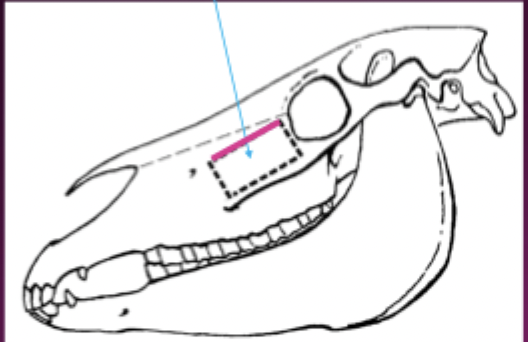
What type of bone flap approach is this?
maxillary
What tools are used to create a bone flap?
mallet and osteotome
oscillating saw
What complications can occur with sinus surgery?
hemorrhage especially with ethmoid hematomas
recurrence
failure to resolve clinical signs
What are important considerations for surgery of the sinuses?
make a large opening into nasal cavity to facilitate drainage
post op lavage may be needed so plan to place a foley catheter just in case
pack the sinus post op to control hemorrhage then remove 48-72 hours after surgery