Forests-Approaches to sustainability
 Call Kai
 Learn
 Practice Test
 Spaced Repetition
 Match
 Flashcards
 Knowt Play
1/21

There's no tags or description
Looks like no tags are added yet.
22 Terms
What are the main principles of "New Forestry" or "Sustainable Forestry"?
Ecosystem-based management and Resilience and natural disturbance emulation
Ecosystem-based management (New Forestry/Sustainable Forestry)
managing forests for more than just timber production, considering the entire ecosystem.
Resilience and natural disturbance emulation (New Forestry/Sustainable Forestry)
incorporating forest resilience and mimicking natural disturbances (such as fires) into management plans.
What is the definition of sustainable forest management (according to the FAO)?
maintains their biodiversity, productivity, regeneration capacity and vitality,
fulfill ecological, economic and social functions now and in the future.
does not cause damage
‘Old’ resource management
Product: timber
Goal: max timber production
Sustained yield
classic clear cut
New resource management
Product: non-timer forest products are also important
Goal: Environmental protection, social sustainability, ecosystem services
Other approaches (adaptive management)
more complex (spatial, temporal) approaches to harvesting)
The challenge in sustainable forest management
Sustainable forestry seeks to balance:
Environmental (e.g. ecosystem services)
Economic (e.g. productive capacity)
Social (e.g. subsistence uses, community access)
Range of actors, stakeholders and a range of interests.

Examples of principles of sustainable forestry
Protect the full pattern of drainage throughout the landscape
→water is the key resource for the entire ecosystem
Seek to approximate natural disturbance regimes in forest development
→the system is adapted to natural disturbance
Integration of multiple stakeholders and agendas - embracing participation
We will elaborate on these examples and the potential ramifications of forestry management with case studies of the Great Bear Rainforest and the Mountain Pine Beetle Outbreak
How are forests in Canada harvested sustainably?
90% of Canada’s forests are publicly owned, managed by the province
multidisciplinary efforts
research (climate factors and harvest, adaptive silviculture)
Managing old growth in BC — Paradigm Shift
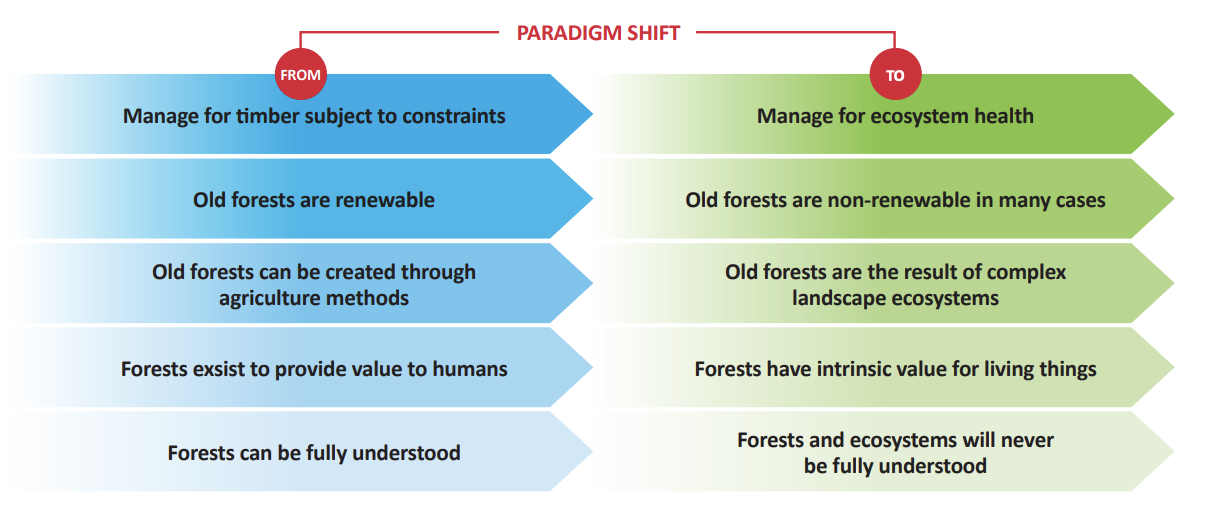
What was planned for old-growth management in B.C., and what is happening in practice?
Monitoring: Continuous monitoring and regular updates were planned, but little has occurred since 1995.
Reviews: Periodic system reviews were planned, but none have occurred.
Forest targets: Both mature and overmature forests were meant to be protected, but OGMAs mainly focus on overmature forests.
Tracking: Target achievement was supposed to be monitored, but no consistent tracking system exists.
Biodiversity: Retention targets were intended to exceed 30%, but some were lowered below this threshold.
Forest quality: OGMAs were meant to contain old forests, preferably high-quality ones, but some contain forests less than 40 years old
Approaches to encourage “sustainable forestry”
Government-led methods and Independent Certification
Approaches to encourage “sustainable forestry”
Government-led methods
Government-sponsored voluntary processes
International legal regimes
Led by governments
Approaches to encourage “sustainable forestry”
Independent Certification
Market based
Standards based
Led by non-governmental organizations
"Sustainable Forest Management" in practice
Objectives from the Montreal Process on Sustainable Management of Temperate/Boreal Forests (1994)
Conservation of biological diversity
Maintenance of productive capacity of forest ecosystems
Maintenance of forest ecosystem health and vitality
Conservation and maintenance of soil and water resources
Maintenance of forest contribution to global carbon cycles
Maintenance and enhancement of long-term multiple socioeconomic benefits to meet the needs of societies
"Sustainable Forest Management" in practice
Objectives from the Montreal Process on Sustainable Management of Temperate/Boreal Forests (1994)
Problem in international agreements like this:
voluntary
no independent oversight/monitoring
no demand for sustainable products
how do you ensure that there is sustainability along the supply chain?
Paid Forest certifications
You don’t actually know if it’s sustainable
Characteristics of how sustainable it is, depends on each company’s priorities.
non-state market-driven regulation
voluntary compliance agreements instead of regulation
A forest company follows a set of rules (the standard).
An independent third party checks whether the company follows those rules.
If it meets the requirements, the certifier gives written proof (certification).
Paid Forest certifications—Goals
Respond to public concerns related to sustainable forest management, including:
deforestation in the tropics
loss of biodiversity
perceived low quality of forest management in areas where traded wood
products are sourced from
Preservation of forest values (ecological, economic, social, cultural, spiritual)
Not having it of not following correctly, affects the image of the coorporation. → public pressure
FSC Certification Process
Two-part Process:
(1)Certification: inspection of the forest management by an independent organization to check that it passes internationally agreed criteria
(2) 'Chain of custody': is the path taken by raw materials from the forest to the consumer, including all successive stages of processing, transformation, manufacturing and distribution.
FSC Certification Process—What does it offer?
Independent auditing of entire commodity chain
Standardize international assessment
Creates market
Usually created where there is more richness e.g GreenPeace Canada
Differences between International agreement based forest management and International and independent certification
the primary purpose is not necessarily applicable

Forest Certification in Canada
CSA ~ Canadian Standards Association
SFI ~ Sustainable Forestry Initiative
FSC ~ Forest Stewardship Council- largest international certifier
Approx. ¾ of Canada’s forests are ‘certified by some organization