8-Introduction: Myoglobin and Hemoglobin
 Call Kai
 Learn
 Practice Test
 Spaced Repetition
 Match
 Flashcards
 Knowt Play
1/117

There's no tags or description
Looks like no tags are added yet.
118 Terms
What characteristics of a binding site dictate ligand binding?
Size
Shape
Charge
Hydrophobicity/Hydrophilicity
COMPLMENTARITY
What is a ligand?
A molecule that binds to a protein
What does reversible ligand binding mean?
A ligand can bind to a protein and later detach from it
Why is reversible binding important for hemoglobin?
It allows hemoglobin to pick up oxygen in the lungs and release it in the tissues
What do myoglobin and hemoglobin have in common?
Both are proteins that bind oxygen reversibly
How many oxygen-binding sites does myoglobin have?
1
How many oxygen-binding sites does hemoglobin have?
4
Where is hemoglobin found?
Inside red blood cells.
What happens to hemoglobin in the lungs?
It binds oxygen because oxygen availability is high
What happens to hemoglobin in tissues where oxygen is needed?
It releases oxygen
What is the main challenge hemoglobin must overcome?
It must bind oxygen efficiently in the lungs and release it efficiently in the tissues
What is hemoglobin's main function?
Transporting oxygen from the lungs to tissues through the blood.
What is myoglobin's main function?
Storing oxygen and facilitating oxygen movement through muscle tissue.
Why is myoglobin useful in muscle cells?
It provides an oxygen reserve and helps oxygen move through muscle tissue.
How do hemoglobin and myoglobin work together?
Hemoglobin delivers oxygen to tissues, and myoglobin helps store and distribute oxygen within muscle
What is a globin fold?
A characteristic protein structure containing eight alpha helices, found in myoglobin and hemoglobin subunits.
CREATES A HYDROPHOBIC POCKET THAT ALLOWS THE HEME TO BIND
What is heme?
A chemical group containing an iron atom that binds oxygen.
What is a prosthetic group?
A tightly associated nonprotein component required for a protein's function
ex: heme group
Is myoglobin a monomer or a tetramer?
A monomer; it contains one globin polypeptide chain
Is hemoglobin a monomer or a tetramer?
A tetramer; it contains four globin subunits
How many heme groups does one myoglobin molecule contain?
1
How many heme groups does one hemoglobin molecule contain?
4
Why is the four-subunit structure of hemoglobin important?
It allows interactions between subunits, enabling cooperative oxygen binding
Why is the iron atom in a heme group important?
Oxygen binds directly to the iron atom in a heme group
The protein (Mb or Hb) itself creates the surrounding environment that helps make oxygen binding effective
What does the phrase “molecular bucket” mean in reference to myoglobin?
Myoglobin binds oxygen and helps move it through muscle tissue, releasing it when conditions favor oxygen delivery
Why is myoglobin useful in rapidly respiring muscle?
It helps maintain oxygen availability where muscle cells need it for energy production
What type of protein is myoglobin?
A globular protein
What is the protoporphyrin ring?
The ring-shaped chemical structure that surrounds the iron in heme and offers it a place to sit
Where is heme located in myoglobin?
In a pocket between the protein's helices.
What role does the globin protein play in oxygen binding?
It creates the surrounding environment (hydrophobic pocket) that helps control and stabilize oxygen binding to heme
Also, it allows the heme to bind, giving oxygen a place to even sit
Why is oxygen transport by simple dissolution in water insufficient?
Oxygen has low solubility in water, so a specialized carrier is needed to transport enough oxygen.
How many nitrogen atoms from the protoporphyrin ring coordinate the iron?
4
What does coordination mean?
Interaction between a central metal ion and surrounding atoms or groups.
What are the three main components involved in oxygen binding through heme?
The iron atom, the protoporphyrin ring, and the surrounding globin protein
What happens to iron once oxygen binds to it?
When O2 binds to the iron in heme, the iron moves into the plane of the heme ring
Why is it important that iron aligns with the heme group?
This structural change helps hemoglobin bind additional oxygen more easily. This is called positive cooperativity.
Where does oxygen bind?
Oxygen binds directly to the heme iron.
How many coordination positions does the heme iron have in the arrangement?
6
What occupies the iron's coordination positions
Positions 1-4: Nitrogens from the protoporphyrin ring
Position 5: 1 nitrogen atom from a histidine amino acid in the protein
Position 6: Position that can bind to O2
What is the proximal histidine in myoglobin?
His F8, also called His 93, which directly coordinates the heme iron.
What is the distal histidine in myoglobin?
His E7, also called His 64
2 functions of His E7, also called His 64?
Helps stabilize bound oxygen through a hydrogen bond
Does this by orienting the oxygen molecule with an H-bond to ensure binding to the heme iron
Prevents CO from binding with such high affinity to the heme iron
What is the difference between the proximal and distal histidines?
The proximal histidine directly coordinates the iron, while the distal histidine helps stabilize oxygen in the binding pocket
What roles do Val E11 and Phe CD1 play?
Help position the heme
Protect the iron from oxidation
Contribute to the oxygen-binding pocket
Why does the protein surrounding heme matter if oxygen binds to iron?
The protein helps control ligand orientation, stabilize oxygen binding, and protect the iron's chemical environment
Why does binding oxygen to heme change its color?
Oxygen binding changes the electronic state of the iron–heme complex, altering its absorption of visible light.
What color is oxygenated arterial blood?
Scarlet red
What color is deoxygenated venous blood?
Darker red/ dark purple
What happens when heme iron changes from Fe²⁺ to Fe³⁺?
It becomes oxidized and cannot bind oxygen normally.
What is metmyoglobin?
Myoglobin whose heme iron has been oxidized to the ferric state, Fe³⁺.
Name three molecules other than oxygen that can bind to ferrous heme.
Carbon monoxide (CO), nitric oxide (NO), and hydrogen sulfide (H2S).
What is binding affinity?
A measure of how strongly a protein tends to bind a ligand
What does the association constant Ka measure?
The tendency of a protein and ligand to form a complex
What does the dissociation constant Kd measure?
The tendency of a protein–ligand complex to dissociate into free protein and ligand
What is the relationship between Ka and Kd for a simple binding reaction?
Kd= 1/Ka
What does a low Kd indicate?
High binding affinity
Protein-ligand complex favored
What does a high Kd indicate?
Low binding affinity
Protein-ligand not favored
Can a high-affinity protein have low occupancy?
Yes. If very little ligand is available, many binding sites may remain unoccupied.
BINDING ALSO DEPENDS ON [LIGAND]
What does a binding curve show?
How fractional saturation changes as ligand concentration increases
What does θ represent?
Fractional saturation, or the fraction of binding sites occupied by ligand
What does θ=0.5 mean?
Half of the binding sites are occupied.
How do you calculate percentage saturation from fractional saturation?
Multiply fractional saturation by 100.
Where is Kd found on a simple binding curve?
At the ligand concentration corresponding to 50% saturation.
θ = 0.5
What does a lower Kd tell you about binding affinity?
The protein binds the ligand more strongly
Why is carbon monoxide toxic?
It binds to heme in hemoglobin, interfering with oxygen transport and delivery to tissues.
What is tissue hypoxia?
A condition in which tissues do not receive enough oxygen.
Why are the brain and heart especially vulnerable to CO poisoning?
They require a continuous supply of oxygen to function properly.
Name four possible symptoms of carbon monoxide poisoning.
Headache, light-headedness, confusion, and vertigo
Can carbon monoxide bind to myoglobin?
Yes. Myoglobin also contains heme, which can bind carbon monoxide.
Interferes with O2 storage and movement within muscles
Why does carbon monoxide bind so strongly to free heme?
Free heme favors the relatively linear binding geometry of carbon monoxide.
How does the distal histidine affect CO binding in myoglobin?
It makes CO's preferred linear orientation less favorable because of steric interference from His E7
How does oxygen's binding orientation differ from CO's?
Oxygen binds in a bent orientation, while CO favors a more linear orientation.
Does myoglobin completely prevent CO from binding to heme?
No. It reduces CO's binding advantage relative to oxygen, but CO can still bind strongly.
What does chemical equilibrium mean?
The forward and reverse reaction rates are equal, so the overall concentrations remain constant
What is the equation for fractional saturation in a simple single-site system?
θ= [PL]/([P]+[PL])\)
What happens to myoglobin's oxygen saturation as oxygen availability increases?
Its oxygen saturation increases.
Why does myoglobin have a hyperbolic oxygen-binding curve?
It has one oxygen-binding site and does not exhibit cooperative binding
What does Henry’s law say about oxygen?
The amount of oxygen dissolved in a liquid is proportional to the oxygen’s partial pressure above it
What happens to oxygen availability when pO2 increases?
More oxygen dissolves in the liquid and becomes available to bind to myoglobin
Kd in terms of O2 and Mb

What is the fractional saturation equation for myoglobin?

What is p50?
The oxygen partial pressure at which a protein is 50% saturated with oxygen.
What does a low p50 indicate?
High oxygen affinity; less oxygen pressure is needed to reach 50% saturation
What does a high p50 indicate?
Low oxygen affinity; more oxygen pressure is needed to reach 50% saturation
What happens to YO2 as Kd decreases, and why?
YO2 increases as Kd decreases
A smaller Kd means the protein has a higher affinity for oxygen, binding it more tightly so that more sites are occupied at the same oxygen level.

YO2 in terms of O2 and p50

What shape is myoglobin’s oxygen-binding curve and why?
Hyperbolic
It rises quickly at first and then levels off as the binding sites approach full saturation
Why will a binding curve never reach full saturation, 1?
Almost all sites are occupied at sufficiently high oxygen pressure. The curve approaches full saturation but does not mathematically reach it at a finite pressure
Where does half saturation occur in terms of p50 and pO2?
pO2= p50
What is hemoglobin’s subunit composition?
α2β2: two alpha subunits and two beta subunits
Why does oxygen binding affect hemoglobin’s other binding sites?
Oxygen binding changes hemoglobin’s structure, influencing the affinity of its other sites
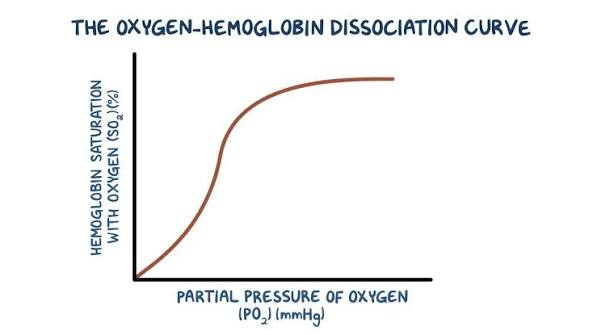
What shape is hemoglobin’s oxygen-binding curve?
Sigmoidal, or S-shaped
Sigmoidal, or S-shaped
Hemoglobin with oxygen bound
Why would very high oxygen affinity, like Mb, be a problem for hemoglobin?
Hemoglobin might hold oxygen too tightly and fail to release enough to the tissues
Why is hemoglobin’s curve sigmoidal?
Hemoglobin has four sites, and binding at one site affects binding at the others

What is cooperative binding?
When binding a ligand at one site affects ligand binding at another site.
Explain the reasons behind hemoglobin’s sigmoidal curve?
Low pO2 acts as binding O2 very weakly, but as more is bound, affinity becomes weaker
Relationship between p50 and Mb/Hb:
Mb: Low p50
Keeps O2 bound until it’s needed
Hb: High p50
Takes up O2, then releases it
What does a low p50 indicate?
High oxygen affinity; less oxygen pressure is needed to reach 50% saturation
Why does myoglobin have a hyperbolic curve?
It has only one oxygen-binding site, so it cannot show cooperativity between multiple oxygen-binding sites.