Turtles and Crocs
 Call Kai
 Learn
Learn Practice Test
 Spaced Repetition
 Match
Match Flashcards
 Knowt Play
1/167

There's no tags or description
Looks like no tags are added yet.
Name | Mastery | Learn | Test | Matching | Spaced | Call with Kai | Chat |
|---|
No analytics yet
Send a link to your students to track their progress
168 Terms
What are the characteristics of Crocodylia?
Four chambered heart, foramen of Panizza, secondary palate, mandibular fenestrae, basihyal throat valve, 5 toes manus; 4 toes pes, gizzard-like posterior, hepatic piston mechanism
When do fossil Crocodylians first appear?
The Cretaceous
When do modern Crocodylian families first appear?
The Tertiary
There is probably early divergence of __________.
Gavialoids
Borealosuchus and pristichampsines are the sister group of what clade?
Alligatoroid + crocodyloid
What is the distinctive characteristics of pristichampsines?
Hooflike digits
Fossil alligatoroids include _____________ and _______________, arose in Early Tertiary.
Brachychampsa, Stangerochampsa
Fossil _____________ include Brachychampsa and Stangerochampsa, arose in Early Tertiary.
Alligatoroids
Fossil alligatoroids include Brachychampsa and Stangerochampsa, arose in _____ ________.
Early Tertiary
What are Mekosuchines?
A Tertiary lineage of SW Pacific crocodyloids that survived until replaced by modern Crocodylus from Asia, lived until prehistoric times in New Caledonia

Describe this picture.
Extinct 12,000 years ago, probably due to humans. Land croc from New Caledonia
Both _____________ and _________ with Late Cretaceous fossils.
Alligatorids, gavialids
Both alligatorids and gavialids with ____ __________ fossils.
Late Cretaceous

Pattern of familial divergence _________.
Equivocal

Controversy over the position of _________, the _____ ______
Tomistoma, false gavial

What do the phylogenomics of gharials show?
That gharials are closely related to false gharials, and both are sister taxa to crocodilides
What are the 2 subfamilies of Alligatoridae?
Alligatorinae and Caimaninae
How many genera & species are in Alligatoridae?
4 genera, 8 species
Alligatoridae total length
1.7-5 m
What are the characteristics of Alligatoridae?
Jaws relatively short & broad, all mandibular teeth inside jaw when mouth closed, aquatic, usually in slow-flowing backwaters, build nests in mounds, parental care, A. mississippiensis well into temperate areas
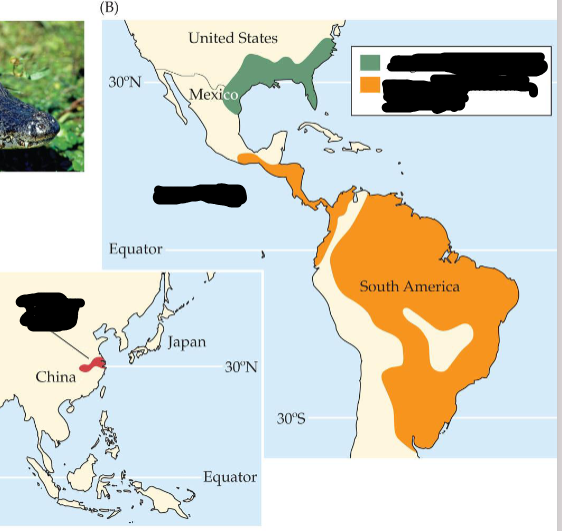
What family has this distribution?
Alligatoridae
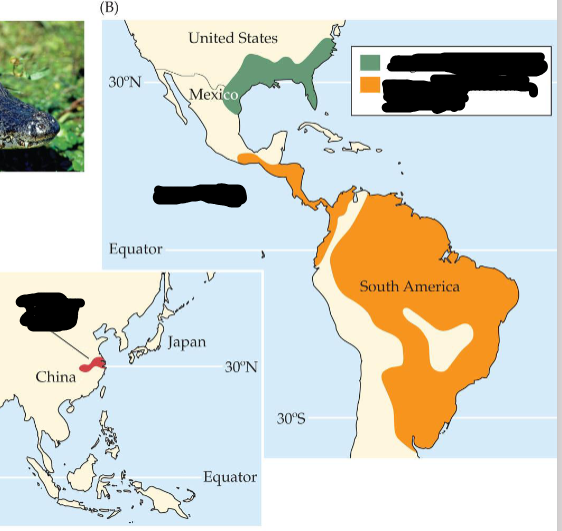
What is the red distribution?
Alligator sinensis (Chinese alligator)

What is the green distribution?
Alligator mississippiensis (American alligator)
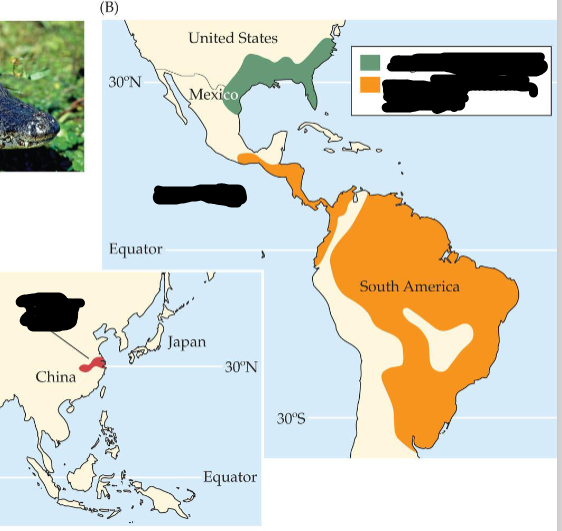
What is the orange distribution?
Caiman, Melanosuchus, Paleosuchus

What species is this?
Paleosuchus palpebrosus (Cuvier’s dwarf caiman)

What species is this?
Melanosuchus niger (black caiman)
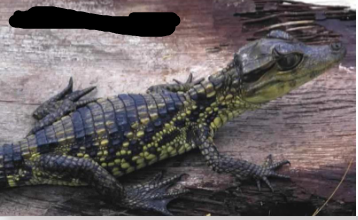
What species is this?
Caiman crocodilus (spectacled caiman)
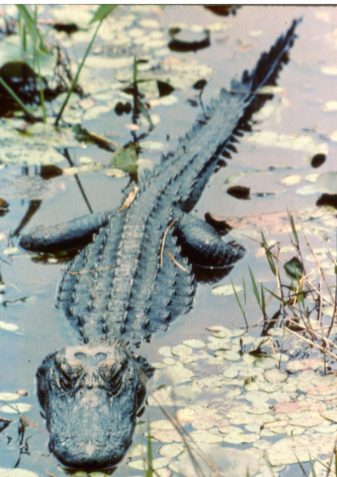
What species is this?
Alligator mississippiensis (American alligator)
How many genera & species are in Crocodylidae?
3 genera, 17 species
Crocodylidae total length
2.5-7 m
What are the characteristics of Crocodylidae?
Long jaws, 4th mandibular tooth lies externally when mouth is closed, aquatic, freshwater and estuarine, sometimes marine, usually diurnal, build nests, parental care

What family has this distribution?
Crocodylidae

What species is this?
Crocodylus johnstoni (Australian freshwater crocodile)
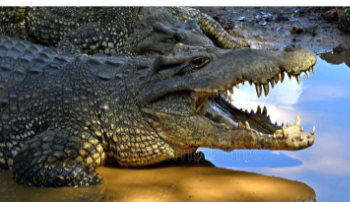
What species is this?
Crocodylus rhombifer (Cuban crocodile)
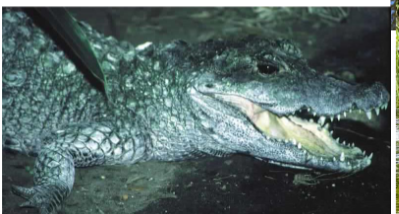
What species is this?
Osteolaemus tetraspis (African dwarf crocodile)

What species is this?
Crocodylus porosus (saltwater crocodile)

How many genera & species are in Gavialidae?
2 genera, 2 species

Gavialidae total length
To 6.5 m
What are the characteristics of Gavialidae?
Long, extremely thin jaws. All anterior teeth lie outside the closed mouth, males with enlarged boss at end of snout (Gavialis), highly aquatic. In deep, fast-flowing rivers. Fish-eating specialists, 35-60 eggs laid in nest, female attends young until dispersed by monsoon rains

What family has this distribution?
Gavialidae

What is the yellow distribution?
Gavialis gangeticus (gharial)
What is the green distribution?
Tomistoma schlegelii (false gharial)

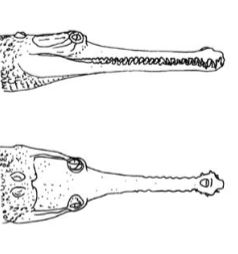
Is this Tomistoma or Gavialis?
Tomistoma

Is this Tomistoma or Gavialis?
Gavialis

What structure is the arrow pointing to?
Palatal valve

What structures are the arrows pointing to (from top to bottom)?
Oesophagus, glottis (tracheal opening), palatal valve

What is the blacked out label?
Musculus diaphragmaticus

What are the blacked out labels (from top to bottom)?
Lever, Leverkapsel

What are the blacked out labels (from top to bottom)?
Pulmonary artery, opening van Panizza

Is this normal breathing or underwater?
Normal breathing

Is this normal breathing or underwater?
Underwater

What are the blacked out labels (from left to right)?
Air enters the nose here
Secondary palate
Air enters the lungs from here. This hole is behind the flap of skin that separates the mouth from the airway

What structure, in what animal, is the arrow pointing to?
Internal nares in Orthosuchus
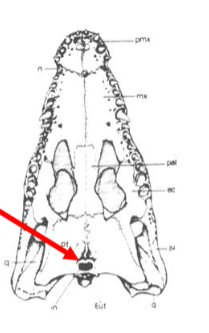
What structure, in what animal, is the arrow pointing to?
Internal nares in Crocodylus

What family is this?
Alligatoridae

What family is this?
Crocodylidae
What family is this?
Gavialidae
What are well developed in Crocodylidae, but very simple in the other families?
Lingual salt glands

What structure are these?
Lingual salt glands
There are many fossil eusuchians, but are most now included in Crocodylia?
No
What is SuperCroc?
A fossil eusuchian
How many families, genera, and species in the order Testudines?
14 families, 98 genera, 356 species
What are the characteristics of the order Testudines?
All with shell, terrestrial or aquatic, broadly distributed in temperate to tropical areas

What order is this?
Testudines
Where do the pectoral and pelvic girdles of turtles lie?
Inside the ribcage

What are the blacked out labels (left to right)?
Pelvic girdle, pectoral girdle

What are the blacked out labels (left to right)?
Tail vertebrae, vertebrae, neck vertebrae

What are the blacked out labels (left to right)?
Fibula, tibia, humerus, radius, ulna

What are the blacked out labels (top to bottom, left to right)?
Ribs, endochondral bone, scutes, scutes, endochondral bone
What are the characters of turtles?
Carapace + plastron, ribs external to limb girdles. Shell places constraints on ventilation, locomotion, reproduction, etc. Toothless, keratinized beak. Oviparous, late maturity, emarginated anapsid skull type.
What are the blacked out labels (left to right)?
Anapsid skull, anapsid skull

What are the blacked out labels (left to right)?
Plesiomorphy, synapomorphy

What are the blacked out labels (top to bottom, left to right)?
Proganochelys, Proganochelys, Pan-Mammalia, Parareptilia, Crown diapsida

What are the blacked out labels (left to right)?
Eothyris, Milleretta, Captorhinus, Youngina, Sphenodon

What are the blacked out labels (left to right)?
Amniota, Eureptilia

What are the blacked out labels (top to bottom, left to right)?
Jugal, parietal, postfrontal, postorbital, quadratojugal, squamosal, supratemporal

What are the blacked out labels (left to right)?
Nuchal bone, nuchal scute

What are the blacked out labels (top to bottom)?
Neural bones, pleural bones, peripheral bones, suprapygal bones, pygal bone

What are the blacked out labels (top to bottom)?
Vertebral scutes, costal scutes, marginal scutes, supracaudal scute

What is the blacked out label?
Anterior boundary of emargination
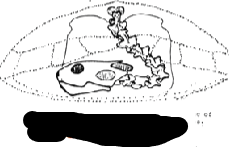
What is the blacked out label?
Pleurodira

What is the blacked out label?
Cryptodira
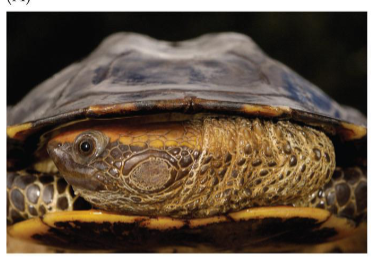
Is this Pleurodira or Cryptodira?
Pleurodira
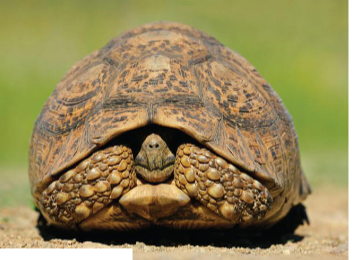
Is this Pleurodira or Cryptodira?
Cryptodira
Why do turtles have an excellent fossil record?
Their large, preservable skeletal elements
What is the earliest known turtle and when is it from?
Proganochelys quenstedi, ~210 MYA

Describe Proganochelys quenstedi
The earliest known turtle, ~ 210 MYA. Carapace present, with fused ribs, plastron present, no marginal teeth, but palatine teeth present. Probably semi-aquatic, to 90 cm carapace length. Sister group to Casichelydia (pleurodires + cryptodires)

What is the blacked out label?
Proganochelys
What is the oldest known turtle and when is it from?
Odontochelys semitestacea, 220 MYA

What species is this?
Odontochelys semitestacea

Describe Odontochelys semitestacea.
Oldest known turtle, 220 MYA, found in November 2008. Full complement of marginal teeth, free sacral ribs, long tail. 220 MYA vs. 210 or 206

What are the two possible interpretations related to Odontochelys semitestacea?
This aquatic form is a paedomorphic turtle and is part of an ancient radiation, with Odontochelys and Proganochelys representing extremes of aquatic and land adaptations at the time
Odontochelys is very similar to the ancestral turtle: the features are primitive, not paedomorphic
All subsequent fossil turtles after Odontochelys are ____________ or ___________.
Cryptodires, pleurodires
What is the first pleurodire, how old is it, and where was it found?
Proterochersis, ~210 MA, Europe
What is the first cryptodire, how old is it, and where was it found?
Kayentachelys, ~185 MA, Arizona
When do modern families of turtles appear?
The Cretaceous
Earliest ___ _______ in Middle Cretaceous, some huge.
Sea turtles
Earliest sea turtles in ______ __________, some huge.
Middle Cretaceous
When did Meiolaniids appear?
Eocene
When did Meiolaniids live until?
Prehistoric times