NUR 331 Adult Health I: Alteration in Neural Functioning – Part 1
 Call Kai
 Learn
 Practice Test
 Spaced Repetition
 Match
 Flashcards
 Knowt Play
1/70

There's no tags or description
Looks like no tags are added yet.
71 Terms
Seizure Disorders
- Seizures
- Epilepsy
Seizures
- Episodes of abnormal motor, sensory, autonomic, or psychic activity
- Result from sudden excessive discharge from cerebral neurons
- Can involve localized area or entire brain
Epilepsy
- Defined by the International League Against Epilepsy (ILAE)
- More than one unprovoked seizure
- Differentiates between focal onset, generalized onset, and unknown onset seizures
Focal (Partial) seizures
Originate within a localized area of the brain
Generalized seizures
Engage bilaterally distributed networks rapidly
Unknown onset seizures
Unclassified due to incomplete data
Pathophysiology of Seizures: Electrical disturbance
Abnormal, excessive, uncontrolled electrical activity in brain neurons causes a seize
Causes of seizures
- Varied and categorized
- Genetic
Structural
- Metabolic
- Unknown
Examples of Causes of Sezuires
- Allergies
- Brain tumor
- Cerebrovascular disease
- CNS infections
- Drug and alcohol withdrawal
- Fever (childhood)
- Head injury
- hypertensioN
- hypoxemia
- metabolic conditions
- toxic conditions
CM of Seizures: Seizure range
- From simple staring episodes to prolonged convulsive movements with loss of consciousness
- Initial pattern indicates brain region of seizure origin.
CM of Seizures: Generalized seizures
- Involve both hemispheres, causing bilateral body reactions
- Intense body rigidity followed by alternating muscle relaxation and contraction
- Possible epileptic cry, tongue chewing, incontinence
- Postictal state: Confusion, difficulty arousing, potential sleep for hours
CM of Seizure: Focal seizures
- Subdivided into motor and nonmotor symptoms
- Impairment of consciousness or awareness, localization, and progression of symptoms
Assessment of Seizures
- Identify seizure type
- frequency
- duration
- severity
- triggers.
- Review developmental history
- previous illnesses
- head injuries.
Diagnostic Testing for Seziures
- Laboratory tests
- Identify metabolic, electrolyte, or infectious causes.
- MRI: Detect structural abnormalities or brain lesions.
- EEG: Record abnormal electrical activity and help classify seizures.
- Video EEG monitoring: Correlate seizure activity with clinical manifestations.
- SPECT: Localize seizure focus, primarily for surgical evaluation.
Nursing Care During a Seizure: Observation and documentation
- Sequence of signs before and during seizure
- Circumstances before seizure (stimuli, disturbances, sleep, hyperventilation)
- Occurrence of an aura (premonitory sensation)
- Initial patient actions, movement onset, gaze position, head position
Nursing Care During a Seizure: Seizure details
- Type of movements, areas involved, pupil size, eye position
- Presence of automatisms, incontinence, duration of seizure phases
- Unconsciousness, paralysis, speech ability, movements at seizure end
- Postseizure cognitive status (confusion, sleepiness)
Nursing care of Sezuires
- Prevent injury
- support patient physically and psychologically.
Nursing Care After a Seizure: Documentation
Events leading to, during, and after seizure
Nursing Care After a Seizure: Complication prevention
- Aspiration, injury
- Place patient in side-lying position for oral secretion drainage.
- Perform suctioning if needed to maintain airway.
Nursing Care After a Seizure: Seizure precautions
- Functioning suction equipment
- low bed position
- padded side rails
- Additional safety measures (e.g., padded floor)
Nursing Care After a Seizure: Postseizure care
- Patient may be drowsy
- wish to sleep
- may not remember events
- Ensure patient safety and comfort.
Guidelines for Seizure Care

Status Epilepticus
acute prolonged seizure activity
Status Epilepticus: Goal of treatment
- Stop the seizures as quickly as possible
- Ensure adequate cerebral oxygenation
- Maintain the client in a seizure-free state
Status Epilepticus: Treatment
- IV diazepam, lorazepam, or fosphenytoin given slowly to halt the seizure
- Monitor continuously Vital signs and Neurologic signs
- EEG and ECG monitoring
- Position side-lying, if possible and have suction equipment ready for use
- Protect the client from injury-long term anticonvulsant therapy places the client at risk for fractures
Spinal Cord Injury (SCI)
- Major health disorder caused by trauma to the spinal cord, vertebral column, supporting soft tissue, or intervertebral discs.
- Approximately 305,000 persons in the United States living with SCI
- Estimated 18,000 new cases annually
- Common causes: motor vehicle crashes, falls, violence (predominantly gunshot wounds), and sports-related injuries
- Predominantly affects males (79% of patients)
- Average age of injury: 43 years
- Major risk factors: younger age, male gender, alcohol, and illicit drug use
- Major causes of death: pneumonia, pulmonary embolism (PE), and sepsis
Pathophysiology of SCI
- Severity: Ranges from temporary dysfunction to permanent paralysis.
- Common injury sites: C5-C7, T12-L1.
- Primary injury: Immediate damage from trauma (compression, contusion, or laceration).
- Secondary injury: Progressive damage from edema, hemorrhage, and ischemia; early intervention can limit further injury.
- Primary injury occurs at the time of trauma
- Secondary injury develops afterward and may be minimized with prompt treatment.
Clinical Manifestations of SCI
- Manifestations depend on the type and level of injury.
- Complete spinal cord lesion: loss of sensory and voluntary motor communication, resulting in paraplegia or tetraplegia
- Incomplete spinal cord lesion: some sensory and/or motor fibers preserved below the lesion
- Injuries classified by area of spinal cord damage: central, lateral, anterior, or peripheral
Assessment and Diagnostic Findings of SCI
- Detailed neurologic examination performed
- X-rays (lateral cervical spine x-rays)
- CT scans
- MRI scan, if ligamentous injury is suspected
- Myelogram, if MRI is contraindicated
- Assessment for other injuries, commonly to the head and chest
- Continuous electrocardiographic monitoring for bradycardia and asystole
Emergency Management of SCI
- Immediate management at the scene is critical.
- Rapid assessment, immobilization, extrication, stabilization, and transportation
- Patient immobilized on a spinal board with head and neck in a neutral position
- Transportation to a trauma center with capacity to manage major neurologic trauma
- Prevent further damage by maintaining the patient in an extended position.
- Use of a rotating specialty bed or cervical collar once the extent of injury is determined
Medical Management (Acute Phase) SCI
- Goals: prevent secondary injury, observe for progressive neurologic deficits, and prevent complications
- Resuscitation and maintenance of oxygenation and cardiovascular stability
- New treatment methods and medications continually investigated
- High-dose IV corticosteroids (methylprednisolone sodium succinate) may be prescribed.
- Oxygen given to maintain high PaO2.
- Diaphragmatic pacing for high cervical spine injuries
Skeletal Fracture Reduction and Traction: SQI
- Immobilization and reduction of dislocations, stabilization of the vertebral column
- Accomplished by surgical or nonsurgical interventions
- Cervical fractures reduced with skeletal traction (e.g., skeletal tongs, halo device)
- Traction force exerted along the longitudinal axis of vertebral bodies
- Gradual increase of traction to restore alignment
- Thoracic and lumbar injuries treated with surgical intervention and immobilization with a fitted brace
Spinal Shock
- sudden depression of reflex activity below the level of injury.
- Muscles without sensation, paralyzed, flaccid, reflexes absent
- Hypotension and bradycardia common
- Close observation for early detection of fever due to blocked sympathetic activity
Neurogenic shock
- loss of autonomic nervous system function below the level of the lesion
- Decreases in blood pressure, heart rate, and cardiac output
- Venous pooling and peripheral vasodilation
- Close observation for early detection of fever due to blocked sympathetic activity
Autonomic Dysreflexia
- Acute emergency!
- Occurs after spinal shock has resolved and may occur years after the injury
- Occurs in persons with SC lesions above T6
- Autonomic nervous system responses are exaggerated
- Symptoms include severe pounding headache, sudden increase in blood pressure, profuse diaphoresis, nausea, nasal congestion, and bradycardia
- Triggering stimuli include distended bladder (most common cause), distention or contraction of visceral organs (e.g., constipation), or stimulation of the skin
Nursing Interventions for Autonomic Dysreflexia
- Place patient in seated position to lower BP
- Rapid assessment to identify and eliminate cause
- Empty the bladder using a urinary catheter or irrigate or change indwelling catheter
- Examine rectum for fecal mass
- Examine skin
- Examine for any other stimulus
- Administer ganglionic blocking agent such as hydralazine hydrochloride (Apresoline) IV
- Label chart or medical record that patient is at risk for autonomic dysreflexia
- Instruct patient in prevention and management
Venous Thromboembolism (VTE)
- Potential complication of immobility in SCI patients
- High risk for deep vein thrombosis (DVT) and pulmonary embolism (PE)
- Manifestations of PE: pleuritic chest pain, anxiety, shortness of breath, abnormal blood gas values
- Low-dose anticoagulation therapy within the first 72 hours and for at least 8 weeks
- Use of anti-embolism stockings or sequential pneumatic compression devices (SCDs)
- Routine use of IVC filters not recommended unless thromboprophylaxis has failed
Spinal Cord Injury Nursing Interventions: Airway & Breathing
- Monitor SpO₂
- lung sounds and ABGs
- support coughing
- suctioning and secretion clearance
Spinal Cord Injury Nursing Interventions: Mobility & Alignment
- Maintain spinal precautions
- reposition safely and perform ROM when appropriate.
Spinal Cord Injury Nursing Interventions: Cardiovascular
- Monitor BP and HR
- advance positioning gradually to limit orthostatic hypotension.
Spinal Cord Injury Nursing Interventions: Skin Integrity
- Offload pressure
- reposition regularly
- assess skin in areas of sensory loss.
Spinal Cord Injury Nursing Interventions: Bladder & Bowel
- Manage urinary retention as indicated
- establish a regular bowel program.
Spinal Cord Injury Nursing Interventions: Nutrition & GI
- Support nutrition and hydration
- monitor for distention, constipation or ileus.
Spinal Cord Injury Nursing Interventions: Safety & Sensation
- Assess sensory deficits
- prevent injury and provide prescribed brace or traction care.
Spinal Cord Injury Nursing Interventions: CLINICAL PRIORITY
- Airway and breathing come first
- cervical SCI (especially C3-C5) may impair diaphragmatic function.
Multiple Sclerosis (MS)
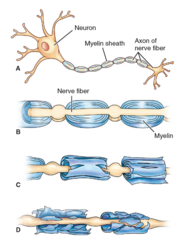
- Progressive, immune-mediated disease of the CNS causing demyelination, axonal damage, and plaque formation.
- Affects approximately 1 million Americans.
- Typically diagnosed between ages 20-50; women affected approximately 3 times more often than men.
- Genetic predisposition
- Epstein-Barr virus
- low vitamin D
- smoking
- obesity
- More prevalent in higher-latitude regions.
Process of Demylination
Three main clinical MS phenotypes
- remitting-relapsing (RRMS)
- secondary progressive
- primary progressive (PPMS)
Common Symptoms of MS
- Symptoms vary widely
- fatigue
- muscle weakness
- impaired gait
- sensory loss
- bladder problems
- visual disturbances
Clinical Manifestations of MS
- Fatigue is the most common and disabling symptom
- Worsens throughout the day, exacerbated by heat and humidity
- Pain caused by lesions on sensory pathways.
- Managed with medications, sometimes surgery
- Cognitive and psychosocial problems may occur.
- Memory loss, decreased concentration, emotional lability
- Bladder, bowel, and sexual dysfunction are common.
No cure for MS
- Treatment aims to delay progression
- manage symptoms
- treat exacerbations
Common symptoms requiring intervention in MS
- ataxia
- bladder dysfunction
- depression
- fatigue
- spasticity
Medications for disease modification and symptom management of MS
- Disease-modifying therapies (DMTs) delay disease progression
- Acute exacerbations treated with high-dose corticosteroids
DMTs target various mechanisms.
- T-cell and B-cell depletion
- immunomodulatory actions
- limiting inflammatory cell migration
- DMTs reduce relapse frequency, neurologic deficits, and delay progression.
- Initiated as soon as possible for RRMS patients
Multiple Sclerosis Nursing Interventions: Collaborative Care
- Coordinate PT/OT
- speech therapy
- social work
- home services.
Multiple Sclerosis Nursing Interventions: Activity & Fatigue
- Encourage exercise and stretching
- pace activity and schedule rest
Multiple Sclerosis Nursing Interventions: Bowel & Bladder
- Use scheduled toileting
- bowel routines
- fluids
- fiber
- prescribed medications.
Multiple Sclerosis Nursing Interventions: Swallowing Safety
- Follow swallowing recommendations
- implement aspiration precautions.
Multiple Sclerosis Nursing Interventions: Cognitive Support
- Provide memory aids
- structured routines
- consistent environment
Multiple Sclerosis Nursing Interventions: Temperatur Control
- Avoid overheating and extreme temperatures
- maintain a cool environment
Multiple Sclerosis Nursing Interventions: Mobility & Safety
- Use assistive devices
- fall precautions
- home modifications
Multiple Sclerosis Nursing Interventions: Psychosocial Support
- Promote stress reduction
- coping strategies
- counseling as needed
Multiple Sclerosis Nursing Interventions: GOAL
- Prevent complications
- conserve energy
- maximize independence
- maximize quality of life
Guillain-Barré Syndrome
- Acute, rapid segmental demyelination of peripheral and cranial nerves
- Annual incidence of 1-2 cases per 100,000 people worldwide
- Slightly higher incidence in males; Death occurs in 5%-10% of cases
Guillain-Barré Syndrome Pathophysiology
- Cell-mediated
- humoral immune attack on peripheral nerve myelin proteins
Guillain-Barré Syndrome Clinical Manifestations
- Muscle weakness and diminished reflexes
- Neuromuscular respiratory failure
- Sensory symptoms: paresthesia and pain
- Cranial nerve demyelination and autonomic dysfunction
Guillain-Barré Syndrome Assessment and Diagnostic Findings
- Symmetric weakness
- diminished reflexes
- upward progression of motor weakness
- History of viral illness
- Lumbar puncture with CSF analysis
- Electrophysiology studies
Guillain-Barré Syndrome Medical Management
- Intensive care unit management
- Mechanical ventilation
- Therapeutic plasma exchange or IVIG
- Continuous ECG monitoring for cardiovascular risks
- Supportive care to prevent complications of immobility
Nursing Interventions for the Patient with Guillain-Barré Syndrome: Enhancing physical mobility and prevention of DVT
- Support limbs in functional position
- Passive ROM at least twice daily
- Frequent position changes at least every 2 hours
- Elastic compression hose or sequential compression boots
- Adequate hydration
Nursing Interventions for the Patient with Guillain-Barré Syndrome
- Administer IV and parenteral nutrition as prescribed
- Carefully assess swallowing and gag reflex and take measures to prevent aspiration
- Develop a plan for communication individualized to patient needs
- Decreasing fear and anxiety
Collaborative Problems and Potential Complications of the Patient with Guillain-Barré Syndrome
- Respiratory failure
- Autonomic dysfunction
- DVT
- Pulmonary embolism
- Urinary retention