Blood worksheet 2
 Note
 Call Kai
 Learn
 Practice Test
 Spaced Repetition
 Match
 Flashcards
 Knowt Play
1/20

There's no tags or description
Looks like no tags are added yet.
21 Terms
the production of RBC is known as erythropoiesis and is under the control of what hormone?
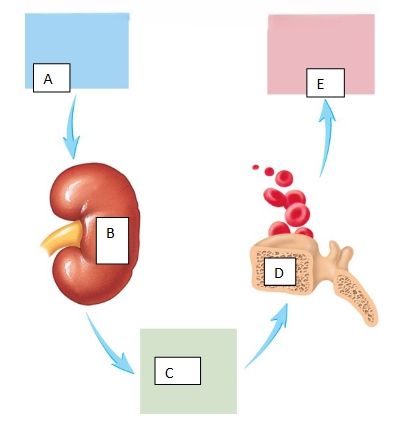
write the chain of events which take place during production of RBC based on the given diagram:
A- blood O2 levels decrease
B- in the kidney
C- increases the production of erythropoietin
D- erythropoietin stimulates red bone marrow to produce more erythrocytes
E- increased erythrocytes causes an increase in blood O2 levels
during clot formation, ______ acts on prothrombin and it converts prothrombin to ______.
prothrombinase; thrombin
Thrombin acts on _____________ to form___.
fibrinogen; fibrin
______________ prevent clot formation by 2 processes.
anticoagulants
what are the 2 processes of anticoagulants?
They inhibit thrombin and promote fibrinolysis.
if antigens on the RBC of blood of donor react with antibodies in the plasma of recipient then the reaction is ______________.
A type blood has _____ antigen and ____ antibodies.
type A; Anti-B
type B blood has _______ antigen and ______ antibodies.
type B; Anti-A
type AB blood has ________ antigen and ______antibodies.
type A and B; neither anti-A or anti-b
type O blood has ________ antigen and ___________ antibodies.
neither type A or B; anti-A and anti-B
___blood group is considered as universal donors and ____blood group is considered as universal recipients.
O; AB
What happens when a person with Type A blood group is given Type B blood?
What happens when a person with Rh-ve blood is given Rh+ve blood?
the first time, your blood produces antibodies against antigens. anytime after that will cause a negative reaction.
who can blood type A donate blood to?
Type A and AB blood groups.
who can type B donate blood to?
Type B and AB blood groups.
who can type AB donate blood to?
Type AB blood group only.
who can type O donate blood to?
All blood types.