Chapter 11: Meiosis and Sexual Reproduction
 Call Kai
 Learn
 Practice Test
 Spaced Repetition
 Match
 Flashcards
 Knowt Play
1/43

There's no tags or description
Looks like no tags are added yet.
44 Terms
Sexual reproduction
Combines haploid (n) gametes through fertilization
Define sexual reproduction and its role in increasing genetic diversity. (exam)
Sexual reproduction combines genetic material from two gametes during fertilization. It increases genetic diversity through crossing over, independent assortment, and random fertilization, producing offspring with unique combinations of genes.
Sexual reproduction combines haploid gametes through ______
fertilization
Fertilization
restores the diploid (2n) chormosome number
Sexual reproduction produces ______ ___ ___
Genetically unique offspring
Mitosos is cell division for ______, Meiosis is cell division for _______
body cells; sex cells
Process of meiosis - reduces number
Reduces the number of chromosomes (2n) by half
2n → n (to 23)
One set inherited from each parent
Fertilization does not double the chromosome number every generation, it ____
recodes the number of chromosomes by ½ to produce haploid (1n) cells
Chromosomes and DNA Packaging (EXAM)
Distinguish between:
Somatic cells (__) – ______, ___ set of chromosomes
Gametes (__) – ______, ___ set of chromosomes.
Somatic cells (2n) – diploid, two sets of chromosomes.
Gametes (1n) – haploid, one set of chromosomes.

Diploid Chromsomes (EXAM)
2n, Two sets of chromosomes (one from each parent)
Haploid Chromsomes (EXAM)
1n, one set of chromosomes (gametes)

Two rounds of division in meiosis (which happens after DNA replication): (EXAM)
Meiosis I and Meiosis II
Meiosis I Goal : (EXAM)
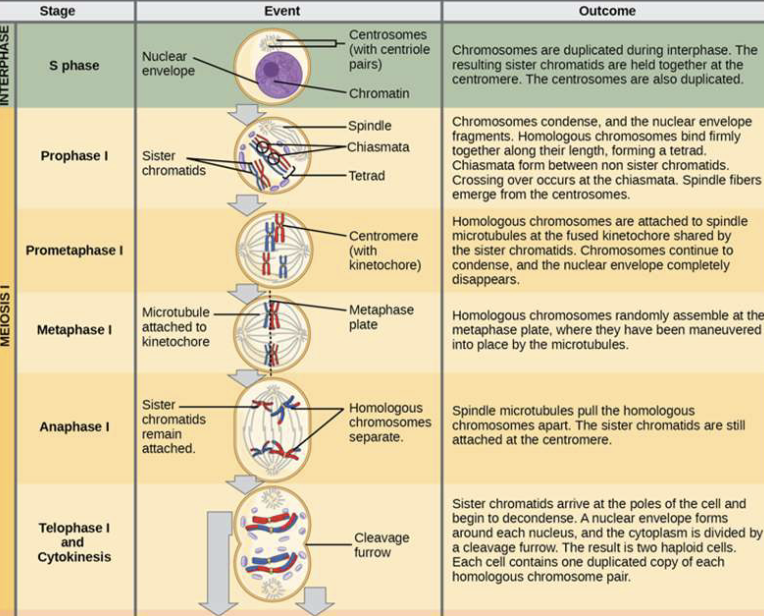
Goal: Separate homologous chromosomes; reduce chromosome number by half. (2n → n)
Meiosis I steps
Proceded by normal interphase (G1, S, G2), where DNA replication occurs ( during s phase), which produces sister chromatids
There is NO second round of DNA before meiosis II
Sister chromatids remain attached at the centromere
Prophase I:
Homologous chromosomes pair (synapsis) to form tetrads (pairs of four sister chromatids)
Crossing over at chiasmata exchanges genetic material, increasing diversity.
Prometaphase I: Spindle fibers attach; nuclear membrane disintegrates.
Metaphase I: Tetrads align randomly (independent assortment).
Anaphase I: Homologous chromosomes separate; sister chromatids remain attached.
Telophase I and Cytokinesis:
Chromosomes reach poles; cells divide into two haploid cells.
Cleavage furrow (animals) or cell plate (plants) forms.
________ is the location, _______ is the handle on the chromosome
centromere, kinetochore
Interphase in Meiosis one
DNA replication occurs (s phase of interphase) ; sister chromatids form.

Prophase I (EXAM)
Homologous chromosomes pair (synapsis) to form tetrads (four sister chromatids paired)
Crossing over at chiasmata exchanges genetic material, increasing diversity.
Paired homologs form a tetrad (four sister chromatids paired)
Crossing over occurs between non sister chromatids
Visible structure at cross over points are called chiasmata

What happens in crossing over (during prophase I)
Crossover exchanges genetic material (DNA) between non sister chromatids of homologous chromosomes

Prometaphase I (EXAM)
Spindle fiber microtubules attach to the kentochore proteins at the centromeres
Each homologous is connected toward an opposite pole
nuclear membrane disintegrates.

Metaphase I (EXAM)
Homologus chromosomes are arranged at the cell equator with kinetochores facing opposite poles
Maternal and paternal homologous chromsomes ( 4 tetrads) orient randomly (Independent assortment)
This Creates different combinations of maternal and paternal chromosomes in gametes

Anaphase I (EXAM)
Homologous chromosomes seperate and move to opposite poles
Chiasmata are broken, but sister chromatids remain attached
Telophase I and Cytokinesis (EXAM)
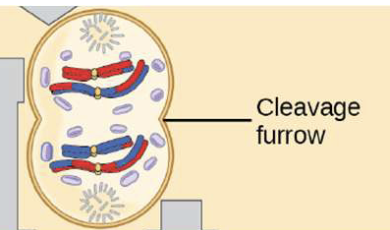
AFTER Meiosis I: n, but chromosomes are still duplicated
Chromosomes reach poles; cells divide into two haploid cells.
Cleavage furrow (animals) or cell plate (plants) forms.
Result: Two HAPLOID cells
Each chromosome still consist of two sister chromatids
Meosis II - Separation of Sister Chromatids: (EXAM)
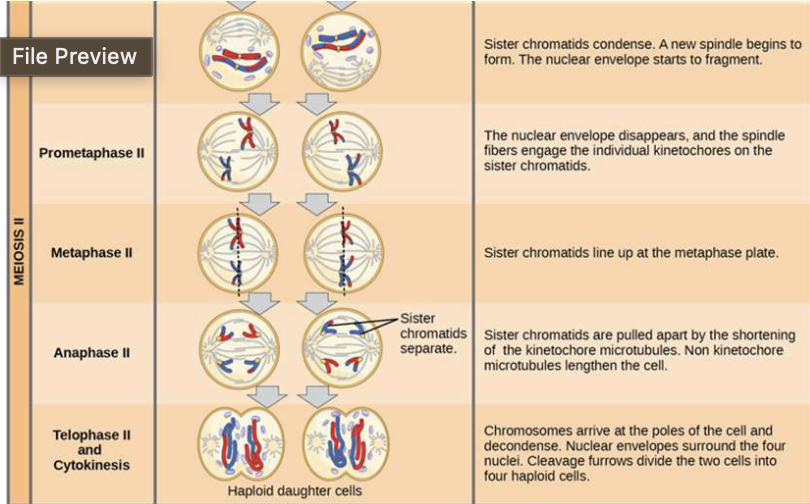
Goal: separate Sister chromatids (similar to mitosis), final result: four genetically distinct haploid (n) cells
Meiosis II resembles mitosis - how?
Cell begin haploid (n), sister chromatids separate, no DNA replication occurs between I and II
Beginning Meiosis II
Chrosomes condense if necessary; a new spindle forms (Prophase II)
Spindle Microtubules attack to kinetochores of sister chromatids from opposite poles (Prometaphase II)
Prophase II (EXAM)
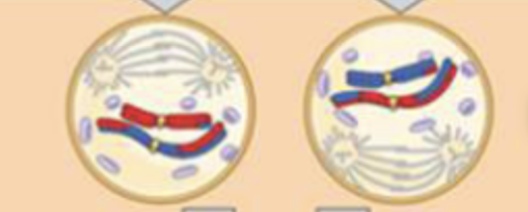
Sister chromatids condense. A new spindle begins to form. The nuclear envelops start to fragments

Prometaphase II (EXAM)
The nuclear envelope disappears, and the spindle fibers (microtubules) attach to the the individual kinetochores on the sister chromatids
Chromosome alignment difference between meiosis I and meiosis II
Meios I: Homologous chromosomes separate
Meiosis II: Sister chromatids separate
Meios I:_______ separate
Homologous chromosomes
Meiosis II: _______ separate
Sister chromatids
Metaphase II and Anaphase II
Chromosomes align individually at metaphase plate.
Sister chromatids separate during anaphase II.
This looks like mitosis

Metaphase II (EXAM)
Chromosomes align at metaphase plate

Anaphase II (EXAM)
Sister chromatids are pulled apart to opposite poles by the shortening of the kinetochore microtubules. Non kinetochore microtubules lengthen the cell
Telophase II and Cytokinesis
chromosomes decondense; nuclei reform; four haploid cells result.
One diploid (2n) parent cell → FOUR genetically unique haploid (n) cells

Telophase II and Cytokenisis
Chormosomes arrive at the poles of the cell and decondense. Nuclear envelopes surround the four nuclei. Cleavage furrows divide the two cells into four haploid cells
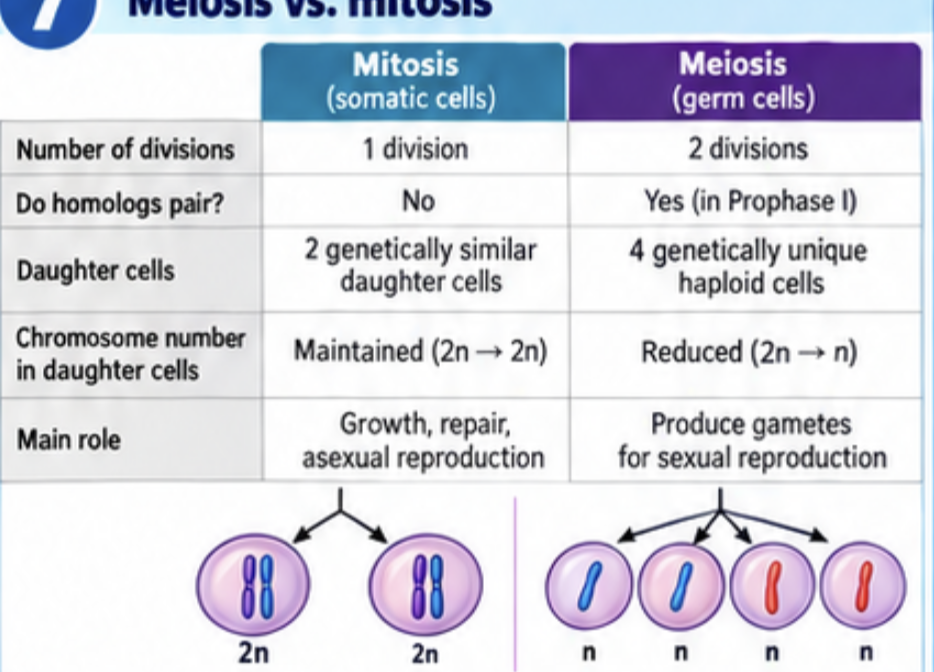
Comparing meiosis to Mitosis (EXAM Q?)
Meiosis
— 2 divisions
— homologs pair in Prophase I
— Crossing over + independent assortment — only in meiosis
— 4 genetically unique haploid (n) cells
— Ploidy reduced
Mitosis
— 1 division
— homologs do not pair
— 2 genetically similar daughter cells
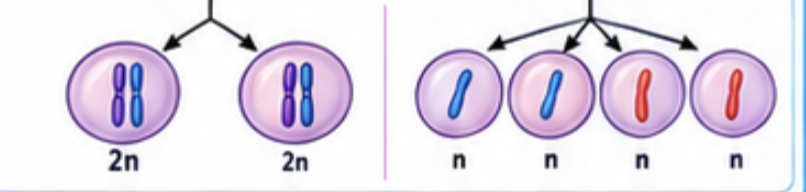
Mitosis _____ chromosome number; meiosis _____ chromosome number (EXAM)
maintains, reduces
Sexual Reproduction: Cost
Requires combining genomes/mating and is less efficient than cloning
Sexual Reproduction: Benefit
Produces genetically variable offspring, which can help populations responds to changing environments, parasites, predators
3 Main categories of life cycles in multicellular organisms (EXAM)
Diploid dominant → animals — multicellular organism is diploid; gametes are haploid.
Haploid dominant → fungi/algae - multicellular organism is haploid; zygote is diploid but undergoes meiosis immediately.
Alternation of generations → plants/some algae — both haploid (gametophyte) and diploid

Diploid dominant life cycle (Animals) (EXAM)
Diploid adult → meiosis → haploid gametes (1n) → fertilization → diploid zygote → mitosis → diploid adult. (2n)
Only the gametes are haploid; there is no multicellular haploid stage
Overall definition: multicellular organism is diploid; gametes are haploid.
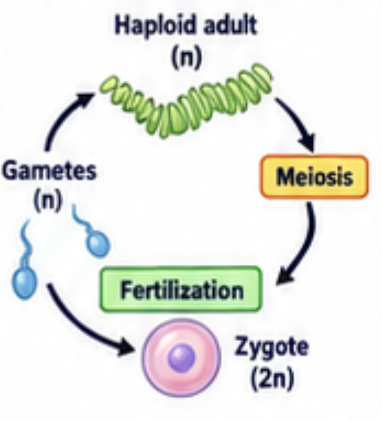
Haploid dominant life cycle (fungi, some algae)(EXAM)
Haploid multicellular organism → haploid cells fuse → diploid zygote → meiosis immediately → haploid spores → mitosis → haploid organisms
The zygote is the only diploid stage
Overall definition: multicellular organism is haploid; zygote is diploid but undergoes meiosis immediately

Alternation of Generations (plants, some algae) (EXAM)
Both the haploid and diploid stages are multicellular
Gametophyte (n) produces gametes by MITOSIS
Sporophyte (2n) → MEIOSIS → spores (n) → MITOSIS → gametophyte (n) → MITOSIS → gametes (n) → FERTILZATION → zygote (2n) → MITOSIS → sporophyte
Overall definition: both haploid (gametophyte) and diploid (sporophyte) multicellular stages alternate.
Understand that ________ restores diploidy (2n) by fusing two haploid gametes. (EXAM)
fertilization