Biology MCAT OWN

0.0(0)
Studied by 4 people
call kaiCall Kai
learnLearn
examPractice Test
spaced repetitionSpaced Repetition
heart puzzleMatch
flashcardsFlashcards
GameKnowt Play
Card Sorting

1/96

encourage image

There's no tags or description

Looks like no tags are added yet.

97 Terms

1
New cards

What’s the difference in way and what is read (what direction and what is read) between all 3 processes of central dogma: replication, transcription, and translation
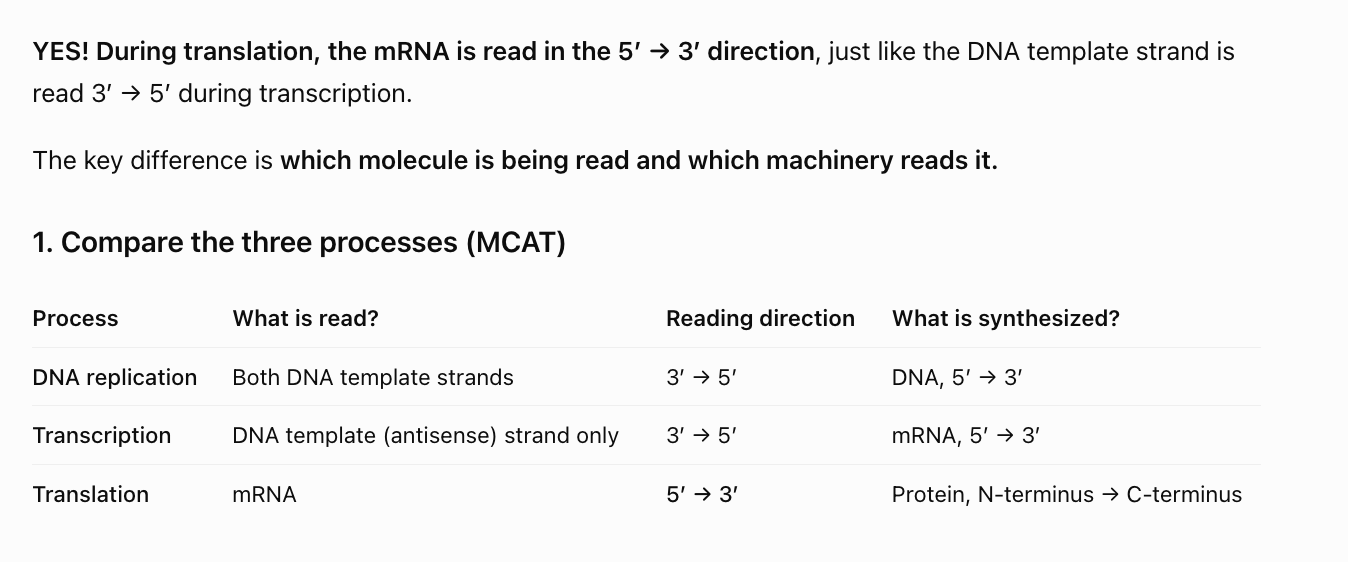
knowt flashcard image
2
New cards

Size and overall number for each ribosome type and tehir subunits in eukaryotes vs prokaryotic ribosomes

knowt flashcard image
3
New cards

Does prokaryotuc mRNA unergo postranscriptional modifications? COMPARE Prokaryotic mRNA and Eukaryotic final mRNA

NO only eukaryotic mRNA has postratcriptional modifications done and added: 5’ cap, 3’ Poly- A Tail and splicing done

<p>NO only eukaryotic mRNA has postratcriptional modifications done and added: 5’ cap, 3’ Poly- A Tail and splicing done</p>
4
New cards

what processe or processes of central dogma use start codon (AUG)?

-only translation uses it
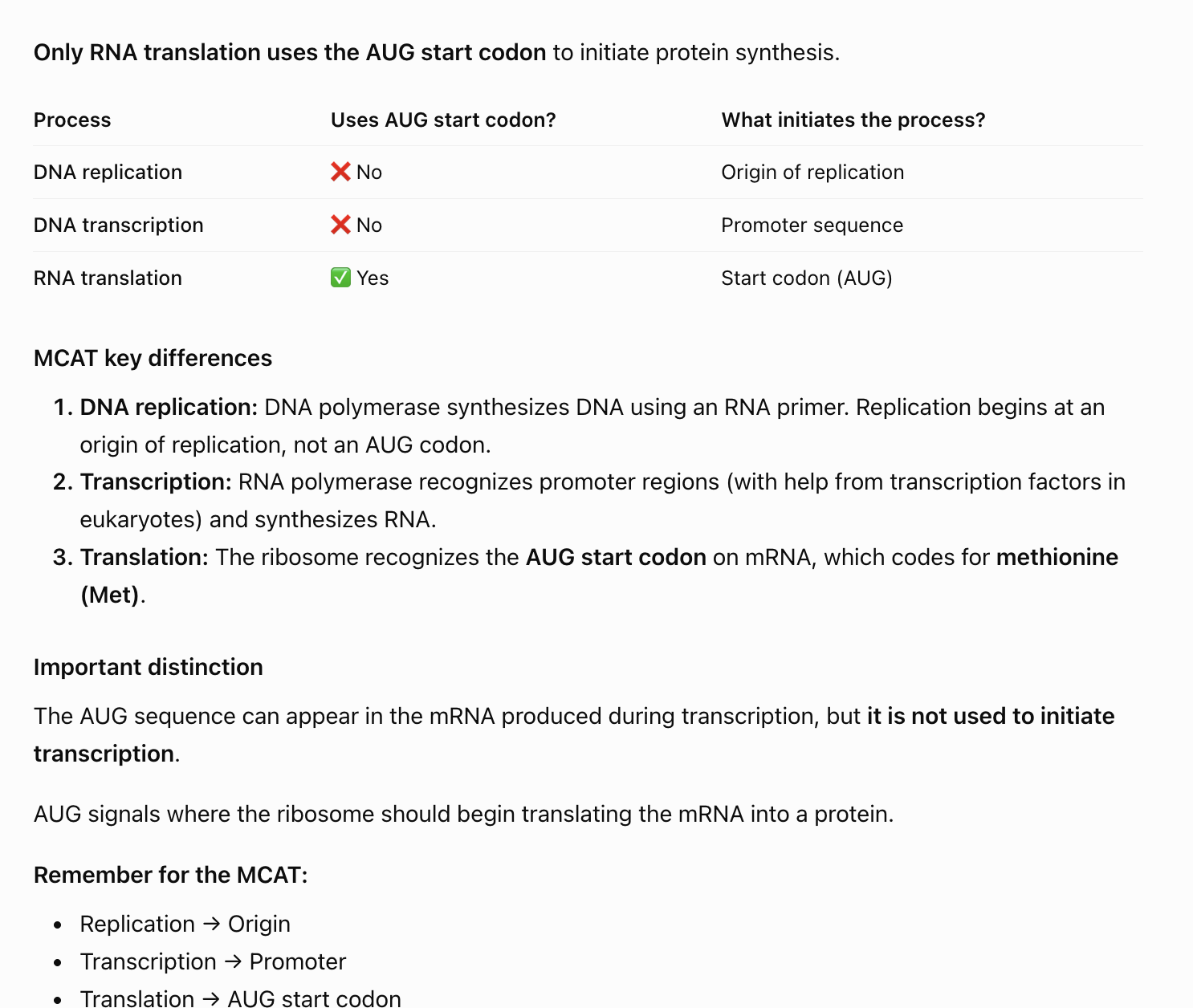
<p>-only translation uses it</p>
5
New cards

large mutations

knowt flashcard image
6
New cards

Purines vs pysimidine

knowt flashcard image
7
New cards

mRNA vs tRNA

knowt flashcard image
8
New cards

how to find the last codon that will be read during translation and what the anticodon brought by tRNA will be?

-the last codon is the codon before the STOP codon

-bc the stop codon is NOT read at all during translation,

-also: poly-A tail at 3’ OH end of mRNA is NOT translated into protein and it’s usually after stop codon anyway

<p>-the last codon is the codon before the STOP codon</p><p>-bc the stop codon is NOT read at all during translation,</p><p>-also: poly-A tail at 3’ OH end of mRNA is NOT translated into protein and it’s usually after stop codon anyway</p>
9
New cards

Poly- A signal and Poly-A tail are after or before Stop codon?

  • they are both after STOP codon => so not translated either

  • poly-A signal found before Poly A tail but Both still AFTER Stop codon


<ul><li><p>they are both after STOP codon =&gt; so not translated either</p></li><li><p>poly-A signal found before Poly A tail but Both still AFTER Stop codon</p></li></ul><p></p>
10
New cards
<p>Nucleoside vs Nucleotide</p>

Nucleoside vs Nucleotide

-also note: ATP is a type of nucleotide
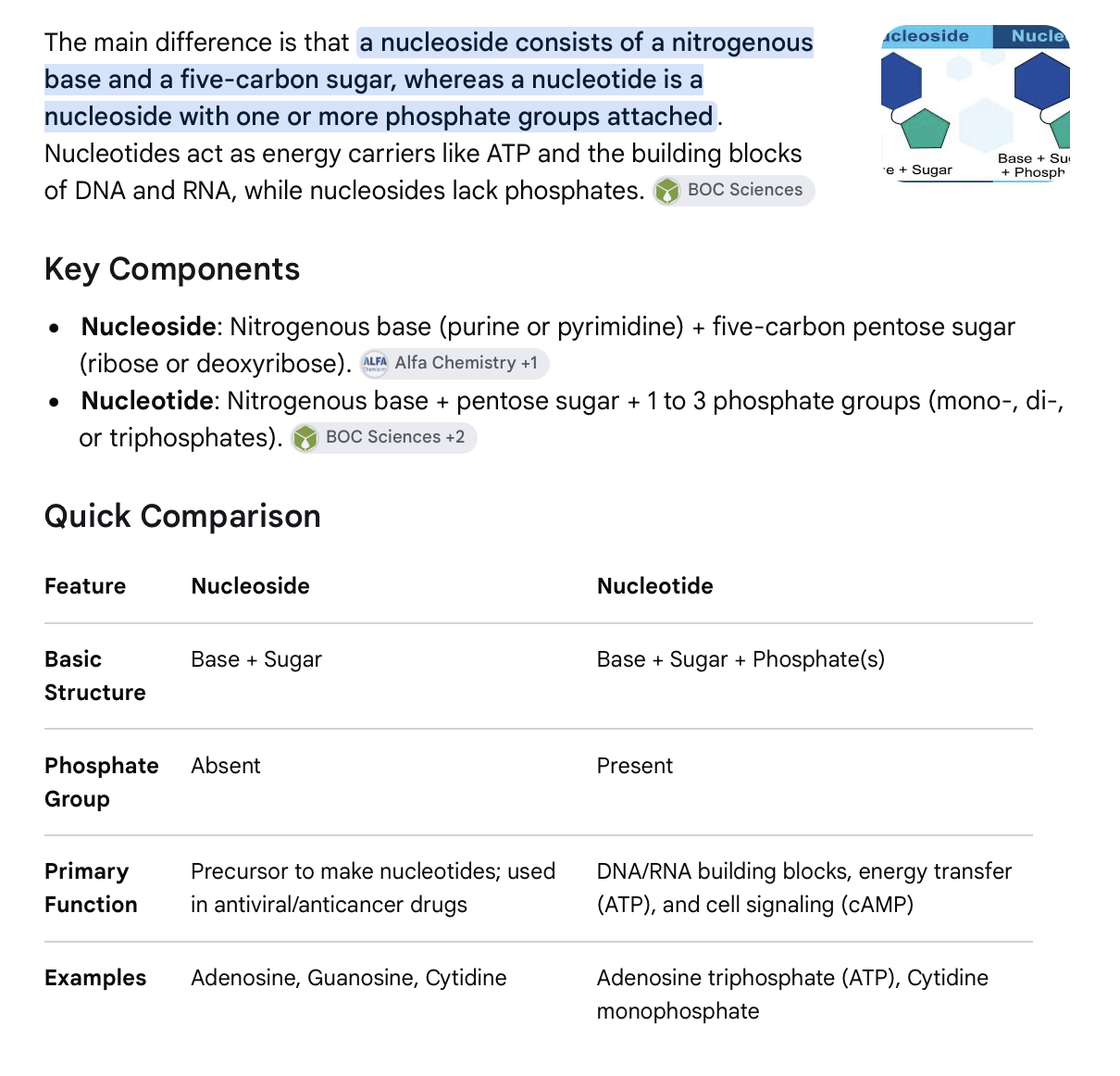
<p>-also note: ATP is a type of nucleotide</p>
11
New cards
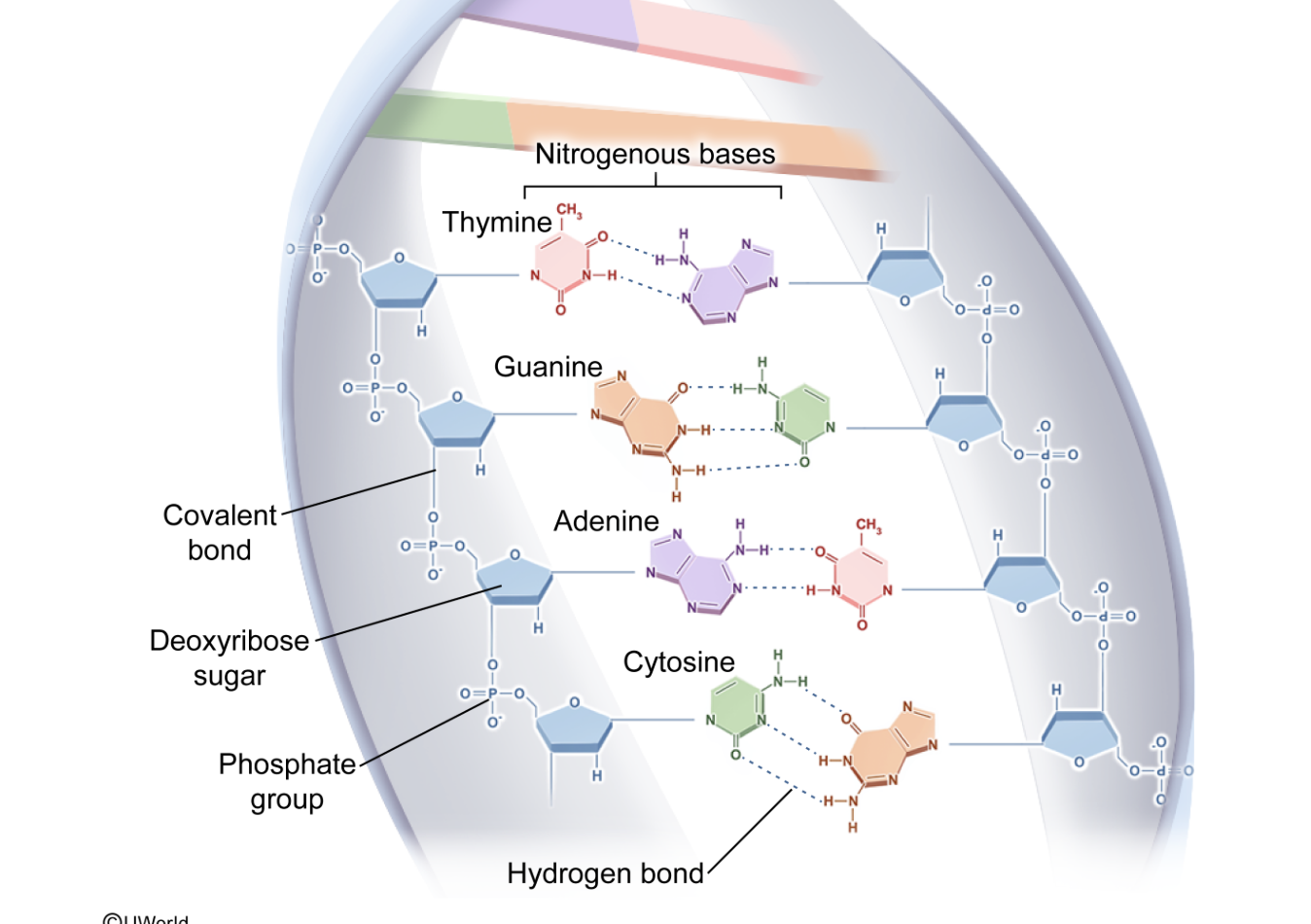
<p>Bonds in DNA</p>

Bonds in DNA

  • H bonds between nitrogenous bases

  • glycosidic bonds between nitrogenous base and sugar

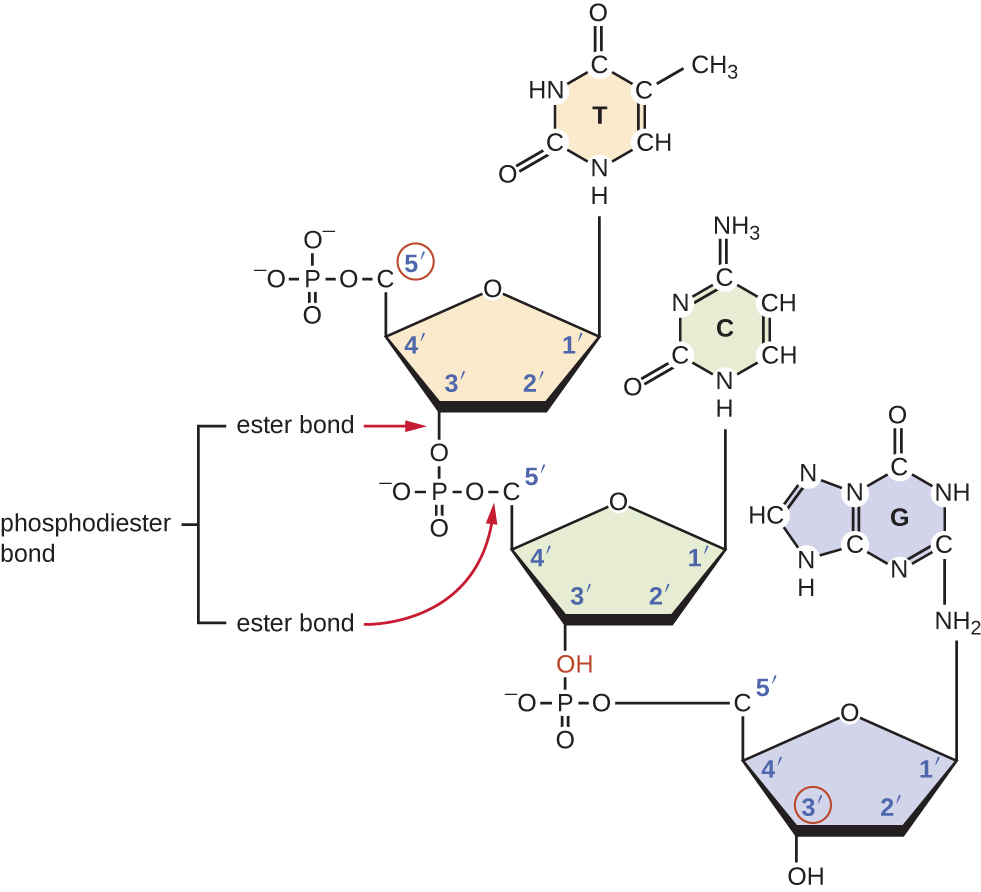
  • phosphoester: between 3’Oh of sugar to its one Phosphate

  • Phosphodiester: connects two phosphoester bonds

3’OH sugar—Phosphate—5’C Sugar3’OH—Phosphate


<ul><li><p>H bonds between nitrogenous bases</p></li><li><p>glycosidic bonds between nitrogenous base and sugar</p></li><li><p>phosphoester: between 3’Oh of sugar to its one Phosphate</p></li><li><p>Phosphodiester: connects two phosphoester bonds</p></li></ul><p>3’OH sugar—Phosphate—5’C Sugar3’OH—Phosphate</p><p></p>
12
New cards
<p>Phosphodiester bonds and its specifics </p>

Phosphodiester bonds and its specifics

-connects a (phosphoester bond: Sugar-PO4) to another Sugar-PO4 bond

-3’OH and Carbon of Sugar— PO4 —5’CSugar-PO4

-called: 3’-PO4-5’ linkage

3’OH sugar—Phosphate—5’C Sugar3’OH—Phosphate

<p>-connects a (phosphoester bond: Sugar-PO4) to another Sugar-PO4 bond</p><p>-3’OH and Carbon of Sugar— PO4 —5’CSugar-PO4</p><p>-called: 3’-PO4-5’ linkage</p><p>3’OH sugar—Phosphate—5’C Sugar3’OH—Phosphate</p>
13
New cards

sugar in DNA and what each part of is connected to what

knowt flashcard image
14
New cards

Bonds in DNA expanded

knowt flashcard image
15
New cards

Phosphoester bond in DNA


-sugar to a phosphate bond

-3’OH—Phosphate

16
New cards

Template and non-template strands of DNA and its relation to mRNA

knowt flashcard image
17
New cards
<p>Transcription &amp; modifications added to pre-mRNA —&gt; mature mRNA</p>

Transcription & modifications added to pre-mRNA —> mature mRNA
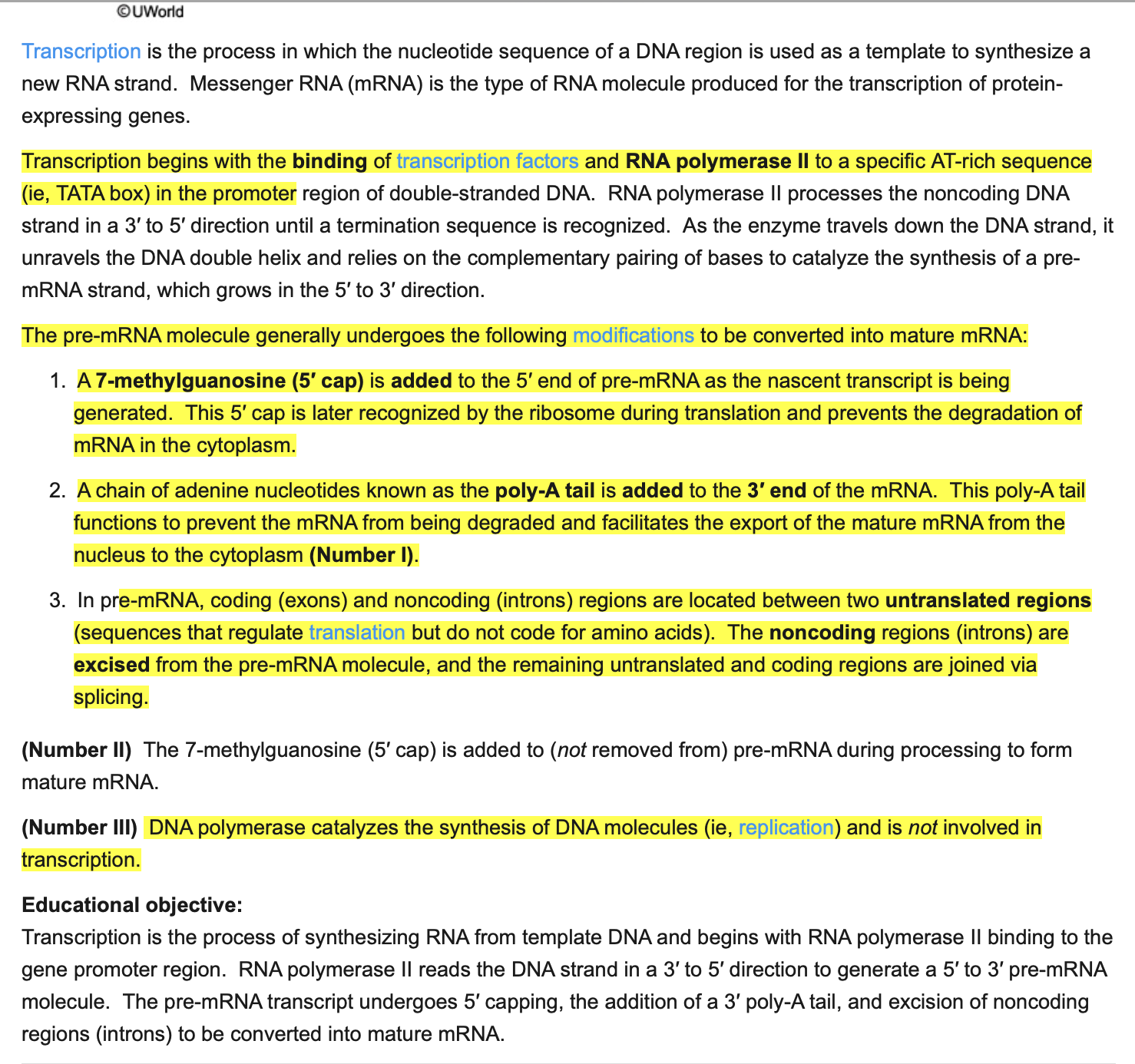
knowt flashcard image
18
New cards
<p>who is Pre-mRNA splicing done by and how? RNA processing= RNA splicing</p>

who is Pre-mRNA splicing done by and how? RNA processing= RNA splicing

-done by SPliceosome proteins (which contain sNRPs which do the actual splicing)

-the sNRPs = snRNA that was also produced during transcription while mRNA transcribed because RNA pol II also makes both types of RNA) + proteins


intron spliced out at: GU & AG sites it also has A-OH site in middle

splice donor site of intron: GU

splice acceptor site of intron: AG

19
New cards

what is alternative splicing?

usually splicing= only introns taken out but sometimes can take out exons to be able to produce diff proteins fro same mRNA which is describe in this case
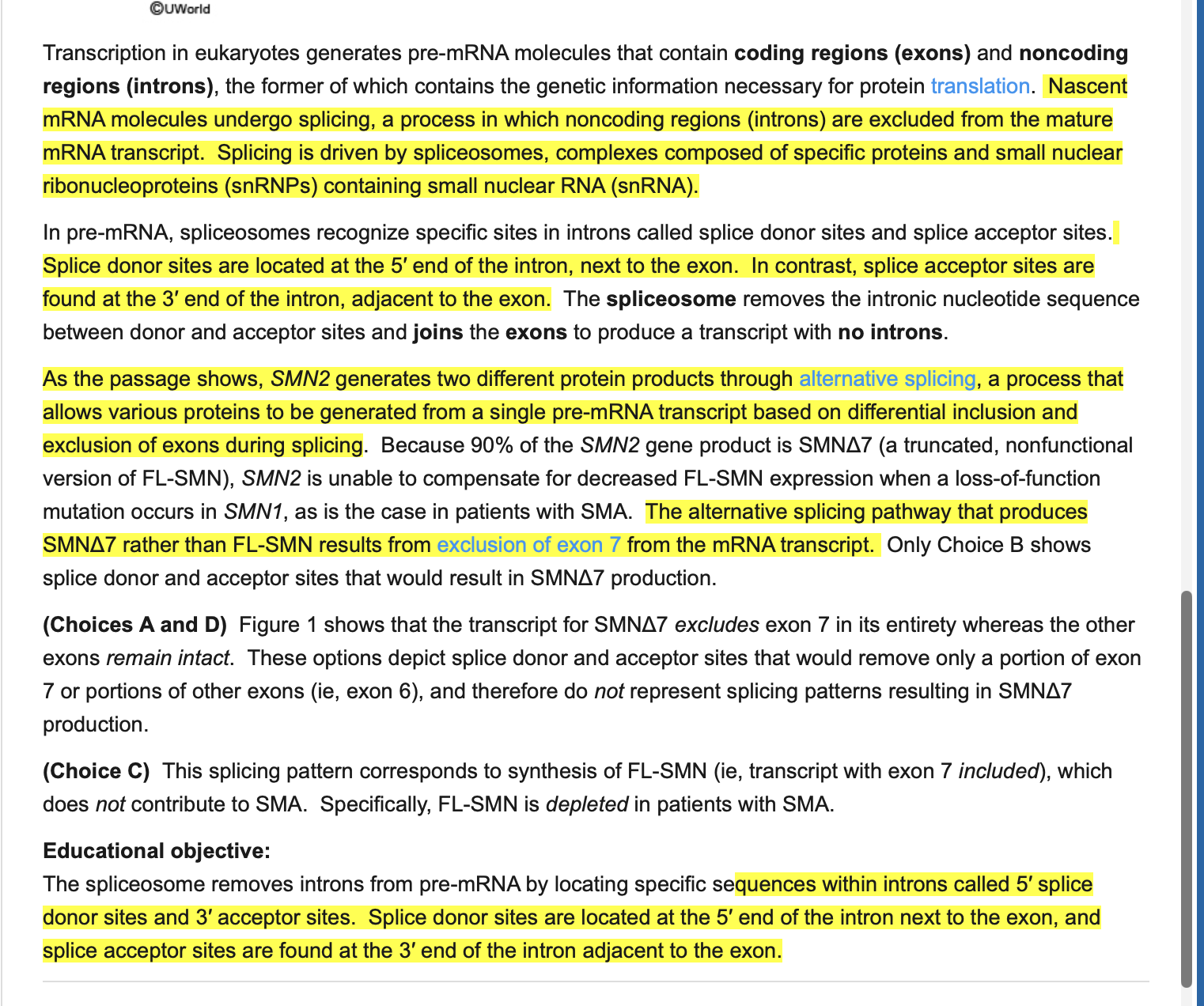
<p>usually splicing= only introns taken out but sometimes can take out exons to be able to produce diff proteins fro same mRNA which is describe in this case</p>
20
New cards

difference in location of pre-mRNA and mature mRNA once made?

-pre-mRNA can only stay in nucleus bc needs to be modified to mature mRNA

-only until mature mRNA —> it can go out from nucleus to the cytoplasm so the mature mRNA can be translated using ribosomes

-pre-mRNA splicing occurs In NUCLEUS

<p>-pre-mRNA can only stay in nucleus bc needs to be modified to mature mRNA </p><p>-only until mature mRNA —&gt; it can go out from nucleus to the cytoplasm so the mature mRNA can be translated using ribosomes</p><p>-pre-mRNA splicing occurs In NUCLEUS </p>
21
New cards
<p>DNA packaging</p>

DNA packaging

knowt flashcard image
22
New cards

DNA/protein post-translational modifications

23
New cards

DNA Methylation

-adding methyl group -CH3 to CpG sites of DNA

-leads to gene silencing

-gene expression decreased

-occurs in CpG sites (C-G) sequences in DNA

-done by: DNA methyltransferase

24
New cards
<p>DNA histone Acetylation</p>

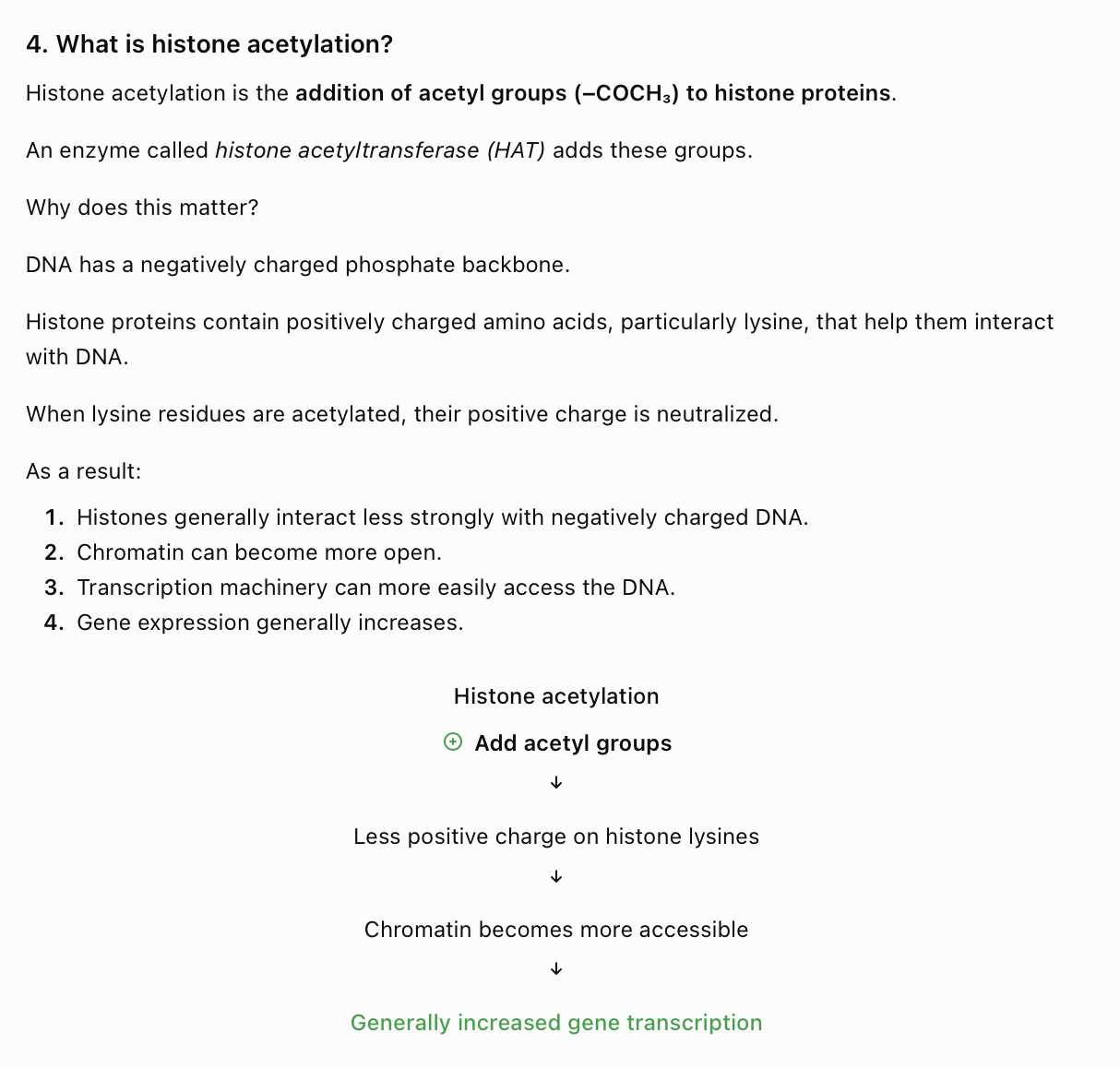
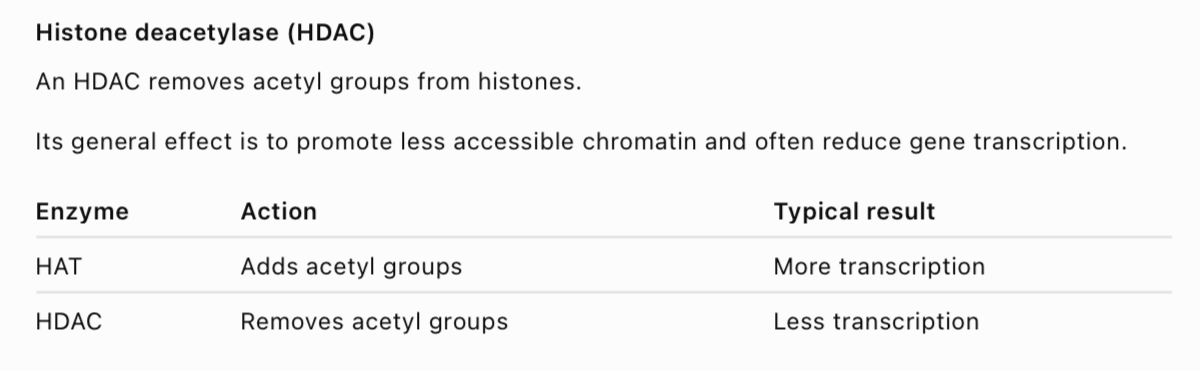
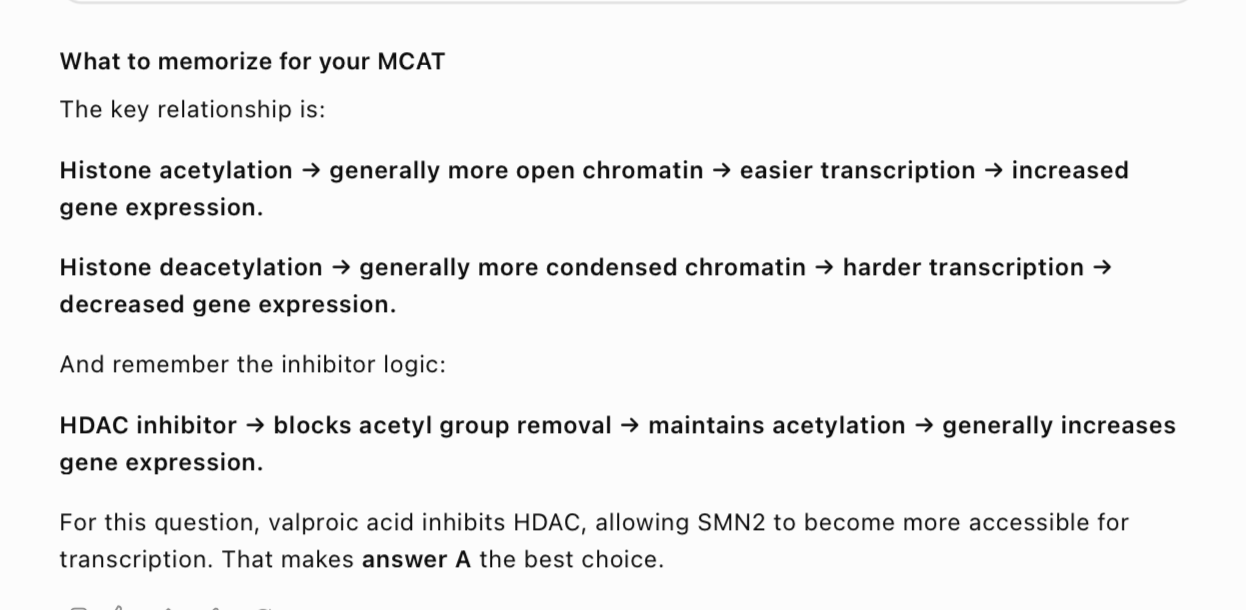
DNA histone Acetylation

-adding positively (+) charged acetyl groups to histone which is also positively charged has lysine AA and has its tail “N-site” of DNA => unwraps DNA (make open Euchromatin)

done by: HAT enzyme (Histone acetyltransferase (HAT))

-increase gene transcription because chromosomes unwrapped = DNA exposed and available to be more readily transcribed
<p>-adding positively (+)  charged acetyl groups to histone which is also positively charged has lysine AA and has its tail “N-site” of DNA =&gt; unwraps DNA (make open Euchromatin)</p><p>done by: HAT enzyme (<span>Histone acetyltransferase (HAT))</span></p><p>-increase gene transcription because chromosomes unwrapped = DNA exposed and available to be more readily transcribed</p>
25
New cards
<p>Histone De-Acetylation</p>

Histone De-Acetylation

-taking off acetyl groups on histones of DNA

-converts from euchromatin to heterochromatin (closed DNA)→ cannot be transcribed
<p>-taking off acetyl groups on histones of DNA </p><p>-converts from euchromatin to heterochromatin (closed DNA)→ cannot be transcribed </p>
26
New cards
<p>Euchromatin vs Heterochromatin</p>

Euchromatin vs Heterochromatin

-euchromatin= unwrapped chromatin = available DNA can be easily trasncribed

-heterochromatin= tight chromatin/DNA = DNA cannot be easily accessed and cannot be transcribed
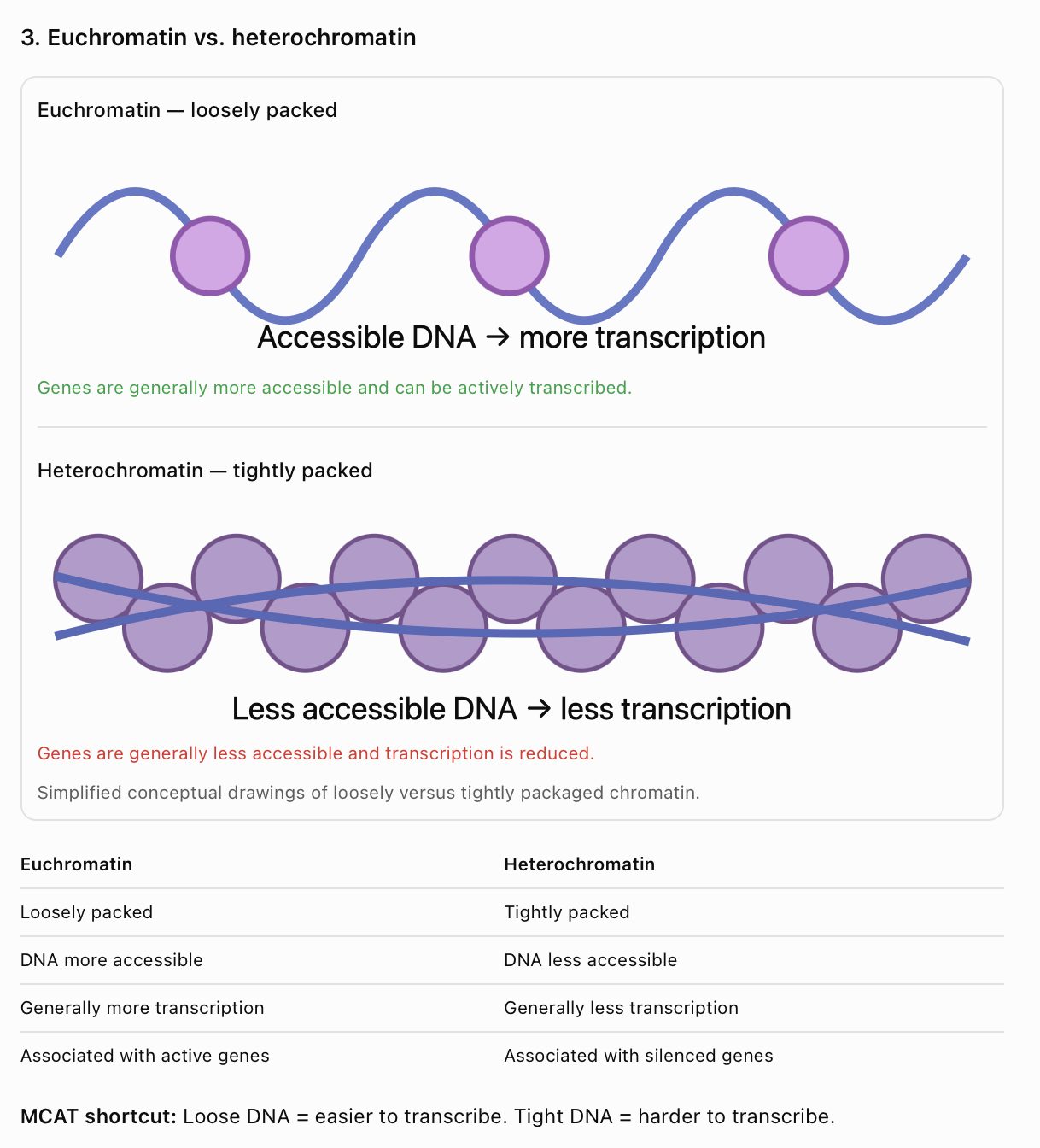
<p>-euchromatin= unwrapped chromatin = available DNA can be easily trasncribed</p><p>-heterochromatin= tight chromatin/DNA = DNA cannot be easily accessed and cannot be transcribed</p>
27
New cards

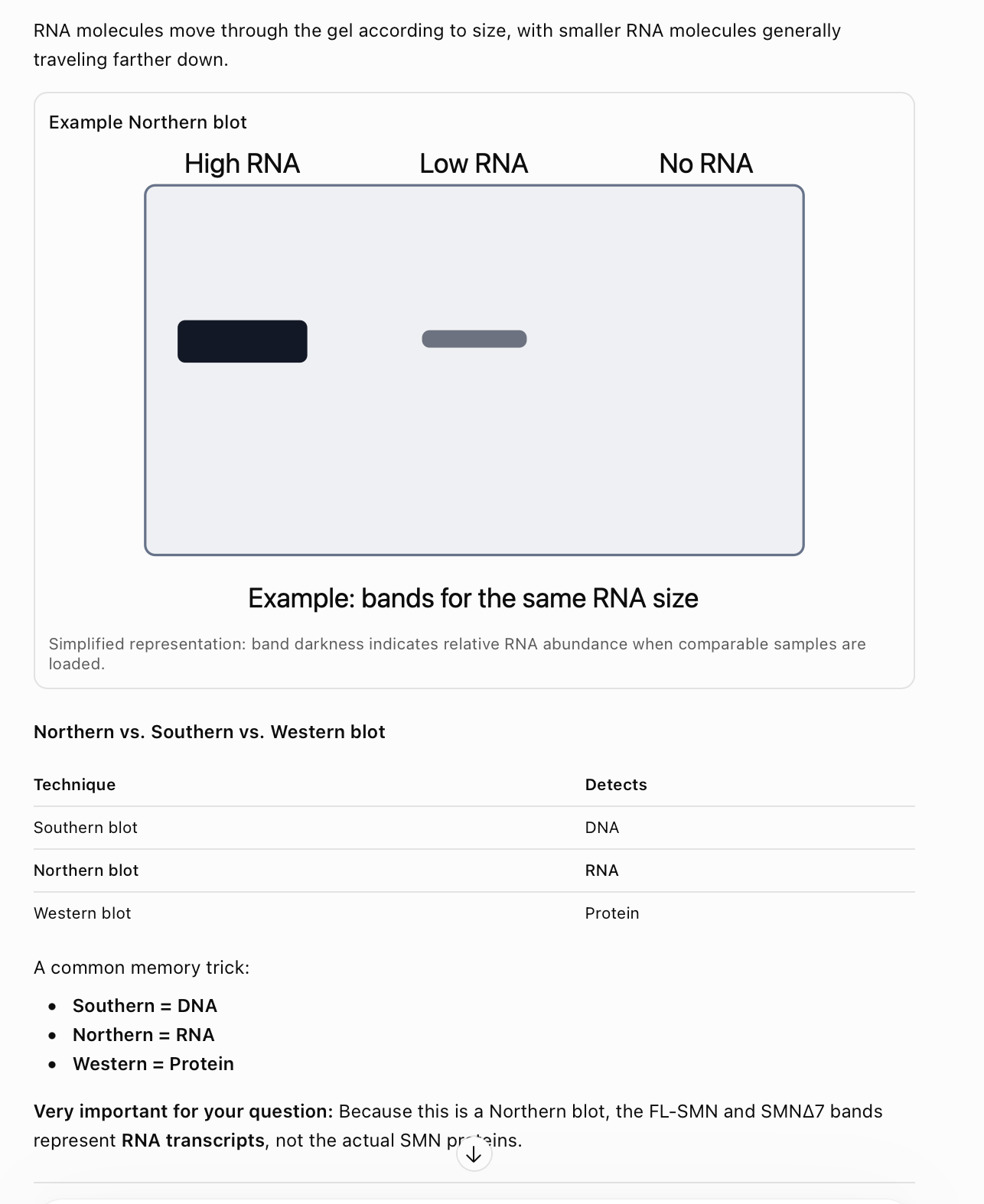
Northern Blot

-measures RNA

-smaller RNA—> travels faster = more towards the bottom of the gel

-bigger RNA —> travels slower = more at the top of the gel

<p>-measures RNA</p><p>-smaller RNA—&gt; travels faster = more towards the bottom of the gel</p><p>-bigger RNA —&gt; travels slower = more at the top of the gel</p>
28
New cards

Southern blot

-measures DNA

29
New cards

Northern vs Southern vs Western Blots


<p></p>
30
New cards

Gel electrophoresis

Purpose: Separate DNA fragments based on their size.

<p>Purpose: Separate DNA fragments based on their size.</p>
31
New cards

Sanger Sequencing

  • a technique that uses gene electrophoresis in addition to its own technique for determining seuqence of nucloetides

  • can read sequence of nucleotides as they are found

  • uses special ddNTPS

  • Purpose: Determine the exact order of nucleotides in DNA.

    Sanger sequencing uses special nucleotides called ddNTPs, which terminate DNA synthesis at specific positions.

    This produces fragments of different lengths, each ending with an identifiable nucleotide.

    In traditional Sanger sequencing, the fragments are separated using gel electrophoresis, with four lanes:

    • A: Fragments terminating with adenine

    • T: Fragments terminating with thymine

    • G: Fragments terminating with guanine

    • C: Fragments terminating with cytosine

    Because you know both the lengths of the fragments and which nucleotide terminated each one, you can reconstruct the DNA sequence.

    For example, reading your question's gel from bottom to top gives:

    T → T → A → C → G

    Therefore, the synthesized DNA sequence is:

    5′-TTACG-3′

    Modern automated Sanger sequencing typically uses capillary electrophoresis and fluorescent labels rather than a traditional four-lane gel, but the underlying principle is the same.


<ul><li><p>a technique that uses gene electrophoresis in addition to its own technique for determining seuqence of nucloetides </p></li><li><p>can read sequence of nucleotides as they are found </p></li><li><p>uses special ddNTPS</p></li><li><p>Purpose: Determine the exact order of nucleotides in DNA.</p><p>Sanger sequencing uses special nucleotides called ddNTPs, which terminate DNA synthesis at specific positions.</p><p>This produces fragments of different lengths, each ending with an identifiable nucleotide.</p><p>In traditional Sanger sequencing, the fragments are separated using gel electrophoresis, with four lanes:</p><ul><li><p>A: Fragments terminating with adenine</p></li><li><p>T: Fragments terminating with thymine</p></li><li><p>G: Fragments terminating with guanine</p></li><li><p>C: Fragments terminating with cytosine</p></li></ul><p>Because you know both the lengths of the fragments and which nucleotide terminated each one, you can reconstruct the DNA sequence.</p><p>For example, reading your question's gel from bottom to top gives:</p><p>T → T → A → C → G</p><p>Therefore, the synthesized DNA sequence is:</p><p>5′-TTACG-3′</p><p>Modern automated Sanger sequencing typically uses capillary electrophoresis and fluorescent labels rather than a traditional four-lane gel, but the underlying principle is the same.</p></li></ul><p></p>
32
New cards

Gel electrophoresis vs Sanger sequencing

knowt flashcard image
33
New cards
<p>MOst RNA a Eukaryotic cell contains in order from greatest to smallest amount</p>

MOst RNA a Eukaryotic cell contains in order from greatest to smallest amount

-most RNA= rRNA (used to make ribosomes)

-tRNA

-mRNA (least amount of RNA is this type of RNA)


Why? Because cells need enormous numbers of ribosomes to manufacture proteins.

Each ribosome contains several rRNA molecules.

Therefore, cells must continually produce large quantities of rRNA.

<p>-most RNA= rRNA (used to make ribosomes)</p><p>-tRNA</p><p>-mRNA (least amount of RNA is this type of RNA)</p><p></p><p>Why? Because cells need enormous numbers of ribosomes to manufacture proteins.</p><p>Each ribosome contains several rRNA molecules.</p><p>Therefore, cells must continually produce large quantities of rRNA.</p>
34
New cards

does circular DNA have telomeres?

What are telomeres?

Telomeres are protective, repetitive DNA sequences located at the ends of linear chromosomes.

Think of the plastic tips on shoelaces.


no, bc circular DNA does not have ends

Why doesn't circular DNA need telomeres?

Because circular DNA has no free ends to protect.

Imagine the difference between a rope and a bracelet:

  • A rope has two ends that can fray.

  • A closed bracelet has no ends.

Therefore, Choice D is incorrect because circular DNA generally does not contain telomeres.


Why are the remaining answer choices wrong?

WRONG Choice C: Circular DNA is only a small proportion of total DNA.

Eukaryotic cells generally contain linear nuclear chromosomes and circular mitochondrial DNA.

However, the question asks about RNA abundance, not DNA abundance.

The amount of circular DNA does not directly explain why mRNA makes up such a small fraction of cellular RNA.

WRONG Choice D: Circular DNA contains telomeres.

Telomeres are repetitive DNA sequences at the ends of linear chromosomes.

They help protect chromosome ends from deterioration and inappropriate DNA repair activity.

Typical circular DNA molecules do not have chromosome ends, meaning they do not need telomeres.

Also, noncoding DNA and non-translated RNA are not the same thing.
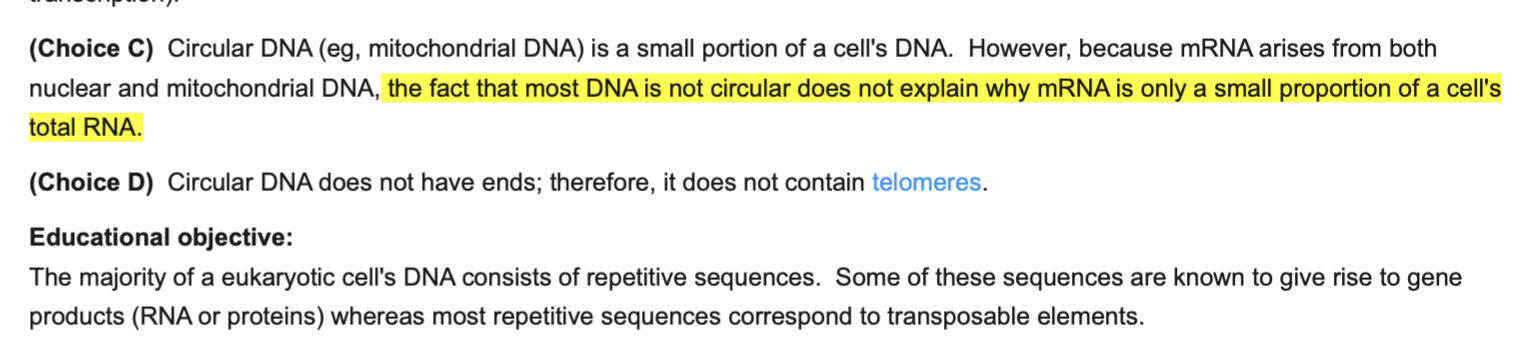
<p>What are telomeres?</p><p>Telomeres are protective, repetitive DNA sequences located at the ends of linear chromosomes.</p><p>Think of the plastic tips on shoelaces.</p><p></p><p>no, bc circular DNA does not have ends</p><p><mark data-color="yellow" style="background-color: yellow; color: inherit;">Why doesn't circular DNA need telomeres?</mark></p><p><mark data-color="yellow" style="background-color: yellow; color: inherit;">Because circular DNA has no free ends to protect.</mark></p><p><mark data-color="yellow" style="background-color: yellow; color: inherit;">Imagine the difference between a rope and a bracelet:</mark></p><ul><li><p><mark data-color="yellow" style="background-color: yellow; color: inherit;">A rope has two ends that can fray.</mark></p></li><li><p><mark data-color="yellow" style="background-color: yellow; color: inherit;">A closed bracelet has no ends.</mark></p></li></ul><p><mark data-color="yellow" style="background-color: yellow; color: inherit;">Therefore, Choice D is incorrect because circular DNA generally does not contain telomeres.</mark></p><p></p><p>Why are the remaining answer choices wrong?</p><p><mark data-color="red" style="background-color: red; color: inherit;">WRONG Choice C: Circular DNA is only a small proportion of total DNA.</mark></p><p>Eukaryotic cells generally contain linear nuclear chromosomes and circular mitochondrial DNA.</p><p>However, the question asks about RNA abundance, not DNA abundance.</p><p>The amount of circular DNA does not directly explain why mRNA makes up such a small fraction of cellular RNA.</p><p><mark data-color="red" style="background-color: red; color: inherit;">WRONG Choice D: Circular DNA contains telomeres.</mark></p><p>Telomeres are repetitive DNA sequences at the ends of linear chromosomes.</p><p>They help protect chromosome ends from deterioration and inappropriate DNA repair activity.</p><p>Typical circular DNA molecules do not have chromosome ends, meaning they do not need telomeres.</p><p>Also, noncoding DNA and non-translated RNA are not the same thing.</p>
35
New cards
<p>Eukaryotic DNA is composed of:</p>

Eukaryotic DNA is composed of:

-mostly linear DNA

-some circular mitochondrial DNA: found inside mitochondria in cells


<p>-mostly linear DNA</p><p>-some  circular mitochondrial DNA: found inside mitochondria in cells</p><p></p>
36
New cards
<p>Most of the actually coding DNA made up of repetitive sequences which most of these consist of transposable element but if they do code for RNA: what type of RNA does some of these repetitive sequences code for?</p>

Most of the actually coding DNA made up of repetitive sequences which most of these consist of transposable element but if they do code for RNA: what type of RNA does some of these repetitive sequences code for?

-note: most repetitive sequences are transposable elements

but the ones that do code for RNA code for: rRNA (mostly) & tRNA

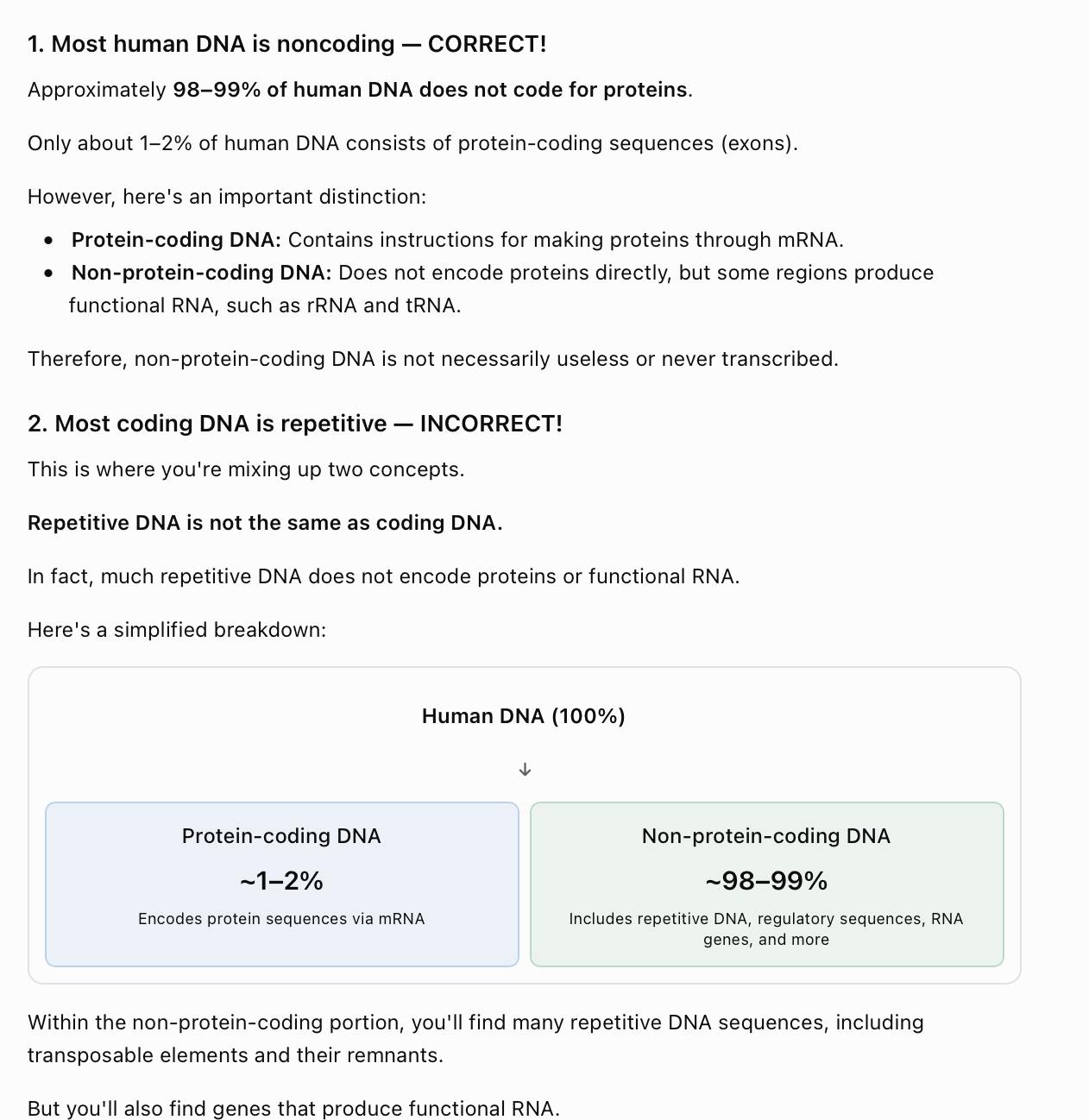
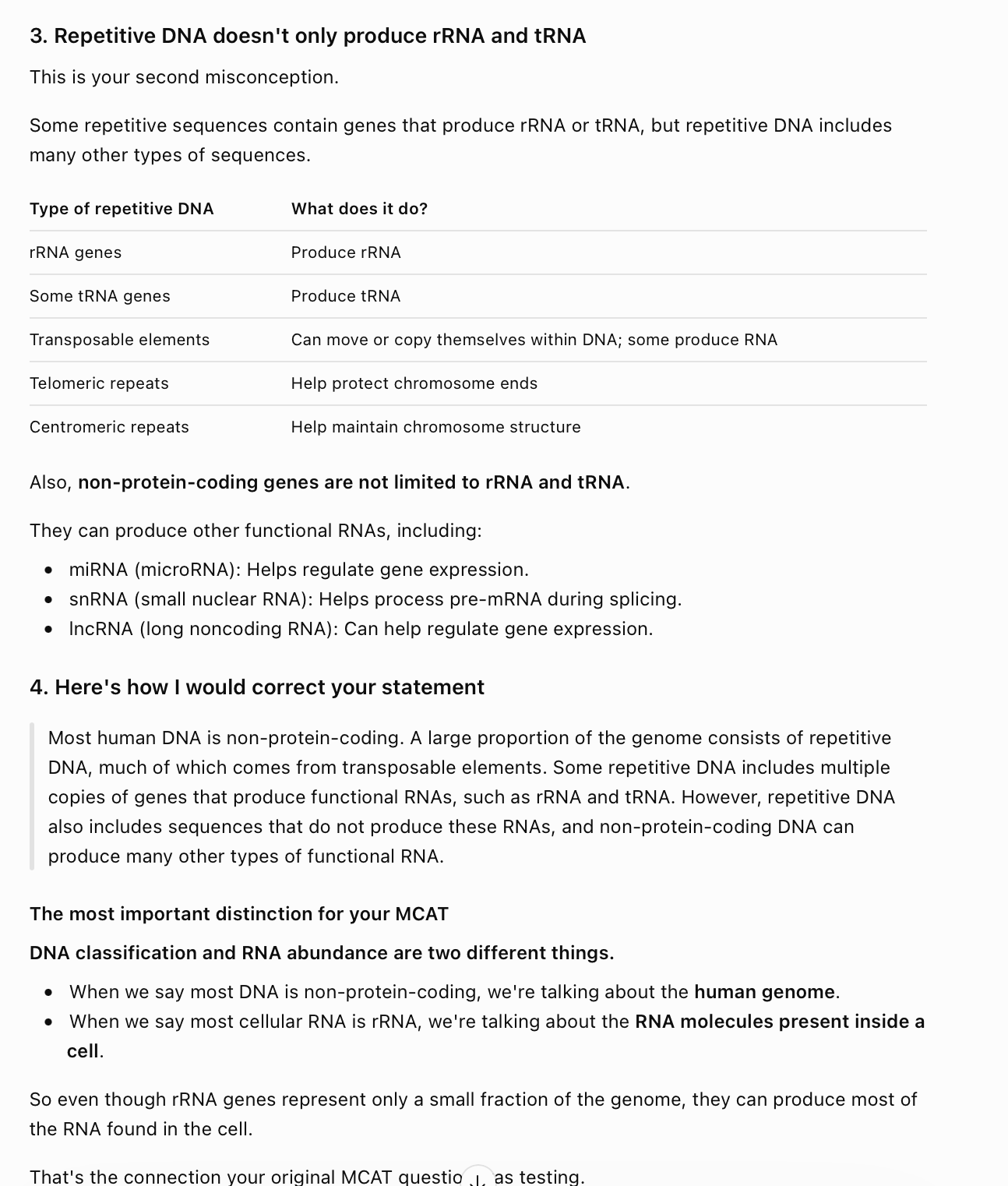
Most human DNA is non-protein-coding. A large proportion of the genome consists of repetitive DNA, much of which comes from transposable elements. Some repetitive DNA includes multiple copies of genes that produce functional RNAs, such as rRNA and tRNA. However, repetitive DNA also includes sequences that do not produce these RNAs, and non-protein-coding DNA can produce many other types of functional RNA.


One important distinction

Not all repetitive DNA codes for RNA!

Much of the repetitive DNA in humans consists of transposable elements and their remnants, rather than rRNA or tRNA genes.

MCAT takeaway: Both rRNA and tRNA can be encoded by repeated gene copies, but the question emphasizes rRNA because it is the most abundant type of RNA in the cell.

<p><strong>-note: most repetitive sequences are transposable elements</strong></p><p><strong>but the ones that do code for RNA code for: rRNA (mostly) &amp; tRNA</strong></p><blockquote><p>Most human DNA is non-protein-coding. A large proportion of the genome consists of repetitive DNA, much of which comes from transposable elements. Some repetitive DNA includes multiple copies of genes that produce functional RNAs, such as rRNA and tRNA. However, repetitive DNA also includes sequences that do not produce these RNAs, and non-protein-coding DNA can produce many other types of functional RNA.</p></blockquote><p></p><p>One important distinction</p><p>Not all repetitive DNA codes for RNA!</p><p>Much of the repetitive DNA in humans consists of transposable elements and their remnants, rather than rRNA or tRNA genes.</p><p>MCAT takeaway: Both rRNA and tRNA can be encoded by repeated gene copies, but the question emphasizes rRNA because it is the most abundant type of RNA in the cell.</p>
37
New cards

Most of DNA in genome is non-coding?

yes


<p>yes</p><p></p>
38
New cards

does meiosis 2 occur two times after meiosis 1?

yes, and no?

<p>yes, and no?</p>
39
New cards

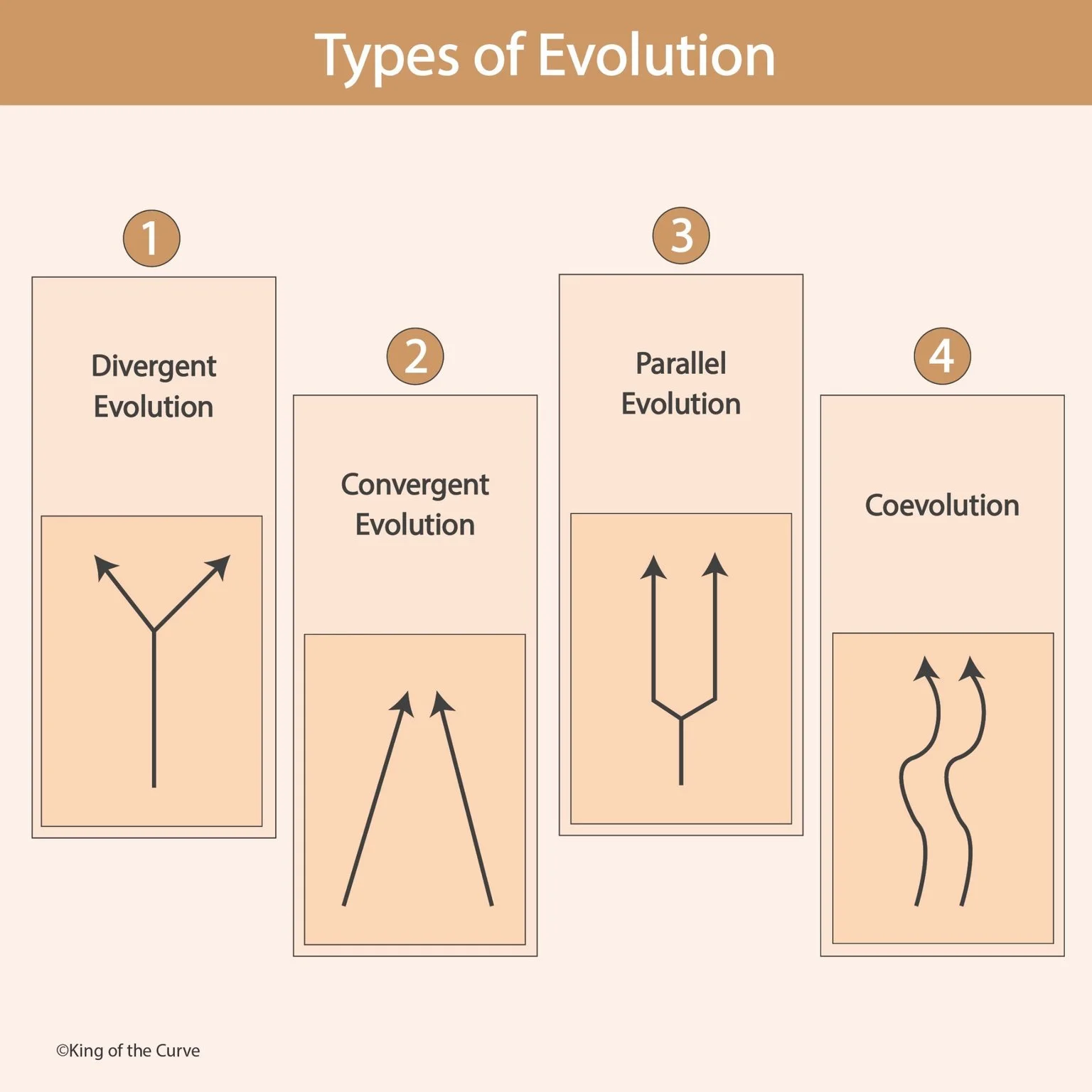
Types of evolution

knowt flashcard image
40
New cards

What occurs during phrophase 1 of meiosis 1

-synapsis occurs: (tetrad formation occurs). Where each chromosome (1 of each parent: 1 mother and 1 father), pairs up and binds to its homologous chromosome => forms a tetrad

-crossing over “recombination” at chiasma point= each homologous chromosome exchange segments of alleles => main point that drives genetic diversity bc of different gene combinations

-nuclear membrane disappears

-centrioles move at opposite ends of the cell & spindle fibers fan out of them

41
New cards

What is the chiasma point and where is it involved/occurs during meiosis and what meiosis?

-only occurs during prophase 1 of meiosis 1

-point where crossing over occurs. Like the location where segments of chromosome break off and exchange and join opposite homologous chromosome
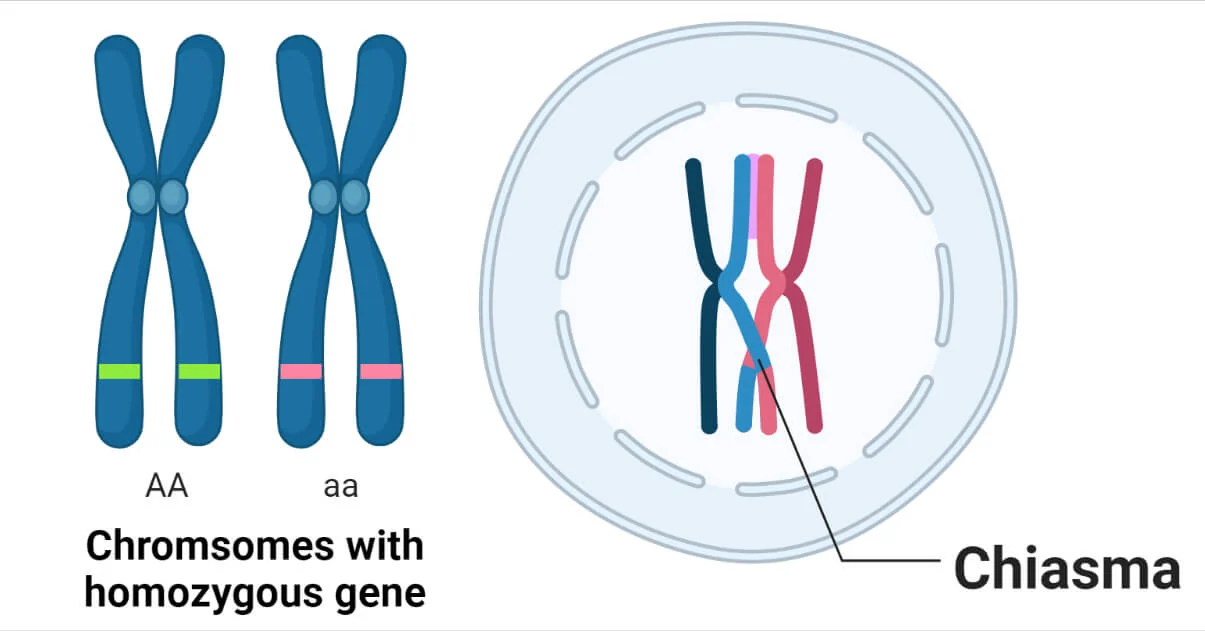
<p>-only occurs during prophase 1 of meiosis 1</p><p>-point where crossing over occurs. Like the location where segments of chromosome break off and exchange and join opposite homologous chromosome</p>
42
New cards
<p>What step of meiosis and in which meiosis drives the main factor contributing to genetic diversity?</p>

What step of meiosis and in which meiosis drives the main factor contributing to genetic diversity?

-prophase 1 of meiosis 1: crossing over
43
New cards
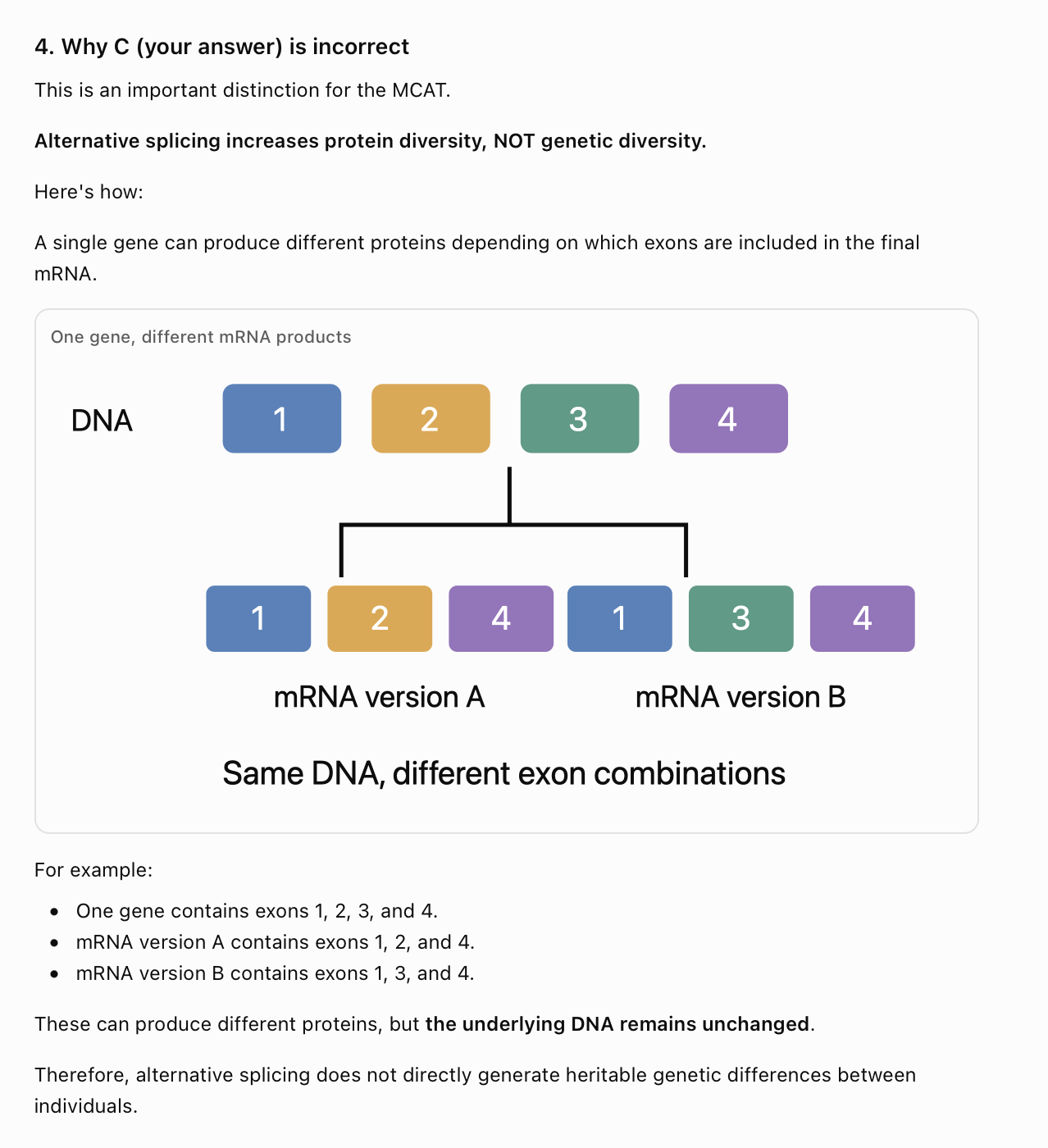
<p>What process leads to increased protein diversity but not genetic diversity?</p>

What process leads to increased protein diversity but not genetic diversity?

-mRNA splicing= leads to increased protein diversity by leaving or taking oyrt some exons to create diff proteins

BUT IT DOESNT introduce increase any genetic diversity this only happens during Meiosis 1 (prophase 1 of meiosis 1)

<p>-mRNA splicing= leads to increased protein diversity by leaving or taking oyrt some exons to create diff proteins </p><p>BUT IT DOESNT introduce increase any genetic diversity this only happens during Meiosis 1 (prophase 1 of meiosis 1)</p>
44
New cards

What processes increase genetic diversity
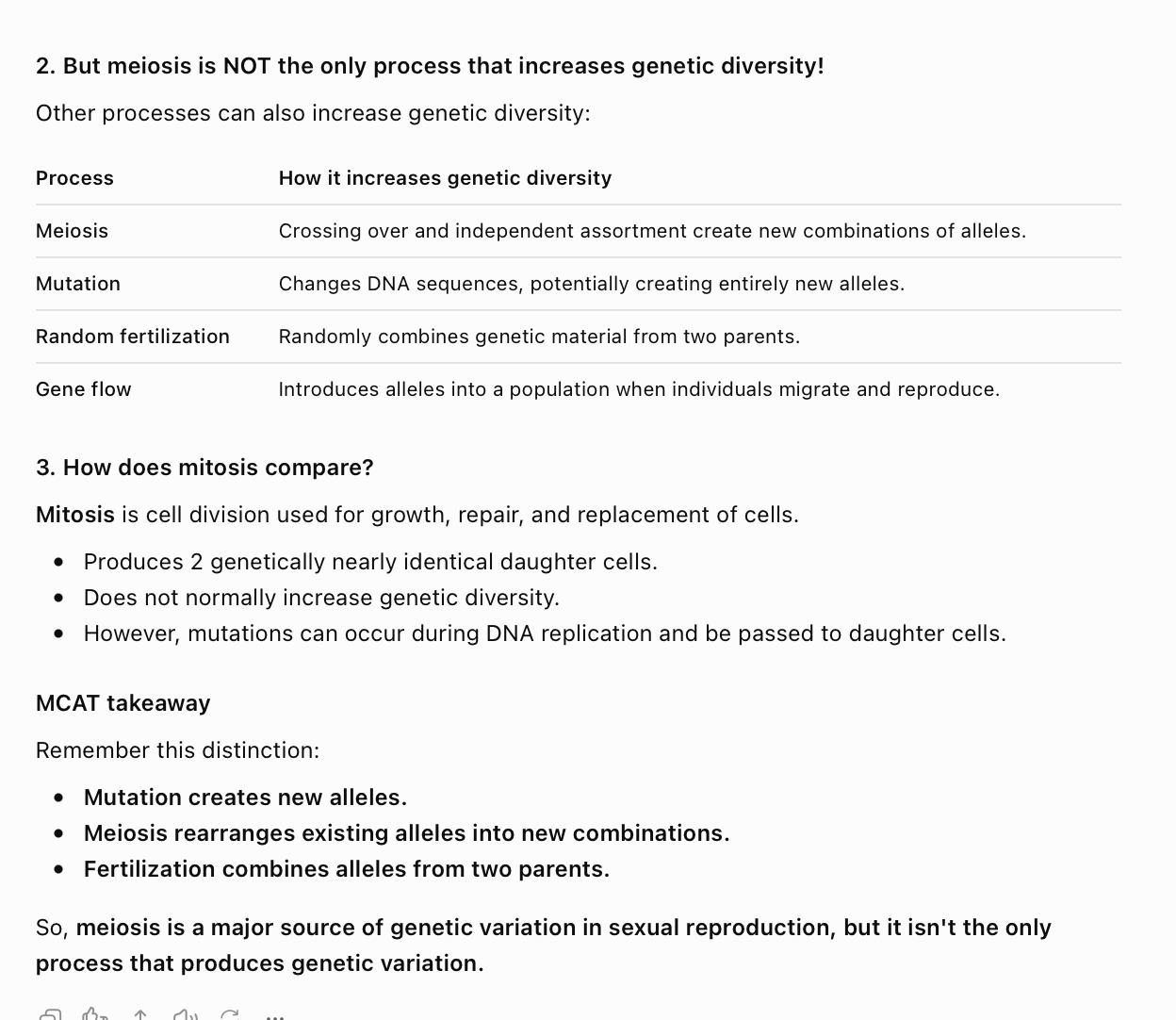
knowt flashcard image
45
New cards

Types of Prezygotic reproductive isolation

-not able to make a zygote at all due to these reasons
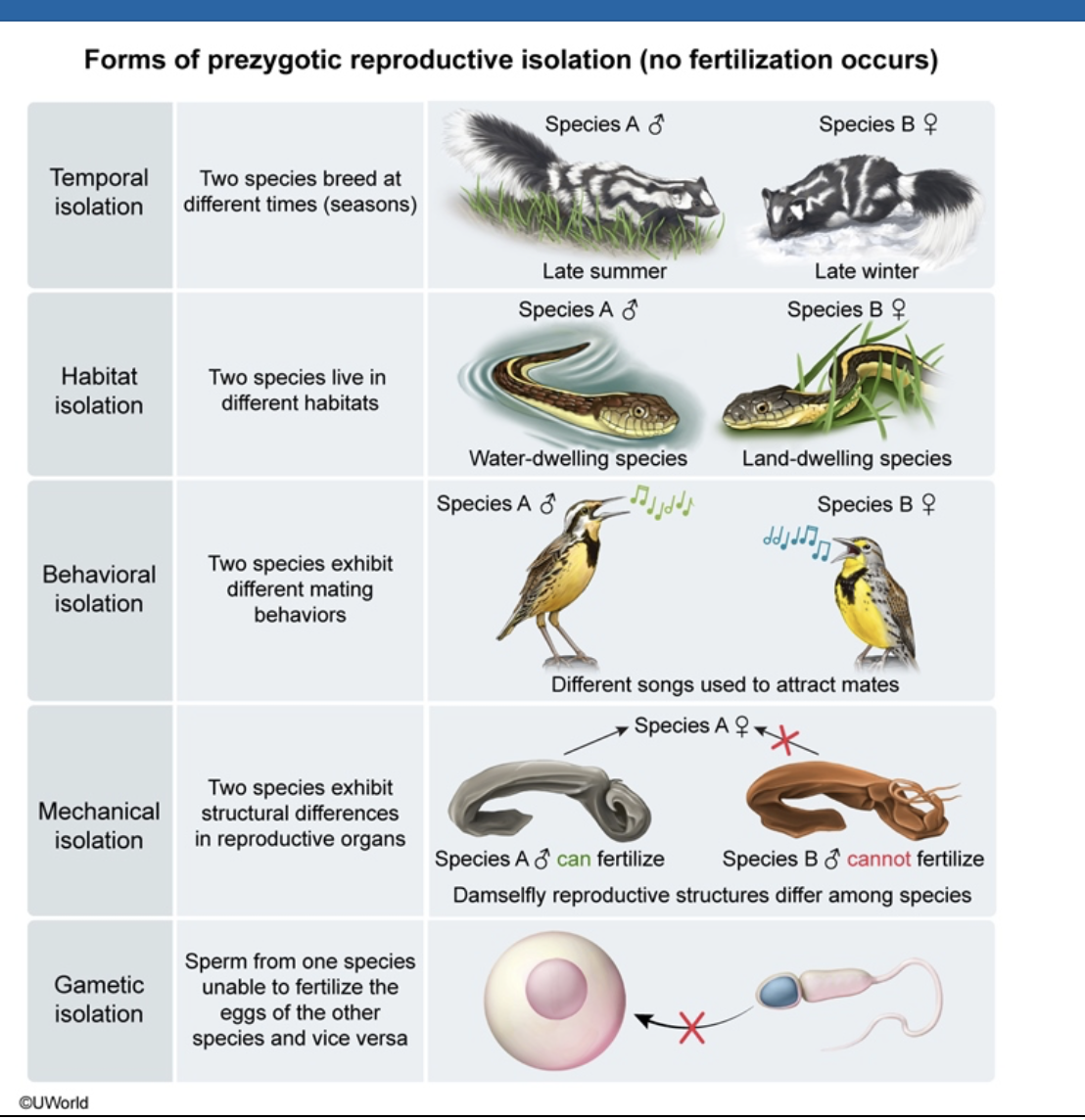
<p>-not able to make a zygote at all due to these reasons</p>
46
New cards

Types of post-zygotic reproductive isolation
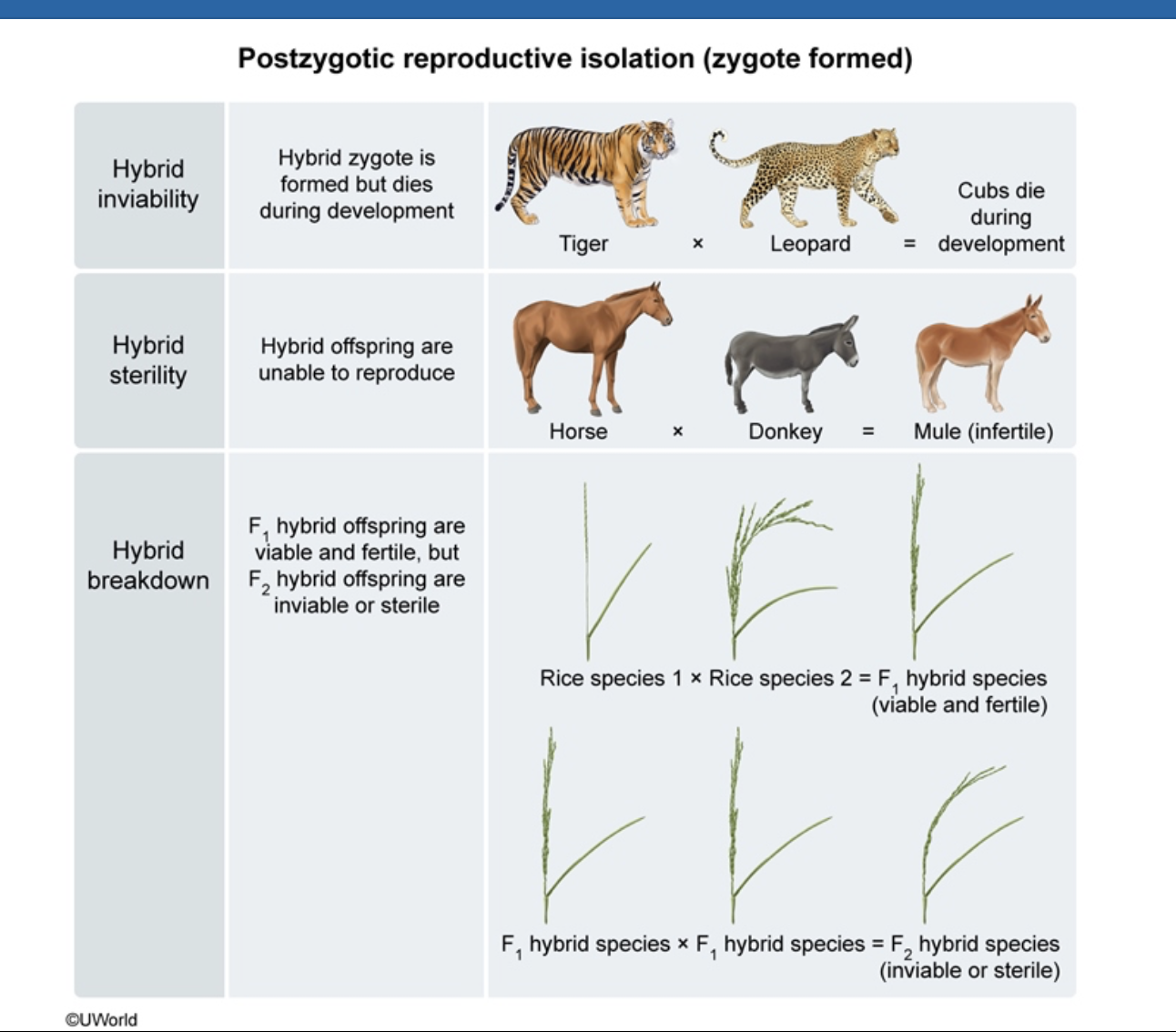
knowt flashcard image
47
New cards
<p>use two Hardy Weinberg equations to get frequency of homo recessive genotype frequency not just allele frequency</p>

use two Hardy Weinberg equations to get frequency of homo recessive genotype frequency not just allele frequency
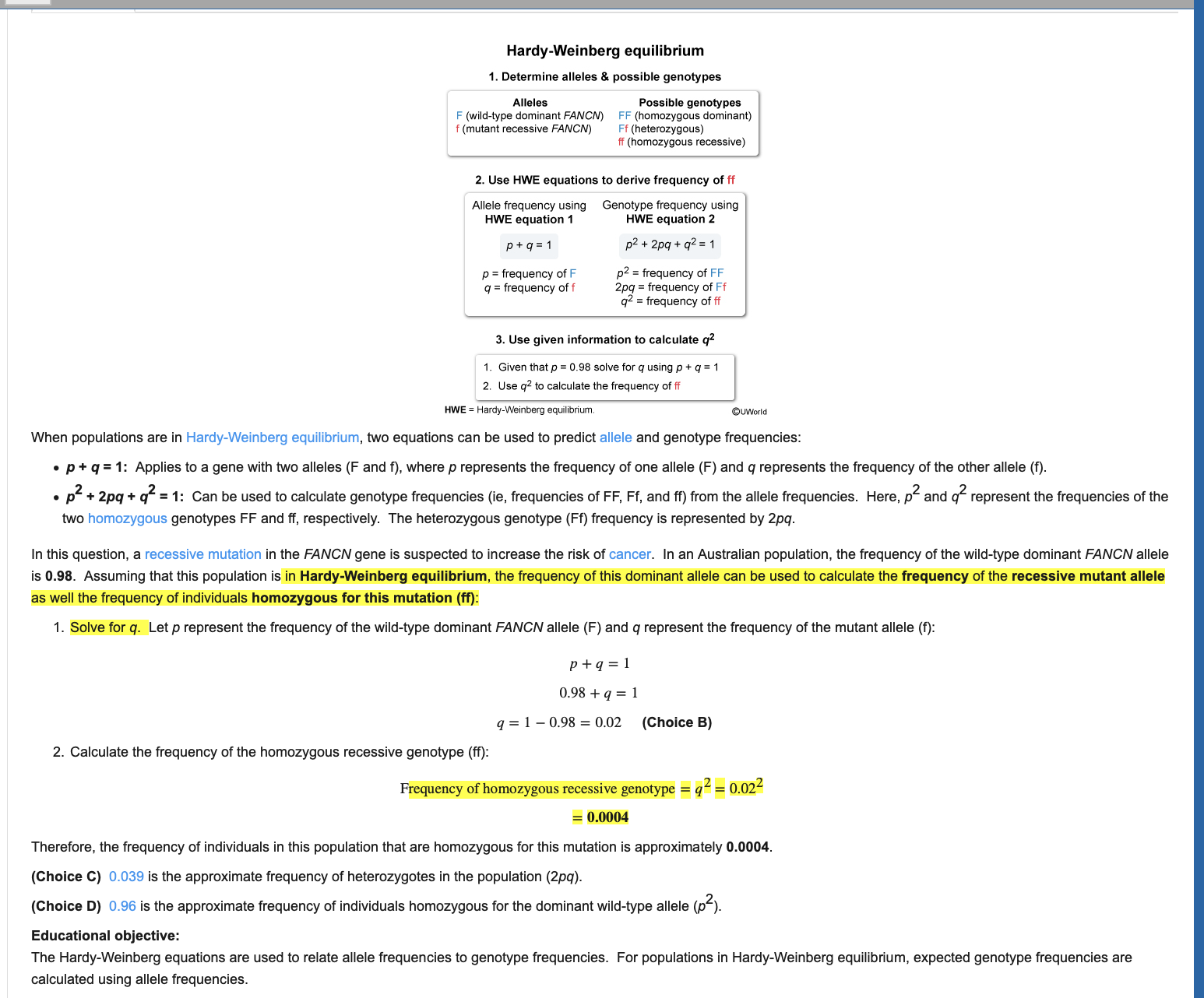
knowt flashcard image
48
New cards

What are alleles

knowt flashcard image
49
New cards
<p>Speciation</p>

Speciation

process of making new species

-you are a different species if you can’t mate with each other?

-leads to organisms if within the sam s[pecieis to become less alike so different —> that become separate species (leading it to become reproductively isolated)

50
New cards

Convergent evolution

  • when distantly relate organisms become more similar or alike by evolving similar traits in an independent manner

  • ex: fish and dolphins both develop fins bc of similar environment despite being separate species


<ul><li><p>when distantly relate organisms become more similar or alike by evolving similar traits in an independent manner</p></li><li><p>ex: fish and dolphins both develop fins bc of similar environment despite being separate species</p></li></ul><p></p>
51
New cards

Barriers to hybridization (producing a hybrid = a child of 2 separate species)
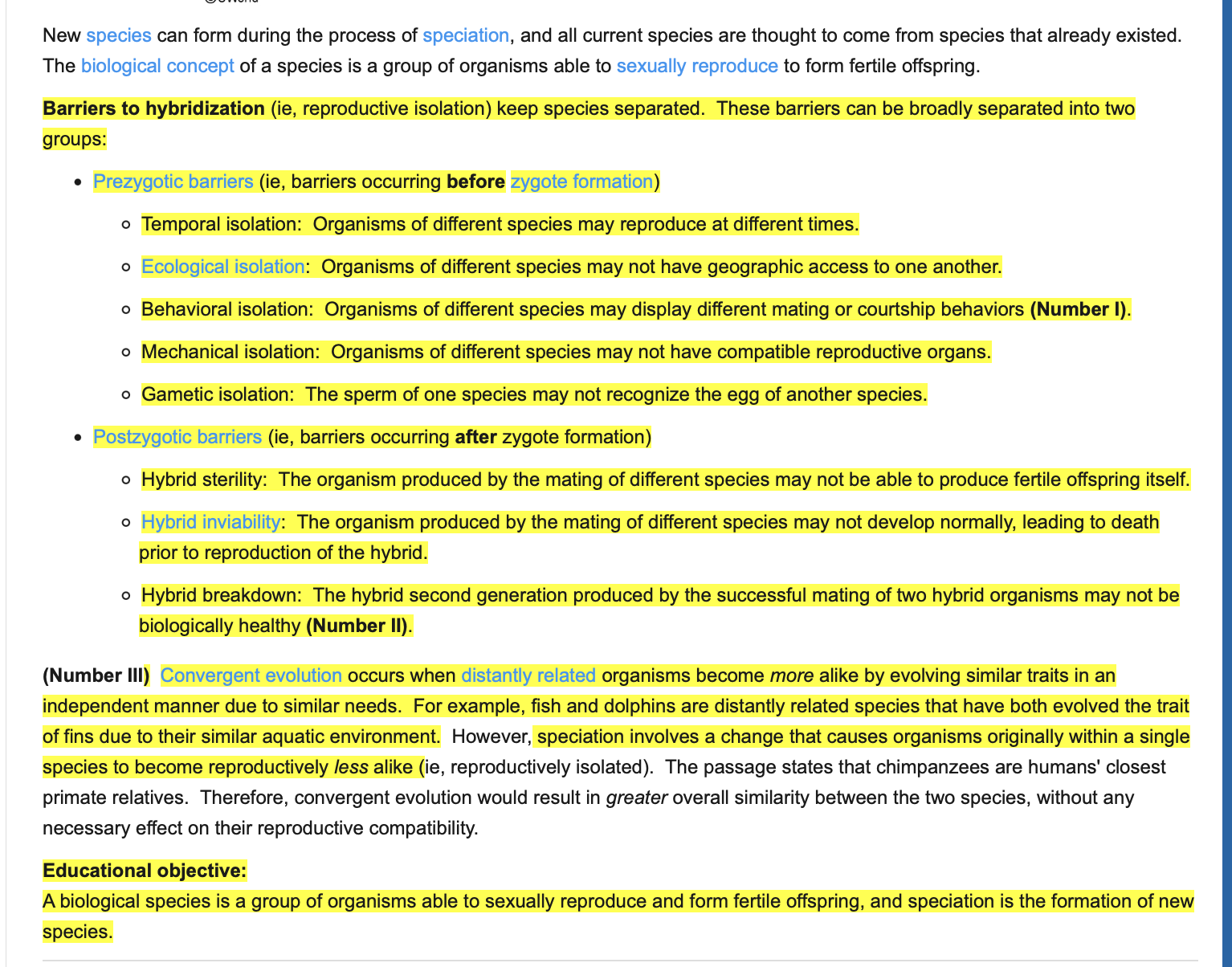
knowt flashcard image
52
New cards

What is Hybrid breakdown? and how is it different from other type of post-zygotic barriers for hybridization

knowt flashcard image
53
New cards

Hybrid inviability? and how is it different from other type of post-zygotic barriers for hybridization
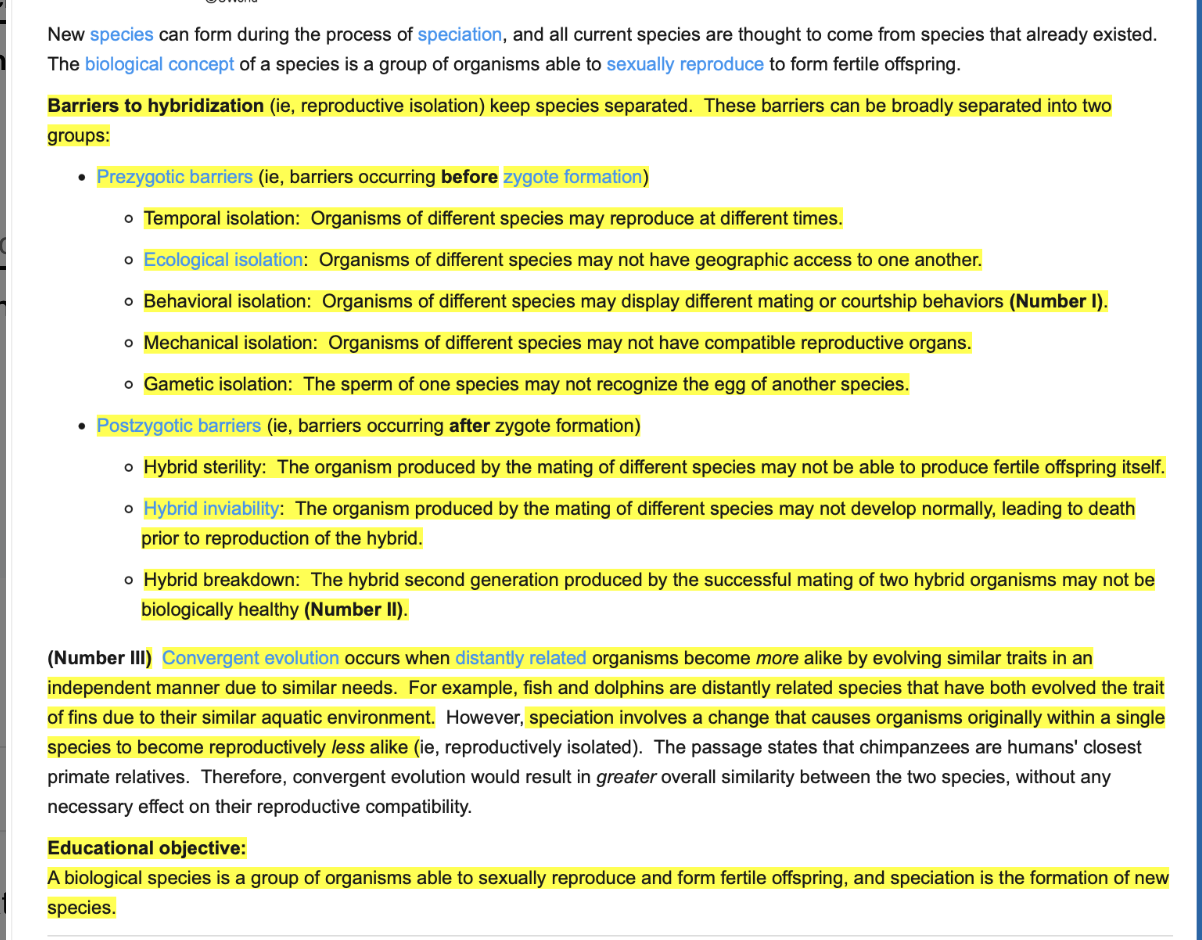
knowt flashcard image
54
New cards

Hybrid sterility? and how is it different from other type of post-zygotic barriers for hybridization

knowt flashcard image
55
New cards

Types of DNA Mutations

knowt flashcard image
56
New cards
<p>What is genetic drift? and types?</p>

What is genetic drift? and types?

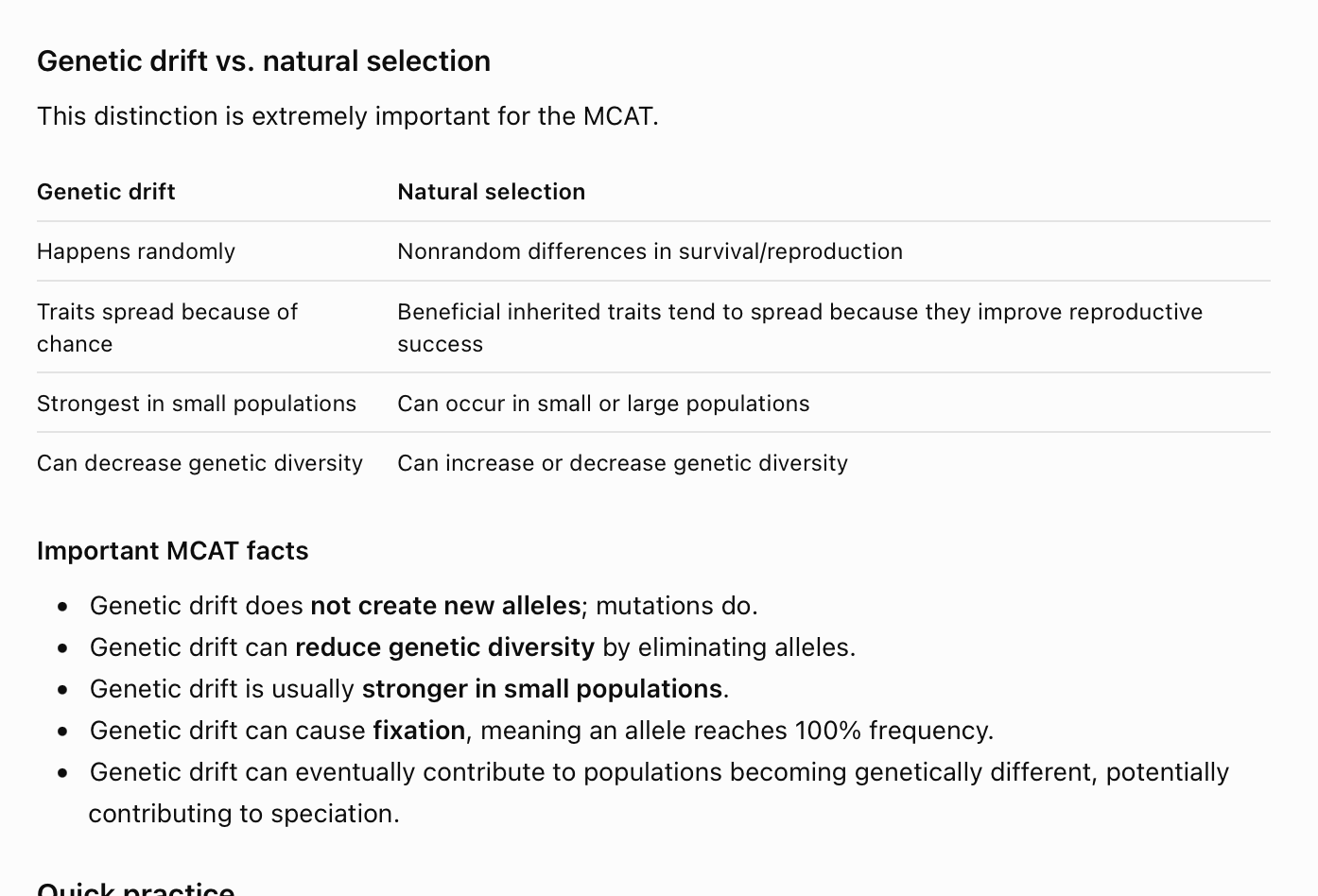
Genetic Drift: Types and Examples (MCAT Biology)

Genetic drift is when the frequency of certain alleles (versions of genes) in a population changes randomly because of chance, NOT because they help organisms survive.

In simple terms: Some genetic traits become more common or disappear simply because of luck.

There are two major types of genetic drift you need to know for the MCAT:

  1. Bottleneck effect

  2. Founder effect

Important MCAT facts

  • Genetic drift does not create new alleles; mutations do.

  • Genetic drift can reduce genetic diversity by eliminating alleles.

  • Genetic drift is usually stronger in small populations.

  • Genetic drift can cause fixation, meaning an allele reaches 100% frequency.

  • Genetic drift can eventually contribute to populations becoming genetically different, potentially contributing to speciation.


<p>Genetic Drift: Types and Examples (MCAT Biology)</p><p>Genetic drift is when the frequency of certain alleles (versions of genes) in a population changes randomly because of chance, NOT because they help organisms survive.</p><p>In simple terms: Some genetic traits become more common or disappear simply because of luck.</p><p>There are two major types of genetic drift you need to know for the MCAT:</p><ol><li><p>Bottleneck effect</p></li><li><p>Founder effect</p></li></ol><p>Important MCAT facts</p><ul><li><p>Genetic drift does not create new alleles; mutations do.</p></li><li><p>Genetic drift can reduce genetic diversity by eliminating alleles.</p></li><li><p>Genetic drift is usually stronger in small populations.</p></li><li><p>Genetic drift can cause fixation, meaning an allele reaches 100% frequency.</p></li><li><p>Genetic drift can eventually contribute to populations becoming genetically different, potentially contributing to speciation.</p></li></ul><p></p>
57
New cards

What is bottleneck effect?

knowt flashcard image
58
New cards

What is founder effect?

knowt flashcard image
59
New cards

What are mechanisms that can change frequency of alleles?
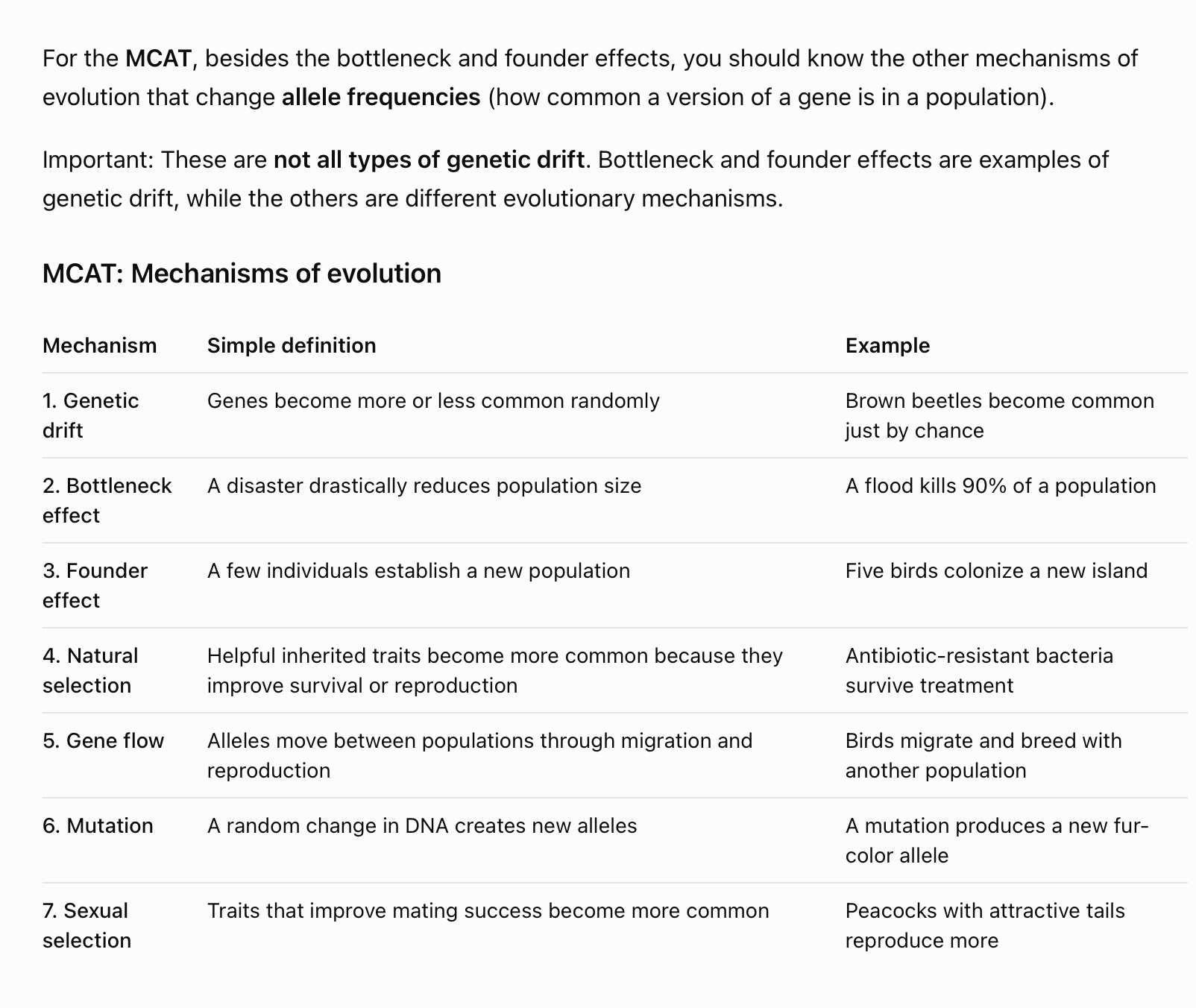
knowt flashcard image
60
New cards

Other types of natural selection? disruptive selection? directional? stabilizing?

knowt flashcard image
61
New cards

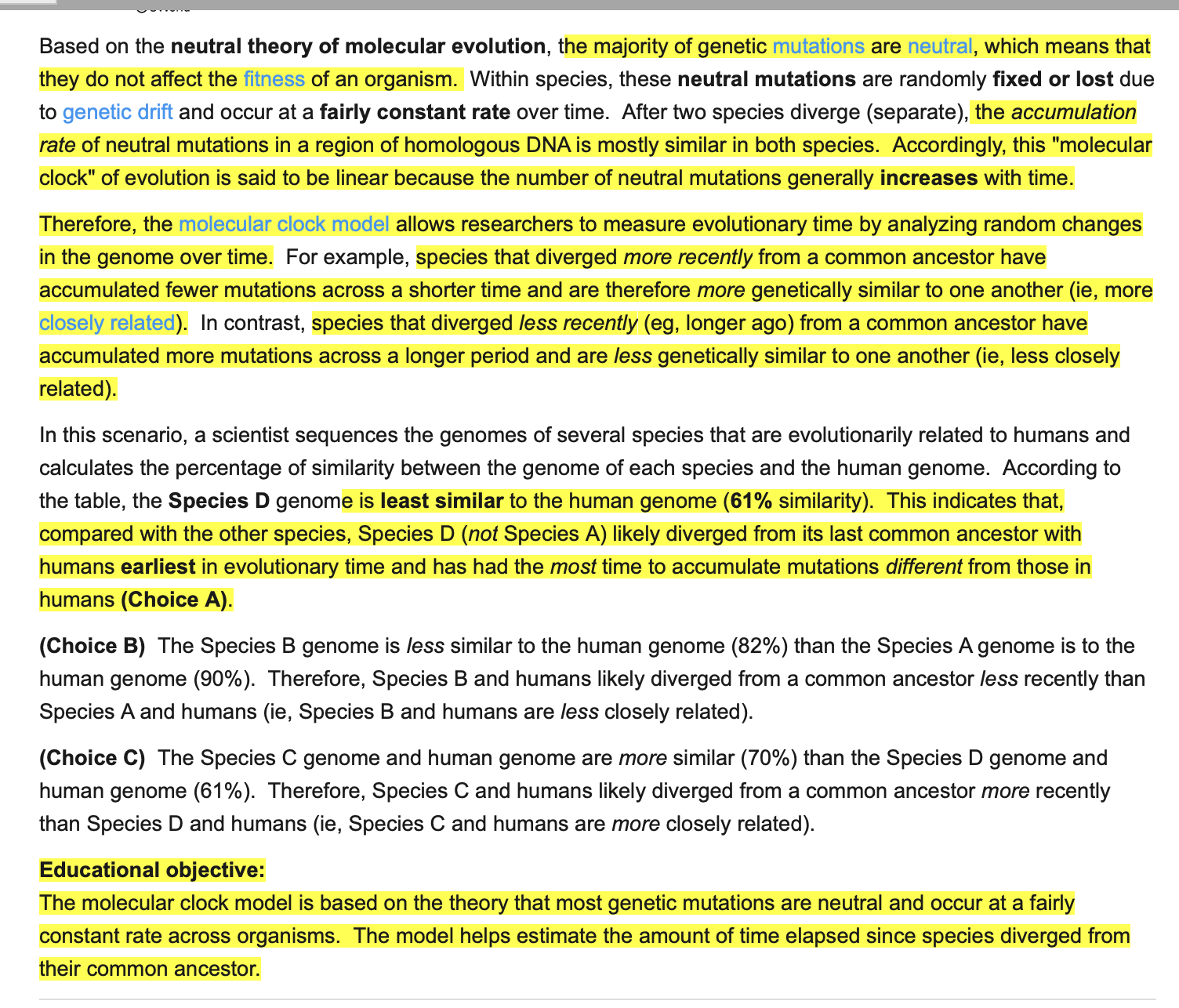
Molecular clock model and theory

knowt flashcard image
62
New cards

what is evolution?

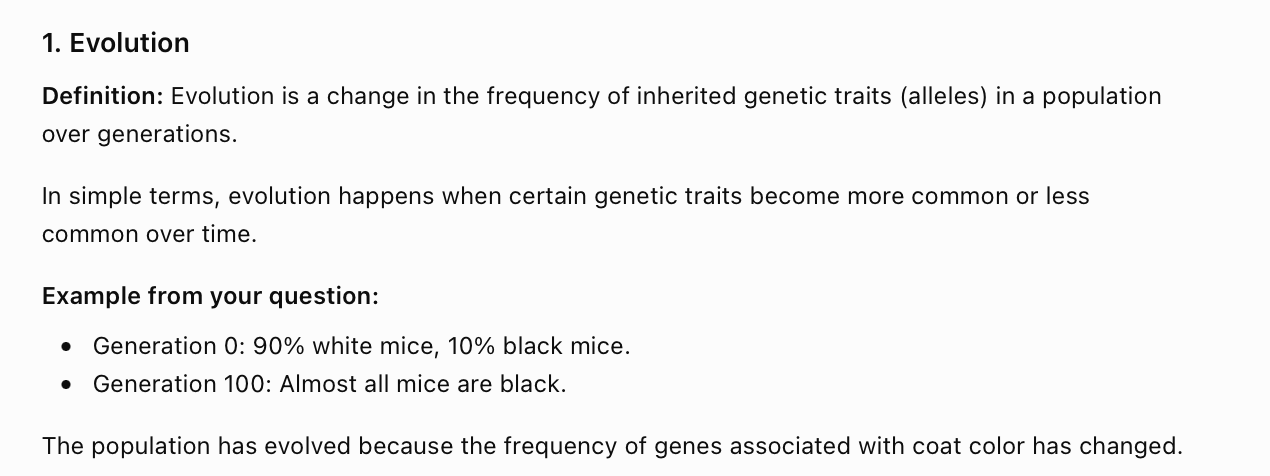
: Evolution is a change in the frequency of inherited genetic traits (alleles) in a population over generations.

In simple terms, evolution happens when certain genetic traits become more common or less common over time.

Example from your question:

  • Generation 0: 90% white mice, 10% black mice.

  • Generation 100: Almost all mice are black.

The population has evolved because the frequency of genes associated with coat color has changed.
<p>: Evolution is a change in the frequency of inherited genetic traits (alleles) in a population over generations.</p><p>In simple terms, evolution happens when certain genetic traits become more common or less common over time.</p><p>Example from your question:</p><ul><li><p>Generation 0: 90% white mice, 10% black mice.</p></li><li><p>Generation 100: Almost all mice are black.</p></li></ul><p>The population has evolved because the frequency of genes associated with coat color has changed.</p>
63
New cards

Adaptation

Definition: An adaptation is an inherited trait that improves survival or reproductive success in a particular environment.

For example, black fur can be an adaptation in a dark environment because it provides camouflage.

However, if the environment becomes white and snowy, that same black fur may become disadvantageous.

Key distinction:

  • Adaptation = a beneficial inherited characteristic.

  • Natural selection = the process that can make beneficial characteristics more common.

An organism does not intentionally develop an adaptation because it needs one.

64
New cards
<p>Mitosis vs meiosis similarities and differences</p>

Mitosis vs meiosis similarities and differences

similarities:

  • For both interphase “G1, S, G2” has to happen before these processes start

  • so they both undergo DNA synthesis which occurs during S-phase of interphase

  • they both start with parent cell with same number of chromosomes “diploid= 46 chromosomes”

  • both processes undergo PMAT (prophase, metaphase, anaphase, and telophase)

Differences:

-primarily in meiosis 1 during phasehase only phase or stage in either process where synapsis and crossing over occurs

-at end of meiosis 2 end up with four haploid daughter cells


<p>similarities:</p><ul><li><p>For both interphase “G1, S, G2” has to happen before these processes start  </p></li><li><p>so they both undergo DNA synthesis which occurs during S-phase of interphase </p></li><li><p>they both start with parent cell with same number of chromosomes “diploid= 46 chromosomes” </p></li><li><p>both processes undergo PMAT (prophase, metaphase, anaphase, and telophase)</p></li></ul><p>Differences:</p><p>-primarily in meiosis 1 during phasehase only phase or stage in either process where synapsis and crossing over occurs</p><p>-at end of meiosis 2 end up with four haploid daughter cells</p><p></p><p></p>
65
New cards

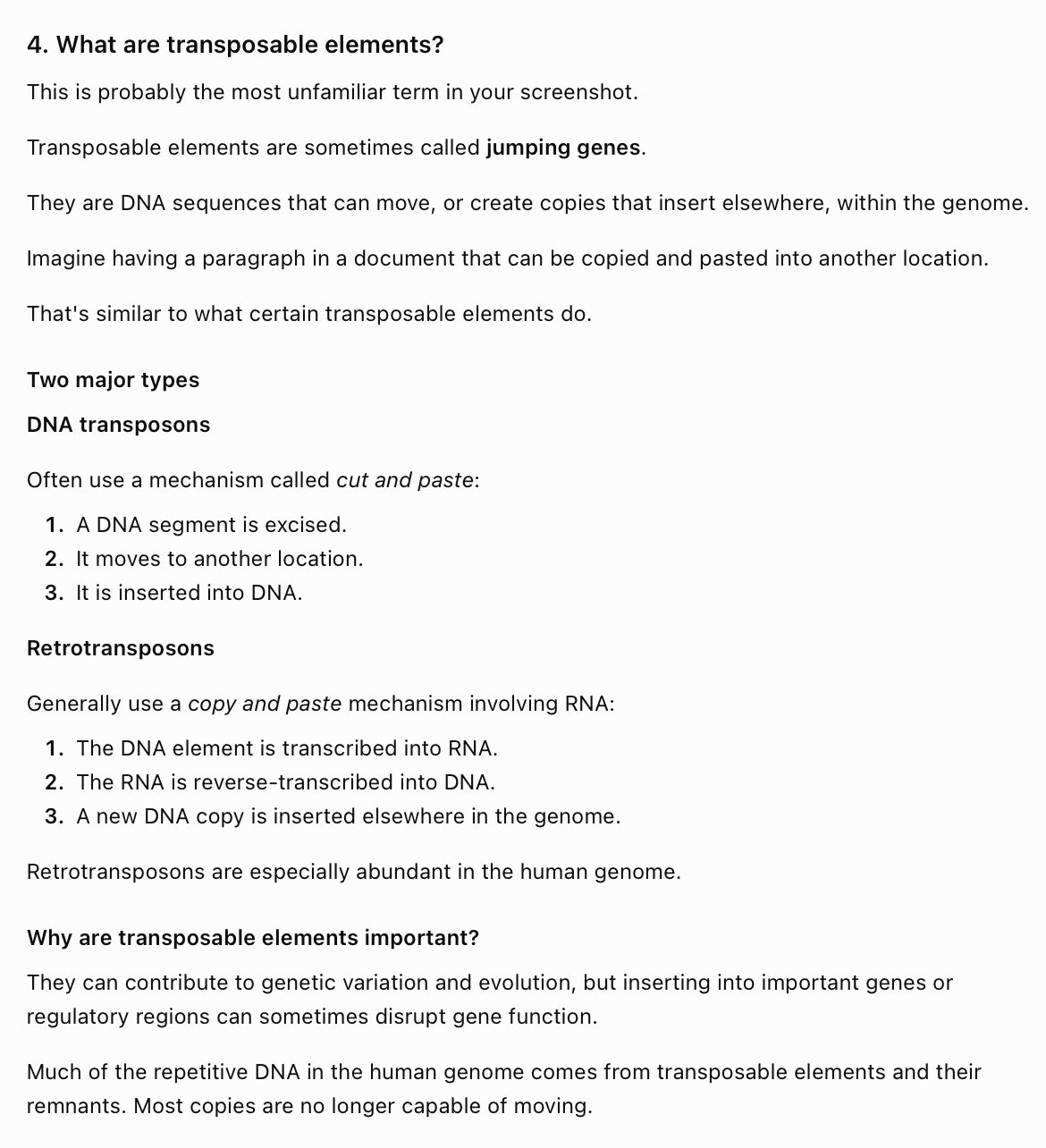
What are transposons “jumping genes”
knowt flashcard image
66
New cards
<p>is most of DNA coding?v</p>

is most of DNA coding?v

no

No

<p>no</p><p>No</p>
67
New cards
<p>What do repetitive sequences if code for anything code for?</p>

What do repetitive sequences if code for anything code for?

actually coding repetitive sequences don’t just code for rRNA they code for tRNA, transposons, telomeres, centromeres etc
<p>actually coding repetitive sequences don’t just code for rRNA they code for tRNA, transposons, telomeres, centromeres etc</p>
68
New cards
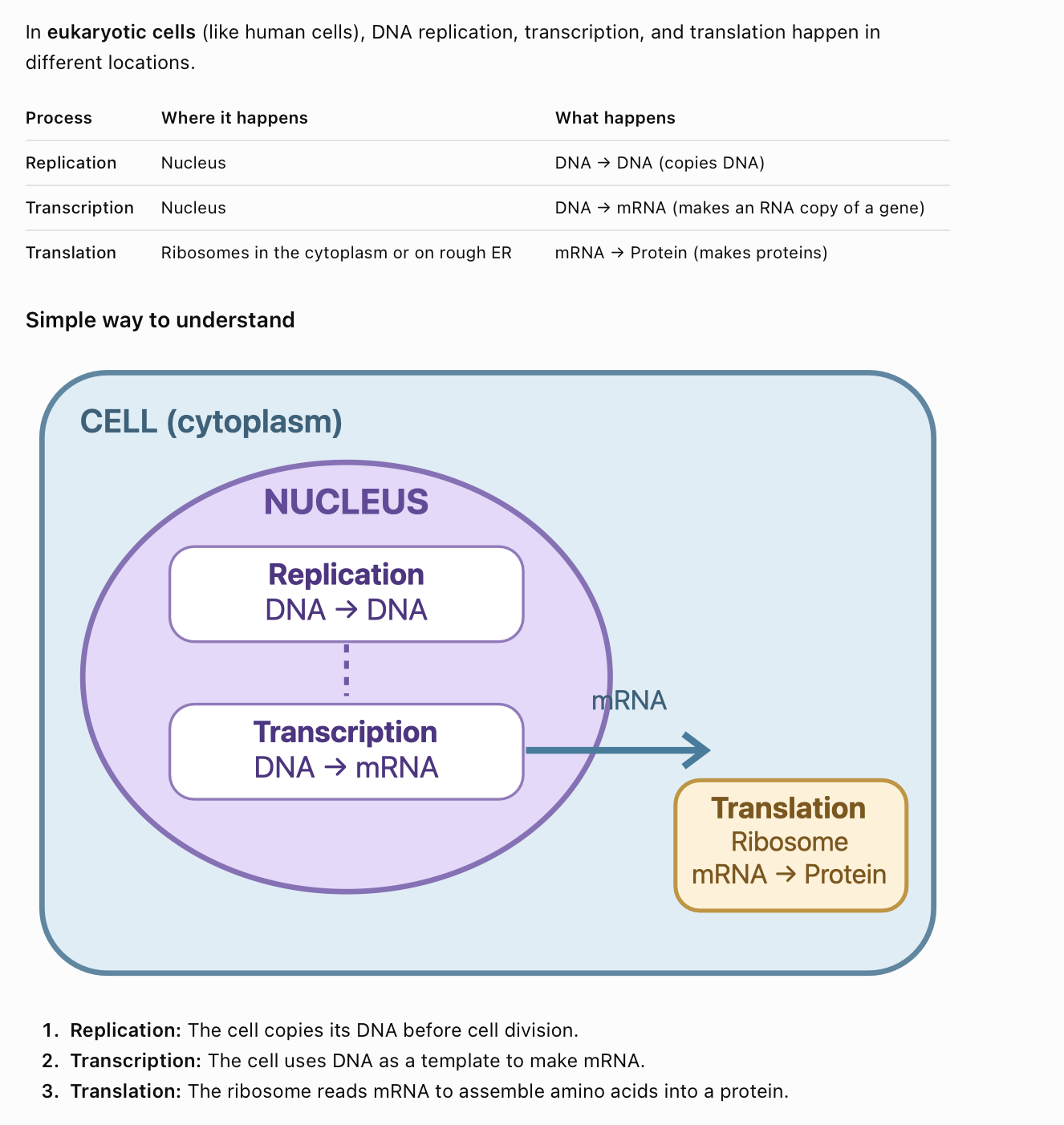
<p>Where does each process occurring the cell: replication, transcription, translation</p>

Where does each process occurring the cell: replication, transcription, translation

knowt flashcard image
69
New cards

Where does each process occurring the cell: replication, transcription, translation for Eukaryotes vs Prokaryotes

knowt flashcard image
70
New cards

Forms of gene expression regulation

71
New cards
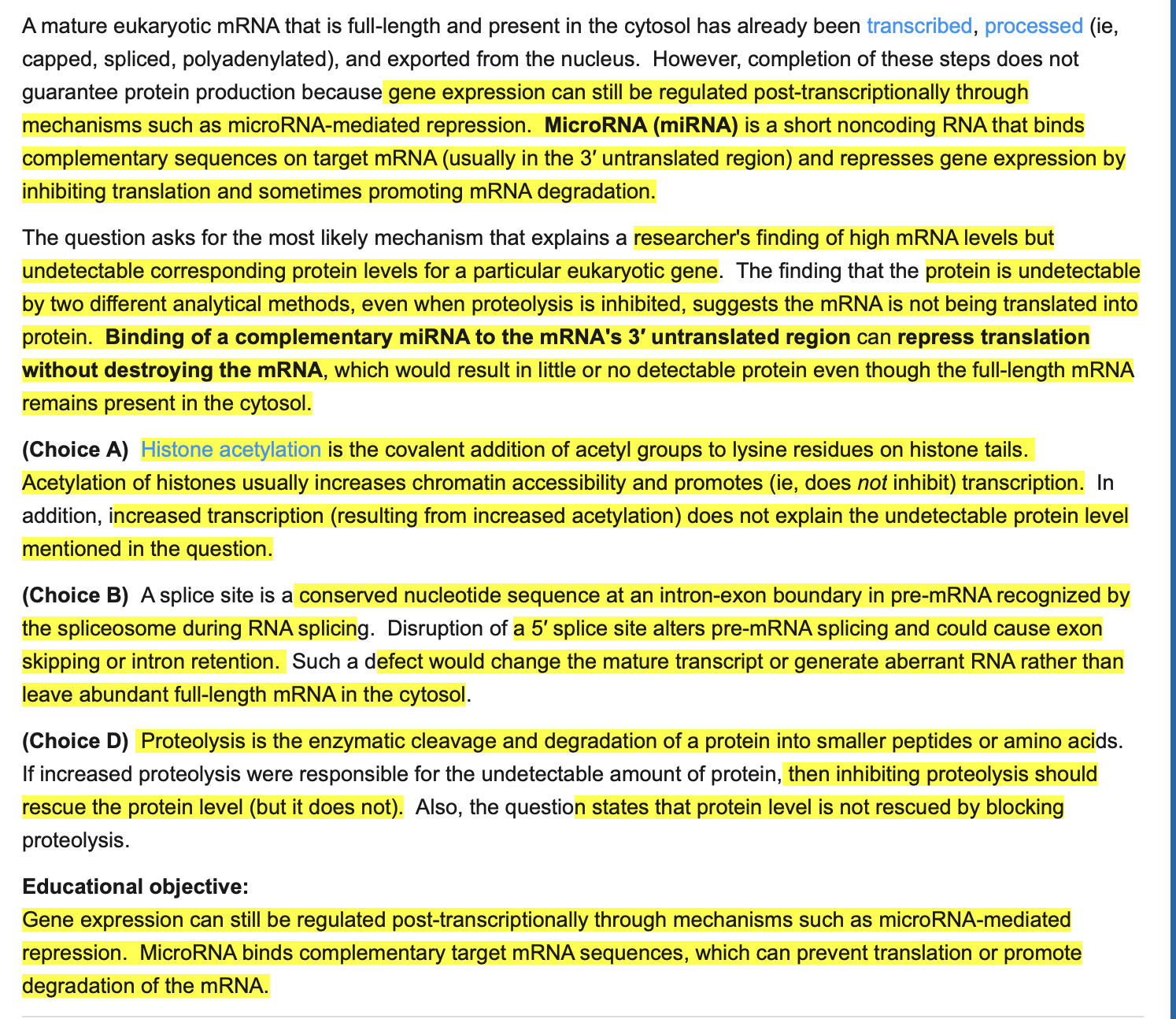
<p>what is micro-mRNA mediated repression?</p>

what is micro-mRNA mediated repression?
knowt flashcard image
72
New cards
<p>why and in what ways could you have increased mRNA present but no protein made or present? also exclude proteolysis bc told inhibitors of it don’t rescue against it so it’s not bc of it. Q/A from UWORLD</p>

why and in what ways could you have increased mRNA present but no protein made or present? also exclude proteolysis bc told inhibitors of it don’t rescue against it so it’s not bc of it. Q/A from UWORLD

knowt flashcard image
73
New cards
<p>Where in the DNA do double stranded breaks occur? DSBS</p>

Where in the DNA do double stranded breaks occur? DSBS

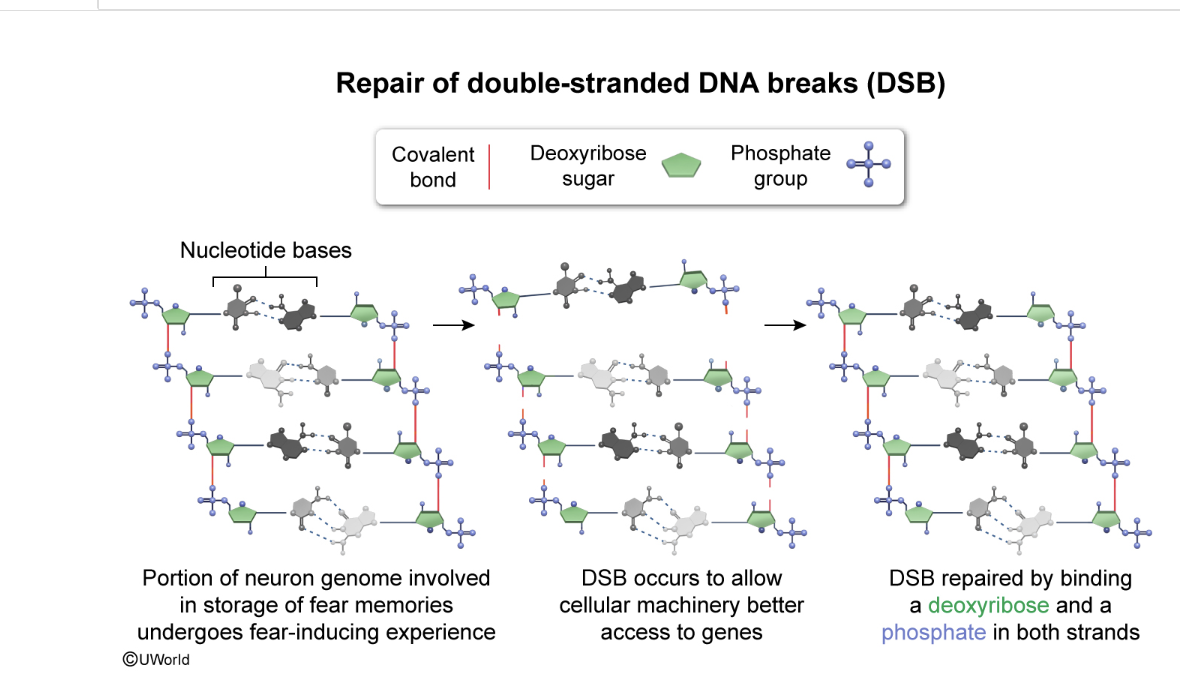
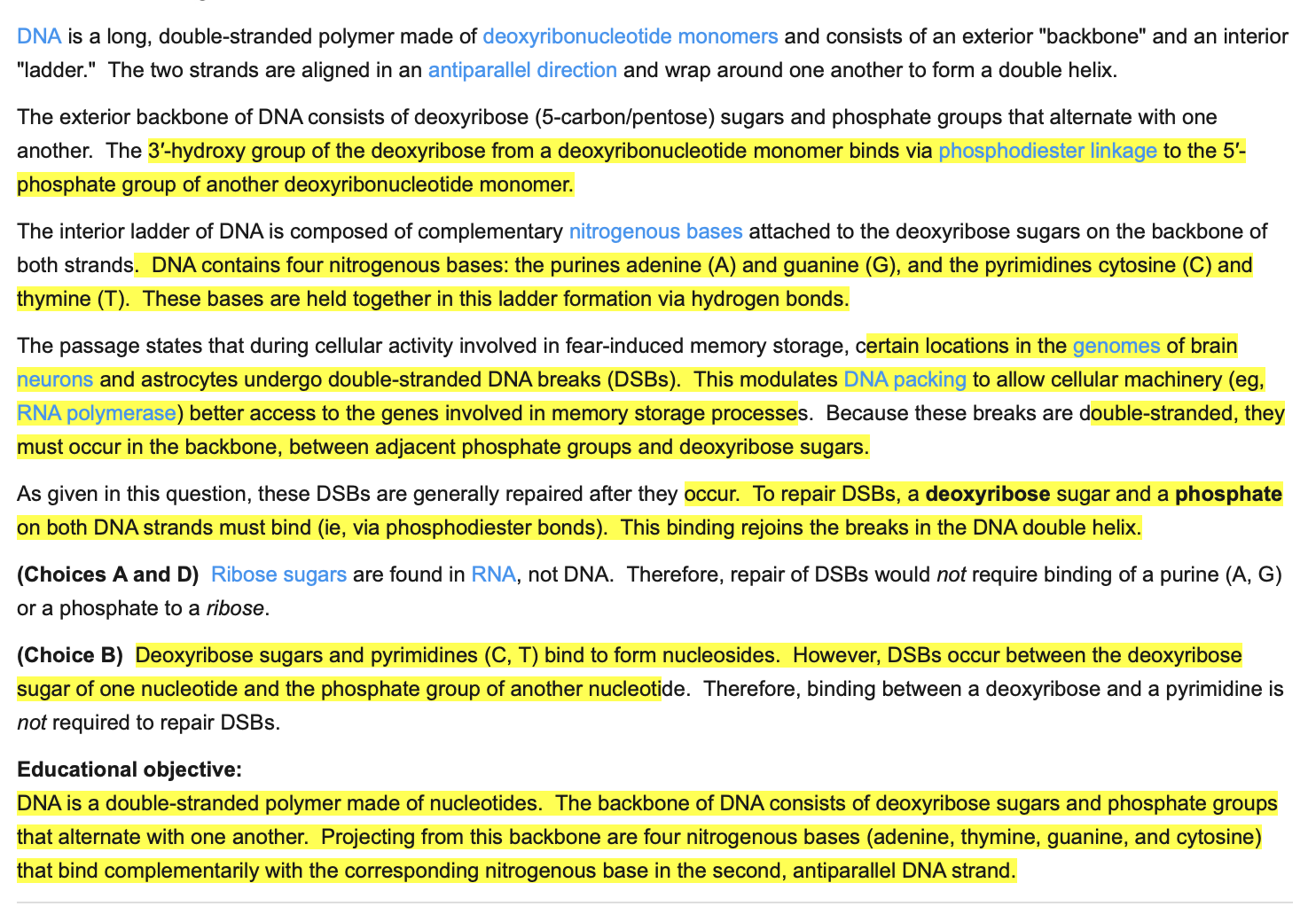
between the covalent bonds or ester bonds that join a phosphate to a deoxyribose sugar

-a DSB “double stranded breaks”= occurs between a deoxyribose and a phosphate in DNA

-DSBs allow cellular machinery better access to genes
<p>between the covalent bonds or ester bonds that join a phosphate to a deoxyribose sugar</p><p>-a DSB “double stranded breaks”= occurs between a deoxyribose and a phosphate in DNA</p><p>-DSBs allow cellular machinery better access to genes </p>
74
New cards

Euchromatin and heterochromatin

knowt flashcard image
75
New cards

Bonds within DNA specific what each carbon hoes uwth what

knowt flashcard image
76
New cards

What are DSBs and how are they repaired?

knowt flashcard image
77
New cards

Error bars (statistical signifincance)

knowt flashcard image
78
New cards

DNA breaks and some repairs

knowt flashcard image
79
New cards

Antagonist vs agonist

An antagonist is a molecule that blocks a receptor from being activated.

Think of a receptor as a lock:

  • Agonist: A key that fits into the lock and turns it on.

  • Antagonist: A key that fits into the lock but doesn't turn it on. It prevents the real key from working.

<p>An antagonist is a molecule that blocks a receptor from being activated.</p><p>Think of a receptor as a lock:</p><ul><li><p>Agonist: A key that fits into the lock and turns it on.</p></li><li><p>Antagonist: A key that fits into the lock but doesn't turn it on. It prevents the real key from working.</p></li></ul><p></p>
80
New cards
<p>Binary fission</p>

Binary fission

Yes. For binary fission and bacterial growth curves, these are the high-yield MCAT points:

  1. Binary fission doubles the population. One bacterium copies its DNA and splits into two. It’s asexual reproduction, not mitosis. Watch out for a question that gives you time instead of the number of doublings. If bacteria double every 20 minutes, then 60 minutes is 3 doublings. Starting with 100 bacteria gives you \(100 \times 2^3 = 800

<p>Yes. For <strong>binary fission and bacterial growth curves</strong>, these are the high-yield MCAT points:</p><ol><li><p><strong>Binary fission doubles the population.</strong> One bacterium copies its DNA and splits into two. It’s <strong>asexual reproduction</strong>, not mitosis. Watch out for a question that gives you <strong>time</strong> instead of the <strong>number of doublings</strong>. If bacteria double every 20 minutes, then 60 minutes is <strong>3 doublings</strong>. Starting with 100 bacteria gives you \(100 \times 2^3 = 800</p></li></ol><p></p>
81
New cards
<p>Growth curve</p>

Growth curve


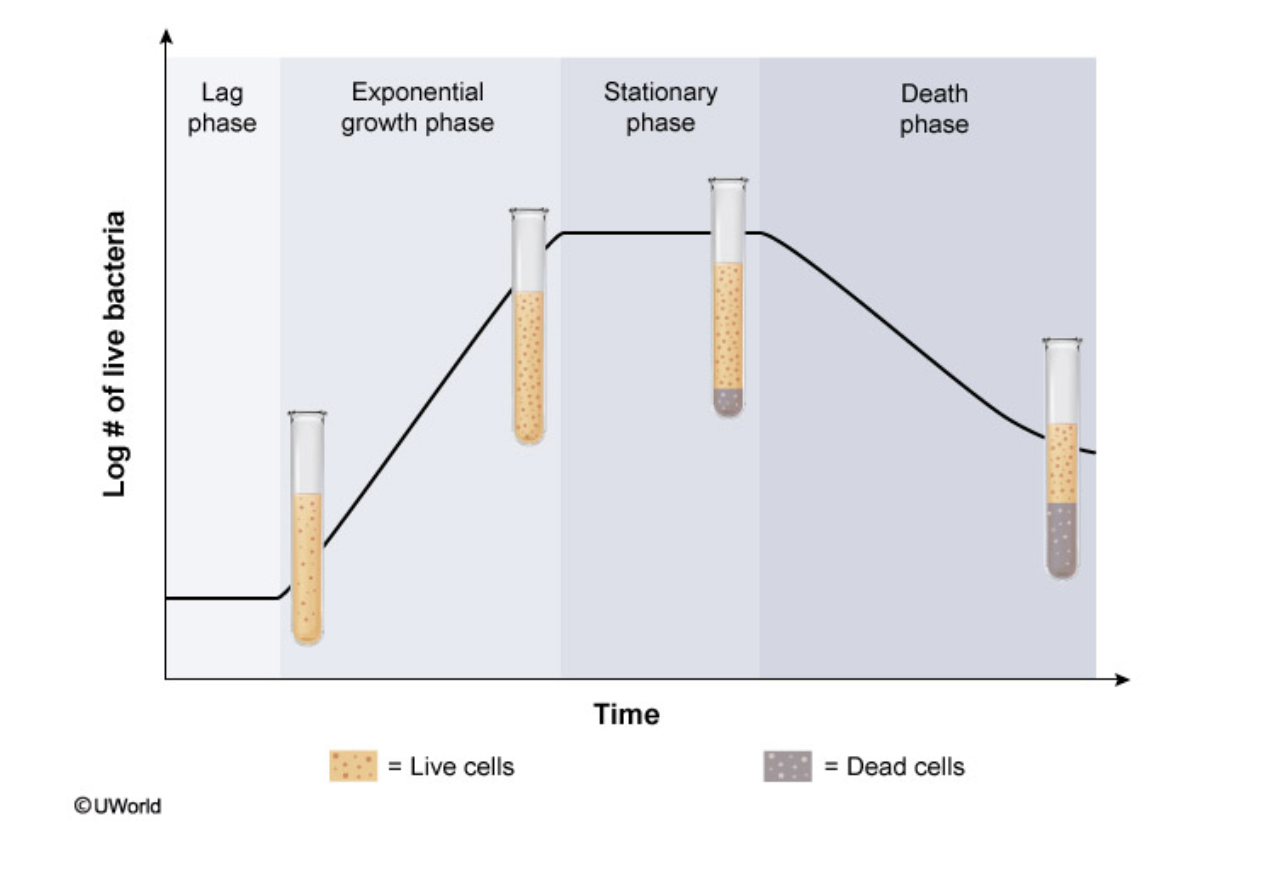
  1. Know the four phases and what causes them. Lag = adjusting, with little population increase. Log = rapid doubling. Stationary = roughly as many cells are dying as are being made, often because nutrients run low or waste builds up. Death = more cells die than are made.

  2. Don’t confuse height, slope, and when growth starts. Height tells you how many cells there are. Slope tells you how fast the number is changing at that point. When the line starts rising tells you how long growth was delayed. In your graph, × had a steep jump but started rising later. A steep jump doesn’t erase the delay.

  3. “No regrowth” doesn’t mean “all the bacteria died.” A bacteriostatic drug inhibits growth, while a bactericidaldrug kills bacteria. The flat ■ line only shows that the population didn’t noticeably increase during the time measured. The graph alone doesn’t prove why.

For this passage, the best shortcut: First ask “When was the antibiotic present?” Then ask “Am I comparing cell number, growth rate, or time before growth starts?” Those two questions get you past the main traps.
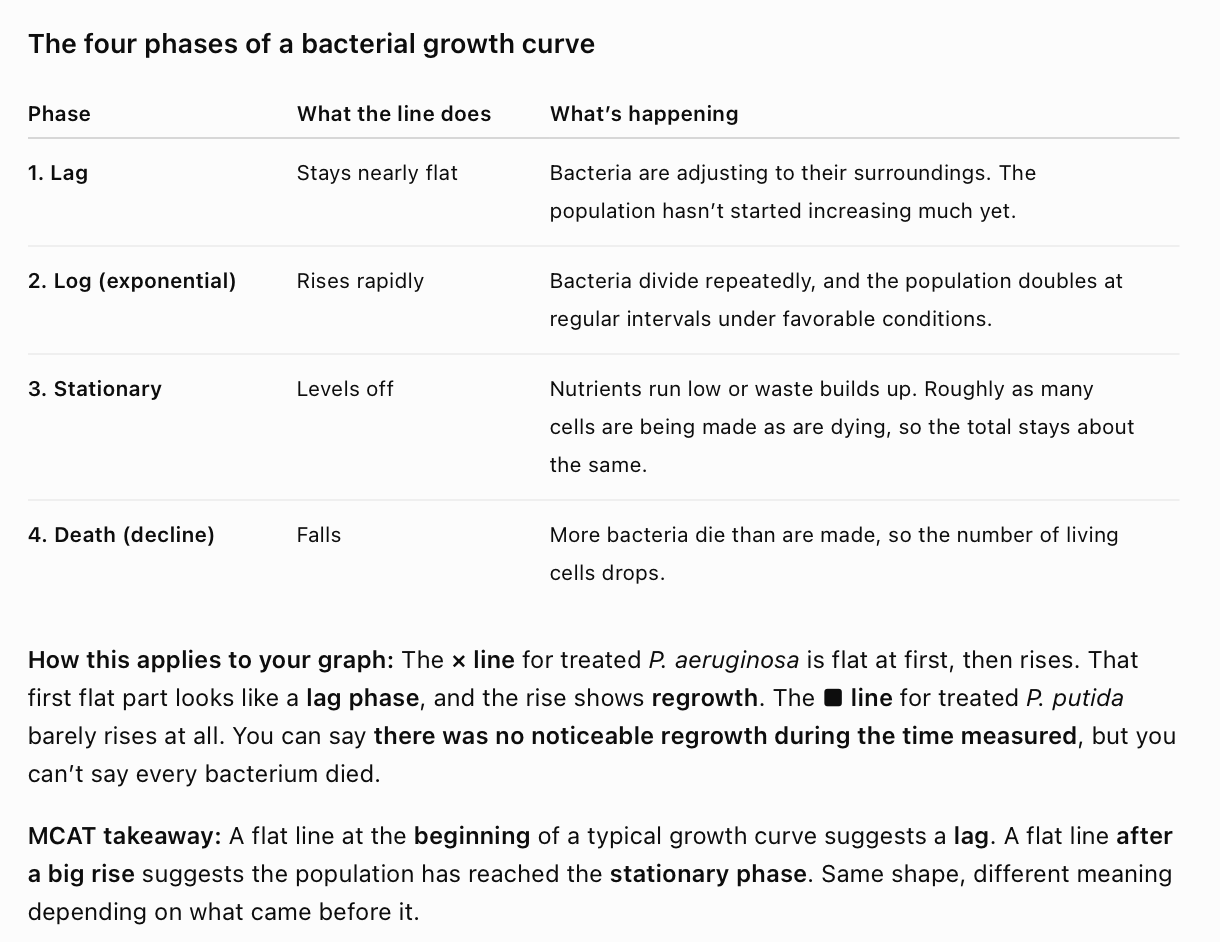
<p></p><ol><li><p><strong>Know the four phases and what causes them.</strong> <strong>Lag</strong> = adjusting, with little population increase. <strong>Log</strong> = rapid doubling. <strong>Stationary</strong> = roughly as many cells are dying as are being made, often because nutrients run low or waste builds up. <strong>Death</strong> = more cells die than are made.</p></li><li><p><strong>Don’t confuse height, slope, and when growth starts.</strong> <strong>Height</strong> tells you how many cells there are. <strong>Slope</strong> tells you how fast the number is changing at that point. <strong>When the line starts rising</strong> tells you how long growth was delayed. In your graph, <strong>×</strong> had a steep jump but started rising <strong>later</strong>. A steep jump doesn’t erase the delay.</p></li><li><p><strong>“No regrowth” doesn’t mean “all the bacteria died.”</strong> A <strong>bacteriostatic</strong> drug inhibits growth, while a <strong>bactericidal</strong>drug kills bacteria. The flat <strong>■</strong> line only shows that the population didn’t noticeably increase <strong>during the time measured</strong>. The graph alone doesn’t prove why.</p></li></ol><p><strong>For this passage, the best shortcut:</strong> First ask <strong>“When was the antibiotic present?”</strong> Then ask <strong>“Am I comparing cell number, growth rate, or time before growth starts?”</strong> Those two questions get you past the main traps.</p>
82
New cards
<p>BActerial exponențial; growth (binary fission) formula:</p><p>ex: </p>

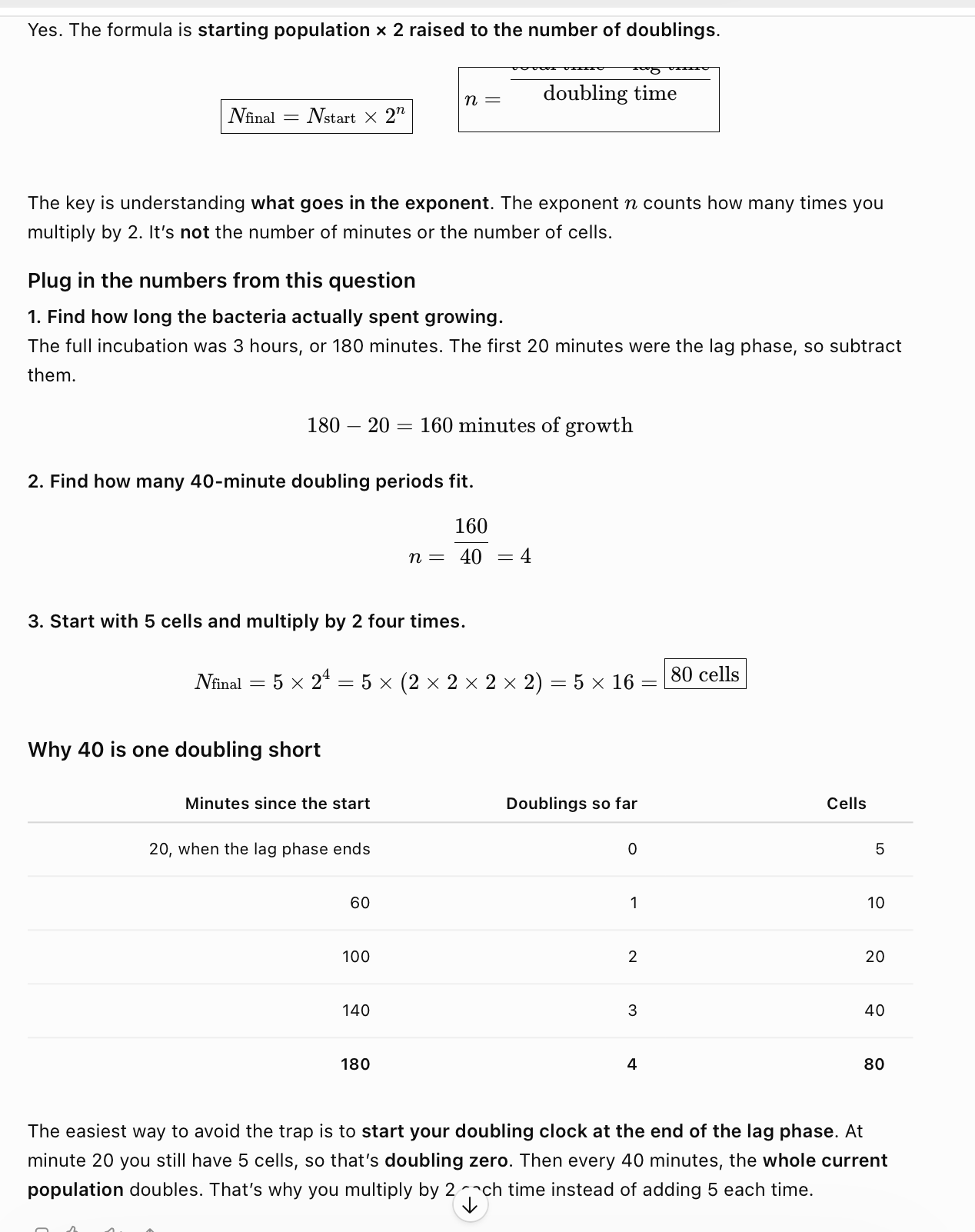
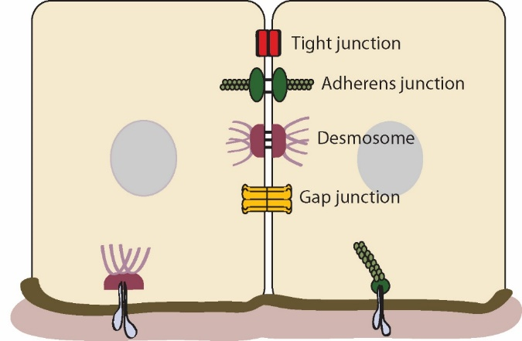
BActerial exponențial; growth (binary fission) formula:

ex:

MCAT shortcut: Subtract the lag time first, then divide by the doubling time. Each doubling means multiply the current population by 2.

C. 80 cells. The bacteria double four times after the lag phase.

  1. Convert the total time. 3 hours = 180 minutes.

  2. Subtract the lag phase. For the first 20 minutes, the bacteria are adjusting to their new environment, so we don’t count that time toward doubling. That leaves 180 − 20 = 160 minutes of growth.

  3. Count the doublings. They double every 40 minutes, so 160 ÷ 40 = 4 doublings.

5 → 10 → 20 → 40 → 80

Why 40 was tempting: 40 cells is where you land after three doublings, at minute 140. There’s still one more 40-minute block before the full 180 minutes are up.
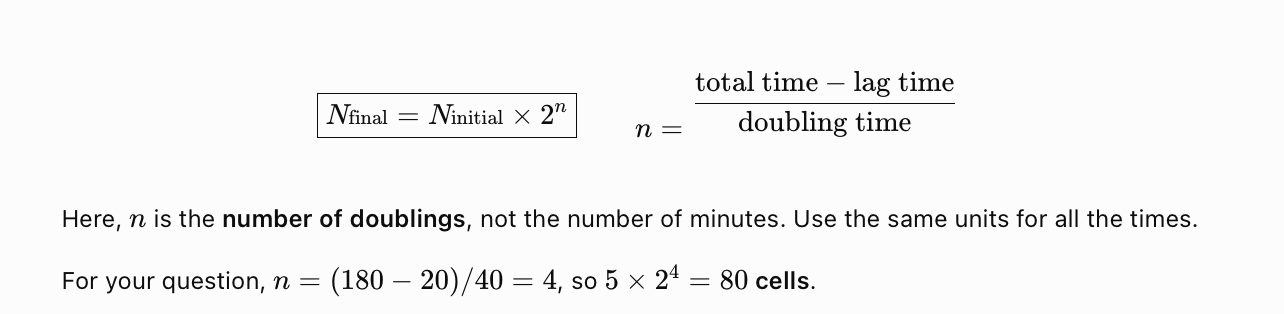
<p><strong>MCAT shortcut:</strong><span> Subtract the lag time first, then divide by the doubling time. Each doubling means </span><strong>multiply the current population by 2</strong><span>.</span></p><p><strong>C. 80 cells.</strong> The bacteria double <strong>four times</strong> after the lag phase.</p><ol><li><p><strong>Convert the total time.</strong> 3 hours = 180 minutes.</p></li><li><p><strong>Subtract the lag phase.</strong> For the first 20 minutes, the bacteria are adjusting to their new environment, so we don’t count that time toward doubling. That leaves <strong>180 − 20 = 160 minutes</strong> of growth.</p></li><li><p><strong>Count the doublings.</strong> They double every 40 minutes, so <strong>160 ÷ 40 = 4 doublings</strong>.</p></li></ol><p><strong>5 → 10 → 20 → 40 → 80</strong></p><p><strong>Why 40 was tempting:</strong> 40 cells is where you land after <strong>three</strong> doublings, at minute 140. There’s still one more 40-minute block before the full 180 minutes are up.</p><p></p>
83
New cards
<p>Desmosomes vs Tight junctions vs Gap junctions</p>

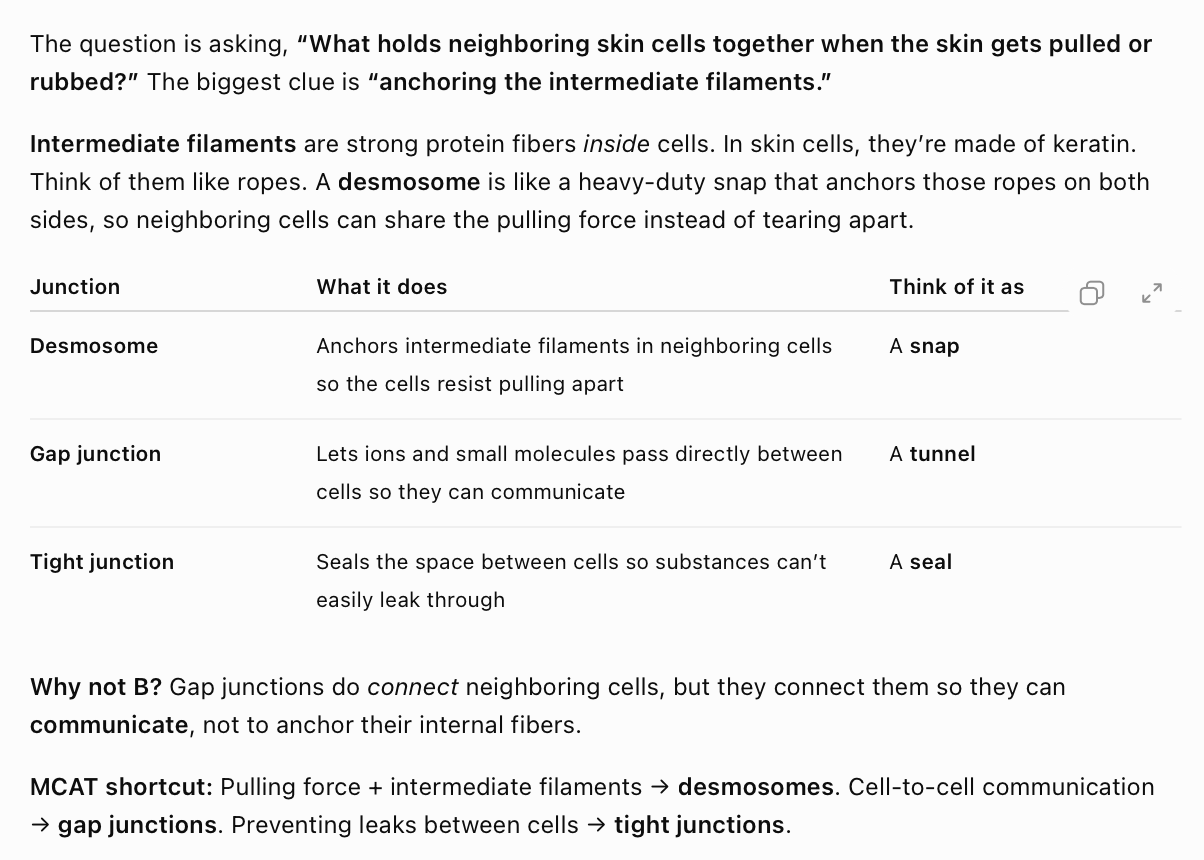
Desmosomes vs Tight junctions vs Gap junctions

desmosomes: Anchors intermediate filaments in neighboring cells, helping them resist being pulled apart (prevents cells from being pulled apart)

Each skin cell has tough fibers inside it called intermediate filaments. Think of them like ropes. A desmosome is like a strong snap that grips the ropes inside both cells. When you rub or stretch your skin, those snaps help keep the cells together.

  • Desmosome = snap. Holds cells together when they’re pulled.

  • Gap junction = tunnel. Lets small things pass from one cell to another.

  • Tight junction = seal. Stops things from leaking between cells.

The giveaway: “Anchors intermediate filaments in neighboring cells” → desmosome.
<p><span>desmosomes: Anchors </span><strong>intermediate filaments</strong><span> in neighboring cells, helping them resist being pulled apart (prevents cells from being pulled apart)</span></p><p>Each skin cell has tough fibers inside it called <strong>intermediate filaments</strong>. Think of them like ropes. A <strong>desmosome</strong> is like a strong snap that grips the ropes inside <strong>both</strong> cells. When you rub or stretch your skin, those snaps help keep the cells together.</p><ul><li><p><strong>Desmosome = snap.</strong> Holds cells together when they’re pulled.</p></li><li><p><strong>Gap junction = tunnel.</strong> Lets small things pass from one cell to another.</p></li><li><p><strong>Tight junction = seal.</strong> Stops things from leaking <em>between</em> cells.</p></li></ul><p><strong>The giveaway:</strong> “Anchors intermediate filaments in neighboring cells” → <strong>desmosome</strong>.</p>
84
New cards

Cell types tissues and organs (IMPORTANT) MEMORIZE
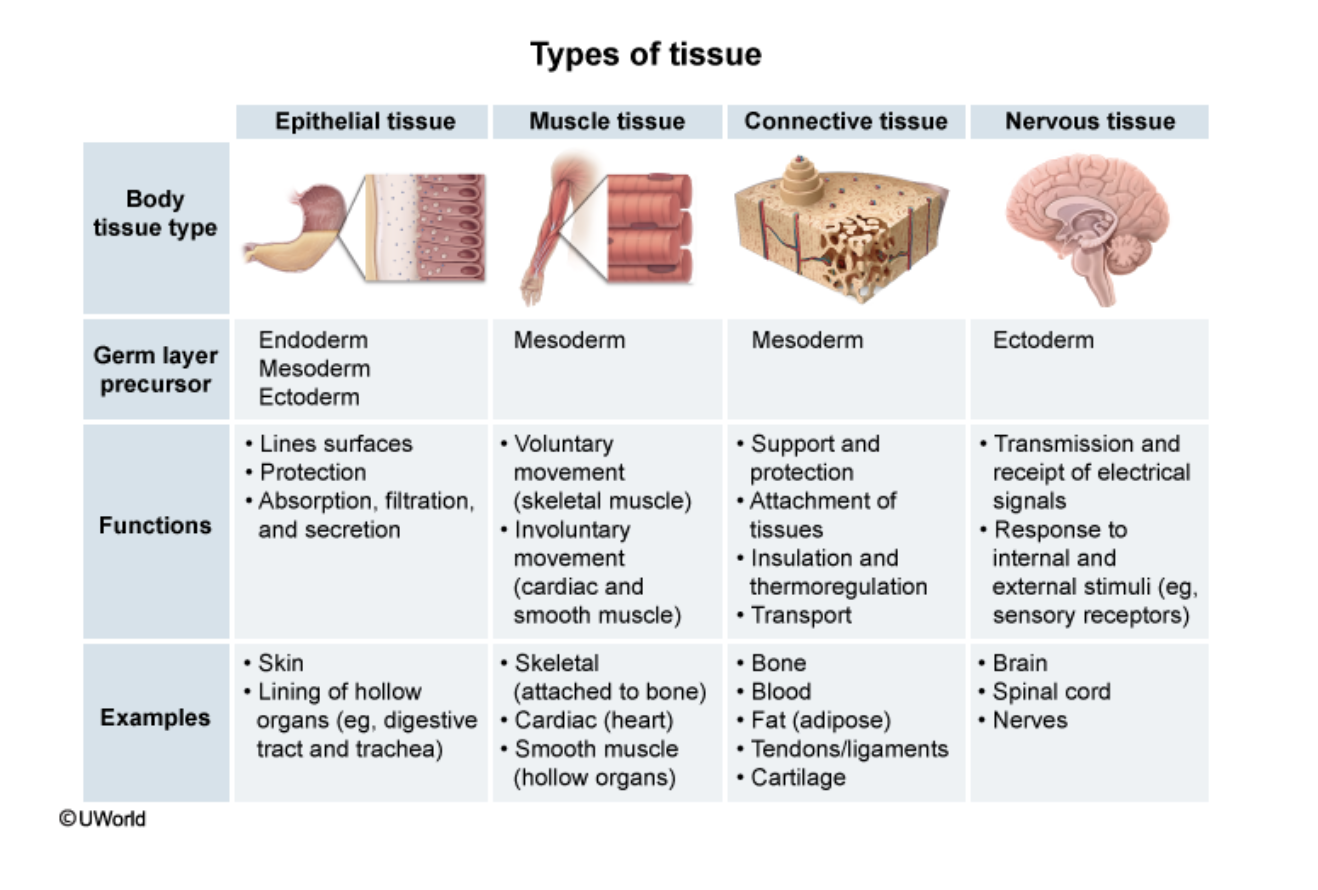
knowt flashcard image
85
New cards
<p>Desmosomes</p>

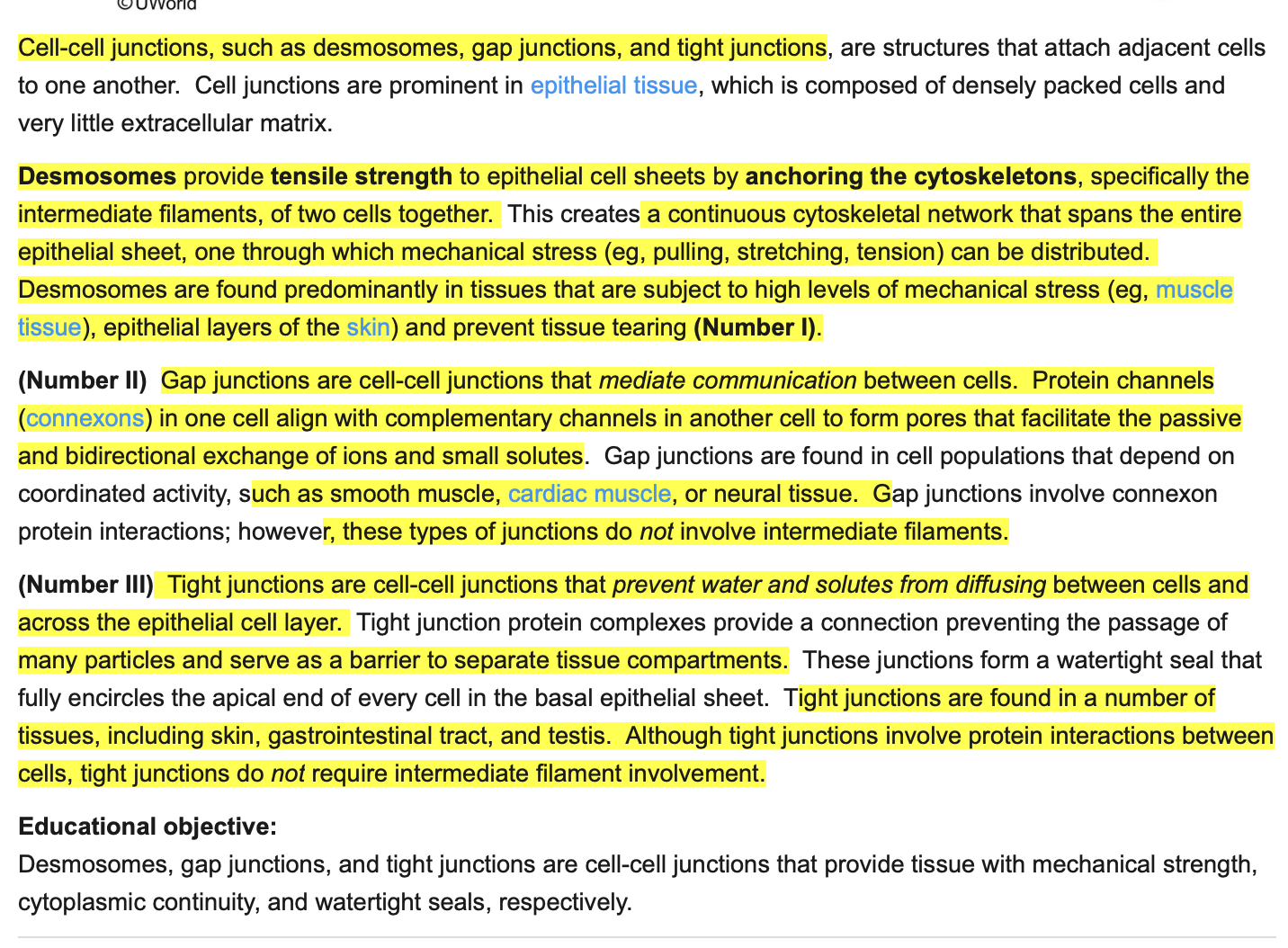
Desmosomes

-involve intermediate filaments as they use them to anchoring cytoskeletons between cells

-present in cells taht undergo a lot of mechanical stress bc it keeps cells together and redistributes the pulling so that cells share it and dont tear apart

<p>-involve intermediate filaments as they use them to anchoring cytoskeletons between cells </p><p>-present in cells taht undergo a lot of mechanical stress bc it keeps cells together and redistributes the pulling so that cells share it and dont tear apart</p><p></p>
86
New cards
<p>Plasmid &amp; restriction enzymes: question 11 set #2 (BIO UWORLD cup 1)- HARD question</p>

Plasmid & restriction enzymes: question 11 set #2 (BIO UWORLD cup 1)- HARD question

-here restriction enzymes cut both the plasmid = make space for insert gene

and also cut the gene at palindrome areas but resulted in sticky ends/overhangs which are the ones we see on each side of gene in answer choices

-note:

even though in figure 1 of passage it showed where plasmid cut we see that we can assume ECORI to cut and whatever is right to its cut should be part of the gene insert

and for Xhol we see and assume taht whatever is left of it should be part of gene insert so when we look at what bases of sticky ends of cldnk gene insert will be kept and cut we have to keep these positions of what is and what is not kept in mind

ECORI= everything right of cuts kept

XHol= everything left of cut will be kept

<p>-here restriction enzymes cut both the plasmid = make space for insert gene</p><p>and also cut the gene at palindrome areas but resulted in sticky ends/overhangs which are the ones we see on each side of gene in answer choices</p><p>-note:</p><p>even though in figure 1 of passage it showed where plasmid cut we see that we can assume ECORI to cut and whatever is right to its cut should be part of the gene insert</p><p>and for Xhol we see and assume taht whatever is left of it should be part of gene insert so when we look at what bases of sticky ends of cldnk gene insert will be kept and cut we have to keep these positions of what is and what is not kept in mind</p><p>ECORI= everything right of cuts kept</p><p>XHol= everything left of cut will be kept </p>
87
New cards
<p>Plasmid how many bases are cut</p>

Plasmid how many bases are cut

knowt flashcard image
88
New cards

Ways for bacteria get genes or DNA without reproducing?

1) transformation: bacteria takes up DNA from environment or takes up plasmid

2) conjugation: passing DNA from cell to cell via direct contact

3) transduction: virus inserts DNA into bacteria

<p>1) transformation: bacteria takes up DNA from environment or takes up plasmid</p><p>2) conjugation: passing DNA from cell to cell via direct contact</p><p>3) transduction: virus inserts DNA into bacteria</p>
89
New cards

Microarray & Hybrodization meanings

NOte: MICROARRAYS not just for binding DNA they can also be made/designed to bind mRNA if that’s what the experiment is testing for


Hybridized= paired bases

<p>NOte: MICROARRAYS not just for binding DNA they can also be made/designed to bind mRNA if that’s what the experiment is testing for </p><p></p><p>Hybridized= paired bases</p>
90
New cards

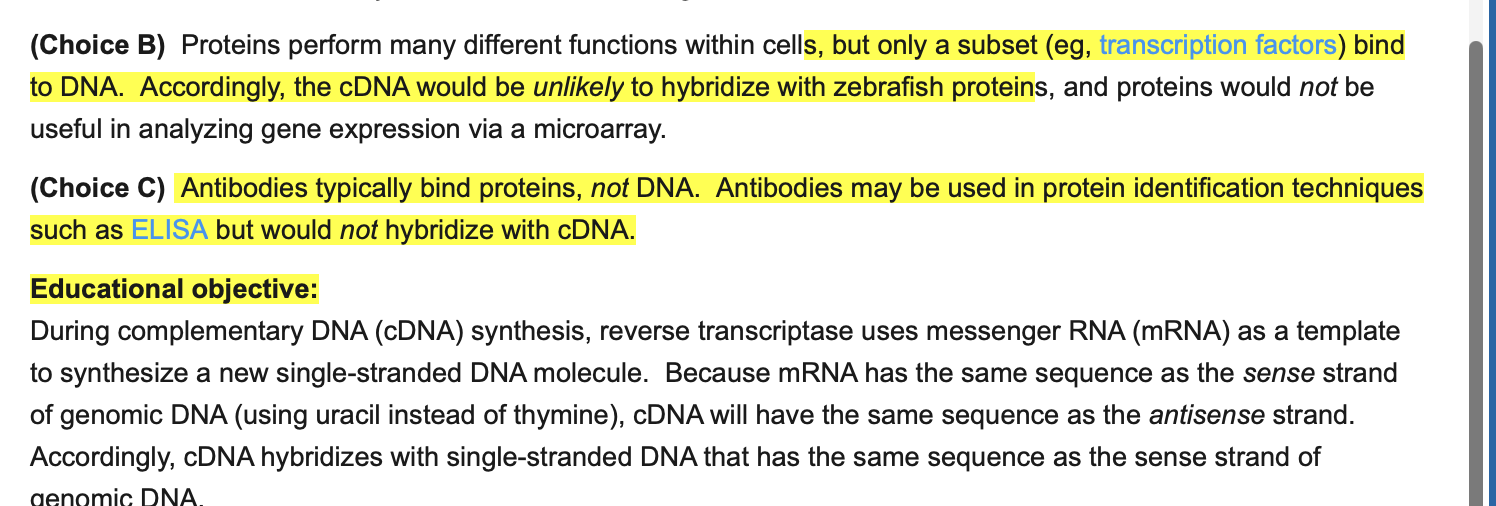
What can antibodies and proteins bind to? can they bind to DNA?

-antibodies: can only bind to proteins ex: ELISA technique

-proteins: usually CANNOT bind to DNA but only Transcription factors (ONLY proteins that can bind to DNA and only during transcription)
<p>-antibodies: can only bind to proteins ex: ELISA technique</p><p>-proteins: usually CANNOT bind to DNA but only Transcription factors (ONLY proteins that can bind to DNA and only during transcription)</p>
91
New cards

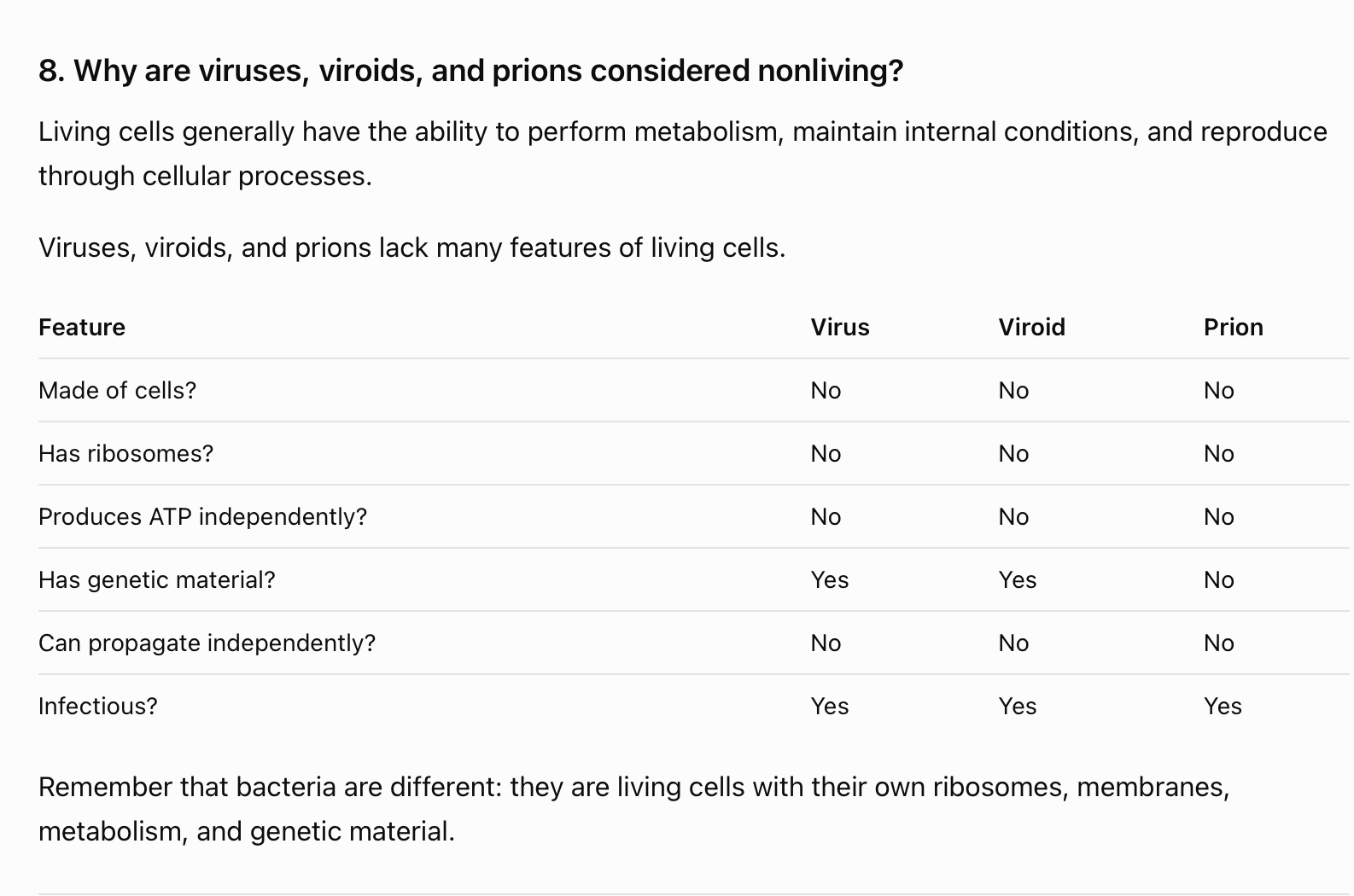
Viruses, viroids and prions

knowt flashcard image
92
New cards
93
New cards
94
New cards
95
New cards
96
New cards
97
New cards