COGS 160 Midterm_Mary Boyle
 Call Kai
 Learn
 Practice Test
 Spaced Repetition
 Match
 Flashcards
 Knowt Play
1/90

There's no tags or description
Looks like no tags are added yet.
91 Terms
Counterintuitive Behavior of Social Systems (Jay Forrester, 1971)
-Social problems are often caused by larger feedback loops, not one obvious cause.
-Three Important Characteristics:
1. Apparent cause may also be a symptom: The obvious cause may come from a larger system. Ex: Stress causes both poor sleep and cravings.
2. Best intervention may be unexpected: Treating visible symptoms may not fix the underlying problem. Ex: Resisting chips won't fix stress or lack of sleep.
3. Short-term gains may have long-term costs: Immediate fixes may worsen future problems. Ex: Staying up late to get more work done → more fatigue tomorrow.
Where is it best to intervene in the stress–sleep–craving cycle?
(S2)
-Intervene at the underlying cause, such as stress or lack of sleep, and not resisting cravings.
Sleep Deprivation Study
-Sleep deprivation ↑ cravings for high-calorie foods due to ↓ anterior cingulate (decision-making) and ↑ amygdala (emotion/reward response), NOT increased hunger.
Gerald Reaven (1988):
Introduced Syndrome X (metabolic syndrome), proposing that insulin resistance as a common underlying cause of multiple metabolic abnormalities, while medicine treated them as separate conditions.
Five risk factors of metabolic syndrome
(S2)
1. Large waistline: Increased abdominal/visceral fat
2. High blood pressure: Increased pressure in blood vessels
3. High fasting glucose: Elevated blood sugar after fasting
4. High triglycerides: Increased circulating fat
5. Low HDL (good cholesterol)
-Metabolic syndrome = Having at least 3/5 risk factors.
What does metabolic syndrome increase the risk of?
Type 2 diabetes, Cardiovascular disease (heart), Stroke
Insulin:
Hormone released by pancreatic beta cells that regulates blood glucose and promotes energy storage.
What Happens During Insulin Resistance?
-Tissues respond less to insulin → Pancreas releases MORE insulin to compensate.
-Early Stage: Insulin ↑ → Blood glucose stays normal.
-Later Stage: Insulin compensation fails → Blood glucose ↑.
-Important: Normal fasting glucose ≠ Normal insulin sensitivity.
Normal Insulin Response After Eating
(S2)
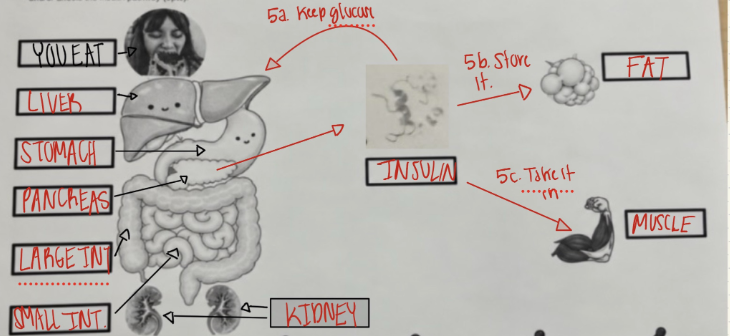
Eat food → Digestion → glucose enters bloodstream → blood glucose ↑. → Pancreatic beta cells release insulin → insulin signals different tissues to respond:
(a) Liver: “Hold on to glucose” → Store as glycogen and reduce glucose release
(b) Fat cells (adipocytes): “Take it in” → Store as energy and suppress lipolysis (fat breakdown).
(c) Muscles (myocytes): “Take it in” → Take up glucose for energy.
Important Cell Types (Adipocyte, Beta Cell, Hepatocyte, Myocyte):
- Adipocyte: Fat tissue → Stores fat and releases fatty acids.
-Beta Cell: Pancreas → Releases insulin.
-Hepatocyte: Liver → Stores and releases glucose.
-Myocyte: Muscle tissue → Takes up glucose.
Reaven's Study: BMI vs. Insulin Resistance:
-BMI alone does NOT determine insulin sensitivity.
-Insulin-sensitive: Need LESS insulin to control glucose, even at higher BMI.
-Insulin-resistant: Need MORE insulin to compensate, even when glucose looks normal.
-Insulin-resistant individuals with lower BMI had x2 the insulin response than insulin-sensitive individuals with higher BMI.
High Fasting Glucose:
(S2)
-Liver becomes insulin resistant → continues releasing glucose overnight.
-Muscles become insulin resistant → Glucose uptake ↓ after meals.
High Triglycerides & Low HDL
(S2)
-Adipocytes become insulin resistant → ↑ Lipolysis (fat breakdown) → Adipocytes leak fatty acids into blood → Liver produces more triglycerides → HDL ↓.
High Blood Pressure:
(S2)
-Kidneys remain insulin sensitive → Respond to elevated insulin → Sodium retention ↑ → Water retention ↑ → Blood pressure ↑.
-Kidneys do NOT need to become insulin resistant to retain more sodium.
Large Waistline:
(S2)
-Visceral fat ↑ (fat around organs) → Fatty acids delivered to liver ↑ → Insulin resistance worsens.
LDL:
(S2)
Insulin resistance increases # of small, dense LDL particles, increasing cardiovascular disease risk.

Labeling Diagram:
From pancreas to insulin arrow: Pancreatic beta cells produce and release insulin when blood glucose rises.
Subcutaneous vs Visceral Fat:
-Subcutaneous Fat: Fat beneath the skin (can be pinched); hips and thighs are safer storage areas.
-Visceral Fat (VAT): Fat surrounding abdominal organs; Associated with inflammation, insulin resistance, and metabolic dysfunction.
Main Idea about The Eight Glasses of Water Myth
-Recommendations from an authoritative figure (Fredrick J. Stare) are not necessarily supported by strong scientific evidence.
Plasma Osmolality and the Key Point:
-Plasma Osmolality: Measures the concentration of dissolved particles in blood (mainly sodium). Water loss → ↑ osmolality.
-Key Point: Feeling thirsty does NOT mean dehydration because it is within normal plasma osmolality
Do coffee and tea contribute to hydration?
(S2)
Yes
Dehydration:
(S2)
When the body loses more water than it takes in.
Vasopressin
Hormone that helps kidneys conserve water. Increased section = increased water retention
How Funding Influences Scientific Research
-Fredrick J. Stare concluded that dietary carbohydrates (sugar) had minimal impact on cardiovascular disease compared to fat and cholesterol but did not disclose industry funding
-Main Idea: Industry funding can influence how scientific evidence is interpreted and presented.
Seven Countries Study:
(S2)
Ancel Keys emphasized dietary fat and cholesterol as contributors to heart disease across 7 countries
John Yudkin:
Emphasized sugar as a contributor to heart disease and diabetes.
Dietary guidelines:
(S2)
Government recommendations based on scientific evidence to promote healthy eating and reduce disease risk.
Glucose vs. Fructose
-Both have the formula C₆H₁₂O₆ and provide energy for cells. Glucose has an aldehyde group while fructose has a ketone group
Photosynthesis:
(S2)
6CO₂ + 6H₂O + light energy → C₆H₁₂O₆ + 6O₂
Simple sugar:
-One or two sugar molecules.
-Monosaccharide: One sugar molecule. Ex: glucose, fructose, and β-glucose.
-Disaccharide: Two sugar molecules linked by a glycosidic bond. Ex: sucrose (glucose + fructose) and maltose (glucose + glucose).
Complex Sugar (Polysaccharide):
-Many sugar molecules linked together. Ex: Starch, cellulose, and glycogen.
Non-sugar:
-Not sugar or carbohydrates. Ex: Carbon dioxide (CO₂); amylase, and maltase (enzymes).
α-glucose vs. β-glucose:
-α-glucose: C1 → OH down, H up.
-β-glucose: C1 → OH up, H down.
-Determines how glucose links together and if digestible to humans.
Sucrose (table sugar):
(S2)
-Glucose + Fructose → Sucrose + H₂O
-Forming sucrose releases H₂O (dehydration synthesis), while metabolizing (breaking down) sucrose requires H₂O (hydrolysis).
Determine whether each of the following is a simple sugar, complex sugar, or non-sugar.
1. Fructose
2. Polysaccharide
3. Carbon dioxide (CO₂)
4. β-Glucose
5. Amylase
6. Starch
7. Cellulose
8. Monosaccharide
9. Sucrose
10. Maltase
1. Fructose – Simple sugar
2. Polysaccharide – Complex sugar
3. Carbon dioxide (CO₂) – Non-sugar
4. β-Glucose – Simple sugar
5. Amylase – Non-sugar
6. Starch – Complex sugar
7. Cellulose – Complex sugar
8. Monosaccharide – Simple sugar
9. Sucrose – Simple sugar
10. Maltase – Non-sugar
Starch vs. Cellulose (Amylose, Amylopectin, Cellulose) —> Determine Linkage, Shape, Function, and if digestible to humans?

Why can humans digest starch and glycogen but not cellulose?
-Humans can digest starch and glycogen (α-links) but not cellulose (β-links) because humans lack enzymes that break β-linkages.
Why can cows digest cellulose?
By using microbes in their gut that break β-linkages.
Maltose:
A disaccharide made of two α-glucose sugar linked together.
How Does Starch Digestion Work?
(S2)
1. Mouth: Salivary amylase breaks starch → maltose (two α-glucose molecules).
2. Stomach: Stomach acid stops amylase, so starch digestion pauses.
3. Small intestine: Bicarbonate neutralizes acid; Pancreatic amylase continues breaking starch → maltose.
4. Small intestine lining (brush border): Maltase breaks maltose → two α-glucose molecules.
5. Bloodstream: Glucose enters the blood and travels through the portal vein → liver.
Amylase:
Salivary and pancreatic forms break α-links in starch but not β-links in cellulose.
What Makes Starch Digest Faster or Slower?
(S2)
1. Fast-digesting starch → quicker rise in blood glucose
-More branches: More enzyme access points.
-Processed, ground, or puffed: Exposes starch to enzymes.
2. Slow-digesting starch → slower rise in blood glucose.
-Whole grains, intact plant cells, or fiber: Limit enzyme access.
-Cooked then cooled: Starch reorganizes, making it harder to digest.
-Acarbose: Inhibits gut-lining enzymes, but reduces post-meal glucose spikes.
Food Comparisons: Which one is faster to digest?
1. Instant mashed potatoes vs. whole-grain bread
2. Whole cooked lentils vs. lentil-flour pasta
3. Puffed rice cakes vs. whole cooked barley
4. Hot rice vs. cooked, cooled, and reheated rice
5. White bread vs. white bread with acarbose
1. Instant mashed potatoes — Processing exposes starch.
2. Lentil-flour pasta — Grinding breaks plant cells.
3. Puffed rice cakes — Puffing exposes starch.
4. Hot rice — Cooling reorganizes starch, slowing digestion.
5. White bread alone — Acarbose inhibits digestive enzymes.
How does vinegar slow carbohydrate breakdown?
(updated)
(S2)
Vinegar contains acetic acid, which may slow gastric emptying and reduce blood glucose spikes after high-GI meals (Digest faster but causes rapid blood glucose spike)
Type 1 vs 2 Diabetes:
(S2)
-Type 1: Autoimmune destruction of pancreatic β-cells → little or no insulin production.
-Type 2: Insulin resistance + β-cell dysfunction → high blood glucose.
Glucose Storage and Transport
(S2)
-Glucose enters blood via intestine or liver and is used by the brain, muscles, and fat or stored as glycogen in the liver and muscles
Glycogen vs triglycerides:
(S2)
-Both store energy, but glycogen = short-term, while triglycerides = long-term.
Fasting vs. After Eating
-Fasting: Low insulin → Liver releases stored and newly made glucose; muscle and fat take up less glucose.
-After Eating: High insulin → Muscle and fat take up more glucose; liver stores glycogen and releases less glucose.
What Triggers Insulin Release?
(S2)
1. Cephalic Phase: Seeing, smelling, tasting, or chewing food activates the vagus nerve to release insulin before blood glucose rises.
2. Incretin Response: Food entering the gut releases GLP-1 and GIP, stimulating insulin secretion.
3. Glucose Sensing: Rising blood glucose increases ATP production in pancreatic β-cells, triggering insulin release.
How Do Pancreatic Beta Cells Release Insulin?
(S2)
1. Glucose enters pancreatic beta cells through GLUT transporters.
2. Glucose undergoes glycolysis, and mitochondria produce ATP (adenosine triphosphate).
3. Increased ATP closes KATP (ATP-sensitive potassium) channels, reducing K⁺ outflow.
4. Reduced K⁺ outflow causes depolarization (inside becomes less negative).
5. Depolarization opens voltage-gated calcium channels
6. Ca²⁺ enters the cell, triggering insulin vesicles to fuse with the membrane.
7. Insulin is released via exocytosis, promoting glucose uptake (with muscle & fat) and liver storage, which lowers blood glucose.
How Is Insulin Made?
-Proinsulin → Insulin + C-peptide.
-Removing C-peptide leaves the A- and B-chains, forming insulin.
-Insulin and C-peptide are released equally, so C-peptide measures pancreatic insulin production.
Insulin Secretion Phases. What happens if the first phase is loss?
(S2)
-First Phase: Fast burst release of stored insulin after glucose rises.
-Second Phase: Slower, sustained insulin release while glucose remains elevated.
-Loss of First-Phase: Causes larger post-meal glucose spikes and may indicate early β-cell dysfunction.
Sulfonylureas (sulfur-nah-leer-re-is): How Do They Increase Insulin Release? What happens if you skip meals?
(S2)
-Sulfonylureas: Diabetes drugs that close KATP channels, increasing insulin release even when glucose is low.
-Skipping meals: Excess insulin can cause hypoglycemia (low blood glucose), leading to dizziness, sweating, or fainting.
Vagotomy (Vah-got-the-me)
(S2)
Cutting the vagus nerve reduces food-triggered cephalic-phase insulin release, but rising blood glucose and gut hormones (GLP-1 and GIP) can still stimulate insulin secretion.
Fat vs. Glycogen. Which one is better for long-term storage?
(S2)
▪ Fat (triglyceride): Nonpolar, hydrophobic, stored with little water, and 6× more energy-dense than hydrated glycogen.
▪ Glycogen: Polar, hydrophilic, stored with water, and made of glucose linked by α-bonds (like starch)
▪ Fat is better for long-term storage because adults store more energy as fat, while liver and muscles store only ~2,000 kcal of glycogen.
Glucagon:
(S1)
(S2)
Hormone released by pancreatic α-cells and signals the liver and muscle to release glucose
β-Cell Dedifferentiation and Rest
(S2)
-Chronic overnutrition increases insulin demand and β-cell stress, potentially causing dedifferentiation (loss of β-cell identity, producing, or releasing insulin). Fasting reduces insulin demand, allowing β-cells to rest.
Fasting-Mimicking vs Alternate-Day Diet:
(S2)
-Fasting-Mimicking: Low-calorie diet mimicking fasting.
-Alternate-Day Fasting: Alternating fasting and eating days.
Wang et al. (2008)
(S2)
-External insulin supplements the pancreas’s own endogenous insulin, reducing β-cell workload in patients with Type 2 Diabetes (T2D) by improving β-cell function and diabetes remission.
Cheng et al. (2017):
(S2)
-Repeated fasting-refeeding cycles activated β-cell regeneration genes of Ngn3 in mice, with β-cell numbers decreasing during fasting and recovering within ~3 days of refeeding.
What are the two mouse models used in Cheng's study?
(S2)
▪ STZ mice (T1D): Streptozotocin destroys β-cells, causing insulin deficiency.
▪ db/db mice (T2D): Defective leptin receptors cause obesity and diabetes, but most humans with T2D have functional leptin receptors.
What is autophagy (ah-toph-fa-g), and why is it important? (Liu)
- Autophagy breaks down and recycles cellular materials during nutrient deprivation, helping newborns survive the transition from placental nutrients to feeding.
What was the significance of Liu et al. (2017)?
(S2)
-Alternate-day fasting protected β-cells in normal mice but increased β-cell death in autophagy-deficient mice, showing that autophagy is necessary for fasting's protective effects.
Castelblanco et al. (2025):
(S2)
-Alternate-day fasting in KATP-defective diabetic mice restored autophagy and β-cell identity, lowering blood glucose.
How Does Adiposity Affect Metabolism?
-Excess body fat increases fatty acid accumulation in the liver and muscles, worsening insulin resistance. Weight loss can improve insulin sensitivity and blood glucose regulation.
Time-Restricted Feeding (TRF; Sutton) and Intermittent Fasting (Yang):
(S2)
-Time Restricted Feeding (TRF, Sutton): Early 6-hour eating window improved insulin sensitivity and β-cell function without weight loss.
-Intermittent Fasting (Yang): Cycles of 5 low-calorie days (~840 kcal/day) and 10 normal days caused weight loss and improved T2D remission.
Why Is Weight Loss a Confounding Factor?
-Weight loss independently improves insulin sensitivity, making it difficult to distinguish benefits from meal timing (Sutton, without weight loss) versus reduced body fat (Yang, with weight loss).
What keeps blood glucose steady?
(S2)
-During fasting, the liver maintains blood glucose by releasing stored glucose and producing new glucose.
-Mechanism: Adipose tissue breaks down triglycerides into fatty acids and glycerol (lipolysis), and the liver converts glycerol into glucose (gluconeogenesis).
Glycogenolysis:
(S2)
Breakdown of stored glycogen into glucose; occurs in liver and muscle
Acetylcholine vs Cortisol:
(S2)
-Acetylcholine: Fast-acting neurotransmitter that regulates nerve signals, heart rate, and digestion.
-Cortisol: Slow-acting stress hormone that increases blood glucose for prolonged energy needs.
Gluconeogenesis:
(S2)
Production of new glucose from non-carbohydrate sources, such as glycerol and amino acids.
Lipolysis:
(S2)
Breakdown of triglycerides in adipose tissue into fatty acids and glycerol.
Hans Selye’s Rat Experiment (1936):
(S2)
Different stressors (cold, injury, toxins) can produce a common physiological stress response.
Three Way Stress Response can be Triggered:
(S2)
1. Circadian Rhythm: Internal clock raises cortisol before waking.
2. Learned Cues: Past experiences trigger an early stress response.
3. Imagination: Thinking about stress triggers a response without actual danger.
Somatic vs Autonomic Nervous System:
(S2)
-Somatic Nervous System: Controls voluntary movements. Ex: arm movement
-Autonomic Nervous System (ANS): Controls involuntary functions. Ex: heart rate and digestion via sympathetic and parasympathetic nervous systems.
Sympathetic vs Parasympathetic Nervous System (SNS):
(S2)
-Sympathetic Nervous System (SNS): Fight-or-flight response that ↑ heart rate and blood glucose while ↓ digestion to prepare for action.
-Parasympathetic Nervous System (PSNS): Rest-and-digest response that ↓ heart rate, ↑ digestion, and promotes energy storage.
SAM vs HPA Axis:
(S2)
-SAM Axis (Sympathetic-Adrenal-Medullary): Fast, short-lived response (seconds); releases adrenaline → ↑ heart rate and blood glucose, ↓ digestion.
-HPA Axis (Hypothalamic-Pituitary-Adrenal): Slower, prolonged response (minutes/hours); releases cortisol → ↑ blood glucose, maintains energy, and suppresses inflammation.
Acute vs Chronic:
(S2)
-Acute: Short-term stress response involving adrenaline and cortisol.
-Chronic: Prolonged stress response that increases allostatic load.
Effects of Adrenaline (Acute Stress) on Blood Glucose:
(S2)
Rapidly increase blood glucose via glycogenolysis, reduced insulin release, and lipolysis while slowing digestion.
Effects of Cortisol (Acute & Chronic Stress) on Blood Glucose:
(S2)
Increase blood glucose via gluconeogenesis, lipolysis, and reduced muscle insulin sensitivity; prolonged exposure increases abdominal fat storage and muscle protein breakdown.
Why is morning cortisol beneficial?
-Raises blood glucose after overnight fasting to fuel the brain and muscles.
How should an insulin pump respond to morning cortisol/illness?
(S2)
-By anticipating increased blood glucose and adjusting insulin delivery to maintain stable levels.
How should an insulin pump respond to a haunted house?
(S2)
-Adrenaline ↑ blood glucose, so the pump should adjust insulin as stress fades.
Homeostasis vs Allostasis vs Allostatic Load:
(S2)
-Homeostasis: Maintain internal stability despite changes.
-Allostasis: Maintain stability by adjusting the body's responses to stressors.
-Allostatic Load: Wear and tear from repeated or prolonged stress responses, causing a slower recovery.
Four Types of Allostatic Load:
(S2)
-Repeated Hits: Frequent stressors with little recovery time (e.g., multiple exams).
-Failed Habituation: Failure to adapt to the same repeated stressor, keeping cortisol ↑ (e.g., weekly quiz anxiety).
-Delayed Shutdown: Stress response continues after the stressor ends (e.g., stressed after an exam).
-Inadequate Response: Weak stress response causes ↑ inflammation (e.g., insufficient cortisol).
Seeman et al. (1997) Study:
(S2)
-Higher allostatic load predicted cardiovascular disease and cognitive/physical decline in older adults (70-79 years).
-10 biomarkers: Systolic/diastolic blood pressure, waist-to-hip ratio, total cholesterol/HDL ratio, HDL, HbA1c, urinary cortisol, epinephrine, norepinephrine, and DHEA-S
Acute Inflammation:
(S2)
-Short-term response to injury or infection. Macrophages detect danger signals (DAMPs/PAMPs) and release inflammatory cytokines (TNF-α, IL-1β, IL-6).
Chronic Low-Grade Inflammation:
(S2)
-Persistent, low-level inflammation caused by metabolic stress (excess fatty acids or glucose), leading to prolonged cytokine release and metabolic dysfunction
Three Types of Adipose Tissue
(S1)
(S2)
-Brown Adipose Tissue (BAT): Burns energy to generate heat
-Visceral WAT: White fat around organs; ↑ increases metabolic disease risk.
-Subcutaneous WAT: White fat beneath the skin; stores energy with lower metabolic risk.
-WAT = white adipose tissue
M1 vs M2 Macrophages:
(S1)
(S2)
-M1 Macrophages: Pro-inflammatory cells common in obese fat tissue that ↑ cytokines (TNF-α, IL-1β).
-M2 Macrophages: Anti-inflammatory cells common in lean fat tissue that release IL-10 to ↓ inflammation and promote repair.
Hyperplasia vs Hypertrophy
(S1)
(S2)
-Hyperplasia: ↑ Fat cell number → Safer fat storage, ↓ inflammation, ↑ insulin sensitivity.
-Hypertrophy: ↑ Fat cell size → ↑ Fatty acid release, ↑ inflammation, ↓ insulin sensitivity.