cognition exam 3 :/
 Call Kai
 Learn
 Practice Test
 Spaced Repetition
 Match
 Flashcards
 Knowt Play
1/178

There's no tags or description
Looks like no tags are added yet.
179 Terms
conceptual knowledge
Lets you recognize objects and events
Makes inferences and predictions
How to know where we are, how to act, what to expect, etc
Made up of all our concepts
knowledge that enables us to recognize objects and events and to make inferences about their properties, made up of our concepts, how we know where we are, how to act what the expect etc..
two features within concepts
Attributes / Features (physical): are all of the physical qualities of an item or scene
Serves a purpose of recognizing what the object is. It is a dog because it is furry and has a tail.
Non-Physical Similarity: helps us make inferences and predictions
Dogs eat dog food, they might bark at people
role of non feature based similarity
Physical similarity alone does not help us make inferences or predictions
How do different looking items end up in the same group?
Different breeds of dogs, they are still grouped together as dogs
How do similar looking items end up in different groups?
what are concepts
the mental representation of a class or individual; and categories of objects, events, and abstract ideas (feature and non feature information)
categorization
all examples or members of a concept
definitional approach to categorization
the idea that we can decide whether something is a member of a category by determining whether the object meets the definition of the category
image for categories, concepts, and exemplars

hierarchical organization of categories
If we go up, we say animals for dogs. Can include a bunch of different things.
structures concepts, data, or business roles into nested, tree-like levels of generality using an IS-A or class-inclusion relationship
superordinate (global) categories
Most general and abstract
“Musical instruments” are not “animals”
“Vehicles” are not “food”
Not many common/shared features (~3 features)
basic level
General name for the main types of a global level category
Most often used in language
Piano is a musical instrument, or “my car” (you don’t say you are going to your convertible)
Decent amounts of shared/common features (~9 features)
superordinate (specific)
Specific name for items in a category
“Grand piano is a type of piano” “my car is a Nissan”
Contains concepts that are most similar in features (~10-11 features)
organization of categories
Superordinate (global)
Are the most general and abstract
Basic
Most often used in language
“Piano” as a type of musical instrument
They might be the most accessible to us.
Subordinate (specific)
Concepts most similar in features
different types of categories (5)
attributes/entity
Thematic and taxonomic
Relational
Ad hoc
Abstract coherent
taxonomic category
some things are similar in physical attributes and also on a semantic level.
The category of fruit, they look different or sometimes they look a little similar, but there is some similarity at the semantic level. Freshwater fish, they look similar, but the meaning is being shared. Pretty common.
thematic
Whether things are co occuring together, same time and place
In a classroom, desk, chair, monitor. They all look different from each other, but they are grouped together and go with the theme of a classroom.
Or a beach, sand, shovel, water, what can you find at the beach
relational/role
Play the same role
Like wallpaper, mask, pot lid, jar cover, things that cover something else. They have the same role
goal derived/ad hoc
Going on a trip, what do I need to pack? Help achieve some goal. Helps you to take a trip
concepts & categories (repeated)
Concepts: Feature and non-feature information
Categories: Items that share feature and non-feature information
Recognizing a category member grants access to conceptual information.
Categories are hierarchically organized to make this efficient.
Physical space, psychological space and perception, categorical perception
You are transforming physical info from the world into a representation, there are some distortions and changes.
Shephard's law of generalization
Distance in psychological space determines similarity.
Psychological distance increases, so psychological similarity decreases exponentially
categorical perception
Categorization changes our psychological space
A circle was paired with a shock. The circle will always predict a shock. They wanted to see what if we present a different circle.

categorization changes our psychological space, why?
Fear response to all items
Physically different items were treated similar
WHY?
Psychological similarity
That category of item elicits fear
Despite physical dissimilarity, all items determined similarities in psychological space
Category of fear generating circles
Once we have categories, our perceptual space of the exemplars seem more similar because you are psychologically grouping them together
categorical perception, what is it (within and between)
Category membership alters psychological similarity
Categorical perception – items within a category are more similar, and items in different categories are more different
Within category compression
Even though there are distant items, if they belong to the same category, our psychological space makes us think these things are much more similar to each other. If they belong to the same within category, there is a compression of these differences.
Between category expansion
When you have these items, they are kind of physically similar ( A B ) but one belongs to one category one belongs to another. Even though physical differences are not that different, but because they belong to a different category you would exaggerate the difference.
Categorical perception: speech categories
Speech sounds varying from da to ta in equal steps
People's perceptions of these sounds are categorical, not reflecting linear change in the physical dimension.
categorical frameworks (3)
classical/definitional view
Prototype model
Exemplar based model
classical definitional view (pros and cons as well)
Awarded category membership when the exemplar meets the definition of the category
Chair: pieces of furniture with 4 legs, back, seat, holds one person
Pros: simple, efficient
Cons: impossible or definition to include all members (dog with no leg)
Does not allow for variation or abstract thinking (chair leg variation)
Wittgenstein (1953) & Family Resemblance
believed that "family" members belong to the same category because they generally are found in similar places, and look, function, or are used similarly. this is a potential solution to the classic/ definitional view as it allows for variation
what do most people do
Most people do unidimensional sorting, only looking at one feature (shape, color)
NOT family resemblance
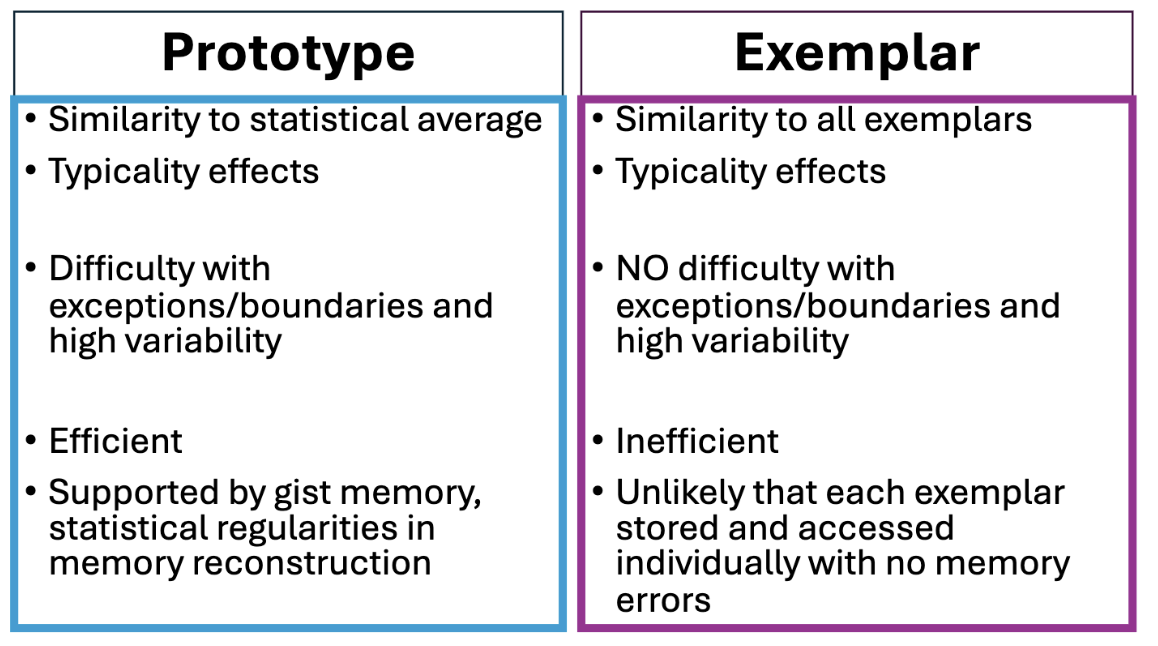
prototype based view, what is a prototype
Category membership is determined by comparing new item to the prototype of the category
Prototype: shares most features amongst category members
The statistical average of all current category members
Ideal member
Reference point
Can be an abstracted item
Comparing the new item to the prototype, I don't know what this item is but it is similar to this prototype. For this item I need to categorize, which one is most similar?
typicality (pbv)
degree to which a member resembles to prototype
typicality effects (3)
exemplar production, endorsement, and sentence verification
exemplar production
more typical items are listed earlier (when asked to list items in a category)
endorsement
having faster category membership verification for more typical items (ex: can quickly say a chicken is a bird, but can't say if a penguin is a bird as fast)
sentence verification
people are faster to verify more typical exemplars than less typical exemplars (ex answers yes faster to the question "is an apple a fruit" than to "is a pomegranate a fruit")
prototype model pros and cons
Pros: efficient categorization and representations and the typically effects
Cons: supports family resemblance despite evidence proving against it, how do you categorize things you've never seen before (exceptions), some categories (like games) do not seem to possess a prototypical structure due to such high variability, and surrounding context can influence the way certain items are classified
exemplar based model
Category membership is determined by comparing the new item to all known category members
Instead of a prototype as a reference point, all known exemplars serve as a reference point(s)
Representation not based on an abstracted summary
pros and cons for exemplar
Pros:
Accounts for typicality effects
More exemplars = more reference points = more typical
You will encounter more typical examples in your life, what you represent in your mind is all types of dogs you have seen, but in general because you encounter more typical looking dogs, you rep more instances of typical items in your category.
Accounts for exceptions
In your mind, you are remembering every single member you know in a category if you think about bird, but penguin and ostrich are in the bird category but they do not fly, but in our bird category we are storing exceptions that belong to the bird, we are remembering all of the members that we know belong.
Accounts for highly variable categories
You are storing every single different game type you know.
Cons:
High memory load, inefficient
Categorizing items at multiple levels?
Superordinate vs basic vs superordinate
Some categories are easier to learn than others
Slower at superordinate level
picture to visualize prototype vs exemplar
semantic network model (aka hierarchical semantic)
an approach to understanding how concepts are organized in the mind that proposes that concepts are arranged in networks and in a hierarchical manner (living things at the top, then plants and animals, then names of plants and animals)

what does the hierarchical organization of categories not explain?
How conceptual info is accessed via categories or how content across categories are related
collins: hierarchical semantic network model (components, hierarchical, property exceptions, and cognitive economy)
2 components
Node: category/concept
Edge: connection to properties and related category/concepts
Both physical and non physical information
Hierarchical: direction of the relationship exist
Cognitive economy: typically shared properties stored once, at higher node (top of hierarchy)
Most birds have wings, don’t have to repeat it
Property exceptions at lower nodes
Ostrich can’t fly, low node under birds bc they can’t fly
how do we access it?
Spreading activation
There is an activation to activate a particular concept, once it is activated, some neighboring concepts are also being activated.
Ex. gave a picture of a robin.
In your mind, robin is activated
Spreading across the related node near the robin. That activation spreads. Also activates the properties connected to the robin node (red breast, blue egg) and also the bird. The fact that the robin is a bird.
Spreads again to its neighboring ones. Bird is also connected to the concept of animal, and it flies and has feathers.
what does spreading activation explain?
Spreading activation explains priming
If robin and bird activation spreads to connected concepts and properties
Primed content more easily retrieved from memory
lexical decision task
A procedure in which a person is asked to decide as quickly as possible whether a particular stimulus is a word or a nonword. (reaction time is faster when the words are strongly related and when neither word was a real word reaction time was slowest bc they don't exist in ur knowledge)
how do we know spreading activation happens?
things that are strongly related are only a few units away allowing for more activation and a faster reaction time, whereas weakly related words were farther away from spreading activation so they had less activation and slower reaction time (study done proves the faster and slower reaction time)
sentence verification technique
A technique in which the participant is asked to indicate whether a particular sentence is true or false. For example, sentences like "An apple is a fruit" have been used in studies on categorization. (supports the semantic network model)
the model predicts that retrieval time for concepts and related properties = distance traveled through the network
what 3 things support the semantic network model?
priming, lexical decision task, sentence verification
two big cons of the semantic network model and why
Does not explain typicality effects in human behavior
Is apple a fruit vs is pomegranate a fruit
Model predicts equal RTs because of equal distance, but this is not the case
Also, evidence against cognitive economy from sentence verification
A pig is a mammal vs a pig is an animal
The model predicts pig-mammal faster than pig-animal because of unequal distance.
But data shows that pig-animal is faster
Some general properties may be stored at specific nodes, against cognitive economy
connectionism
an approach to creating computer models for representing cognitive processes (parallel distributed processing)
connectionist models
biologically inspired models that can simulate human learning. They mimic how neurons interact with each other, nodes act as the soma and the lines (edges) act as the axon.

input units
units that are activated by stimulation from the environment (sensory receptors) and send signals to hidden units (small features)
hidden units
where higher processing occurs and/or top down influence (features combined)
output units
units in a connectionist network that contain the final output of the network, with perceptions or actions.
difference between the 2 models
concepts have distributed representations in the connectionist model, which are designed to represent processing and concepts
distributed representation
Concepts have distributed representation
Some info about concepts can be represented in all of these nodes and through how strong those connections are.
Can simulate human learning
how can connectioniost models simulate human learning?
synaptic pruning is mimicked in the connectionist model via weight changing (build good connections remove bad connections)
connection weight
In connectionist models, a connection weight determines the degree to which signals sent from one unit either increase or decrease the activity of the next unit. (determines what information is passed on)
Strength of synaptic connection matters
Weight of connections determines what information is passed on
Each node gets good information from other nodes
The output was correct
Weights between nodes will get stronger
Stronger weights through practice and repetition
If nodes get bad info and output was incorrect, weights between nodes will get weaker
how do weights between nodes get stronger
each node gets good info from other nodes and output was right
how do they get weaker omg it’s the same 4 concepts im going crazy
Each node gets bad information from other nodes and the output was incorrect
error signal
difference between the output signal generated by a particular stimulus and the output that actually represents that stimulus, the model is told the output was incorrect
basically, the number that tells the network how wrong its guess was and which direciton it needs to adjust.
back propogation
model looks backwards to determine what node (s) gave bad information and then decreases their weights (once you understand its wrong you put less weight on it)
training
Connectionist models before training
Inaccurate
Unable to differentiate concepts
With training
Has to be trained on multiple concepts to distinguish them
distributed representation and why it’s important
Distributed representations refer to a way of encoding information in which individual pieces of data are represented across a network or system rather than in isolated units. This concept matters because it enables the representation of complex patterns and relationships, making it especially relevant to understanding how cognitive processes are modeled in artificial intelligence systems. It also means that connectionist models and human brains are not completely disrupted by damage, if one neuron dies other neurons (or nodes) pick up the slack
graceful degradation
disruption of performance occurs gradually as parts of the system are damaged
Connectionist models and humans can generalize learning to new items
Similar concepts = similar patterns of activity
the property where damage to a part of the network—such as cutting connections or removing units—does not cause the entire system to fail catastrophically. Instead, performance declines slowly and incrementally.
differences between the two models
Semantic network model
One single node activation per concept
spreading activation
Connectionist
Distributed representation
Concepts and properties represented by activation at different nodes
embodied cognition approach
states that our knowledge of concepts is based on reactivation of sensory and motor processes that occur when we interact with the object (ex when we read the word hammer we think about the use of the hammer)
When representing certain concepts, it represents the concept and how you will use/interact with that concept. When you are representing scissors, not only are you getting sensory info on how scissors look, but you are also encoding the actions you will use with the scissors. All represented in the brain.
knowledge of concepts from activation of sensory and motor processes
Reading action word ~ performing action
Predicts:
Motor representation
Necessary for recognition
evidence against ECA
stroke patient AA cannot produce motor actions for items but is still able to recognize object, it also doesn't apply to abstract concepts like liberty and freedom
semantic category approach
Proposes that specific neural circuits in the brain support specific categories. focuses on areas of the brain that are specialized to respond to specific types of stimuli from a particular category (localized processing and distributed representation)
Specific neural circuits represent different categories
Map of verbal representation across cortex from listening to stories
Also done with films
localized processing and distributed representation.
sensory functional hypothesis
states that our ability to differentiate living things and artifacts depends on two separate memory systems: a semantic memory system that distinguishes sensory attributes / features and a system that distinguishes functional features. For living things we perceive sensory features and for artifacts we perceive functional features
The brain divides semantic memory into a sensory system (handling visual and perceptual details) and a functional system (handling actions, purposes, and uses)
How Living Things Are Known: Living things (like animals, fruits, and vegetables) look very similar to one another—many animals have four legs, eyes, and fur. To tell a tiger apart from a lion, or a lemon apart from a lime, you rely heavily on sensory features (stripes, color, shape, taste).
How Non-Living Things Are Known: Man-made objects and tools (like hammers, saws, and keys) are defined mainly by functional features—what they are built to do and the physical actions required to use them. Even if two hammers look completely different, you recognize both because of their function.
According to the Sensory-functional hypothesis what would happen if someone had impaired sensory perception?
they would have an impaired ability to identify living things but would be able to identify functional things/ artifacts
According to the Sensory-functional hypothesis what would happen if someone had impaired functional perception>
they would have an impaired ability to identify functional things/artifacts but would be able to identify living things
evidence against sensory functional hypotheis
patient with poor perceptual performance identified living things more than non-living, and another patient had specific deficits for only small function items (ex hammer) but had no trouble with larger man made things like a car
multiple factor approach
seeking to describe how concepts are represented in the brain by searching for multiple factors that determine how concepts are divided up within a category. more than looks and function distinguish living and non-living, evidence for in-between items (does not support sensory functional hypothesis, as it is a revision of it)
crowding
another factor researchers have proposed to differentiate between animals and artifacts. animals tend to share many properties such as eyes legs, and the ability to move whereas artifacts don't
hub and spoke model
Some people with brain damage have a hard time telling what the object they are seeing is.
This model says maybe this is the region (hub region) where all the modality-specific (spokes) concepts are being integrated. If you have a concept, like chalk, you have visual info, and also olfactory info, and the motion of using the chalk. Maybe a concept is represented in those modalities, and this one area is where it is integrated.
Patients that have damage have a hard time identifying objects.
Modality specific differences can help them recognize (ex. Holding the crayon like a crayon tells the amnesia patient it is a crayon)
Semantic dementia
disease damages the hub (glue) while the outer spokes are fine, so when a patient looks at chalk, their eyes see a white stick, but bc the hub is broken, the brain cannot connect what they see to what it means.
embodied vs hub and spoke bc im confused
Embodied Cognition and the Hub-and-Spoke Model side by side:
Embodied Cognition says: "To know what chalk is, your brain just replays the sight, smell, and hand-motion of writing with chalk. That's all you need."
Hub-and-Spoke says: "Yes, replaying the sight, smell, and hand-motion (the spokes) is true, but you also need one central manager (the hub) to glue those replays together, otherwise brain damage wouldn't wipe out object recognition the way it does in semantic dementia.
—-
Embodied Cognition explains how holding the crayon helps (physical action triggers memory).
Hub-and-Spoke explains why the patient couldn't recognize the crayon just by looking at it in the first place (their central hub was damaged, cutting off the automatic link between sight and action).
What is mental imagery (ch10 start)
The ability to recreate the sensory world in the absence of physical stimuli, not just visual
auditory
taste
smell
touch
what are the 4 uses of mental imagery
Navigation
From dunkin to starbucks obviously i am impaired bc i dont know
Planning
Things you will do before you go to bed
Decision making
What hair style would fit for me
Memory
studies of imagery during the cognitive revolution (3)
Dual coding theory
When you encode certain info, one code can be verbal and another is a visual code.
Paired associate learning
Concrete pairs vs abstract pairs
Memory for concrete pairs were better than abstract noun pairs
Conceptual peg hypothesis
Concrete nouns create images other words can hang onto
early studies of imagery, wilhelm vs francis
Wilhelm wundt
Argued that thoughts occur with images
People were describing visual features, maybe these thoughts go with images
Francis galton
Used the method of introspection
Said people can still think even if they cannot form images
When he asked people, some would report that they do see visual vivid images, but some people would say the images are fuzzy
Imageless thought debate in early days
Wundt: thoughts cannot occur without images
galton: thoughts can occur without images
WE NEED SOMETHING MORE OBJECTIVE
studies of imagery in cognitive revolution
Mental chronometry (shepard and meltzer)
Chronometry: time measuring
Determine the amount of time to carry out various tasks
Quantitative method
mental rotation
A classic study of visuospatial sketchpad and mental imagery
Varied complexity of each pair
Images rotated in different directions
Measured reaction time in same/different task = mental chronometry
Shepard, what did he find with greater angle rotation and why
Greater angle rotation in the object pair, longer reaction times for same/difference judgments
Why?
Evidence that people were able to mentally rotate images as they would with real objects
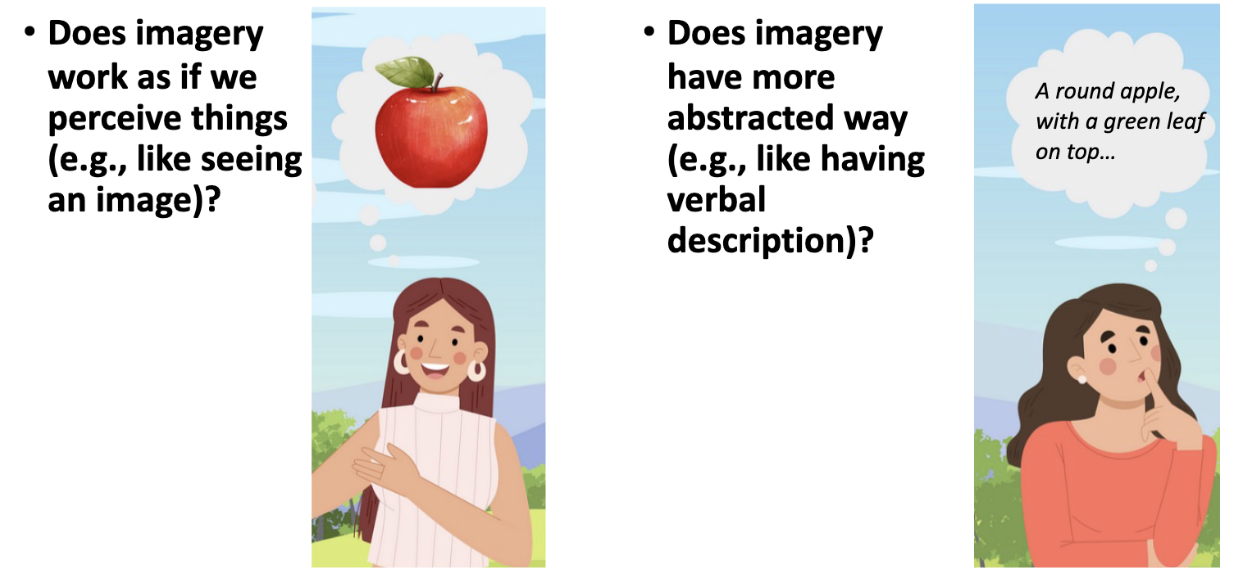
picture to visualize the two hypothesis on how imagery works
mental scanning (Kosslyn)
Learn locations of objects on map
Remove map on screen
Asked questions
Measured RT now: how long it took them to mentally scan from one landmark to another
Linear increase in RT as distance increased
Suggests that mental imagery maintains spatial information
More
Also used images of different objects
The longer the distance to scan the image the longer it took for them to do this task
Differences in RT seem to rely on encoding the spatial layout of the image
spatial/analogue account of mental imagery
Kosslyn's view
Mental images – quasi pictures in the mind
Imagery is like a perceptual experience
imagery debate (spatial vs propositional)
Spatial (deceptive) representation hypothesis (kosslyn)
Mental imagery works like perception
Mental imagery can be represented by spatial information
I ask you to imagine an apple, imagining a visual image of it in your head
Propositional representation hypothesis (Pylyshyn)
Core representation is not a spatial depiction
Mental imagery can be represented by abstract symbols, language, or semantic based representation.
what are propositions
Propositions are another type of representation
Capture structured knowledge about the world
Abstract format, symbolic representation, language
Conceptual descriptive codes
UNDER (CAT, TABLE)
TOP (APPLE, LEAF)
propositional representational account
Pylyshyns view
Opposed the idea that people use spatial/deceptive representations
Mental imagery is more like propositional representations
Visual experience may occur (epiphenomenon)
But the core representations are propositional (like abstract or thinking)
epiphenomenon
something that accompanies the real mechanism but it not actually part of the mechanism (what Pylyshyn believed happened when visual experiences occur as he believed in propositional representations)
Pylyshyn claimed this mental picture does not actually help you solve spatial problems. Instead, it is just a side effect of the underlying propositional calculation
How can this account explain the RT data found in kosslyn studies?
Reflection of tacit knowledge
Using knowledge of spatial relations unconsciously
Not actually using visual images
imagery debate image

Finke and Pinker (additional evidence to support kosslyn)
Participants judge whether arrow points to dots previously seen
Longer reaction time when greater distance between arrow and dot (as if they were mentally "traveling")
Not instructed to use visual imagery
No time to memorize, no tacit knowledge
proves Kosslyns spatial representation
People were presented with four random dots on the screen
Some dots were removed and an arrow appeared
Slower reaction time when the arrow was further away from the dot
Why is it important? To remove people's existing (tacit) knowledge as an alternative hypothesis. Must rely on visual and spatial information to do this task.
imagery vs perception
Size in visual field
How much is stuff taking up in your visual field
Things become more detailed as they are larger in visual field
Does the same apply in imagery
Does context effect imagery
manipulated imagined animal size not knowledge about the animal, smaller mental images longer reaction times, context of paired animal changes the size of the mental image
Context (paired animal) matter à changes the size of the mental image
Differences in size are represented in mental images
PERKY BANANA
participants were told to look at a white screen and imagine a banana, while a faint image of a banana was projected on screen, eyes got subliminal information not consciously able to see it. No one noticed there was a picture on the screen and people described the object that matched the image projected on the screen
Letter visualization experiment (Farah)
instructed participants to imagine either a letter H or letter T on the screen then flashed two squares one after the other with either a T or a H on it, the target letter was detected more accurately when the participant had been imagining the same letter, showing that perception and imagery share mechanisms and influence and interact with each other
Conclusion
Ample evidence exists in support of the spatial nature of mental imagery
Most experiments use reaction time as the dependent measure.
Measure time necessary to scan or travel within a visualized scene.
what 4 techniques prove our brain creates mental imagery
imagery neurons, brain imaging, TMS, and patient cases
imagery neurons
Some neurons respond to seeing certain objects
Some patients had electrodes implanted in medial temp. Some of the neurons were being recorded, in this case they were responding to particular categories of objects. That particular neuron was really activated when seeing images like a baseball.
When patients are seeing other kinds of info, like faces, the same neuron is not really responding. Somehow, this neuron cares about this baseball but not faces.
What about when you imagine the object?
The same neurons fire when people imagine that object in the brain or mind
brain imaging fMRI
compared the brain activity in the visual cortex using FMRI during perception(looking at stimulus), imagery (mentally imagining the stimulus) and a baseline where there was no visual stimulus or imagery performed. the results showed that the visual cortex was active during visual perception and visual imagery (not during the base line no stimulus)
brain activity in the primary visual cortex
brain imaging (PET)
topographic organization of the visual cortex
size of the image, seeing bs imagining, supports for shared mechanisms of imagery and perception
—
participants were asked to create small, medium and large visual images while they were in a brain scanner. When they created small images activity was centered near the back of the brain, but as the size of the mental image increased activation moved toward the front of the visual cortex just as it does for perception. Thus both imagery and perception result in topographical organized brain activation.