College 3
 Call Kai
 Learn
 Practice Test
 Spaced Repetition
 Match
 Flashcards
 Knowt Play
1/33

There's no tags or description
Looks like no tags are added yet.
34 Terms
Koppeling
als een stuk van een chromosoom wordt overgeërfd dan zijn al die genen die dicht bij elkaar zitten erven allemaal samen over (En dan is er natuurlijk de overerving van de één beïnvloedt heel erg de kans dat de ander ook overerft.)
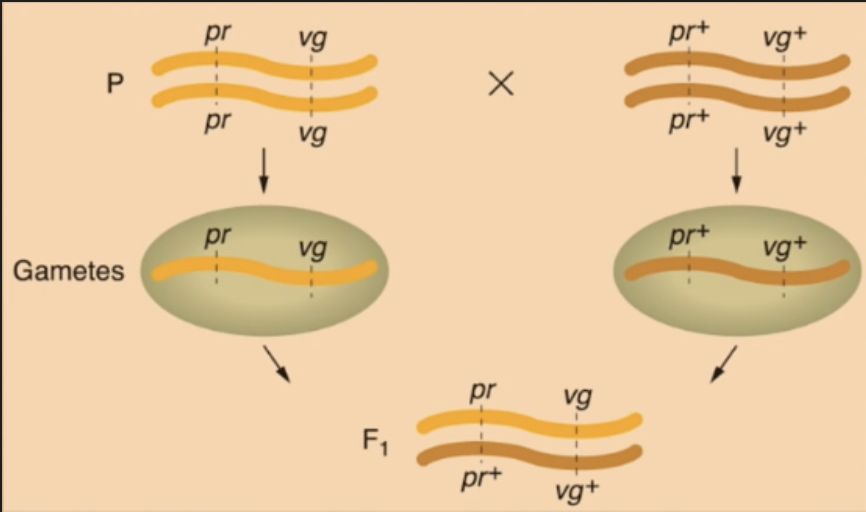
the loci of those genes are on the same chromosome and, hence, the alleles on any one homolog are physically joined (linked) by the DNA between them.
The Diagnostic Testcross
To test if two genes are linked, geneticists cross a dihybrid (A/a:B/b) with a homozygous recessive tester (a/a:b/b). Because the tester parent contributes only recessive alleles, the progeny phenotypes directly display the gamete genotypes produced by the dihybrid.
Unlinked Genes (Independent Assortment): Produces a 1:1:1:1 progeny ratio (AB,Ab,aB,ab.) -> Recombinant Frequency (RF) = 50%. (Half the offspring are parental types, and half are recombinant types.)
Linked Genes: If two genes are close together on the same chromosome, they tend to be inherited together as a unit (the “parental” combination). Deviates from 1:1:1:1. The progeny will show two large, equally frequent parental (nonrecombinant) classes totaling greater than 50%, and two smaller, equally frequent recombinant classes totaling less than 50%. RF < 50% proves that two genes are linked. Recombinant Frequency (RF) = Total number of recombinant progeny / Total progeny inspected * 100%
Cis conformation
Both wild-type (dominant) alleles reside on one homologous chromosome, and both mutant (recessive) alleles reside on the other (AB/ab or + + / ab)
Trans Conformation
Each homologous chromosome carries one wild-type allele and one mutant allele (Ab/aB or +b/a+)
Crossing over 1
The physical breaking and rejoining of two homologous DNA molecules at the exact same position during meiosis, creating reciprocal recombinant chromatids. Als de chromosomen naar het equatoriale vlak gaan en de homologe chromosomen paren krijgen we strand invasion waarbij een van de chromatiek van het ene chromosoom invadeert (stand invation) in de andere chromosoom en daarmee gaat basenparen en dat zorgt er voor dat die chromosomen stukjes DNA uitwisselen (crossing over) de kruising heet chiasma en daar wordt DNA uitgewisseld. Crossing over occurs after DNA replication at the four-chromatid stage of meiosis. Fungal tetrad analysis proves this because a single meiosis can produce four distinct haploid genotypes (AB,Ab,aB,ab), which is impossible if crossing over happened before replication at the two-strand stage. Within one meiocyte, 2, 3, or all 4 chromatids can participate in multiple crossovers (though each individual crossover involves only 2 nonsister chromatids). Sister-chromatid exchanges occur rarely and produce no new allele combinations
Holiday junction resolution en recombinatie
Holliday junction resolution is the final step of genetic recombination, where two DNA molecules that have exchanged strands are cut apart again.nThe important thing to understand is that the Holliday junction can be resolved in two different ways, which determine whether crossing over happens or not.
Formation of a d loop. Regions of heteroduplex are formed, kunnen met elkaar bases paren omdat ze veel op elkaar lijken
When in contact with recombination enzymes there is heteroduplex and homoduplex involves 4 DNA strands. 2 axis of symmetry. Resolve cleavage can be horizontal or vertical axis prenatal segments are either stil covelently linked or linked to each other (have exchanged). Ligations creates pairs of proudly duplexes (non-recombinant products and recombination products). heteroduplex DNA still.
During meiosis, two homologous chromosomes (one from each parent) can exchange DNA.
The DNA strands of two homologous chromosomes break.
A strand from one chromosome enters and pairs with the matching DNA sequence on the other chromosome. This is called strand invasion.
The DNA strands become connected, forming a cross-shaped structure called a Holliday junction.

The Holliday junction cannot stay connected permanently. Special enzymes called resolvases cut specific DNA strands at the junction. There are two possible ways to cut the strands:

Non-crossover
The resolvase cuts one pair of strands.
The DNA molecules separate.
The DNA sections on either side of the junction remain in their original arrangement.
No exchange of the surrounding chromosome regions occurs.
Crossover
The resolvase cuts the alternative pair of strands.
The DNA molecules separate.
The DNA sections on either side of the junction are exchanged.
This produces chromosomes with new combinations of alleles. The cut DNA strands are then joined again by DNA ligase
Genetusche en fysieke kaart met drie punts kruising
Crossovers occur roughly at random along paired homologs. The farther apart two linked genes are, the higher the probability of a crossover between them, and the higher the RF. 

We kunnen bepalen in welke mate genen onafhankelijk van elkaar overerven. Als twee genen heel vaak samen overerven en bijna nooit van elkaar gescheiden worden, weten we dat ze dicht bij elkaar op hetzelfde chromosoom liggen. Ze blijven alleen uit elkaar als er tussen hen in een crossing over-optreedt. Dit is echter een toevallig proces. Als de genen ver genoeg van elkaar verwijderd zijn op hetzelfde chromosoom, gedragen ze zich alsof ze op verschillende chromosomen liggen en onafhankelijk van elkaar overerven. Deze genetische afstand wordt gemeten in centiMorgan (cM).
1 m.u. = 1 cM = 1%. Recombinant frequency (RF)
Map distances along a chromosome are roughly additive (e.g. is A-B = 5 m.u. and A-C = 3 m.u. then B-C is either 8 m.u. or 2 m.u.). 

Naarmate de recombinatiefrequentie toeneemt, liggen de genen verder van elkaar af. Het maximale wat je kunt waarnemen is een frequentie van 50%. Als de recombinatiefrequentie 50% bedraagt, gedragen de genen zich alsof ze op verschillende chromosomen liggen, omdat ze dan volledig onafhankelijk van elkaar overerven.
Distortions between genetic and physical maps:
Recombination hotspots: Regions with unusually high crossover rates -> expands map distance relative to physical DNA length.
Recombination blocks: Regions with suppressed crossing over -> compresses map distance.
Species/sex exceptions: No crossing over occurs in male Drosophila (no synaptonemal complex); human females have higher autosomal RF than males.


GENKARTERING MET EEN DRIEPUNTSKRUISING
Determine linkage, gene order and map distance for three genes (A,B,C) in a single cross (A/a B/b C/c x a/a b/b c/c).
The heterozygous parent has three gene pairs. Each gene can contribute either its uppercase or lowercase allele. So 2^3 = 8 offspring classes
Gamete | Type |
ABC | Parental |
abc | Parental |
Abc | Recombinant |
aBC | Recombinant |
ABc | Recombinant |
abC | Recombinant |
AbC | Recombinant |
aBc | Recombinant |
But we don't immediately know which recombinant classes came from which crossover. We work it out from the numbers.
Single crossover would be between A and B or B and C: Abc/aBC or ABc/abC Double crossover would be one crossover in each region AbC/aBc


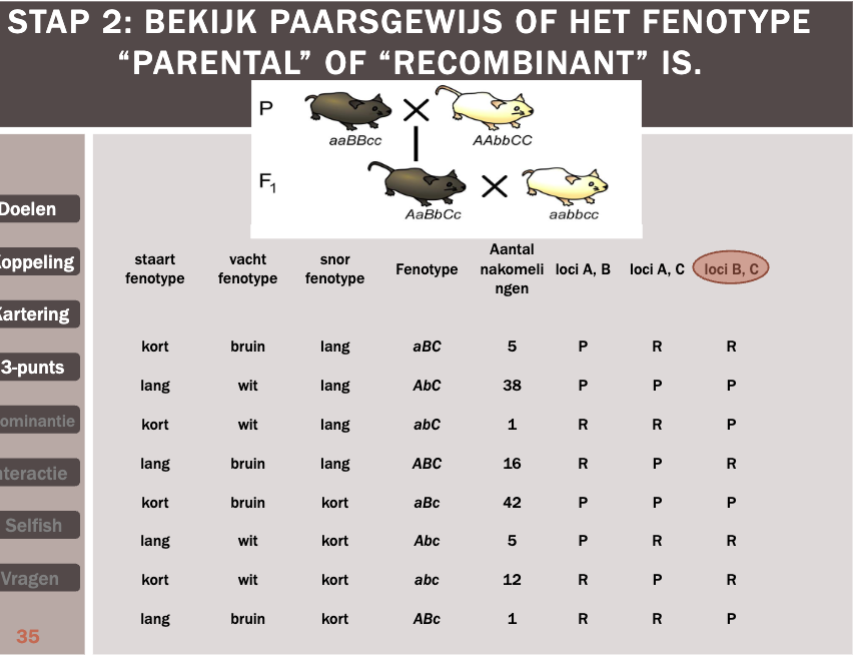
Compare the parental classes with the DCO classes to find the middle gene. For example:
a | b | c | |
Parental | a | b | c |
DCO | a | B | c |
Recombinant Frequency (RF) = recombinant offspring / Total offspring * 100%


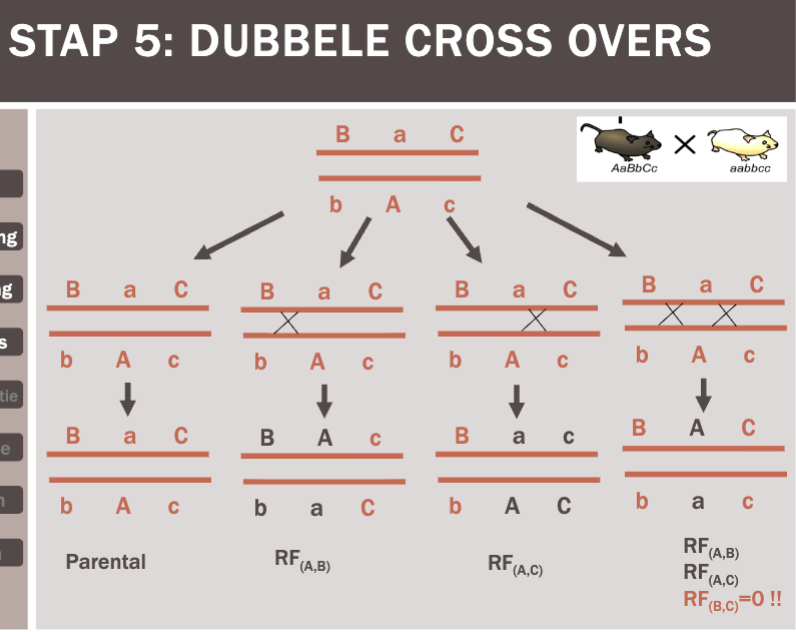
We zien dubbel cross overs niet. Because a double crossover has one crossover in A–B AND one in B–C. It contributes to both distances. This is why you add the two interval distances.      



Genetische kaart versus fysieke kaart
pic 

Why can recombination frequency never exceed 50%
This is a separate concept. Imagine two genes that are very far apart on a chromosome. There could be multiple crossovers between them.
1 crossover → recombinant
2 crossovers → can restore the original parental arrangement
3 crossovers → can produce recombinant arrangements again
4 crossovers → can restore parental arrangements again The key is that an even number of crossovers can restore the parental allele combination, while an odd number produces a recombinant combination. When genes are very far apart, crossovers become so frequent that you cannot distinguish parental from recombinant combinations reliably. The result approaches:
50% parental
50% recombinant
Tetrad analysis
The previous experiment counted offspring individually. In fungi, scientists can sometimes examine all four products of a single meiosis together. These four products are called a tetrad. You can directly see which allele combinations were produced in that meiosis. For two genes A and B, assume the original chromosomes were: AB and ab. There are three possible tetrad types:
Parental ditype (PD): All four products are parental
Nonparental ditype (NPD): All four products are recombinant.For linked genes, this can occur due to a four-strand double crossover.
Tetratype (T):Both parental and recombinant products (AB, Ab, aB, ab) This is commonly produced by a single crossover between the genes.
Unlinked genes: PD and NPD occur approximately equally often.
Linked genes: PD is much more frequent than NPD. If genes are linked, the original parental combinations are more likely to stay together than completely new combinations are to appear. The Perkins formula corrects for double crossovers: Distance = 50(T+6NPD) Here T and NPD are expressed as proportions, not percentages. If you use percentages, the equivalent formula is: 0.5(T%+6NPD%)
Centromere mapping
This is another experiment, specifically using fungi such as Neurospora, where the spores are arranged in a line. The goal is now different: You are trying to find the distance between a gene and its centromere. The centromere is the chromosome region where the spindle attaches during cell division. The spores remain arranged in the order they were produced, which lets you see whether the gene separated during the first or second meiotic division.
First-division segregation (MI): No crossover between the gene and the centromere. The alleles separate during meiosis I, producing blocks of four:
AAAAaaaa
Molecular marker
A molecular marker is a small difference in DNA that allows you to distinguish between two chromosomes. Imagine two homologous chromosomes. They contain the same genes in the same locations, but their DNA sequences aren't necessarily identical. For example, one chromosome might have a G at a certain position, while the other has an A. 

That difference is a molecular marker. It acts like a landmark that allows scientists to track which chromosome was inherited. The marker itself doesn't have to affect anything about the organism. It can simply be a DNA difference that is easy to detect. A. Single-nucleotide polymorphisms (SNPs): A SNP is a difference in one nucleotide (one DNA base) at a specific location. The rest of the DNA can be identical. Only one base differs. Scientists can use these differences to determine which chromosome a person inherited from each parent. B. Tandem repeats (VNTRs / microsatellites): These are DNA sequences in which a short sequence is repeated multiple times next to each other. Different people can have different numbers of repeats at the same location. Because more repeats means a longer DNA sequence, scientists can detect the differences using:
PCR → copies the DNA region containing the repeats.
Gel electrophoresis → separates the DNA fragments based on their size.
Longer DNA fragments travel less far through the gel than shorter fragments. So you can identify which repeat version someone has by looking at the band positions.
The main advantage is that molecular markers are codominant. This means you can distinguish both alleles in a heterozygous individual. With a dominant/recessive visible trait, a heterozygote might look exactly like a homozygous dominant individual, meaning you cannot distinguish their genotypes just by looking. With a codominant molecular marker, you can directly see that the individual has inherited two different alleles
Heteroduplex DNA
Normally, the two DNA strands match perfectly. During crossing over, a strand from one homologous chromosome can pair with a strand from the other homologous chromosome. If the two homologs have different alleles at a certain position, they may not match perfectly. During crossing over, DNA strands from these two homologs can pair with each other. This creates a DNA region where the bases don't match properly. This is called heteroduplex DNA
5:3 octad instead of 4:4
Normally, after meiosis in Neurospora, you get eight spores arranged in an octad, with four of one allele and four of the other. But sometimes you get: AAAAAaaa → 5 A and 3 a
Crossing over created heteroduplex DNA.
The heteroduplex contained a mismatch because the two homologs had different alleles.
The mismatch wasn't repaired before DNA replication.
When the DNA was replicated, the two different bases were copied separately.
This produced one extra spore with one allele and one fewer with the other allele. This is called postmeiotic segregation
Crossing over 2
We start with two homologous chromosomes, each consisting of two sister chromatids. Crossing over occurs between non-sister chromatids.
Step 1 — Double-strand break (DSB)
Both strands of DNA break at the same position in one chromatid.
One chromatid breaks
────────── ✂ ──────────
Both DNA strands are broken at the same location.
This break is the starting point of the recombination repair process.
Step 2 — 5′ end resection
Enzymes remove DNA from the broken ends, specifically chewing back the 5′ ends.
This leaves two exposed single-stranded 3′ tails.
After resection
─────── 3′ →
← 5′ ───────
The 3′ ends are now able to invade the homologous chromosome.
Why? The exposed single-stranded DNA can now find a matching DNA sequence on the other homolog.
Step 3 — Strand invasion
One of the exposed 3′ tails enters the intact homologous chromosome and pairs with its complementary DNA strand.
It pushes the original strand aside, creating a displacement loop called a D-loop.
The broken strand enters the intact homolog
──────────────
───────╲______
───────╱────────
The invading DNA pairs with the homologous sequence and displaces the original strand.
The DNA doesn't need to be identical. It only needs to be sufficiently homologous (similar) to pair.
Step 4 — DNA synthesis and Holliday junction formation
The invading 3′ end acts as a starting point for DNA polymerase.
DNA polymerase adds nucleotides to the 3′ end, using the intact homolog as a template. This extends the invading DNA and helps repair the missing DNA.
The other broken end can then also pair with the homologous chromosome, and DNA synthesis fills in the remaining gaps.
After the DNA strands are joined, the structure contains two Holliday junctions.
Double Holliday junction
──────╲──────╱──────
──────╱──────╲──────
──────╲──────╱──────
──────╱──────╲──────
The homologous DNA molecules are connected through two Holliday junctions.
A Holliday junction is basically a connection where DNA strands from the two homologous chromosomes have crossed over and are joined together.
Step 5 — Resolution of the Holliday junctions
The DNA is now connected at the Holliday junctions. Enzymes cut and rejoin the DNA strands to separate the molecules again.
Depending on how the junctions are resolved, the result can be:
Crossover: DNA sections are exchanged, producing recombinant chromosomes.
Non-crossover: DNA is repaired without exchanging the chromosome sections on either side of the break.
For a crossover, the final result is two recombinant chromatids and two unchanged chromatids (assuming the usual two-chromatid crossover)
Complete dominance
One wild-type allele produces enough protein product to run normal cell chemistry. This is called haplosufficiency. Recessive mutations are usually null mutations in haplosufficient genes (e.g., Phenylketonuria / PKU)
Haploinsufficiency
A single wild-type allele is not enough to produce normal function. In this case, a null mutation is dominant because one dose produces subnormal protein levels (e.g., DiGeorge syndrome)
Dominant Negative Mutations
Mutant polypeptides act as "spoilers" or "rogues". They bind to normal proteins (such as multi-subunit protein dimers or trimers like collagen) and distort them, ruining overall function (e.g., Osteogenesis imperfecta / brittle-bone disease)
Incomplete dominance
bloemen, sickeld cell anemia, hetyrozygote (form van bloed cell) malaria (coevolution). The heterozygote displays an intermediate phenotype between the two homozygotes (e.g., red × white snapdragons produce pink heterozygotes, yielding a 1:2:1 phenotypic ratio in the F2)
Codominance
bloed typen. Both alleles are expressed fully and independently in the heterozygote. Classic examples include human ABO blood groups (IA and IB alleles are codominant) and sickle-cell hemoglobin (HbA and HbS show codominance at the molecular level, incomplete dominance for cell shape, and complete dominance regarding severe anemia)
Gen-interactie
Het is onderdeel van een hele cascade van chemische reacties die verschillende stoffen in elkaar omzetten, waarbij sprake is van voorlopers en eindproducten. Vaak zijn deze netwerken gekoppeld aan andere netwerken, wat uiteindelijk leidt tot de specifieke phenotypes. Wij kunnen deze kleur waarnemen en het koppelen aan een bepaald gen, maar dat gen maakt deel uit van een veel ingewikkelder netwerk. In dit voorbeeld van een biochemisch netwerk zie je hoe allerlei stoffen in elkaar worden omgezet en bijvoorbeeld eiwitten worden aangemaakt. Een belangrijk onderdeel hiervan is het aminozuur phenylalanine, dat in ons lichaam moet worden omgezet door een specifiek enzym. Als dit enzym zijn werk niet goed doet, komt de hele cascade onderaan in het netwerk stil te liggen, wat aantoont hoe cruciaal een enkel gen en het bijbehorende enzym zijn voor het totale proces. Neem bijvoorbeeld het gen dat betrokken is bij PKU (fenylketonurie). Als dit gen gemuteerd is, kunnen we bepaalde stoffen niet meer omzetten. Dit betekent dat de hele onderliggende reactiereeks stilvalt. Het illustreert dat één gen niet slechts één eigenschap van een organisme beïnvloedt, maar dat de gevolgen veel verder reiken. Zo leidt een mutatie in dit specifieke deel van de route tot een verstoorde productie van melanine. Melanine is het pigment in je huid; zonder melanine ontwikkel je albinisme. In het schema zijn de rode blokjes de mutaties die leiden tot deze aandoeningen, allemaal het gevolg van een defecte bovenliggende stap. Echter, als er een mutatie optreedt in een later stadium van de keten, werkt alleen dat specifieke deel niet meer, terwijl de rest van de route wel functioneert. Dit laat zien hoe cruciaal het is om te bepalen waar het product van een gen in een biochemische route precies ingrijpt. Het echte probleem bij een mutatie in het PKU-gen is echter niet alleen het uitvallen van de downstream-stappen, maar vooral de ophoping van het substraat. Phenylalanine kan niet meer worden afgebroken en hoopt zich op. Het wordt onder meer gekoppeld aan suikers en accumuleert in je bloed. Wanneer de concentratie te hoog wordt, wordt het giftig voor je hersenen, wat leidt tot ernstige neurologische afwijkingen 

one-gene–one-polypeptide hypothesis: genes dictate the structure of enzymes that catalyze sequential steps in cellular pathways. Synthetic Pathways: Chains of enzymatic reactions that build essential molecules (e.g., arginine synthesis in fungi or the phenylalanine breakdown pathway in humans). Signal-Transduction Pathways: Cascades of signals from the cell membrane to the nucleus that trigger cellular responses (e.g., yeast mating pheromone response). Developmental Pathways: Genetic steps that construct an organism's body plan during embryogenesis
Complimentatie experiment
als alle mutaties recessief zijn, betekent dit dat het wildtype-allel haplosufficient is. Dit houdt in dat één kopie van het gen voldoende is om het normale fenotype tot stand te brengen. Als je twee verschillende mutanten kruist, zou je een individu moeten kunnen krijgen dat op het ene gen een mutatie en een wildtype-allel heeft, en op het andere gen eveneens een mutatie en een wildtype-allel. In dat geval zijn beide allelen voldoende aanwezig en krijg je weer het normale, wilde type, zoals een gewoon bloemetje. Als je bij zo’n kruising echter niet het oorspronkelijke bloemetje krijgt, dan zijn de twee mutaties óf in hetzelfde gen gelegen, óf het wildtype-allel is niet haplosufficient. Als je daarentegen een kruising maakt met een andere mutant en je krijgt weer rode bloemen (het wilde type), dan weet je dat deze mutaties op verschillende genen liggen. Je kunt ze dan complementeren door ze met elkaar te kruisen. Hieruit kun je afleiden dat je waarschijnlijk met twee verschillende genen te maken hebt, die elk haplosufficient zijn. Op deze manier kun je een keten van stappen die leiden tot een eindproduct, in kaart brengen. Je kunt hiervoor moedwillig mutanten aanmaken, bijvoorbeeld door planten bloot te stellen aan een mutagene stof. Vervolgens kruis je deze mutanten met elkaar en analyseert je hoe de erfelijkheid in elkaar zit. Op die manier kun je de afzonderlijke stappen in zo’n biochemische keten ontwarren door middel van kruisingsexperimenten.

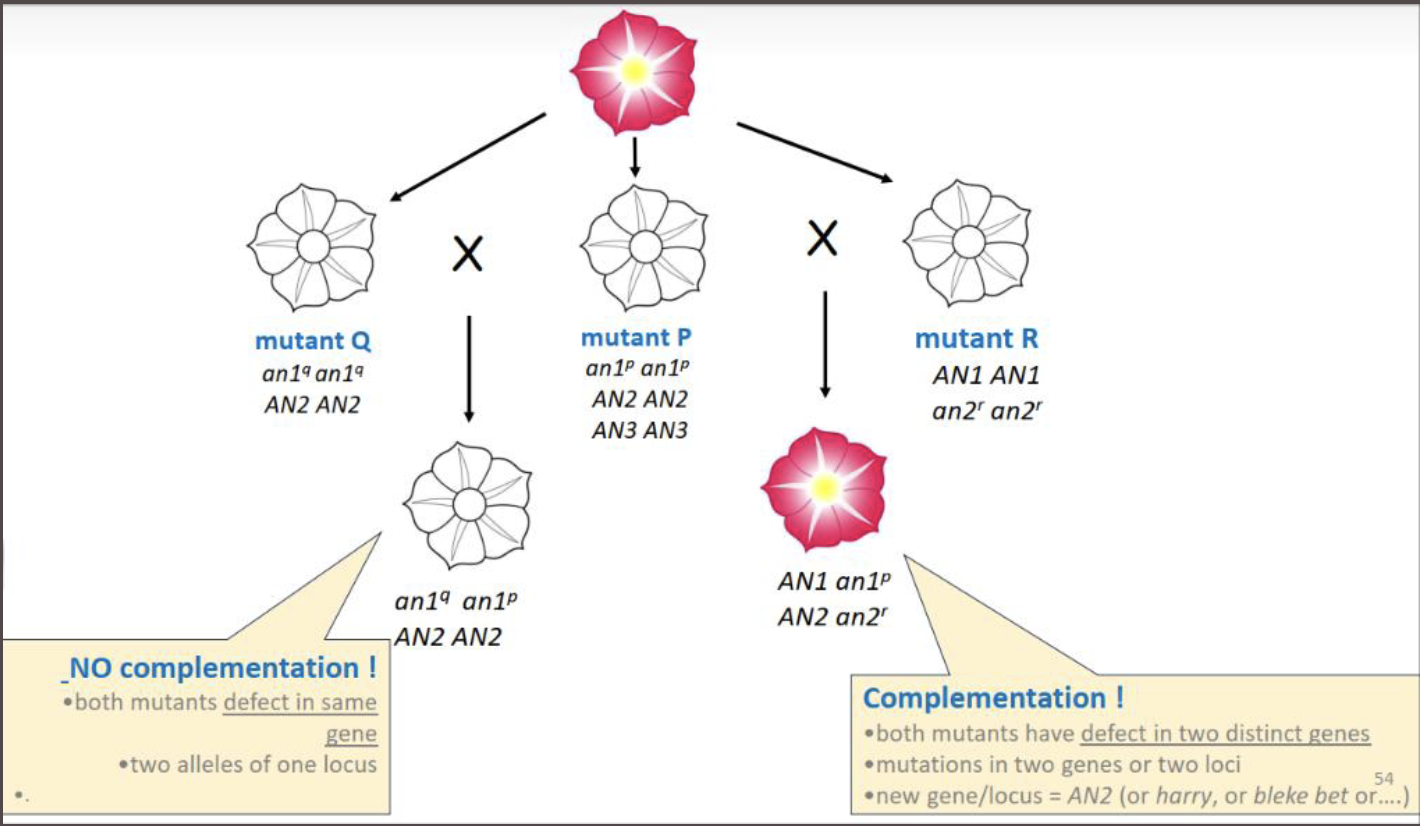
  To determine whether two independently isolated recessive mutations that produce the same mutant phenotype belong to the same gene or different genes, geneticists use the complementation test:
Cross two pure-breeding recessive mutants. If the F1 progeny display the wild-type phenotype, the mutations have complemented, proving they belong to different genes. (Each mutant parent provides a healthy wild-type allele for the gene the other parent lacks).
If the F1 progeny display the mutant phenotype, the mutations have failed to complement, proving they are alleles of the same gene.
Lethal allenen
Essential Genes: Genes that are absolutely critical for survival; mutations that completely destroy them are lethal alleles. Een afwijking van de klassieke Mendeliaanse overerving treedt op wanneer je te maken hebt met letale allelen. Dit zijn allelen die, vaak door pleiotrope effecten, dodelijk zijn voor het organisme. Vaak is het zo dat individuen die homozygoot zijn voor zo’n letaal allel, niet levensvatbaar zijn. Dit kan komen door een storing in de embryonale ontwikkeling, waardoor het embryo niet verder kan ontwikkelen en sterft. Het kan ook zijn dat de dood later intreedt, maar het resultaat is hetzelfde: een deel van het verwachte nageslacht ontbreekt in de populatie. Dit leidt tot een afwijking van de verwachte verhoudingen. Neem bijvoorbeeld een kruising tussen twee muizen die heterozygoot zijn voor een letaal allel. Volgens de wetten van Mendel zou je verwachten dat het nageslacht in de verhouding 1:2:1 komt (homozygoot dominant : heterozygoot : homozygoot recessief). In dit specifieke geval leidt de homozygote toestand echter tot de dood. 

Als gevolg daarvan zie je in het overlevende nageslacht geen 1:2:1 verhouding, maar een verhouding van ongeveer 2:1 (tweederde heterozygoot en een derde homozygoot recessief/wildtype, afhankelijk van welke toestand letaal is). De “ontbrekende” kwart is namelijk het deel dat homozygoot was voor het letale allel en daardoor is overleden. Een dergelijke afwijking van de verwachte 3:1 of 1:2:1 verhouding is dus een sterke aanwijzing voor de aanwezigheid van een letaal allel
Pleiotropy
The phenomenon where a single gene/allele affects multiple, seemingly unrelated phenotypic traits (e.g., the yellow allele affects both coat color and embryonic survival)
Penetrance
The percentage of individuals with a specific genotype who actually express the expected phenotype. Incomplete penetrance occurs when someone carries a mutant genotype but displays a completely normal phenotype
Expressivity
Measures the degree or severity of phenotypic expression in individuals who have the same genotype (e.g., varying patch sizes in piebald beagles)
Epistase
Epistase is een ander mechanisme dat kan leiden tot afwijkingen van de klassieke Mendeliaanse overerving. Met epistase wordt bedoeld dat de expressie van het ene gen wordt beïnvloed door een ander gen. Dit betekent niet dat de genen fysiek dicht bij elkaar op het chromosoom hoeven te liggen, maar dat er een functionele interactie is. 

Vaak zorgt het ene gen ervoor dat een ander gen wordt ‘aangezet’ (geactiveerd) of juist ‘uitgezet’ (geremd). De genen werken dan samen om een bepaald proces uit te voeren, of het ene gen remt het andere. Als er een mutatie optreedt in het ene gen, heeft dit direct invloed op de expressie van het andere gen. Deze vorm van epistatische beïnvloeding komt heel veel voor in het genoom. Omdat de interactie tussen genen de verwachte verhoudingen van het nageslacht verandert, leidt epistase dus ook tot afwijkingen van de klassieke Mendelse wetten
Selfish gene
Het concept van het “selfish gene” is geïntroduceerd door Richard Dawkins in zijn boek uit de jaren tachtig. Het centrale punt is dat natuurlijke selectie niet primair plaatsvindt op het niveau van het individu, maar dat de eenheid van selectie stukjes DNA zijn. Het enige doel van die DNA-stukken is om door te geven aan volgende generaties. Jij bent in wezen slechts een “schil” of voertuig voor je genen. Je genen hebben met elkaar samengewerkt om jou te vormen, met als enig doel dat jij je zult voortplanten, zodat diezelfde genen opnieuw kunnen samenkomen in de volgende generatie. De genen zelf zijn eeuwig; zij maken een reis door de tijd, verpakt in verschillende individuen. Jij sterft, maar de genen die je draagt, waren er al duizenden jaren geleden en zullen waarschijnlijk nog lang bestaan. De echte maatstaf voor succesvolle evolutie is dus in hoeverre DNA-stukken ervoor zorgen dat zijzelf worden doorgegeven. Soms loopt zo’n DNA-lijn dood, maar andere stukken DNA zijn al actief sinds het begin van het leven. Dit perspectief kan leiden tot complicaties, zoals meiotische drive. Meiotische drive verwijst naar genen die tijdens de meiose actief worden om hun eigen frequentie in het nageslacht te vergroten, ten koste van andere genen. Een bekend voorbeeld hiervan komt voor bij fruitvliegen (Drosophila). Bij bepaalde mannetjes (die XY-chromosomen hebben, netals mannen) ligt op het X-chromosoom een gen dat XR wordt genoemd. Dit gen codeert voor een giftige stof. Het probleem is dat deze vrugvliegen tijdens de zaadcelvorming een syncytium vormen: de cellen zijn nog niet volledig van elkaar gescheiden en kunnen dus materiaal met elkaar uitwisselen. Het XR-gen op het X-chromosoom maakt de giftige stof aan, die via het syncytium in alle ontwikkelende zaadcellen terechtkomt. Later, wanneer het DNA wordt verpakt in de uiteindelijke zaadcellen, wordt het XR-gen pas actief. De cellen die een Y-chromosoom dragen, hebben geen resistentie tegen deze gifstof en gaan daardoor dood. Alleen de zaadcellen met het X-chromosoom overleven, omdat het XR-gen op datzelfde chromosoom ook een resistentiemechanisme produceert. Het resultaat is dat dit mannetje vrijwel uitsluitend zaadcellen met een X-chromosoom produceert (90 tot 100% van het geval). Hij maakt dus bijna uitsluitend dochters, die weer het XR-chromosoom erven. Dit is een vorm van “zelfzuchtig” gedrag op genetisch niveau: het gen bevordert zijn eigen overleving ten koste van de genetische diversiteit. Toch blijft dit meiotische drive-gen in evenwicht in de populatie (bijvoorbeeld bij circa 20% van de individuen) en wordt het niet vastgelegd (fixatie) bij 100% van de populatie. Dit heeft te maken met sekseselectie. Hoewel mannetjes met het XR-chromosoom veel zaadcellen “vernietigen” en daardoor minder vruchtbaar lijken, hebben ze vaak compenserende voordelen, zoals een agressiever gedrag of fysieke kenmerken (bijvoorbeeld kortere “stokjes” of uitsteeksels). Vrouwtjes in deze populatie hebben echter een sterke voorkeur voor mannetjes zonder het drive-gen, herkenbaar aan hun langere uitsteeksels. Door deze voorkeur van de vrouwtjes zorgen ze ervoor dat de mannetjes zonder drive-gen meer nakomelingen krijgen, wat de frequentie van het drive-gen in de populatie laag houdt en in evenwicht brengt
9:7 Ratio (Genes in the Same Pathway)
Occurs when two genes operate sequentially in a pathway. If either gene is homozygous mutant, the pathway fails, producing the same mutant phenotype. Only genotypes possessing at least one functional wild-type allele for both genes (A-dot B-) produce the wild-type phenotype 

9:3:4 Ratio (Recessive Epistasis)
Epistasis occurs when a mutant allele of one gene completely masks the expression of a mutant allele at a second gene. In recessive epistasis (e.g., coat color in Labrador retrievers or flower color in Collinsia), being homozygous recessive at the epistatic locus overrides the second locus entirely, grouping the single-mutant and double-mutant classes together into a 4/16 phenotypic group 

12:3:1 Ratio (Dominant Epistasis)
Occurs when a single dominant allele at one locus masks the expression of alleles at a second locus (e.g., foxglove petal pigmentation)
13:3 Ratio (Suppression)
A suppressor is a mutation at a second gene that reverses the effect of an initial mutation, restoring a wild-type phenotype. If a recessive suppressor has no phenotype of its own, it yields a 13:3 ratio in the F2 generation 

Synthetic Lethality

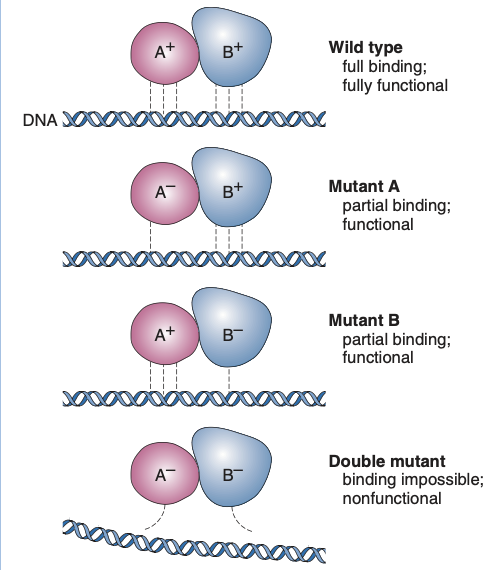
When two single mutations are entirely viable on their own, but combining them into a double mutant causes lethality (9:3:3 ratio, missing the double-mutant "1"), indicating that the two proteins normally interact closely in a physical machine or backup pathway