Chem Modern Atomic Theory Models and People
 Call Kai
 Learn
 Practice Test
 Spaced Repetition
 Match
 Flashcards
 Knowt Play
1/25

There's no tags or description
Looks like no tags are added yet.
26 Terms
Aristotle
Philospher that thought that matter was continuous and not made of the smaller particles.
Democritus
Philospher that hought the world was made of 2 things; Empty space and tiny particles called atoms.
450 BC
Aristotle and Democritous
Antonine lavoiser
Law of conservation of mass: matter cannot be created nor destroyed. Mass of reactants=mass of products. 1782
Charles Coulumb
Law of electronical charges: opposites attracked, likes repel. 1785
Joesph Proust
Law of Defenite proporations: atoms must combine in whole number ratios. 1799
John Dalton
Law of multiple Proportions: atoms can combine in different whole number ratios. 1803 Father of modern atomic theory.
Dalton's atomic model

Michael faraday
thought that the atomic structure might be related to electricity 1839
Ben Franklin
discovered that there might be 2 types of charges: positive and negativr charge.
JJ Thomson
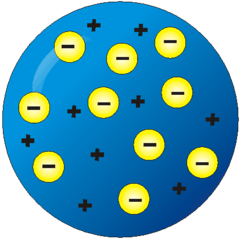
Cathode Ray tube Expirament, plum pudding model. Discovered that that were negative electrons in an atoms, and that everything else was positive. 1897
Ernest Rutherford
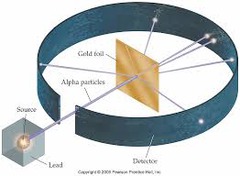
Gold foil expirament, discovered that the atom was mostly empty space, that is contains some positive charge, and that the is a concentrated area of positive charge (nucles) 1909
Neils Bohr
Solar system model, concluded that electrons are like planets thay orbit around the nucleus. 1913
Lous de Brogile
Found that electrons sometimes act like waves or particles 1924
James Chadwick
Proved the existance of nuetrons, particles having mass, explained why the same atom might have different masses.1933
Werner Heisenburg
Concluded that the more precisly the location of an electron is determined, the less precisly the speed is known. 1927
Erwin Schrodinger
charge cloud model, based onthe quantum theory. 1926
Ground State
state of lowest energy
Excited state
any state of higher than ground state
Quantum theory
When atoms or molecules absorbs or emits energy, it must be in a specific amount called a quanta
Classical physics theory
any amount of electrons can me gained or lost by an object, which can result in a continuous line spectrum.
wave length
distance from crest to crest or trough to trough
frequency
the number of wave cycles that pass a given point
solar system model

Plum pudding model
gold foil expirament