ear conditions - week 5
 Call Kai
 Learn
 Practice Test
 Spaced Repetition
 Match
 Flashcards
 Knowt Play
1/6

There's no tags or description
Looks like no tags are added yet.
7 Terms
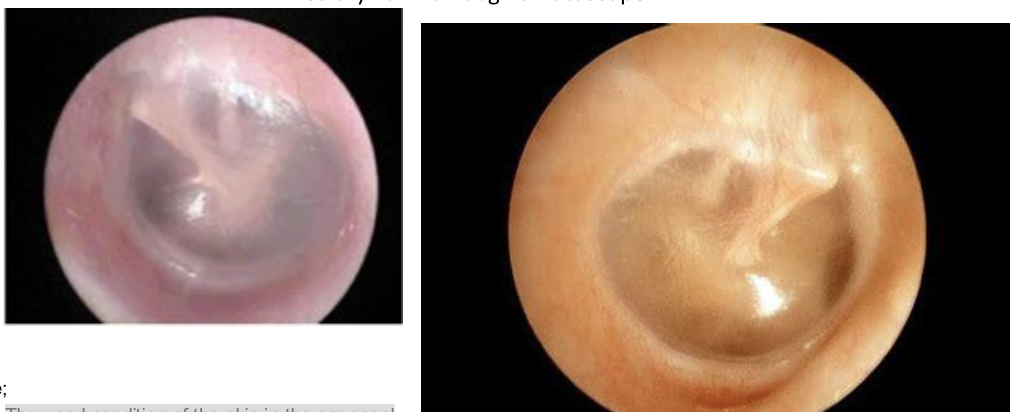
healthy ear
The good condition of the skin in the ear canal
Translucent and healthy tympanic membrane (ear drum)
You can see some of the ossicles (small bones of the ear from previous diagram)
White ‘Triangle’ of light shining back showing the drum is the correct convex shape
ear wax blockage
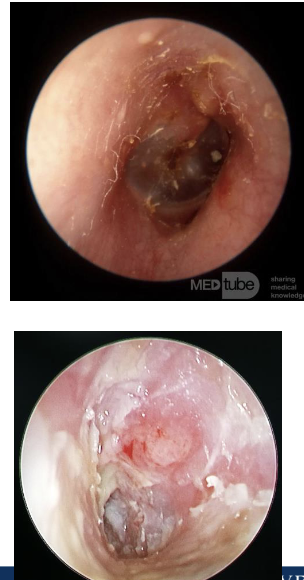
This Ear canal is blocked with wax
The old impacted wax is black – and surprisingly hard to see as absorbs
all light. Looks more like a ‘hole’ very often.First line treatment is Olive Oil ear drops to soften wax, dissolve it and
allow its removal.Second choice is hydrogen peroxide. This can give a faster break down
of wax, but much more likely to irritate / damage skin or eardrum. Must
be avoided when risk of damage to any tissue.Can be treated OTC

otitis externa
This is how otitis externa (often called eczema of the ear) can present through
an otoscope.
Skin of the ear canal is damaged
Can involve eardrum
Not necessarily infected, but is always at risk of infection.
Usually requires treatment with prescription eardrops
These normally contain combination of steroids (for inflammation) and/or
anti infection agents.Pharmacy treatments via PGD (patient group directions) are new and
emerging
otitis media
This condition is infection / inflammation of the middle ear
Outer ear often not involved at all – therefore eardrops of very
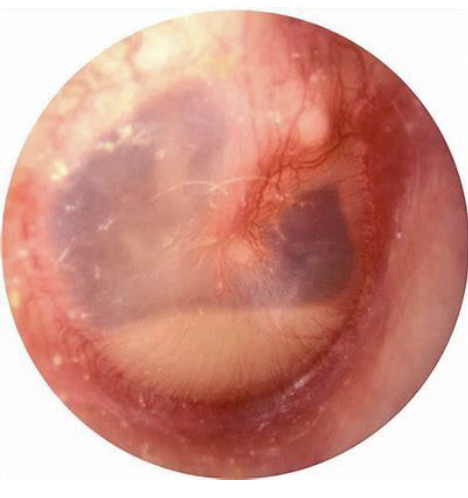
limited (if any) useYou can see here the build-up of purulent fluid behind the ear
drum.The only normal passage of escape for this fluid is the Eustachian
tube which has become blocked.Treatments can include systemic antibiotics if appropriate.
Treatments should include advice / medication to clear eustachian
tube such as decongestants. Some of which is available OTC.It is likely hearing will be impaired if pressure has built up behind
the eardrum
otitis media - more severe
This are examples of more severe otitis media
The fluid and pressure has built up here to the point that the
eardrum is beginning to bulge.Risk of perforation imminent (you can see the beginning of a
perforation in the lower picture.The eardrum bulges in a ‘doughnut’ shape because the eardrum is
connected to the Malleus (small ‘hammer’ bone) in the centre.This eardrum will not be functional and hearing will be impaired.
These cases should be referred.

perforated eardrum
This is an example of a perforated eardrum through the otoscope
Uncomplicated perforations normally heal themselves.
ENT specialists in hospital can apply patch treatments to assist
their healing.Ear drops should not be applied to these cases.
Currently no pharmacy treatments are available and these cases
should be referred.
ear grommets
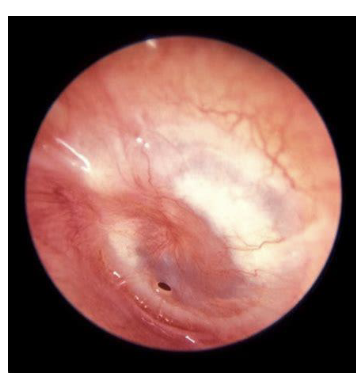
This is what ear grommets look like through the Otoscope
Children are very prone to blocked eustachian tubes.
This is because the face structure is not fully formed yet and
essentially the eustachian tube is cramped whilst they are still
growing.This makes pressure build up behind the ear a common problem,
and common cause of hearing difficulties.A grommet makes an artificial tube through the ear drum, allowing
air though from the middle ear out of the canal.This allows the pressure to equalise even if the eustachian tube is
blocked.This treatment can restore total hearing loss in severe cases.
OTC drops should not be used.
Ear is always more at risk of infection, care should be taken, and
any complications referred.
