Nervous System - Neurons, Neurotransmitters, Receptors
 Call Kai
 Learn
 Practice Test
 Spaced Repetition
 Match
 Flashcards
 Knowt Play
1/38

There's no tags or description
Looks like no tags are added yet.
39 Terms
what is a membrane potential
difference in electrical energy between ICF and ECF due to the electrochemical gradients of ions
what is the membrane potential at rest
lots of Na outside (+ outside), lots of K inside (- inside)
what is repolarization and what is the membrane potential then
inside of the cell is negative, outside of the cell is positive. K flows out of the cell. Happens as a recovery after depolarization
what is depolarization and what is its membrane potential then
inside of the cell is more positive, outside of the cell is more negative. Na flows into the ell. Triggered during contraction/signals
what channels are open and closed at resting membrane potential (-70mL)
Voltage-gated Na and voltage-gated K channels are closed
what is a threshold potential
level of membrane potential that a neuron needs to reach to trigger an action potential
what is the membrane potential at threshold potential
Voltage gated NA channels opened, allowing NA to flow into cell and changing the resting potential of -70mV to –55mV
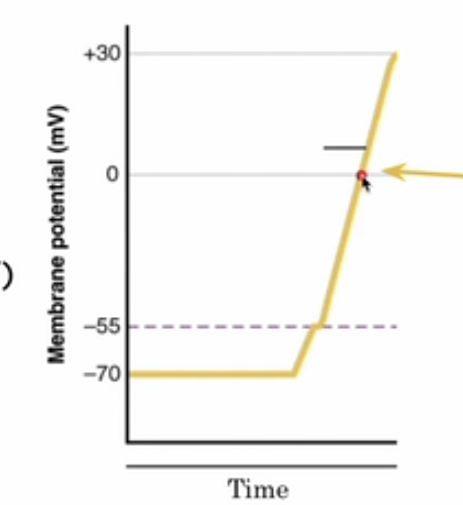
what channels are open/closed at repolarization
Voltage-gated Na channel close and are inactivated, voltage-gated K channels open, allowing for K ions to flow out of the cell (losing + ions and decreasing the membrane potential (going from a more positive to a more negative membrane potential)
what is hyperpolarization
when all the K+ ions are flowing out and the cell is losing + ions, the membrane potential will dip below the normal –70mV for a little bit before restabilizing
what happens to the membrane potential after hyperpolarization
Afterwords, voltage-gated K channel will close up, allowing Na+/K+ ATPase Pump to restabilize the inside of the cell (going back to the resting membrane potential)
Afterwords, voltage-gated K channel will close up, allowing Na+/K+ ATPase Pump to restabilize the inside of the cell (going back to the resting membrane potential)
what is a refractory period
time intervals after an action potential when a cell is unable/harder to fire a new impulse
what is a relative refractory period
a new actional potential CAN be triggered, but you need a super strong stimulus to do so
From late repolarization to hyperpolarization phase
Happens due to voltage-gated K+ channels remaining open
what is an absolute refractory period
no new action potential can be generated, no matter how long the stimulus
From depolarization - repolarization
Happens due to voltage-gated Na channels are inactivated
what are the states of the voltage gated na channel during different states
resting: closed
depolarization: open
repolarization: inactivated
hyperpolarization: closed
dendrites have a ___ that ___ and ___
local graded potential, starts at dendrites, moves to axon hillock
what is the difference between local graded potential and normal action potential
Intensity and distance of the action potential can change, unlike action potentials where they have a set intensity and cannot be decreased (aka, as the local graded potential travels from the dendrites to the axon hillock, that distance can change and the signal can lose its intensity as it goes down
local graded vs action potential
local: short distance, strength change
action: long distance, uniform potential
what are the 2 types of local graded potentials
excitatory: depolarizes
inhibitory: hyperpolarizes
this means that the potential can start with either depolarization or hyperpolarization
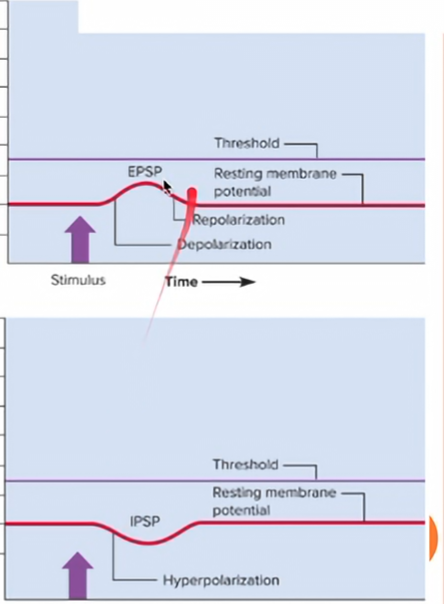
what is summation
Because there are many dendrites on a neuron, all of the incoming graded potentials get added up and it MAY or MAY NOT reach the threshold potential to fire an action potential
what is temporal summation
postsynaptic neuron (the neuron that has the incoming graded potentials) is adding up multiple graded potentials coming from 1 singular presynaptic neuron (the neuron sending the info to the postsynaptic one) at different times
what is spatial summation
postsynaptic neuron is adding up multiple graded potentials from multiple presynaptic neurons at the same time
can an action potential start with either depolarizaiton or hyperpolarization
only depolarization
what is the difference between how an action potential vs local graded potential is triggered
a local graded potential uses gated channels on the dendrites and soma, while an action potential uses voltage-gated channels on a certain zone and the axon
diameter of axon: how does it affect the velocity
larger diameter = faster
myelin sheath thickness: how does it affect the velocity
thicker = faster
Saltatory vs continuous conduction: how does it affect the velocity
saltatory = faster, continuous = slower
length of itnernodes: how does it affect the velocity
longer = faster
size of nodes of ranvier: how does it affect the velocity
smaller = faster
density of ion channels: how does it affect the velocity
higher density = faster
what is isochronicity
nerve signals arrive at different parts of the body at the exact same time, even if some signals have to travel further than others
types of nerve fibers; group A
largest diameter, heavily myelinanted.
Ex: motor neurons
fastest
types of nerve fibers: group B
intermediate diameter, lightly myelinated
Ex: visceral afferents, preganglionic Sy autonomic
medium speed
types of nerve fibers: group c
smallest diameter, unmyelinated
Ex: postgangionic autonomic fiber
slowest
step 1 of how the action potential only flows one way
When depolarization happens (voltage gated Na channel opnes and lets Na in), it goes in both directions. BUT one side will encounter a closed voltage-gated Na channel as it travels to the axon terminal while the other side will hit an inactivated voltage-gated membrane channel that doesn't allow anything to go through (the ones that go to the inactivated channel are lost, which makes you lose some intensity of the action potential)

step 2 of how the action potential only flows 1 way
As the action potential flows to the axon terminal, the previous voltage-gated channel will become inactivated as the other opens

what do lidocaine and mepivacaine do
voltage-gated sodium channel blockers, stops action potential and numbs person
what does saxitoxin do
selective, reversible (slow) voltage-gated sodium channel blocker
stops action potential from happening, paralyzes a person temporarily
what does cyanobacteria and its specfic inhibitors do
agonist of acetylcholine, irreversible binding to ACh receptors
Anatoxin A: irreversibly binds to ACh receptor
ach channel is kept open, locking Na channels shut and cannot repolarize (stuck in a depolarizing state)
Anatoxin A(S): AChesterase inhibitor
ach channel is kept open, locking Na channels shut and cannot repolarize (stuck in a depolarizing state)
causes a lot of sporadic movement then paralysis