Food and Nutrition Final Exam
 Call Kai
 Learn
 Practice Test
 Spaced Repetition
 Match
 Flashcards
 Knowt Play
1/5

There's no tags or description
Looks like no tags are added yet.
6 Terms
Amino Acids:
How many are their
What is their function
Describe their structure
20 known amino acids
They are the building blocks of protein
Contains:
Amino group (N)
Acid group (COOH)
Side chain: differentiates one AA from another

Amino Acids: What are…
EAA
Dispensable AA
Conditional Essential AA
EAA—Essential amino acids
Cannot be synthesized and must be supplied by the diet (9 total)
Dispensable AA
Can be synthesized in sufficient quantities
Conditionally Essential AA
Normally non-essential but may need supplementation from diet
How are amino acids linked together? Condensation? Hydrolysis? AA’s together?
Amino acids are linked together via peptide bonds. This creates proteins.
Condensation: joins amino acids together via removal of water
Hydrolysis: separation of amino acids via addition of water
Two amino acids: dipeptide
Three amino acids: tripeptide
10+ amino acids: polypeptide
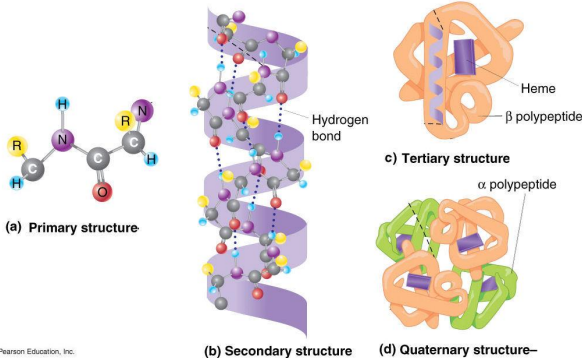
Describe the structure of protein
Primary: AA sequence
Secondary: Weak electrical attractions (hydrogen bond)
Tertiary: Folding of the long AA chain. Hydrophobic amino acids cluster on the inside, while hydrophilic ones face the outside.
Quaternary: Multiple polypeptides interacting together (hemoglobin)
What is denaturation? What does the shape of protein matter?
The shape of the protein is critical for its function
Denaturation:
When subjected to heat, acid, or other conditions that disturb stability, proteins uncoil and lose their function, without any change to their ‘primary structure’.
E.g., salivary amylase denatures in stomach acids or the hardening of an egg when cooked