Chemistry TEST UNIT 1
 Call Kai
 Learn
Learn Practice Test
 Spaced Repetition
 Match
Match Flashcards
 Knowt Play
1/21

There's no tags or description
Looks like no tags are added yet.
Name | Mastery | Learn | Test | Matching | Spaced | Call with Kai | Chat |
|---|
No analytics yet
Send a link to your students to track their progress
22 Terms
How are emssion line spectra produced
produced when electrons transition from higher to lower energy levels, emitting energy in the process.
electron from n=3 to n=2
red
electron from n=4 to n=2
green
n=5 to n=2
blue
n=6 to n=2
purple
electron transition to n=1
UV radiation (highest energy transitions)
e- transition to n=2
visible light
e- to n=3
infared radiation
different spectrums and differences
emission spectrum- coloured lines on black background, shows the specific wavelengths (or frequencies) of light emitted
absorption spectrum- black lines on coloured backgrounds
continuous spectrum- shows all wavelengths / frequencies of visible light
absorption and emission
absorb- lower to higher energy level
emission- higher to lower energy level
Aufbau principle
when adding electrons to an atom, the lower energy orbitals must be filled first.
Pauli exclusion principle
an atomic orbital can only hold two electrons and they must have opposite spins.
Hund’s rule
when we have degenerate orbitals (orbitals of the same energy) then each orbital is filled with a single electron before being doubly occupied.
Order of sublevels filled
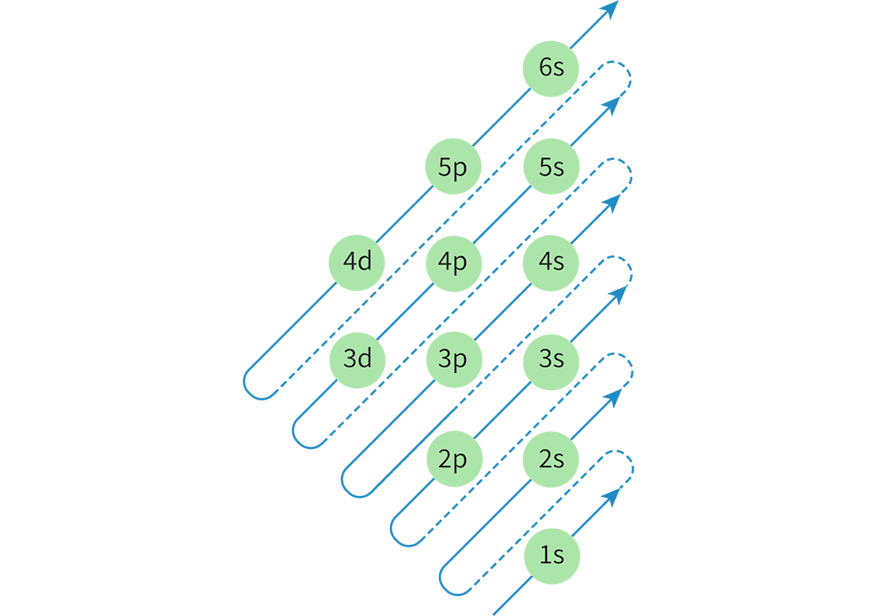
exceptions to the Aufbau principle
Cr- 4s1 3d5
Cu - 4s1 3d10
Heterogeneous mixture
non-uniform
visible phases or boundaries such as those that can be seen between the 2 things
Homogeneous
Homogeneous mixtures do not have visible phases or boundaries. They have a uniform composition meaning that the components of the mixture are equally distributed and in the same state.
Solvation
the separation of a heterogeneous mixture of two solids based on differences in
solubility
the solvent molecules surround the soluble molecules and
dissolve the solid into a solution. The insoluble solid can now be separated by filtration. The soluble substance can be separated from the solution by evaporation.
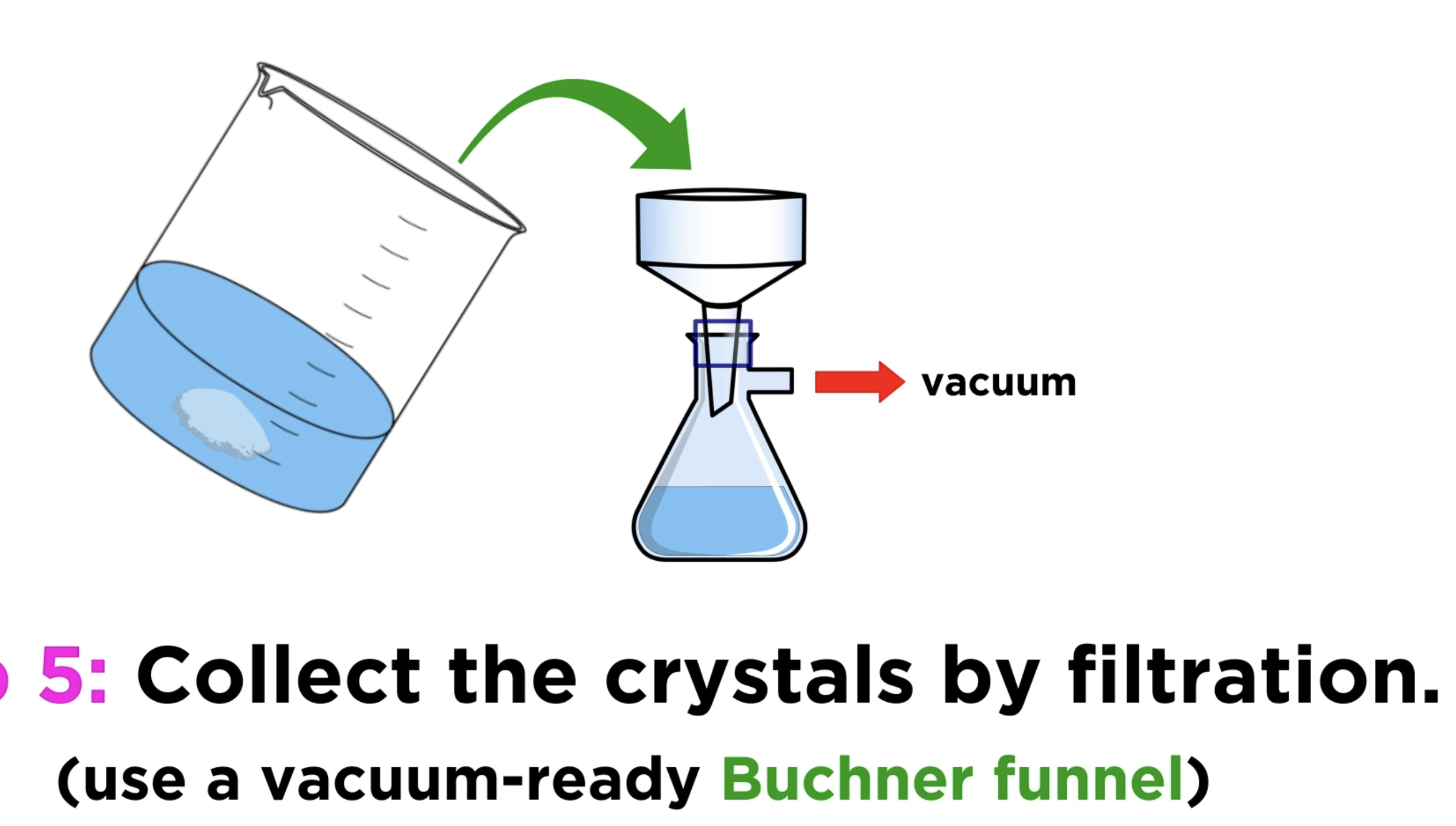
recrystalisation
remove impurities that are mixed in with a solid.
Hot solvent is added (minimum amount for dissolving) to impure solid
When crystals are formed, they are left to cool, which decreases solubility (in the solution, which impurities are in)
Filtration then done to obtain pure crystals.
What is the electromagnetic spectrum?
The electromagnetic spectrum is a range of frequencies that covers all electromagnetic radiation and their respective wavelengths and energy.
Define the term ionisation energy
Ionisation energy is the maximum amount of energy an electron can reach, corresponding to the energy required for the electron to escape the atom.
Define the term frequency
Frequency is the number of waves per second