MS2 - dermatology
 Call Kai
 Learn
 Practice Test
 Spaced Repetition
 Match
 Flashcards
 Knowt Play
1/61

There's no tags or description
Looks like no tags are added yet.
62 Terms
What skin changes happen with age?
thinner, less elastic, less collagen, and drier
What skin components becomes flattened as we age?
epidermal rete pegs / dermal papillae
What are the two common skin probelms that occurs with aging?
Xerosis (dry skin) / Pruritus (itching)
Hypo-pigmentation in
soles and palms
Hyperpigmentation in
creases of soles and palms
Nail changes
Diffuse pigmentation
Linear dark bands
Oral mucosa may appear
blue or blue-gray
Rash =
Temporary eruption of skin (contact dermatitis, allergic reaction)
Lesion =
patho or traumatic loss of normal tissue (primary or secondary)
Secondary lesions includeS
scales, scab, excoriation, fissure
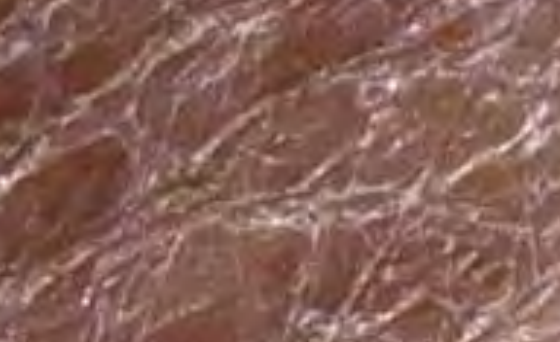
scales
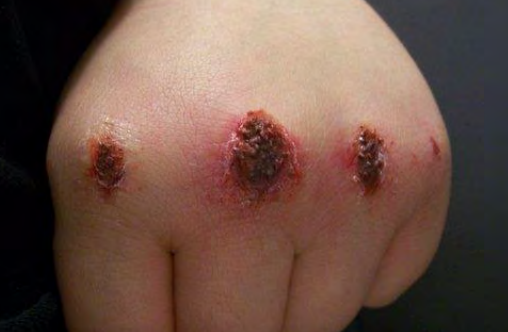
scab

exocoriation (scratching skin surfaces)

fissure (linear cracks within dry calluses)

Dermatitis is ______; eczema is ________
exogenuous (contact); endogenuous (atopic dermatities)
Patients with Overactive Immune Skin Responses present with all of the following except:
thining skin (lichenification)
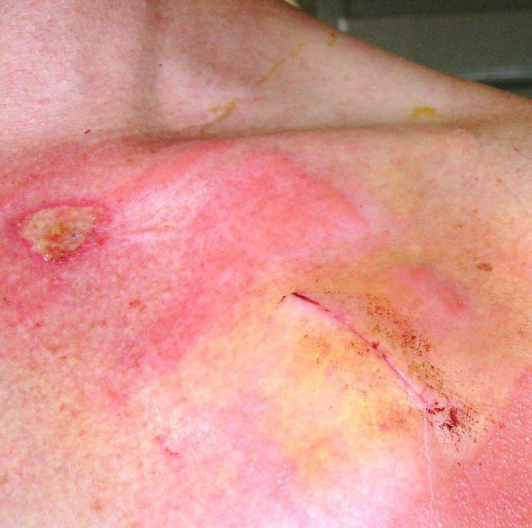
dermatitis
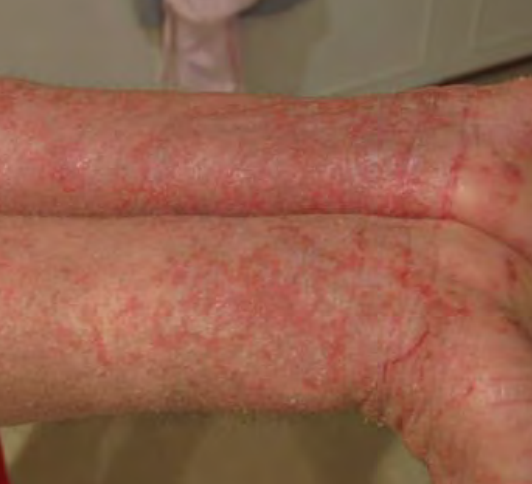
eczema
Adverse Drug Reactions symptoms are ususlly
mild, accompanied by pruritus, and resolve promptly when the drug is stopped
Adverse Drug Reactions can develop into life-threatening diseases such as
Toxic epidermal necrolysis (TENS) / Stevens–Johnson syndrome (SJS)
Common causes of adverse drug reactions include
Sulfa-based drugs
Penicillin
Anticonvulsants
N S A I D s
Psoriasis is a chronic condition that involves lesions that appear as
round, erythematous, dry, scaling plaques covered by silvery white scales
Common locations for psoriasis =
Scalp, nails, extensor surfaces of extremities, elbows, knees, umbilical, and sacral regions
Patients with psoriasis may also have
psoriatic arthritis
What are the two types of Psoriasis?
Pustular and nonpustular type
Treatment for psoriasis includes
Systemic and topical steroids;
immunosuppressives
Ultraviolet therapy
Coal tar product
Urticaria (hives) can be
acute or chronic
Urticaria (hives) involves
Pruritic edematous pink or red wheals
Common causes for urticaria
• Foods • Medications • Allergens • Chemicals • Cold pack • Adhesives
Urticaria (hives) treatment involves
antihistamine
What is the most common benign epithelial tumors?
seborrheic keratosis
Initially Seborrheic Keratosis =
flat, welldemarcated, small, brown pigmented areas
Over time Seborrheic Keratosis
become raised, darker, with a soft, crumbly surface
What population is Seborrheic Keratosis common in?
older adult
Skin Tag (cutaneous papilloma / fibroma) are
Soft, round, Same as skin color (or tan / brown), and Benign tumors ranging from 1 mm to 10 mm
What populations are skin tags common in?
elderly and obese
Is medical treatment necessary for skin tags?
NO but avoid torsion with manual therapy/modalities
Lipoma are
Single or multiple fatty tumors
Develop slowly, easily movable beneath skin
Painless
Nevi (moles)
Light-dark brown
Flat – round
With/without hair
(A)BCDE method to detect melanoma
Asymmetrical
most early melanomas are asymmetrical
A(B)CDE method to detect melanoma
Border
most melanomas are uneven
AB(C)DE method to detect melanoma
Color
shades of brown, tan, black can be first sign of melanomA
ABC(D)E method to detect melanoma
Diameter ≥6 mm
larger than common moles
ABCD(E) method to detect melanoma
Evolving
changing in size, shape, color, bleeding, crusting
Skin cancers named after
skin cells in which cancer develops
Albinism is a congenital disorder affecting =
skin, hair, and eyes
Lack the enzyme to synthesize melanin
Melasma =
Acquired light or brown hyperpigmentation (on face)
Melasma causes include
exposure to sunlight (exacerbates)
pregnancy, oral contraceptives
idiopathic
Melasma may disappear after
cessation of contraceptives or childbirth
Ephilides (freckles)
• Indicates skin damage from sun exposure • Monitor for subtle changes that may indicate pathology
Lentigines (liver spots)
• Small brown lesions
• In areas frequently exposed to sun
• Back of hands, neck, and face
Mongolian Spots
• Congenital blue-gray macular lesions in lumbosacral area
• Caused by melanocytes
• Typically disappears by age 5
• If present, almost always in infants of Native American, Indian or Asian origin
Vitiligo
• Loss of melanocytes • Distinct borders on face, neck, axillae, extremities • Inherited
Vitligo may also be seen with
Thyroid disease • Pernicious anemia • Diabetes
Tinea Pedis (athlete’s foot)
• Primarily affects interdigital spaces and plantar feet •
Contracted by walking barefoot or wearing occlusive footwear
• Spores can live up to 1 year in skin scales
Tinea Pedis (athlete’s foot)
• Erythema, pruritus, scaling, maceration, and/or bulla formation
Treatment for Tinea Pedis (athlete’s foot)
antifungals (topical, sometimes systemic)
Candidiasis (yeast infection)
Uncontrolled proliferation results in local infection especially in skin folds or under occlusive dressings
Candidiasis (yeast infection) presentation
• Red, pustular, well-defined scaling eruptions on skin • White, cheesy adherent masses on mucosa
High risk of yeast infection include those with
ecreased immunity, diabetes, infection, chronic steroid use, those who work with frequent exposure to water, long course of antibiotics
Treatment for yeast infection
antifungals