CHEM 1030: Exam 3
 Call Kai
 Learn
 Practice Test
 Spaced Repetition
 Match
 Flashcards
 Knowt Play
1/61

Earn XP
Description and Tags
sì session 13
62 Terms
molarity equation

molality equation

what is dilution
the process of decreasing the concentration of the solute by adding more solvent
dilution equation

what are strong electrolytes
completely dissociate in water to form ions
what are weak electrolytes
partially dissociate in water to form ions
what are non-electrolytes
don’t produce ions when dissolved in water
what cations are always soluble in water?
group 1 ions & NH4+
what anions are always soluble in water?
NO3-, ClO4-, and CH3COO-
Cl-, Br-, and I- are soluble except when paired with…
Ag+, Cu+, Hg22+, and Pb2+
SO42- is soluble except when paired with…
Ba2+, Ca2+, Hg22+, Pb2+, and Sr2+
Slightly soluble anions
O22-, S2-, OH-, CO32-, PO43-, AsO43-, CrO42-, C2O42-
define weak acids
acids which only partially dissociate
define strong acids
acids which completely dissociate
examples of weak acids
acetic acid, carbonic acid, hydrosulfuric acid, phosphoric acid
examples of strong acids
HCl, HBr, HI, H2SO4, HNO3, HClO4
Bronsted-Lowry definition
Acids donate H+, bases accept H+
net ionic equation for strong acid-strong base reactions
H+(aq)+OH−(aq)→H2O(l)
reduction
process of gaining electrons in a chemical reaction
oxidation
process of losing electrons in a chemical reaction
oxidation number for all pure elements
0
oxidation number for single-atom ions
the charge of the ion
oxidation number of fluorine
-1
oxidation number of oxygen
-2 in MOST cases
oxidation number of hydrogen atoms
+1 in MOST compounds
exception of hydrogen’s oxidation number
metal hydrides (LiH)
exception of oxygen’s oxidation number
bonded w/ fluorine & bonded to another O atom
oxidizing reagent
reactant that accepts electrons; is reduced
reducing agent
reactant that donates electrons; is oxidized
work and heat equation
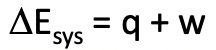
work equation

enthalpy definition
sum of internal energy & pressure-volume product of a system
enthalpy equation
H = E + PV
heat capacity equation

breaking bonds…
requires energy (endothermic)
making bonds…
releases energy (exothermic)
London dispersion forces
Intermolecular forces btwn atoms/non-polar molecules due to induced dipoles
Intramolecular forces
Chemical bonding, electron repulsion, VSEPR
Intermolecular forces
Attractions & repulsions between molecules
Viscosity
resistance to flow
Hydrogen bonding
Particularly strong intermolecular force btwn polar molecules; containing H bonded to F, O, or N
ion-dipole
Mixtures of ionic compounds & polar compounds
Dipole-dipole
2 polar molecules
Greater solubility = ______ intermolecular forces btwn solute + solvent
Great
Immisicible
Not soluble
Triple point
Where all 3 phases coexist
Properties of water
High surface tension, density decreases at lower temps, adhesion/cohesion
+q
system absorbs heat
-q
system releases heat
+w
work done ON system
-w
work done BY system
+𝚫E
internal energy increases
-𝚫E
internal energy decreases
three methods of calculating changes in enthalpy (𝚫H)
Hess’s Law, Standard enthalpy, and bond energies
𝚫H negative
exothermic; releases heat
𝚫H positive
endothermic, absorbs heat
Hess’s Law
adds together enthalpy changes of multiple rxns to find the over 𝚫H

Standard enthalpy of formation
Uses formation enthalpies of reactants and products to calculate 𝚫H

Bond energies
uses energy required t break bonds (reactants) and energy released when forming bonds


which area is solid (ice)
blue

which area is liquid (water)
green

which area is gas (vapor)
yellow