physics 1301 unit 3
 Call Kai
 Learn
 Practice Test
 Spaced Repetition
 Match
 Flashcards
 Knowt Play
1/23

Earn XP
Description and Tags
- rotation motion -tangential angular velocity and acceleration-centripetal accel.-forces that cause centripetal forces-fictitious forces-banked curves
24 Terms
ΘΔ=
wt
conversion factor w to Θ/s
360/2(pi)rad
every portion of an object has the ___ angular velocity and acceleration because
same; bc the distance is different but the angle (ssector) is the same and thats what matters
Θ=
tan-1(at/ac) or Fgy/Fgx
constant angular accel. means
constant at → a is always the same
can find v using
at or regular kinematics
centripetal force is (pos or neg)
negative. Fc= -nsinΘ
banked track
min and max safe speeds are determined by Θ, friction, and radius
ac=
-gtan(Θ) ONLY if theres no friction and car doesnt slide up or down
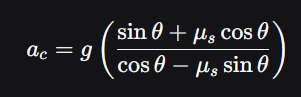
(general formula) ac=
g times (sin theta plus coefficient of friction times cosine theta) divided by (cos theta MINUS coefficient of friction times sin theta)
Fc=
mac = (mv2)/r
sigma Fr=
-mv2/r
newtonian gravitation: F=G(m1m2)/r2, r=
the distance between centers of both objects
given surface to surface, add the radii to the total distance
force exerted by m1 on m2 is
EQUAL but in opposite direction to F exerted by m2 on m1.
linear a=
final - initial velocity over delta time
total a
vector of tangential a and centripetal a
if an object moves at constant speed,
at=0.
at changes speed
ac changes direction
on a circular path _____ change
both v and and angular acceleration change ?
force acting at an angle,
use force thats perpendicular to the door → Fsin(theta)
which angle to use for rotational equilibrium
the angle BETWEEN the force and the radius (F and r)
when mass is concentrated around hoop
it takes longer to stop because I depends on how the mass is distributed and an the location of the axis of rotation
center of mass on a symmetrical object must
lie on the axis of symmetry
the larger r is, the larger the
angular acceleration
torque
causes angular acceleration