Lecture 3 PSYC 2P36
 Call Kai
 Learn
 Practice Test
 Spaced Repetition
 Match
 Flashcards
 Knowt Play
1/33

There's no tags or description
Looks like no tags are added yet.
34 Terms
Summary

Divisions
Central and Peripheral
Somatic & Autonomic
Afferent & Efferent Nerves
CNS
Brain & Spinal Cord
receives sensory data from the body, processes that information, and sends out instructions to direct physical actions and internal processes
PNS
Somatic and Autonomic
Afferent and efferent nerves
PARA AND SYMP
connects your central nervous system (the brain and spinal cord) to the rest of your body, acting as a communication network to send sensory input and motor commands
Somatic
External
Afferent
Skin, Muscles, Eyes, Ears
Efferent
Muscles
manages voluntary movements of skeletal muscles and relays sensory data,
Autonomic
Internal
Afferent
Internal Organs
Efferent
Interal Organs
Branches into Sympathetic & Parasympathetic systems
automatically and unconsciously regulates vital internal body processes, such as heart rate, blood pressure, digestion, and body temperatur
Sympathetic
Activation
body for stress, danger, intense exercise, or emergency situations
Parasympathetic
Relaxation
Cranial Nerves
Specific Sensory / motor functions
12 pairs - split to two sides of the body
relay sensory, motor, and autonomic signals to and from the head, face, neck, and torso
Meninges
Dura mater
Arachnoid
Pia mater
Cerebrospinal Fluid - CSF
Protects brain
Transports nutrients
Drains waste products
Ventricles
2 Lateral, Third, Fourth,
produce, store ns circulate csf
Cerebral Acqueduct
Hydrocephalus, medical condition, excess csf
channel in the midbrain that connects the third ventricle to the fourth ventricle
Blood-Brain Barrier
Composed of tightly packed cells in blood vessels
Protects the brain, impeding passage of certain molecules
Large molecules require transporters - ie, glucose
Impairment of the BBB is associated with neurological conditions
Anatomy of a Neuron
External Features
Cell membrane
Cell body
Dendrites
Axon Hillock
Axon
Myelin
Nodes of Ranvier
Buttons
Synapses

Multipolar Neuron
Has multiple dendrites and an axon extending from cell body
4 Classes of Neurons
Unipolar
Bipolar
Multipolar
Multipolar Interneuron
Internal Features of a Cell Body
Nucleus
Mitochondria
Endoplasmic reticulum
Cytoplasm
Golgi complex
Cell membrane
Microtubules
Neuron Cell Membrane
Channel Proteins
Signal Proteins
Lipid Bilayer
*Cell membrane is a lipid bilayer with signal proteins and channel proteins embedded
Internal Features of a Neuron - Buttons
Synaptic Vesicles
Neurotransmitters - inside vesicles
Neuroanatomical structure terminology
Nuclei
Clusters of cell bodies in CNS
Ganglia
Clusters of cell bodies in the PNS
Tracts
Bundles of axons in CNS
Nerves
Bundle of axons in PNS
Glial Cells
Oligodendrocytes
Myelination in the CNS
Schwann Cells
Myelination in the PNS
Microglia
Immune system responsibilities
Role in cell death, synapse elimination
Astrocytes
Largest glial cells
Perform multiple functions
Directions in the Vertebrate NS - BRAIN
Anterior / Posterior ( Left / Right )
Dorsal / Ventral ( Up / Down )
Medial / Lateral ( In / Out )
Directions in the Vertebrate NS - Spinal Cord
Anterior / Posterior ( Up / Down )
Dorsal / Ventral ( Right / Left )
Medial / Lateral ( In / Out )
Anatomy of the Spinal Cord
Gray matter
Cell bodies and unmyelinated interneurons
White matter
Myelinated axons
31 pairs of nerves
Dorsal Roots
Sensory - Afferent
Ventral Roots
Motor - Efferent

5 Major Divisions of the Brain
Forebrain
Telencephalon
Diencephalon
Midbrain
Mesencephalon
Hindbrain
Metencephalon
Myelencephalon
Myelencephalon
Medulla
Reticular Formation
Arousal system
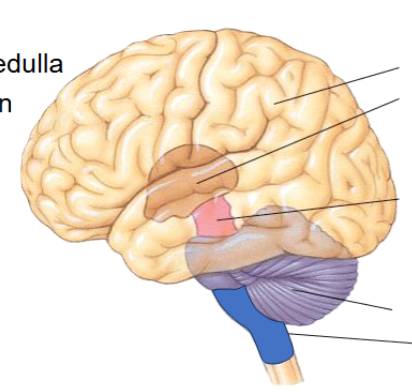
Metencephalon
2 parts
Cerebellum
Pons
RF

Mesencephalon
Tectum
Superior colliculi ( visual motor )
Inferior colliculi ( auditory )
Tegmentum
RF
Red nucleus (sensorimotor)
Substantia nigra (sensorimotor)
Periaqueductal gray (analgesic)

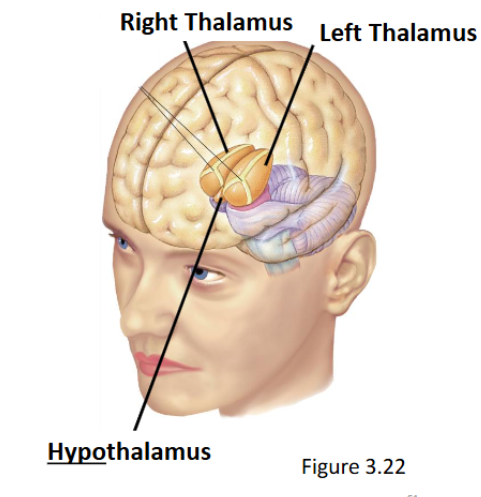
Diencephalon
Small Area in forebrain
Thalamus
Sensory Relay Nuclei
Hypothalamus
Below thalamus
Above PG
Endocrine function
Motivated behaviors
Optic Chiasm
Telencephalon - Cerebral Hemispheres
Largest Divison
Characterized by cortex
Many convolutions . folds
Fissures and Gyri
Commisures connect TWO hemispheres
ie. corpus callosum
Four Lobes
Frontal (Motor)
Parietal (Sensory)
Temporal (Auditory)
Occipital (Visual)

Subcortical Areas - Limbic System
Regulates motivated behaviors
Structures
Amygdala
Hippocampus
Mammillary body
Fornix
Septum

Subcortical Areas - Basal Ganglia
Regulates movement
Structures
Striatum ( Caudate & Putamen )
Nucleus Accumbens
Globus Pallidus
Pathway to substantia nigra to striatum deteriorates with Parkinson’s

Summary of Brain Structures
