CHEM 3653: Homework 8
 Call Kai
 Learn
 Practice Test
 Spaced Repetition
 Match
 Flashcards
 Knowt Play
1/51

There's no tags or description
Looks like no tags are added yet.
52 Terms

The image shows six bases, nucleosides, or nucleotides. Match each description with the corresponding structure. Only four of the structures have a corresponding description.
purine base

The image shows six bases, nucleosides, or nucleotides. Match each description with the corresponding structure. Only four of the structures have a corresponding description.
pyrimidine base

The image shows six bases, nucleosides, or nucleotides. Match each description with the corresponding structure. Only four of the structures have a corresponding description.
pyrimidine nucleoside

The image shows six bases, nucleosides, or nucleotides. Match each description with the corresponding structure. Only four of the structures have a corresponding description.
purine nucleoside

The image shows six bases, nucleosides, or nucleotides. Match each description with the corresponding structure. Only four of the structures have a corresponding description.
pyrimidine nucleotide

The image shows six bases, nucleosides, or nucleotides. Match each description with the corresponding structure. Only four of the structures have a corresponding description.
purine nucleotide

Identify the base type and sugar group in each nucleotide or nucleoside.
Molecule 1
pyrimidine, deoxyribose

Identify the base type and sugar group in each nucleotide or nucleoside.
Molecule 2
purine, deoxyribose

Identify the base and sugar group in each nucleotide or nucleoside.
Molecule 3
pyrimidine, ribose
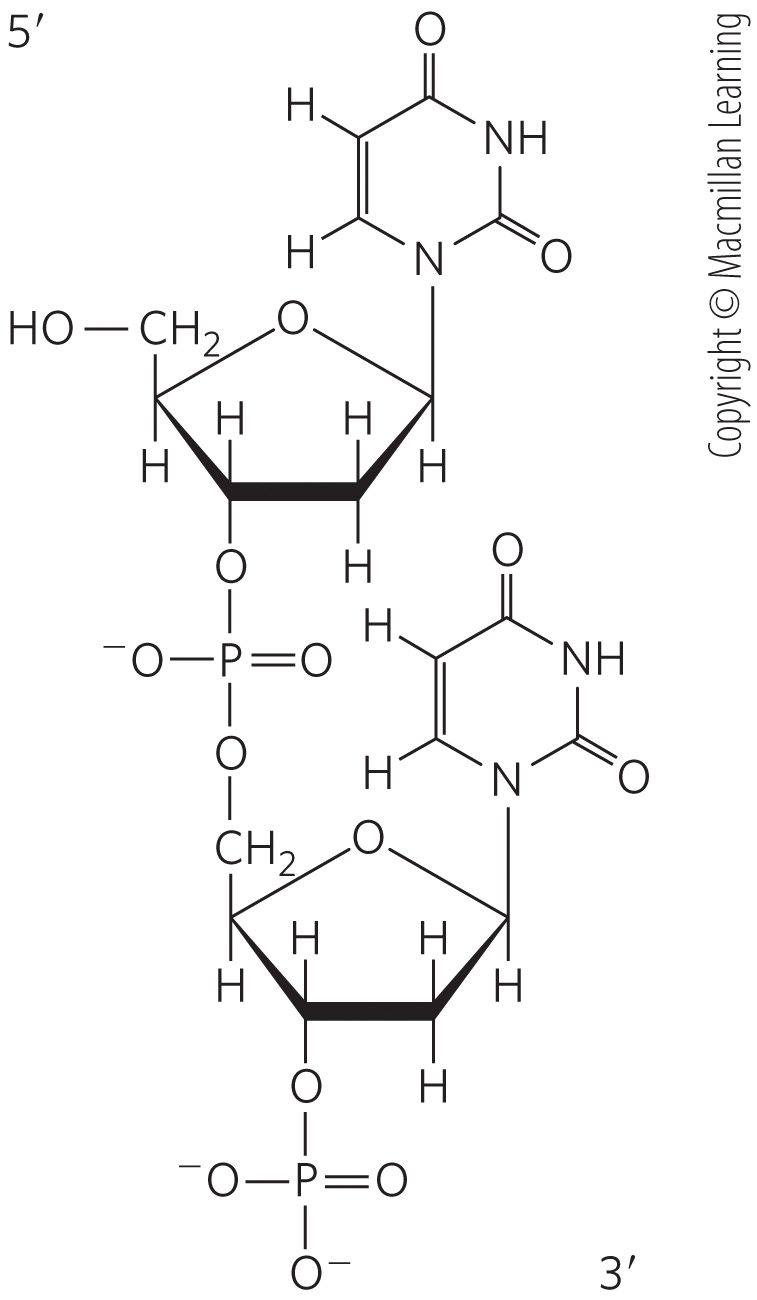
A research assistant isolates the dinucleotide shown here from a lake bacterium.
Is the dinucleotide RNA or DNA?
DNA, because it contains deoxyribose.
A short duplex RNA has the sequence AUGGUACCA. What is the sequence of the complementary RNA strand?
UGGUACCAU
If completely unraveled, all of a human's DNA would be able to reach a distance of nearly 3.2×10⁵ km, the distance from Earth to the Moon. Given that each base pair (bp) in a DNA helix extends a distance of 3.4 Å (angstroms), calculate the number of base pairs found within the entirety of a human's DNA.
Please enter your answer to two significant figures using scientific notation.
9.4 × 10¹⁷
Suppose a double-stranded DNA segment is 2520 base pairs long.
Calculate the number of helical turns if the DNA were in the B form, given that B‑form DNA contains 10.5 base pairs per helical turn.
240
Suppose a double-stranded DNA segment is 2520 base pairs long.
Calculate the number of helical turns if the DNA were in the Z form, given that Z‑form DNA contains 12 base pairs per helical turn.
210
One strand of a DNA duplex has the sequence GACCTTAAAGC. What is the sequence of the complementary strand?
GCTTTAAGGTC
A duplex DNA oligonucleotide in which one of the strands has the sequence CCCTATAGTGAGTCGTATTA has a melting temperature (𝑡m) of 63 °C.
If an RNA duplex oligonucleotide of identical sequence, substituting U for T, is constructed, how will its melting temperature compare to that of its DNA counterpart?
The 𝑡m will be higher.
Many eukaryotic cells have highly specialized systems that specifically repair G–T mismatches in DNA. The mismatch is repaired to form a G≡C (not A=T) base pair. This G–T mismatch repair mechanism occurs alongside a more general system that repairs virtually all mismatches.
Why might cells require a specialized system to repair G–T mismatches?
G–T mismatches commonly result from the spontaneous deamination of
5-methylcytosine to thymine
AMP is a constituent of many different coenzymes, including coenzyme A.
What is its function of AMP in the coenzyme A structure?
The adenine component generally serves as a binding handle, interacting with enzyme active sites.
In biochemical reactions, when a nucleophile attacks the α-phosphoryl group of ATP, the leaving group is almost always pyrophosphate (the nucleophile becomes linked to AMP) rather than adenosine.
Complete the passage explaining this.
A _____ bond joins the α‑phosphoryl group to adenosine. A _____ bond joins the α‑phosphoryl group to the last two phosphoryl groups. Cleavage of the _____ bond will yield the greatest chemical energy.
phosphate ester, phosphoanhydrine, phosphoanhydrine
Bacterial endospores form when the environment no longer supports active cell metabolism. The soil bacterium Bacillus subtilis, for example, begins sporulation when one or more nutrients are depleted. The end product is a small, metabolically dormant structure that can survive almost indefinitely with no detectable metabolism. Spores have mechanisms that prevent the accumulation of potentially lethal mutations in their DNA during dormancy that can exceed 1,000 years. B. subtilis spores are much more resistant than are the organism’s growing cells to heat, UV radiation, and oxidizing agents, all of which promote mutations.
One factor that prevents potential DNA damage in spores is their greatly decreased water content.
How would decreasing the water content affect some types of mutations?
Low water content in endospores decreases the rate of depurination reactions.
Bacteria form endospores when the environment no longer supports active cell metabolism. The soil bacterium Bacillus subtilis, for example, begins sporulation when it depletes one or more nutrients. The end product is a small, metabolically dormant structure that can survive almost indefinitely with no detectable metabolism. Spores have mechanisms that prevent the accumulation of potentially lethal mutations in their DNA during dormancy, which can last more than 1,000 years. B. subtilis spores are much more resistant than are the organism’s growing cells to heat, UV radiation, and oxidizing agents, all of which promote mutations.
Endospores have a category of proteins called small acid‑soluble proteins (SASPs) that bind to their DNA, preventing formation of cyclobutane‑type dimers.
What causes cyclobutane dimers?
ultraviolet (UV) light
A typical bacterial repressor protein discriminates between its specific DNA‑binding site (operator) and nonspecific DNA by a factor of 104 to 106. About 10 molecules of repressor per cell are sufficient to ensure a high level of repression.
Assume that a very similar repressor existed in a human cell, with a similar specificity for its binding site. How many copies of the repressor would a human cell require to elicit a level of repression similar to that in the bacterial cell?
(Hint: The E. coli contains about 4.6 million bp; the human haploid genome has about 3.2 billion bp.)
Enter your answer to the nearest thousand.
7000
The observation that people who have diabetes insipidus form large quantities of dilute urine supports the “simple permeability” hypothesis for the function of aquaporins because these individuals have a genetic defect in a gene that encodes for an aquaporin.
The statement is correct
The chloride-bicarbonate antiporter in red blood cells moves chloride ions into the cell and bicarbonate ions out of the cell as the red blood cells pass through the respiring tissues, and they move chloride ions out of the cell and bicarbonate ions into the cell as the red blood cells enter the alveoli in the lungs.
Correct

Given the plot shown below, which of the following represent valid combinations of terms that could go on the x- and y-axes? Select all that apply.
rate of transport on the y-axis, and concentration gradient (i.e., progressively increasing c1/c2) on the x-axis (for a small-to-medium sized, polar molecule moving through a cell membrane, possibly with the help of transporters)
Imagine that there is a 100-fold concentration gradient of an uncharged, medium-sized, and polar molecule inside the cell versus the outside of the cell (i.e., the concentration is 100 times greater inside the cell). Imagine further that a ligand-gated channel has just opened, and that the molecule mentioned above can now pass through the channel. In terms of kcal/mol, what is the “driving force” for the exit of the above-mentioned molecule out of the cell. Assume the membrane potential is −65 mV (inside of the cell negative relative to outside the cell). Assume also that the temperature is 37 °C.
2.8 kcal/mol of free energy available to “drive” the molecules inside the cell
GABA stands for gamma-aminobutyric acid, and it is a major inhibitory neurotransmitter in the brain. When two GABAs bind to the GABAA receptor, a resulting conformational change allows the passage of chloride ions from the synaptic cleft into the neuron. Thus, the GABAA receptor is a ligand-gated receptor. When two GABAs bind to the GABAA receptor and trigger the opening of the Cl− channel, what is the ∆Gt (in kcal/mol) for the transport of Cl− ions into the neuron? Assume the following conditions: [Cl−] is 10 mM and 180 mM inside and outside the neuron, respectively; the transmembrane potential is −60 mV (inside of the neuron negative relative to the outside of the neuron); assume also that the temperature is 37 °C; and F is 23.1 kcal/V∙mol.
−0.39 kcal/mol
Consider the situation in which a semipermeable membrane (permeable to ions but not to larger proteins) is used to separate two chambers. One chamber has proteins that have net negative charges at the pH of the buffer solution. If one adds KCl and allows the diffusion of K+ and Cl− ions to reach equilibrium (i.e., a Donnan Equilibrium), then what is the membrane potential (absolute value in mV to the nearest ones) across the membrane if the [K+] in the chamber with the proteins is 130 mM and [K+] in the chamber without the proteins is 15 mM? Assume a temperature of 25 °C.
55 mV
If it costs 11.0 kcal/mol to “run” the Na/K ATPase (i.e., pumping 3 Na+ ions out of the cell and 2 K+ ions into the cell per 1 ATP hydrolyzed), then what is the minimum concentration of ATP required to provide just enough energy to run the Na/K ATPase? In other words, what does the concentration of ATP need to be so that the free energy of ATP hydrolysis is −11.0 kcal/mol. Assume that ΔG°′ is −7.3 kcal/mol, [Pi] is 3.5 mM, [ADP] is 0.9 mM, the pH is 7.2, and that the temperature is 37 °C.
0.8 mM
Primary active transport directly uses the free energy of ATP hydrolysis to transport a substance against a gradient, whereas secondary active transport takes advantage of a gradient that was already built up (through primary active transport) to move a substance against its concentration gradient at the same time another substance (the one whose concentration was built up through primary active transport) moves down its concentration gradient. In other words, the secondarily transported substance is “hitching a ride” with the primarily transported substance.
The statement is correct
When the neurotransmitter acetylcholine is released into the synaptic cleft, it diffuses to the nearby muscle cell and binds to receptors on the surface of the muscle cell. This process leads to muscle contraction. How is the message to contract “turned off”?
Acetylcholine is degraded to acetate and choline by the enzyme acetylcholinesterase
The potassium ion channel has a pore diameter that is 3 Å, which is larger than the ionic diameters of Li+ (1.2 Å), Na+(1.9 Å), and K+(2.66 Å). Nonetheless (and although it seems counterintuitive), the potassium ion channel allows the larger potassium ions to pass through, but it effectively precludes the passage of the smaller Li+ ions and Na+ ions.
The statement is correct
When SNARE-mediated fusion of a vesicle with the plasma membrane is complete, phospholipids that were on the inner leaflet of the vesicle are found on the outer leaflet of the plasma membrane of the cell.
The statement is true
The pH of gastric juice is 1.2. The cells that produce gastric juice have an internal pH of 7.3. What is ∆G (in terms of kcal/mol) for transport of protons from these cells into the stomach at 37 °C? The gas constant is 1.987 cal/K mol, and the value of Faraday's constant is 23.1 kcal/Vmol. Assume that the potential difference across the membrane separating the cells and the interior of the stomach is –81 mV (inside of cells negative relative to the lumen of the stomach). Report your answer to the nearest tenth of a unit.
10.5
In a cell, if the concentration of Na+in = 10 mM and the concentration of Na+out = 135 mM, what is the value of ΔG for the transport of one mol of Na+ ions into the cell? Assume a temperature of 37 °C and a membrane potential of –60 mV (inside of the cell negative relative to outside the cell).
Also, F = 23.1 kcal/V*mol. Report your answer in terms of kcal/mol to the nearest hundredth of a unit.
-2.99
In E. coli, oxidation-reduction reactions (or ATP hydrolysis) within the cell membrane generates a ΔpH of 1.2 (interior higher by 1.2 unit) and a ΔV of –116 mV (interior negative). Along with H+ ions, beta-galactosides are cotransported in response to the total "proton motive force." How much energy (in kcal/mol) is made available by the above ΔpH and ΔV? Be sure to include the sign of ∆G in your answer. The temperature is 37 °C, F = 23.1 kcal/V·mol. Report your answer to the nearest hundredth of a unit.
-4.38
To what maximum concentration gradient could E. coli accumulate beta-galactosides if its pumping of H+ ions from inside the cell to outside the cell resulted in a ΔpH of 1 (interior higher by 1 unit) and a membrane potential of –118 mV (interior negative). In other words, imagine that the E. coli are going to use the free energy of the H+ ions coming back into the cell (which they are poised to do) to bring in (or cotransport) beta-galactosides into the cell against their concentration gradient such that the maximum possible gradient allowable is obtained, which is due to the maximum amount of free energy available to do so. Again, the temperature is 37 °C, and F = 23.1 kcal/V*mol. Report your answer to the nearest ones.
835
Imagine an ion, which has a charge of +1, going from a concentration c1 on one side of the plasma membrane to a concentration c2 on the opposite side of the membrane: c1 ⇌ c2. Imagine also that at equilibrium an uneven distribution of the ion across the membrane (due in part to relatively large, net negatively charged and impermeable proteins on one side of the membrane) leads to a resting membrane potential of –118 mV (inside the cell negative relative to outside the cell). Such an equilibrium is called a Donnan Equilibrium. What is the maximum ratio of c2/c1 that would exist? Use 23.1 kcal/V*mol for Faraday's constant and 37 °C for the temperature (which you of course have to convert to the Kelvin scale by adding 273). Report your answer to the nearest ones.
84
The sodium potassium pump transports 5 ions for every molecule of ATP that is hydrolyzed: 3 Na+ out of the cell and 2 K+ into the cell. The pump maintains internal Na+ at 13 mM and external Na+ at 144 mM; it maintains internal K+ at 138 mM and external K+ at 9 mM. Assuming that the membrane potential is –69 mV (inside negative relative to outside), the temperature is 37 °C, and F is 23.1 kcal/V·mol, how much energy does it take to run the pump (i.e., how many kcal of energy are required per 5 mol of ions pumped)? Report your answer to the nearest tenth of a unit.
9.4 kcal
Human erythrocytes have about 2.2 x 10⁵ aquaporin (AQP-1) monomers. If water molecules flow through the plasma membrane at a rate of 5.1 x 10⁸ per AQP-1 tetramer per second, and the volume of an erythrocyte is 5.3 x 10⁻¹¹ mL, how rapidly (in seconds) could an erythrocyte halve its volume as it encounters the high osmolarity (1 M) in the interstitial fluid of the renal medulla? Assume that the interior of the erythrocyte consists entirely of water. Also, the rate of diffusion of water across the membrane can be ignored in this problem. Report your answer to the nearest thousandth.
0.032 seconds
So, you want to be a moleionaire? People have a hard time trying to conceptualize just how large a number a mole is. Perhaps this question will help you in this regard. Suppose you had a mole of dollars and were allowed to spend one billion dollars per second for the next 89 years. At the end of this time, what percent of your original mole of dollars would you have left? Enter your answer to the nearest ones.
100%
In 1925, E. Gorter and F. Grendel, studied erythrocytes from a dog and obtained data similar to the following: volume of packed cells (38 mL); number of cells (7.96 x 10⁶ per mm3); Total surface area of lipid monolayer from cells (63 m2); Total surface area of one cell (98 μm2). Calculate the total surface area (in terms of μm2 to the nearest ones) of lipid monolayer per cell. Think about whether the figure you calculated supports the claim that cell membranes are composed of a bilayer.
208
Derive an expression that relates the surface area (SA) of a cylinder to the volume (V) of a cylinder (i.e., SA:V). Then derive an expression that relates the SA:V of one cylinder to that of another cylinder and use this relationship to compare the SA:V of a ~cylinder-shaped Escherichia coli to the SA:V of a ~cylinder-shaped Bacillus megaterium. E. coli is 2.1 μm in length and 0.5 μm in diameter whereas B. megaterium is 3.9 μm in length and 1.5 μm in diameter. Report your answer to the nearest tenths. For example, if your answer was 6.9:1 you would just report 6.9, the "to one" part is understood.
2.8
You need a strong acid for an experiment, and you are given a bottle that you are told contains a strong acid at 15.0 M concentration. (The name of the acid on the label was rubbed off, so you are not sure of the identity of the acid.) You make a 0.1 M solution and you want to know if you can assume that the [H+] will be 0.1 M since the acid is a strong acid and thus should (so you have been told) completely dissociate. You see that the label on the bottle lists a pKa for the acid of -6.5. A pKa? Why does a strong acid have a pKa? You decide that you better calculate the relative error that will result when you make the assumption that a 0.1 M solution of the strong acid will result in a 0.1 M [H+] versus the concentration that you obtain when you properly treat the dissociation using the listed pKa value. Normally, the relative error is expressed as follows: Er = ((xi – xt)/xt) × 100; where xi is the value under the assumption that complete dissociation occurs and xt is the true or actual value obtained when the pKa of the acid is taken into account. Now, the units for an answer that is expressed as a percent could equivalently be stated as “parts per hundred”. Because the value of ((xi – xt)/xt) is likely to be a small number, I want you to multiply this value by 109 rather than 102 (as shown in the above equation). Thus, your answer will be in terms of parts per billion (ppb), and you should report your answer in these terms to the nearest ones (e.g., enter “11” if your answer is 11 ppb). For this problem, you can ignore the contribution of H+ ions due to the autoproteolysis of water. You will need to do this problem with the aid of a spreadsheet, and be sure to adjust the format of the cells to retain several figures beyond the decimal point.
32 ppb

The hydrogen attached to N3 of cytosine (see structure below, which shows cytosine as it predominantly exists at physiological pH) has a pKa of 4.4. Which form of cytosine will predominate in a solution that contains cytosine and is at a pH of 4.8?
The form that does not have the hydrogen attached to N3 of cytosine.

The compound 5′ guanosine monophosphate (5′ GMP) is shown below. The hydroxyl that is part of the phosphoryl group and labeled “1” has a pKa of 0.7; the hydroxyl that is part of the phosphoryl group and labeled “2” has a pKa of 6.1; the protonated N1 of the guanine moiety has a pKa of 9.4 (N1 is negatively charged when it is unprotonated), and the protonated N7 of the guanine moiety has a pKa of 2.4 (N7 is neutral when it is unprotonated). Given this information, what will be the average net charge of 5′ GMP when the pH equals 6.1? Hint: one way to calculate the average net charge is as follows: Net charge = Σqifi, where qi is the charge on the ith group and fi is the fraction of the ith group that is in the charged form. To simplify matters, assume that if the pH is 2 or more units from the pKa of a particular group, then that group is completely protonated or unprotonated, as the case might be. If the pH is less than 2 units from the pKa of a particular group, use the Henderson-Hasselbalch equation to determine the ratio of charged to uncharged form for that group, then convert that ratio to a fraction.
-1.5
Chargaff determined that A = T and G = C in all isolated DNA regardless of species. Therefore, it logically follows that A + G = T + C.
Yes, it does logically follow that A + G = T + C
In the late 1920s, the British physician Frederick Griffith injected a mouse with a preparation that included a mixture of the nonvirulent, rough strain of a pneumococcal bacterium and the virulent, heat-killed smooth strain of the same bacterium. What happened to the mouse?
It died

Which atom of guanine forms the N-glycosidic bond to the 1′ carbon of ribose (or deoxyribose) in a nucleoside (or deoxynucleoside)?
N9
Adenylate refers to which of the following?
Adenosine 5´-monophosphate (AMP)
At physiological pH, adenine has
5 carbons, 5 hydrogens, and 5 nitrogens
Select all the appropriate descriptions that apply to pseudouridine 5′-monophosphate. (Hint: although you may not have encountered this molecule before, you can use what you know about the structures of nucleotides/nucleosides and naming conventions to figure this out.)
It is a purine nucleotide
It is a pyrimidine nucleoside
It is a pyrimidine nucleotide
It has a triphosphoryl group
It has a monophosphoryl group
It has a diphosphoryl group
It is a purine nucleoside
Options 3 and 5