PSYC1002 - Learning/Motivation: Classical Conditioning
 Call Kai
 Learn
Learn Practice Test
 Spaced Repetition
 Match
Match Flashcards
 Knowt Play
1/20

Earn XP
Description and Tags
1. What is classical conditioning? 2. Understand the terminology in classical conditioning (CS, CR, US, UR). 3. Describe different examples/types of classical conditioning. 4. What is second-order conditioning? 5. What is extinction? 6. Why do conditioned responses return following extinction?
Name | Mastery | Learn | Test | Matching | Spaced | Call with Kai | Chat |
|---|
No analytics yet
Send a link to your students to track their progress
21 Terms
What is learning?
An enduring change within an organism brought about by an experience that leads to a change in behaviour.
What is associative learning?
An enduring change brought about by experience of associations which leads to a change in behaviour.
Who pioneered conditional learning?
Ivan Pavlov - 1849-1936
What is the US in Pavlov’s dog?
Unconditioned stimulus is the food.
What is the UR in Pavlov’s dog?
The unconditioned response is the salivation to food.
What is the CS in Pavlov’s dog?
The conditioned stimulus is the bell.
What is the CR in Pavlov’s dog?
The conditioned response is the salivation to the bell.
Is the conditioned response always the same as the unconditioned response?
No
What are examples of the UR and CR which are not the same?
UR being escape behaviour and CR being fear.
What is different between first and second order conditioning?
Second order conditioning does not require direct experience of the US, in order for it to happen
What is second order conditioning?
The conditioned stimuli (CS1) is first paired with the unconditioned stimuli (US). A second conditioned stimuli (CS2) is then paired with the first conditioned stimuli (CS1) but not the unconditioned stimuli (US). Despite the CS2 not being directly paired with the US it will still present the same response.
In second order conditioning, is the CS2 paired with the US?
No

What are examples of appetitive conditioning?
Food preferences
Place preferences
What are examples of Aversive conditioning?
Anticipatory nausea
Place avoidance (avoid pubs from parmi food sickness)
Conditioned taste aversion (get food sickness eating a parmi)
Conditioned fear
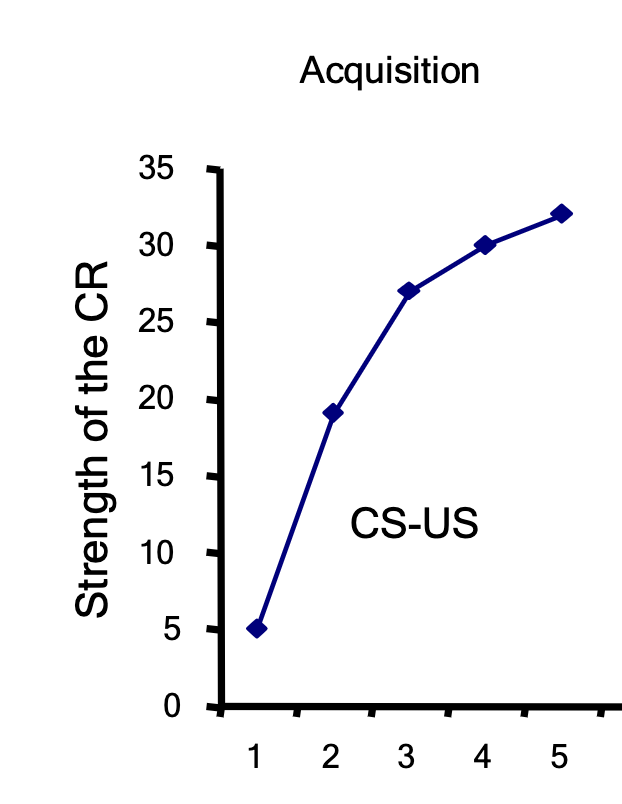
What is acquisition?
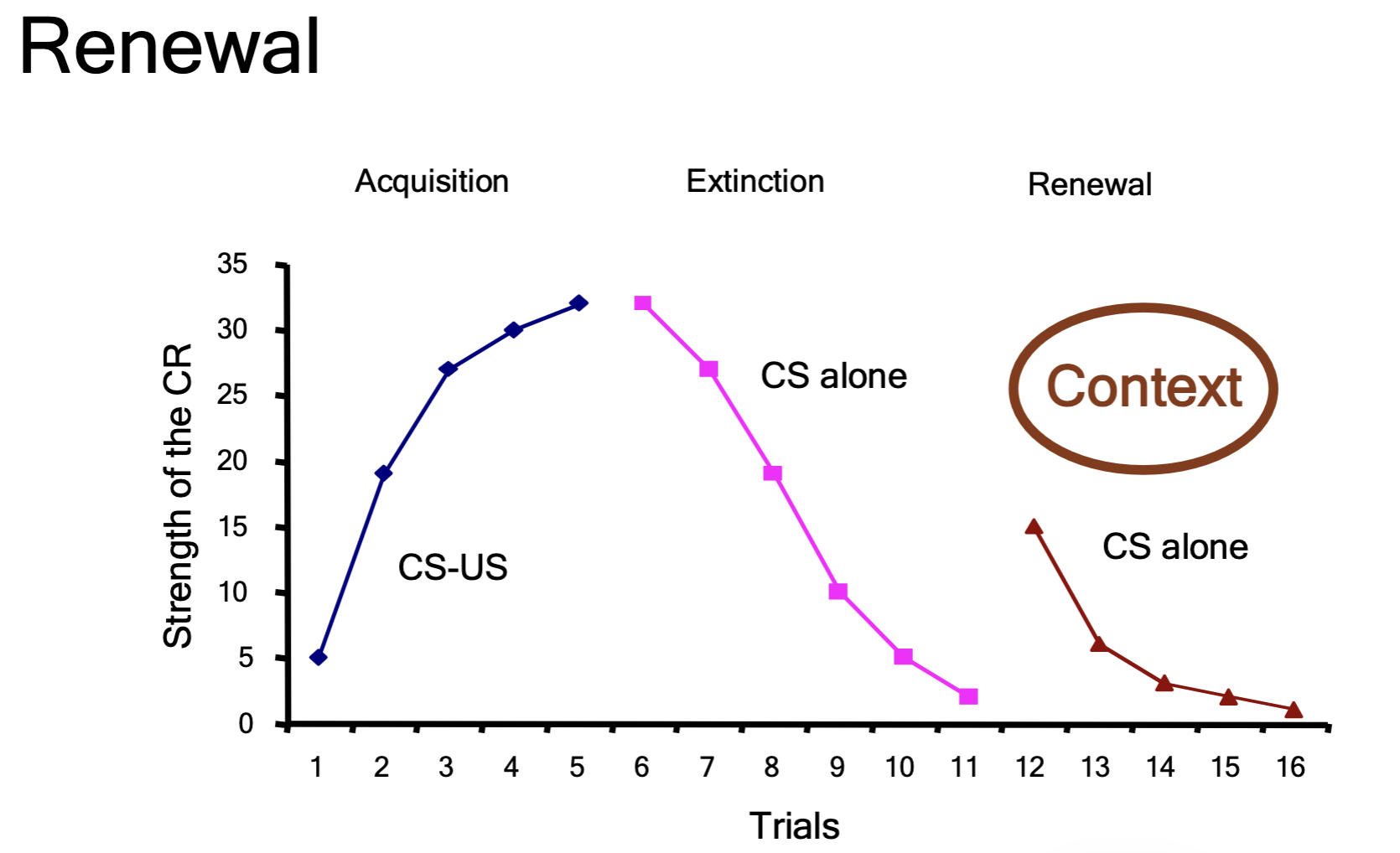
Acquisition is the repeated presentations of the CS paired with the US resulting in an increase in the CR when presented with the CS.
What is extinction?
Extinction is repeated presentations of the CS without the US after acquisition resulting in a reduction of the CR when presented with the CS.

Is extinction the same as “unlearning” a behaviour?
No. You have competing memories of the acquisition (CS-US) and extinction (CS-no US).
Can the acquisition memory return?
Yes:
spontaneous recovery
renewal
What is spontaneous recovery?
Spontaneous recovery is when the original condition response returns due to the passing of time.

What is renewal?
The renewal of the conditioned response due to a change in context.
What is a challenge for exposure therapy?
Having the response generalise beyond the therapy when the context changes to the outside world.