04 Utility and Preference
 Call Kai
 Learn
 Practice Test
 Spaced Repetition
 Match
 Flashcards
 Knowt Play
1/47

Earn XP
Description and Tags
UCL MATH0002 Topic 04 — core slides 1–14 and summary of 04_Utility_Preference.pdf. Utility, preferences, indifference curves, signed MRS, convex preferences, perfect substitutes and complements. Self-contained questions for shuffled study.
48 Terms
What three assumptions underlie the model of consumer choice?
Preferences determine satisfaction from consumption; consumers face constraints (e.g. money or regulations); consumers maximise satisfaction subject to those constraints.
What is a consumption bundle X?
X = (x₁, x₂, …, xₙ) lists the quantity of each good consumed per time period. With two goods, a bundle is X = (x, y).
Why do we model consumer choice between bundles rather than individual goods?
Satisfaction from a good depends on how much of it and of other goods the consumer already consumes.
What are cardinal utility and a utility function U(X)?
Cardinal utility measures satisfaction or happiness in utils. U(X) assigns utility to each bundle X. Later, ordinal utility uses these numbers only to rank bundles.
How does a rational consumer choose using a utility function?
Choose an available bundle with the largest utility. If several bundles share the highest utility, choose any one of them.
If U(x, y) = 2x + y, which bundle is preferred: (2,1) or (1,2)?
U(2,1) = 5 and U(1,2) = 4, so (2,1) is preferred.
What is the two-good Cobb–Douglas utility function?
U(x, y) = Cxᵃyᵇ, where a, b, C > 0. Holding either good fixed leaves a power-law function of the other good.

For U(x, y) = √(xy), which bundle is preferred: (1,3) or (2,2)?
U(1,3) = √3 < U(2,2) = 2, so (2,2) is preferred.
What is marginal utility of good x?
MUₓ = ∂U/∂x ≈ ΔU/Δx: the change in utility from a unit increase in x, holding the quantities of other goods constant.
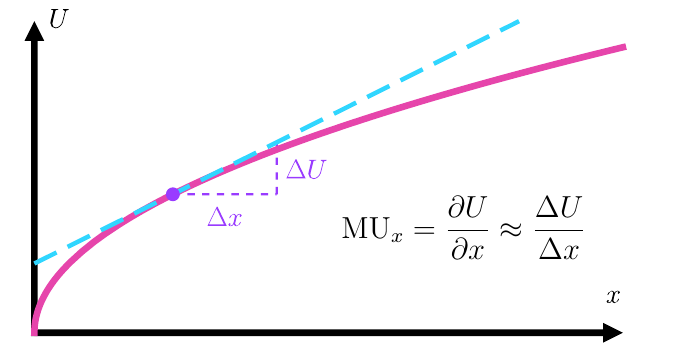
For U(x, y) = √(xy), what are the marginal utilities at (x,y) = (4,1)?
MUₓ = ½√(y/x) = ¼; MUᵧ = ½√(x/y) = 1. An additional unit of y gives four times the marginal utility of an additional unit of x at this bundle.
What does monotonicity imply about marginal utility?
MUₓ ≥ 0 (and similarly for other goods): more of any good is better or at least no worse.
What is diminishing marginal utility?
MUₓ decreases as x increases, holding other goods constant: the more apples consumed, the less additional satisfaction from one more apple.
Why can observed choices not identify cardinal utility values?
Different utility functions can give exactly the same ranking of bundles and hence the same choices. Behaviour reveals rankings, not a numerical measure of happiness.
What does ordinal utility mean?
Utility is a tool for ranking bundles. Only whether U(X) is greater than, equal to, or less than U(Y) matters; the numerical values themselves have no actual meaning.
Which transformations of a utility function preserve consumer preferences?
V = f(U) preserves preferences if f is strictly increasing over the relevant utility range. Examples: U³, e^(5U), and 7U − 3.
Why do U(x, y) = √(xy) and V(x, y) = xy give the same choices for nonnegative quantities?
V = U² and U ≥ 0, so V is a strictly increasing transformation of U. Both rank (2,2) above (1,3), and preserve all other bundle rankings.
Can ordinal utility values be compared between different people?
No. Utility values cannot be compared across people; they represent each person’s own ranking of bundles.
What do X ≿ Y, X ≻ Y and X ∼ Y mean?
X ≿ Y: X is weakly preferred to Y, like U(X) ≥ U(Y). X ≻ Y: X is strictly preferred, like U(X) > U(Y). X ∼ Y: indifference, like U(X) = U(Y).
What does completeness of consumer preferences mean?
Any two bundles can be compared: X ≻ Y, Y ≻ X, or X ∼ Y. Incomparable bundles are excluded.
What does transitivity of consumer preferences mean?
If X ≿ Y and Y ≿ Z, then X ≿ Z. Preferences are rational when they are complete and transitive.
How can indifference and strict preference be expressed using weak preference ≿?
X ∼ Y means both X ≿ Y and Y ≿ X. X ≻ Y means X ≿ Y but not Y ≿ X.
What is an indifference curve (IC), also called an isoutility curve?
It joins all two-good bundles (x,y) that are equally desirable: they have the same utility. Each bundle is a point in the plane.
What is an indifference map?
The complete set of indifference curves. The curves are contours of the utility function, like contours on a topographical map.

For U(x, y) = √(xy), what is the indifference curve through (1,1)?
U(x,y) = U(1,1) = 1, so √(xy) = 1 and y = 1/x for x > 0.
For U(x, y) = √(xy), what is the indifference curve with utility c > 0?
√(xy) = c gives xy = c², so y = c²/x for x > 0.
What does weak monotonicity mean in these consumer-preference slides?
Strictly more of every good is strictly better. More of only some goods, with none reduced, is better or equally good.
Under weak monotonicity, how does (3,4) compare with (2,1) and with (3,1)?
(3,4) ≻ (2,1), since both quantities rise. Also (3,4) ≿ (3,1): with only y increased, it may be strictly better or equally good.
Under weak monotonicity, which bundles are definitely better or worse than a bundle X = (x,y)?
Bundles strictly above and right of X are better; bundles strictly below and left are worse. In the other two quadrants, the ranking depends on preferences and the IC.

Under weak monotonicity, which indifference curves are preferred?
Curves above and to the right (farther from the origin) represent strictly preferred bundles. Every bundle lies on some IC.
Under weak monotonicity, what slopes can indifference curves have?
They cannot slope strictly upwards. They slope downwards, allowing horizontal segments (slope 0) and vertical segments (slope −∞).
Why are upward-sloping, crossing or thick indifference curves disallowed in these slides?
Each would allow indifferent bundles X ∼ Y with Y strictly above and right of X, contradicting weak monotonicity.
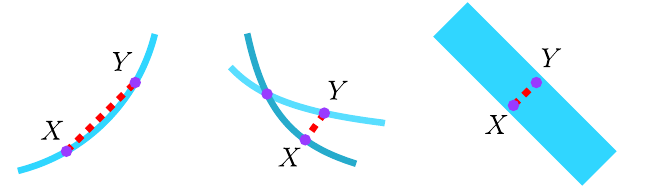
How do an indifference map, a preference relation and a utility function compare as descriptions of preferences?
They convey the same ranking information. To compare two bundles on an indifference map, compare which bundle lies on the preferred IC.
What is the marginal rate of substitution (MRS) of y for x?
The slope of the indifference curve at a given bundle: MRS = dy/dx. These slides use the signed slope, which is negative or zero.

What does convexity of an indifference curve imply geometrically?
A line between two points on the curve lies above or farther from the origin than the curve; a tangent lies below or closer to the origin. Bundles at least as good as the IC form a convex set.

What do ICs and MRS look like for perfect complements?
ICs are L-shaped. On their horizontal and vertical parts MRS is 0 or −∞, respectively; at the kink there is no single slope. A shortage in one good cannot be compensated by a surplus in the other.
