BIO 2102 A&P 2 CH25-27
 Call Kai
 Learn
 Practice Test
 Spaced Repetition
 Match
 Flashcards
 Knowt Play
1/136

There's no tags or description
Looks like no tags are added yet.
137 Terms
Nutrition
process by which the body uses and obtains certain components of food
nutrients
substances taken into the body and used by cells to produce energy, synthesize molecules, and to use in chemical reactions
digestion, absorption, transportation, cell metabolism
What are the 4 components of nutrition?
carbohydrates, lipids, proteins, vitamins, minerals, water
What are the 6 classes of nutrients?
calorie
the amount of energy required to increase the temperature of 1 gram of water by 1 degree Celcius
Kilocalorie
Whats the name for 1000 calories
Carbohydrates
its separated into monosaccharides, disaccharides, and polysaccharides
complex carbohydrates
they’re polysaccharides; they require more digestive “work” to break down
95%
what percent of lipids in a human diet are triglycerides?
saturated & unsaturated
what are the 2 main categories of lipids?
trans fats
typically industrially processed polyunsaturated fats to alter the stability of a fat
proteins
What are amino acids
essential amino acids
The general the 9 amino acids that the body cannot synthesize
conditionally essential amino acids
amino acids that can normally be synthesized, but no under specific conditions such as during premature birth
complete protein
name for a _____ that contains all 9 essential amino acids
incomplete protein
name for a _____ that does not contain all 9 essential amino acids
vitamins
organic molecules that exist in small quantities in food and are essential to metabolism
essential vitamins
They are _____ that cannot be produced by the body and must be ingested
provitamins
an incomplete _____ that the body can convert into a functional vitamin
form coenzymes
whats the function of vitamins
minerals
inorganic nutrients necessary for normal metabolism
metabolism
the total sum of all chemical reactions in the body
catabolism
whats the energy-releasing process of breaking molecules into smaller pieces called?
anabolism
whats the energy-requiring process of building larger molecules from smaller molecules called?
glycolysis
the breakdown of glucose into 2 pyruvate molecules and 4 ATP
Anaerobic fermntation
process that happens in the absence of oxygen, glycolysis products form 2 lactate molecules from 2 pyruvate
Aerobic respiration
catabolism of glucose in the presence of oxygen
carbon dioxide, water and ATP
what does aerobic respiration produce?
glycolysis, Acetyl-CoA formation, Kreb’s cycle, Electron transport chain
what are the 4 phases aerobic respiration
Electron transport chain
The name for the process where a series of electron carrier proteins within the inner mitochondrial membrane cycle in and out?
ATP synthase
enzyme thatsynthesizes ATP molecules within mitochondria during aerobic respiration
lipids
primary energy-storage molecules in adipose tissue
free fatty acids
circulating fatty acids no longer bound to glycerol
glycogenesis, lipogensis, glycogenolysis, gluconeogenesis
what are the 4 processes involved in glucose use and storage
glycogenesis
process forming glycogen; stimulated by insulin
lipogenesis
process of lipid formation from excess glucose and amino acids
glycogenolysis
breakdown of glycogen and liberation of stored glucose into the blood; stimulated by glucagon
gluconeogenesis
synthesis of glucose by the liver in the absence of glycogen
absorptive state, postabsorptive state
what are the 2 major metabolic states
absorptive state
period immediately following a meal when nutrients are being absorbed from the digestive system
Postabsorptive state
period between absorptive staes when blood glucose is maintained by interconversion of molecules
metabolic rate
the total amount of energy produced and used y the body per unit of time
basal metabolism, thermic effect of food, muscular activity
what are the 3 ways metabolic energy are used?
Basil metabolic rate
energy required to keep a resting body functional
age, body temperature, sex, pregnancy, body composition
what are the various factors that influence BMR?
thermic effect of food
the energy cost of digestion and absorption
30%
what percent of the total energy expenditure does muscular activity use?
free energy
the total amoutn of energy derived from ingested food
57%
how much energy is lost as internal body heat?
43%
how much energy is captured in the form of ATP
radiation, conduction, convection, evaporation
what are the 4 ways that human exchange heat with the environment
radiation
exchange of heat between 2 objects that are not in physical contact
conduction
exchange of heat between 2 objects in physical contact
convection
exchange of heat between the body and air/water as it moves across the surface of the skin
evaporation
loss of heat energy via the conversion of water to vapor
negative feedback mechanisms
what is body temperature maintained by?
skin vasodilation, sweating
what are the 2 heat loss mechanisms in the body?
skin vasoconstriction, shivering
what are the 2 heat gain mechanisms
excretion, regulation of blood volume and pressure, regulation of blood solute concentrations, regulation of extracellular fluid pH, regulation of red blood cell synthesis, regulation of vitamin D synthesis
what are the 6 major functions of the urinary system
excess water, excess ions, metabolic wastes, toxic substances
what are the wastes that are included in urine?
excretion
process when kidneys filter blood to remove wastes
kidneys, ureters, urinary bladder, urethra
what are the 4 major structures of the urinary system?
Nonmesenteric/retroperitoneal
kidneys are located behind the peritoneum
renal cortex, renal medulla
what are the 2 major kidney regions?
renal cortex
superficial layer of the kidney tissue proper immediately deep to the capsule
renal medulla
surrounds the renal sinus
renal papillae
tips of pyramids through which urine is emptied

minor calyx
funnel-shaped chamber surrounding the tip of the papilla that recieves urine
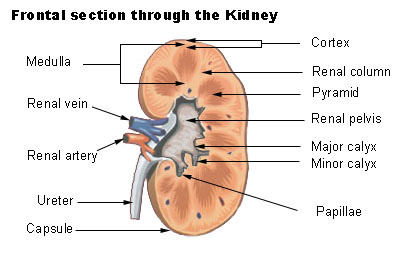
major calyx
larger funnel-shaped chamber where multiple minor calyces empty

renal pelvis
a single chamber embedded in the sinus that receives urine from all major calyces within a kidney

ureter
tube directing urine from the renal pelvis to the urinary bladder

nephron
functional unit of the kidney; specialized tubes that filter blood

renal corpuscle, proximal convoluted tubule, nephron loop, distal convoluted tubule
what are the 4 regions of the nephron?
collecting ducts
series of arched tubes that drain multiple nephrons’ distal convoluted tubules
renal corpuscle
the blood-filtration segment of nephrons
glomerulus, glomerular capsule
what are the 2 components of the renal corpuscle?
glomerulus
network of capillaries twisted around each other
glomerular casule
double-walled chamber surrounding the glomerulus
porous capillaries, filtration slits, high pressure arterioles
what the 3 specializations that make corpuscle efficient at filtering blood
filtrate
filtered substances that enter the glomerular capsule and continues down the nephron
juxtaglomerular apparatus
regulatory structure near glomeruli
renal tubule
the final 3 sections of a nephron
proximal convoluted tubule, nephron loop, distal convoluted tubule
what are the sections of the renal tubule
descending limb, ascending limb
what are the 2 components of the nephron loop?
descending limb
proximal segment; narrow tube descending into the medulla
ascending limb
distal segment; thicker tube ascending out of the medulla
afferent arterioles
arterioles that carry blood into the glomerular capillaries
glomerular capillaries
fenestrated capillaries within the glomerular capsule
efferent arterioles
arterioles that carry blood away from the glomerular capillaries
filtration, tubular reabsorption, tubular secretion
what are the 3 components of urine production
filtration
nonspecific process that separates materials based on size and/or charge
glomerular filtration rate
the rate of filtrate formed per minute
1%
how much percent of the filtrate actually becomes urine
filtration pressure
combination of 3 pressures that determine the amount of filtrate formed
glomerular capillary pressures, capsular hydrostatic pressure, blood colloid osmotic pressure
what are the 3 pressures categorized in filtration pressure?
glomerular capillary pressure
outward pressure from blood pressing on the fenestrated capillary walls; forces fluid and solutes out of the blood; blood pressure in _____ capillaries than normal capillaries
capsular hydrostaic pressure
inward pressure opposing filtration; created by filtrate filling the capsular space
blood colloid osmotic pressure
inward pressure opposing filtration; created by osmotic pressure of plasma proteins that cannot fit through filtration membrane
intrinsic mechanisms, extrinsic mechanisms
glomerular filtration rate is regulated via what 2 general mechanisms
myogenic mechanism, tubuloglomerular feedback
what are the 2 intrinsic autoregulation processes?