Race
 Call Kai
 Learn
 Practice Test
 Spaced Repetition
 Match
 Flashcards
 Knowt Play
1/20

There's no tags or description
Looks like no tags are added yet.
21 Terms
Ethnicity
a person’s geographic lineage
what part of the world are your ancestors from
Race
simplified social categories, based on a person’s percieved ethnicity, and typically determined by soperficial physical characteristics like skin color
social construction like gender
dark skin usuallly just means closer to the equator
Fluidity of Race in America
what Americans consider white has changed (italians, irish, jews, etc.)
ex. N.I.N.A. (No Irish Need Apply)
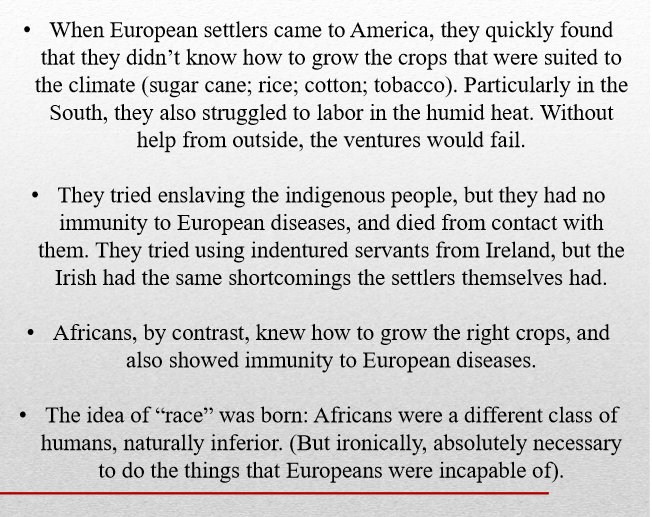
Excerpt
figured out w/o help, they would not survive
tried to enslave the indigenous but they had no immunity to European diseases so 80-90% of the Native Americans died
Irish did not knw any more info and were not equipped for manual labor so not helpful
turned to African Americans which had info and could withstand the manual labor in the sun

Another Excerpt
in defining this underclass, you had to define everything else that wasn’t the underclass (whiteness/blackness was an American creation with the english/dutch being white first)
started to become not the majority bc of other immigrants (Irish, Jews, Polish) so accepted them as white so were back to being the majority

Racism
the belief that there are inherent, important differences between people of different skin colors, and that those differences justify the stratification in society
the ability to put that belief into action “discrimination” requires social power
ex. explicit, implicit, structural
Explicit Racism
the conscious, purposeful, knowingly, targeted, and meaning it racism
ex. Residual Segragation (legilation → restrictive covenants → red-lining → forece → flight)
most people’s wealth is in the value of their home (black + hispanic people it is a higher %, how much your house is worth is remendoulsy important, America has a long history of keeping Black people from growing their wealth
Residual Segragation
legislation → restrictive covenants → red-lining → forece → flight
part of exlicit racism
Legislation
beginning in post-Civil War Reconstruction, many cities passed laws prohibitinh Blacks from living in certain neighborhoods (Baltimore and Louisville)
in Buchanan v. Warley (1917), the Supreme Court held that the laws violated the Equal Protection Clause
part of explicit racism under residual racism
Restrictive Covenants
inidividual homeowners (or neighborhood associations) wrote provisions into deeds that prohibited any future owner to sell to a Black buyer
if sale ever took place, orginal owner could takes parties to court for breach of contract
Shelly v. Kraemer - Supreme Court held these unconstitutional (even though private agreementsm ultimely depended on the government taking action to enforce them)
part of explicit racism under residual racism
Redlining
wanting to protect the value of their mortgaged houses, banks drew “red lines” on maps to delineate neighborhoods where they wouldn’t give loans loans to black buyers (bc whites then didn’t want to buy houses whch decreases the value of it in that area)
outlawed by a series of federal laws (e.g., Fair Housing Act 1968, Equal Credit Opportunity Act 1974, and Home Mortgage Discolsure Act 1975)
hard to build case to prove this, so likely still exists
part of explicit racism under residual racism
banks will only loan you enough moeny to cover the house and don’t like it when a house sells and then it decreases in value bc if reposses they lose money
Force
occosional acts of violence were enough to intimidate Blackas from trying to move to White neighborhoods
Cicero, IL (1951) - when Black WW2 vet Harvey Clark Jr. and family tried to move into a white nighborhood, 4,00 White residents rioted and burned down the partment building → no arrests were made
Detriot (1942) - into the 1950s, Whites rioted every time the City tried to integrate a housing project and it eventually relented and stopped trying
Levittown, PA (1957) - hundred of protesters broke windows/burned crosses to keep William and Daisy myers from being the first Black family in the new suburb
part of explicit racism under residual racism
Flight
between 1950-1980, the share of Whites living in suburbs roughly doubled from 24.5-47.4%
Census records indicate that neigjhborhoods tend to reach a “tipping point” at which white people start to leave en masse (~13% minority owned)
part of explicit racism under residual racism
white people sjust started leaving and building new places (how subrbs started) away/outside of town
What does segregation cause/create/affect?
wealth inequality and edicuational inequality (houses in undesirable locations and wealth based on house value (home equity) and money to schools is based on value of house sin the district (diff. in advanced classes))
shortens lifespans (more racially segregated neighborhoods are, more younger deaths/unnatural ones)
increases crime (higher homicide rates)
affects access to infrastructure, exposure to environmental hazards, proximity to jobs and health care, and contact/mere exposure theory4
merely being exposed to people diff. than you lowers antagism to diff. groups
Explicit vs Implicit Bias
explicit - aware of thoughts and emotions towards a specific groups (ex. hate speechm discrimination, prejudice)
implicit - gut reactions occur within milliseconds, unconscious attitude and beliefs (feelings, behavior, and judgement), and unaware (subconscious)
Implicit Racism
gut reactions occur within milliseconds, unconscious attitude and beliefs (feelings, behavior, and judgement), and unaware (subconscious)\
microaggressions
largely unconscious, bias, or disciminations w/o the discriminating party being unaware hey are treating people different based on race
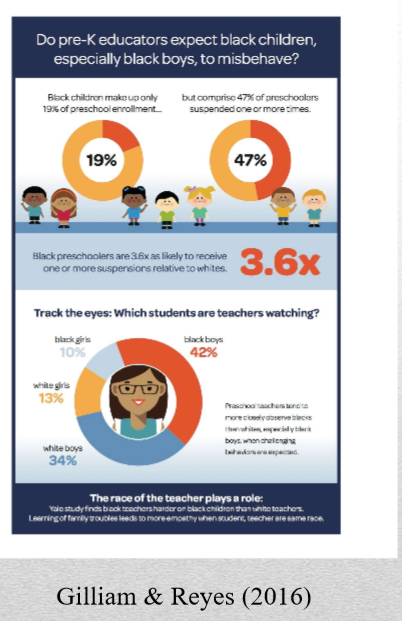
Hughes et al (2023) and Gilliam/Reyes (2016)
Hughes → researchers showed 178 prospective teachers videos showing young children engaging in various behaviors; found that teh teachers interpreted identical behavior very different;y according to the child’s race
Gillaim/Reyes → vid of various children playing collaboratively and hooked people up to machine to see where the teacher ‘s were looking at (more time watching black boys than white → moderated more closely and had higher suspension rates))
part of implicit racism
Correl et al (2002)
police shooting simulator
difference in vids were just color of skin/race of the suspect
white = fewer mistakes
black = more false positives

Racism in a Resume
researchers created identical resumes and only changed the names (well this was the only main/meaningful difference)
white names got more callbacks

Institutional/Structural Racism
a form of racism that occurs when institutionas (govs., schools, workplaces, etc.) discriminate through their policies and practices
the collective failure of an organization to provide an appropriate and professional service to people because of their color, culture, or ethnic origin. it can be seen or detected in procsesses, attitudes, and behavior that amount to discrimination thorugh prejudice, ignorance, thoughtlessness, and racist stereotyping
a system in which favors white people, perpetuated by institutions, doesn’’t require individuals to be racist, comes from people follwoing the rules of the institution not bc they personally have a bias or problem/prejudice
ex. workplace discrimination

Cocain Setnces
crack (10g) vs powdered (100g) both = 10 years
don’t jave a choice in acting different between balck and white people
